Leading an Industry and Solving the World’s Problems (Interview w/ Kurt Avery)
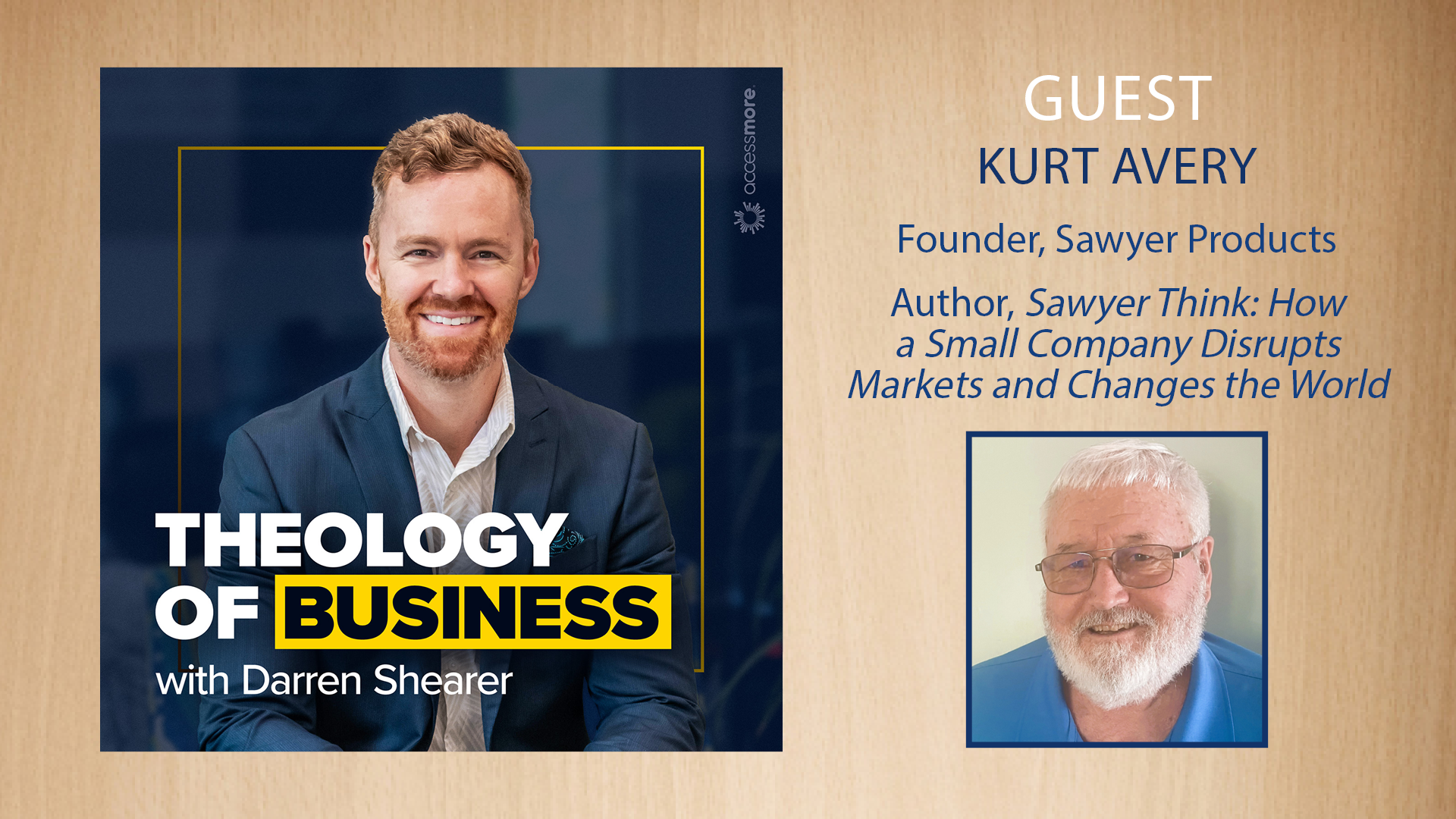
On this episode, Kurt Avery shares how his industry-leading outdoor products company (Sawyer Products) is making a Christ-centered impact through Kingdom-class products and generosity.
Kurt Avery is the founder of Sawyer Products and currently serves as president and owner. Before founding Sawyer, he served as a marketer for globally known brands. Avery is passionate about and committed to creating disease-free water for life in communities throughout the world. He is a graduate of Hope College and Northwestern University’s Kellogg School of Management. He and his wife Barbara reside in Florida and are parents of four and grandparents of five.
He’s the author of the new book, Sawyer Think: How a Small Company Disrupts Markets and Changes the World.
- https://www.sawyer.com/
- New book: Sawyer Think: How a Small Company Disrupts Markets and Changes the World
Theology of Business is the show for marketplace Christians seeking to explore and apply God’s will for business. If you want to learn more about how to do business for the glory of God and shape culture through discipling the business world, this show is for you.
Full Episode Transcript
Heads up: This transcript was created with AI, so you might notice a few typos or small mistakes. We recommend listening to the episode for the best experience!
SPEAKER_02 0:05
Welcome to the Theology of Business Podcast, where marketplace Christians explore God’s will and ways for business. The show features conversations with today’s Christ-centered business leaders who are represented Christ faithfully in the business world. I’m your host, Darren Scheer, and if you want to make your work, leadership, and company’s culture more Christ-centered, you’ve come to the right place. Hi everyone, and welcome back to the Theology of Business Podcast. I’m your host, Darren Scheer, and this is a show for marketplace Christians seeking to explore and apply God’s will for business. On this episode, we’re joined by Kurt Avery. Kurt is the founder of Sawyer Products. And uh, if you are a backpacker or just an outdoor aficionado, you definitely know Sawyer products. Uh, I live about 20 minutes from the Appalachian Trail, and Kurt was just telling me that probably 90% of the products that are used as far as um bug repellent and you know snake bite remedies and um water filtration, all sorts of these outdoor products. Uh, probably 90% of what’s being used on the Appalachian Trail are coming from Sawyer, Sawyer products. And so he serves as the president and the owner. Before founding Sawyer, he served as a marketer for globally known brands. He’s passionate about and committed to creating disease-free water for life in communities throughout the world. He’s a graduate of Hope College and Northwestern’s uh Kellogg School of Management. And he and his wife Barbara reside in Florida and are parents of four and grandparents of five. And he’s the author of the new book, Saw Your Think How a Small Company Disrupts Markets and Changes the World. Kurt, welcome to the Theology of Business podcast.SPEAKER_00 1:56
Well, thank you. It’s great to be here.SPEAKER_02 1:58
Kurt, what’s one of your favorite stories that illustrates the impact being made by your company? I know you’re doing a lot of philanthropy, but but specifically um in the company with your customers, like what’s what’s one of your favorite stories?SPEAKER_00 2:12
It it’s just we started in ’84, and um my wife and I hit the road, and we were just uh living in the stores, teaching everybody, training them on our products and stuff like that. Um, we had some pretty big God moments. Uh Gulf War I came around and they needed sunscreens. And at that point, we had just moved into a partnership with a company making, you know, hand filling 2,000 bottles a day, and they wanted 230,000 a week. And so, of course, I said, Yeah, we can do that. You know, I’m a big guy, I don’t let uh let little details like that get in the way. And sure enough, we were we were bidding uh a buck or two below the next lowest bid, and we kept saying, What is wrong? What are we not doing here? We might get killed or something. But turns out we were right, we pushed our pencils correctly, and we got the bid, and it ultimately ended up with 3.2 million bottles. So it was really nice because we had lost a lot of money starting the company up till then that helped us. But um, the the the strange thing was we got in there and we’re already making this stuff, and then we find out there’s a little criteria that says you have to be a commercial brand. I said, uh oh. We’ve been in business for two weeks. I just started selling sunscreens two weeks earlier. I shipped two cases, one to California and one to a little hardware show store, Broadway Hardware in McAllen, Texas. So it turns out I’ve only got 12 products out on the whole marketplace. And one case was a mile from where the inspector was. So he got in his car, drove down there, saw it on the shelf, and said, Yeah, you’re a commercial brand, you get the contract, which is good because we had already made a half a million bottles. But um, I mean, those don’t things don’t still happen. You if you don’t think God’s got your hand on your business, then then you’re crazy because that that just doesn’t happen in the real world.SPEAKER_02 4:04
Yeah. Well, it’s uh it’s a win-win for the military. I’ve been out in Kuwait, and you definitely need sunscreen out there, and I’m sure that’s where a lot of that sunscreen was consumed uh during Gulf War I.SPEAKER_00 4:17
Yeah, no, it was a lot, it was amazing. We it it turned out to be a pretty unique formula because you know there’s no timeouts, and so it actually would last up to three days without being reapplied in the in the say because you there’s no time to quit shooting, I gotta put sunscreen on. No, so we ended up with a pretty neat formula out of all that from uh one of our scientists. So yeah, quite the experience, but we we saved the government I don’t know, four or five million dollars because we were a couple bucks below every the next lowest bid.SPEAKER_02 4:47
Yeah. So Kurt, when did you first realize God wanted to be involved in your work and business?SPEAKER_00 4:53
Well, I I’ve always been a believer from the eye from the eye to a grasshopper. I don’t remember ever not being a believer. Um, and and I went through the phase of apologetics where I looked at why Christianity versus all the other stuff, and it was obviously pretty pretty obvious from creation and everything else that that Christianity is is the right religion. So never really doubted that. So I I don’t know if I ever separated it saying, How do you do business without God? I mean, it’s just He’s everything, so it’s got to be in everything. Um, but as far as you know, but of course I worked with big corporations, and so you know, you you’re you’re there as a Christian, but you’re not driving the whole company. But once we started Sawyer, um we we started with the snake bike kit, and I wanted to name it a Christian company. And so I ended up with Acts 24, 5 and 6 backwards, called it Saphetha, because that’s where Paul was bit by the viper on Malta, and then they thought he was a god, and he said, I’m not a god, but I’ll show you a god. So we always wanted Sawyer to be dedicated to uh to Christianity, to God, you know. So we started, but then it got to be by America, and that didn’t sound like an American name, so we switched it to Sawyer, Safada B A Sawyer for first 20-some years. So we’ve always had that in in mind, never never strayed.SPEAKER_02 6:11
And you you said Savage, what was that backwards?SPEAKER_00 6:14
Uh Acts 28, 4, 5, and 6. S A F F E T A.SPEAKER_02 6:18
Got it, got it.SPEAKER_00 6:20
Doesn’t run off your time. The other one I use, I like Teleo. We we we started another company called Teleo for owning some buildings, and that’s those were Christ’s last words on the uh cross. We a lot of people interpret it as it is finished, but it can also be interpreted as paid in full. So I I have a son who speaks a bunch of Greek, so he told me oh, it can be paid in full. So I like that.SPEAKER_02 6:41
Yeah, love that. And there was a point when you realized that you had the very product needed in developing um developing countries. Uh tell us about that.SPEAKER_00 6:54
Well, this is I’m strange, okay. You gotta understand, I’m not normal. Um, long, long away, we had the water filtration and then we had the insect repellents, and half the world dies of one or the other, either mosquito bites or bad water. I said, okay, God, why don’t we just go fix all that? Why don’t we just so of course that means him, not me, you know, we meaning him. Um, so we had the products that people needed. And that gave us an enormous well, how do you not share the filter? And and our filter is way beyond anything else. It’s they’re called point of use. You use them right at the point where you’re ready to drink or from a faucet or whatever. How do you not share that? I mean, what what’s the number? 800 billion people don’t have clean water, you know, and here you sitting there with the with the absolute best solution. I mean, it’s less than$20, it’s small in a Coke can, and it never wears out. The thing’s good for a million gallons. I mean, you know, how do you not? I we got one now that costs less than 10 cents to give a person clean water for life.SPEAKER_02 7:58
You don’t have to you have to change the filter?SPEAKER_00 8:00
No, you just clean it, you backflush it like a swimming pool. Wow. So how do you how do you not share that? So the beauty of it was is for us, the repellents are very profitable. So we could use this to subsidize. I I don’t need money. I you know, I get a the shirt is 10 years old and I get new shoes every four years, and so I’m not taking there’s no U-Haules in heaven, so I’m not taking it with me. So um let’s give it away. But what what really was interesting is and what the book points out to people is how you can maximize your taxes. So nobody, because I it is 100% owned by me and I’m sub-S, so I don’t have to make a profit on the product. Okay, nobody, no law says I have to make a product. So I can give these things away, I can sell them at a loss, I can sell them at deep discount. So if I don’t make a profit, I don’t have to pay taxes on a nonprofit. So um it became pretty easy for me to maximize the gifting, right? So you can write it off, and we also uh are doing a lot of RD. So, for instance, we we prove that it works because the end game here is we’re gonna do whole countries, we’re not just gonna do people. And we’re literally lining up countries. We’ve done five countries border to border already, one big one, four little ones. And so we spent, we can write off the RD because I’m answering questions. Uh you know, we know that within two weeks, these filters wipe out 95% of all sickness, waterborne sickness. The other five percent is because they’re not handling their toiletries right or washing their vegetables or whatever. But we wipe out 95% in two weeks, just takes two weeks. And 95% of sickness is gone. Wow. I mean, the savings, they’re not having to take malaria pills, you know. I mean, I mean diarrhea pills and all that kind of stuff. And we can save anywhere some 10 to 20 percent of their income because they’re not buying fuel, either wood or uh gas, to boil water to drink. And so we’re proving all that, and that’s RD, because I also have other pieces of the puzzle. We change the whole culture, the way the husband treats the wife, girls aren’t out there getting raped, having to go long distance for water, people aren’t sick, they’re rehydrated, they’re thinking better. There’s all kinds of benefits going on culturally, and we’re doing some big ones where even the tribes have settled out. There’s not as much warfare between tribes because they don’t need to, they’re not fighting over water or anything else. So we’re proving all that. So when you do that, that’s RD. So I can write it off.SPEAKER_02 10:42
So even if you dig wells, um, you know, they’re still fighting over wells, right?SPEAKER_00 10:50
Well, here’s the thing: you sometimes there’s no surface water at all. Okay, if there’s any surface water, I don’t care how bad it is, we’ll make it drinkable. But if there’s no surface water, you deal with drill. Now, what drill well do you drill? If you drill a shallow well, you can get some water, but it’s still not safe. Well, it is it, of course, it’ll be safe with our filter. So you can do a shallow well, use our cheap filter, uh inexpensive filter, and now you can clean, or you have to dig a deep well to get to water that doesn’t need to be treated later. The problem with the deep wells is they break down and and people go in, they build the wells, and then they say goodbye, and there’s nobody to maintain them. 80% of all wells fail within a year.SPEAKER_02 11:31
Wow. And how many of those just completely fall into permanent disrepair?SPEAKER_00 11:37
And how what percentage are actually a business of going out and fixing wells? They actually have charities that do that. Um, yeah, most of the time it’s if it’s a deep well, good luck. Um, but but the whole point is you can build a five thousand dollar well or for three, four hundred dollars, do the same thing with our filters. I mean, these filters look that the average filter serves 20 people a day. Wow.SPEAKER_02 12:03
And then I have one that’s$20,$20, and 20 people are drinking off of that every day for 10 years. For 10 years.SPEAKER_00 12:12
Right. Now the newest one we brought out, you just put it on a faucet, so we can now go into the cities, and that’s 500 gallons a day for a$20 filter for 10 years. I mean, it’s staggering. We we can we can take we can do a whole orphanage with one$20 filter. I mean, it’s it’s staggering. So that that’s kind of where we’re at. But we had to prove all that. So it’s all RD, and you can write that off, and you can donate filters and all that stuff. So you’re really doing it pretty cheap because I liken it to, you know, if we made cupcakes, we’d have to sell the cupcakes, take the profit, pay taxes on the profit, and then we could give away something. But since we have the very thing people want, I don’t have to make the profit, I don’t have to pay taxes because we didn’t make the profit. So our giving of this product is way times more valuable than if it was something that they didn’t need and we just wanted to help out.SPEAKER_02 13:05
Yeah. So you’re just making profit off of what you’re selling online to the retail business, company, the retail business, and then that, and then you’re just giving these to are you typically going through chair other charities?SPEAKER_00 13:22
Yeah, we we have 140 charities in 80 countries. I mean, we’re in some of the hard ones. We’re in, you know, we are in Gaza, we’re in Yemen, we’re in North Korea, we’re in Iran. Uh, there are Christian enclaves in those countries, and we work with them. There’s so about 80% of the charity work done around the world is done by Christians. Um, so probably that same thing for us. We have Christian and non-Christian groups. Um we either give it to them. Sometimes I give them cash, quite a few who give cash. Um or I deep, deep discount it. Um but we’re in every tragedy. Samaritan Spirit keeps two plane loads of our filters ready at all times. Because even on day two, you have to have water, even them. Uh right now we’re servicing the earthquakes in Japan. We’re flying a lot of product over to Japan for their earthquakes. So we’re every natural disaster, we’re there because everybody has to have water on day two, and we’re the easiest solution.SPEAKER_02 14:23
Yeah. Hurricane Harvey, were you guys there for that one? I was I was in Houston at that time.SPEAKER_00 14:30
We don’t do domestic.SPEAKER_02 14:32
Okay.SPEAKER_00 14:32
Because they love to pass out bottled water. They could. We were pretty close. I had a deal with Florida on when the hurricanes came through, and it got nixed. They’re worried about legal lawyers suing them, you know, because they want their bottled water. But every international, I mean, we are there, you know, like the Cajun Nation will always have it when they’re rescuing people. They come back to a station before they get it back into circulation. So we are in the domestics, but in a small way. We do Indian reservations where they have hard times with water, uh, Canadian reservations. Uh, we’re in every country. Um, but any international disaster, whether it’s a typhoon, hurricane, cyclone outside the United States, we’re we’re in everyone. We’re we have people can go in there with two duffel bags of filters, hunker down during the hurricane, and when they come up the next day, they can take care of a couple hundred thousand people out of two suitcases.SPEAKER_02 15:25
Yeah. Wow. And so y’all don’t do domestic because of just the the bureaucracy.SPEAKER_00 15:32
FEMA doesn’t want to pay for them. I I mean, I would get I I can’t even give them away. Now, we we did some like when you had the um problem in eastern Kentucky, they had that, or the boil alert in Jackson, Mississippi. Yeah, we got filters and rotary will bring them in. Some of our charities will work there. So we’re able to get them into something like that. But in general, uh with a hurricane now, FEMA’s not gonna they don’t too many lawyers in the United States, they don’t want to take the chance. Yeah, which is silly because you imagine plastic bottles we could save them. Gas them out and cutting up. I I I mean, one filter can one one little filter can wipe out I don’t know, 2,000 bottled waters and not needed.SPEAKER_02 16:16
Right.SPEAKER_00 16:17
And and then you got it for the next hurricane and the next one and the next one. So welcome to America.SPEAKER_02 16:23
Yeah, yeah, yeah. Especially in places like, you know, during uh Katrina, I remember I was at stationed at Barksdale Air Force Base, and I mean there were uh I mean dozens and dozens of semi-trailers just full of product going to waste and spoiling sitting there on our base uh because of the the red tape and and just not being able to get the the trucks mobilized. Uh but you know if they were to have the I mean that’s moving bottled water is I mean that is just uh enormous logistical uh uh job, but to be able to move these filters, it seems like it would make a lot more sense.SPEAKER_00 17:06
Yeah, you can you can do several thousand people in one one little bag. Do you if you ever remember in the when Puerto Rico had the double hurricanes, and if you go there now you see all that bottled water sitting on the tarmac, I mean, yeah, truckload after truckload. They got there too late. By the time they got there, half the people in Puerto Rico were drinking out of our filters, or a third or whatever. I mean, that you know, we took care of the people, they didn’t need the bottle water, and then it just sits there and rots. And that was not cheap to get all that bottled water to Puerto Rico either, you know.SPEAKER_01 17:38
Oh, yeah.SPEAKER_00 17:39
So that’s you know, to it’s a weird low, but we are we are well appreciated where we are. So you go in there and you change lives.SPEAKER_02 17:50
Right.SPEAKER_00 17:51
I mean just think no more diarrhea. What one of my favorite stories is a guy, uh a missionary went to a village in Uganda and he’s sitting there and he’s there doing his mission work for a week, and he says, I noticed you don’t name your kids till they’re three years old. And the par the parents said, Yeah, because we know if they make it to three, they’ll live. You know, otherwise they might lose a third of their kids. So he goes back there with filters, a couple hundred filters, but sets up the village, goes back there the next year later, they name them all at birth. They haven’t lost a kid since the bottles since the filter showed up. Wow. Because it, you know, that it that’s what gets little babies is the bad water.SPEAKER_02 18:39
So what percentage of your volume of products that are distributed or and or sold are um on the the the for-profit side and what percentage are on the nonprofit, you know, international side?SPEAKER_00 18:56
Yeah, I just happened to look at that uh just yesterday. I say about a third of all the filters we distribute maybe a little more go overseas for charity. Either sometimes we sell them at a subsidy and sometimes we don’t. But we also give a lot of cash too, though. So we we always use the phrase we give away 90% of profits, which we do. But I also give away more than that because I don’t let it become a profit. So that which becomes a profit, we give away 90%, but but more than half of that never even made it to the profit line. So it’s it’s quite a chunk, but you know, why not? Right?SPEAKER_01 19:37
Yeah.SPEAKER_00 19:38
So the book is trying to encourage other people to do the same thing. I mean, why can’t a plumber give away plumbing services? Why can’t a uh baker, you know, give away bread or donuts or whatever, restaurants got extra food. How can you take your business and benefit other people for Christ? You know, that there’s a witness there. It’s interesting. And we do big projects too. We do slums, we do all kinds of stuff, but generally the conversion rate is in the 10 to 15 percent. So the other, you know, 85 to 90 say thank you very much for the water, but I’m not, you know, we always share the gospel with when we do that. And uh that’s an interesting stat to me. I mean, I’m wrestling with that. But you know, maybe some catch on later on because after their life has really changed, they they figure it out, or the neighbors now now we we always use locals, we don’t bring in the gringos. I mean, it’s always passed out by local people, creates jobs, creates authenticity, they’re networked in the community, and so they keep they keep working. So I’m sure that number keeps rising over time, but that’s the initial thrust. Yeah, it’s like I said, it’s uh it’s our job to bring the bread, not feed the 5,000. That’s that’s uh that’s the Holy Spirit and God’s job to do. So we just you just get it out there, yeah.SPEAKER_02 20:59
Well, what a great metric to track the conversion rate, you know, because most of us we hear conversion rate and we’re we’re thinking, you know, what percentage of people on my email list are are you know responding and purchasing that product and tracking links and all that stuff, but the conversion rate of the the impact of your business on the stakeholders and how they respond favorably to to Christ.SPEAKER_00 21:29
I mean, that’s uh yeah, we we built in a GIS system, so we have a QR code on the filters, and so because we’re getting ready to do big numbers with countries and they’re gonna pay for it. You know, if Peru wants a million filters, they’ll pay for it, you know. And get the payback on the filter is anywhere from two days to two months, you got your money back. But governments always want somebody else to pay for it, you know how that goes. A lot of corruption down there. But with the QR code, you take your smartphone, you you scan it, and it takes you right to a link where In 18 different languages, we’ll teach you how to put it on, how to take care of it, how to maintain it. We teach you best practices, what to do with your fecal matter, how to keep your water from getting contaminated. You know, so we’re very sophisticated. We’re not just selling a filter, we’re selling a whole educational package. So when we have that GIS system, we can do these measurements. And we do do a lot of measurements on these things. So now if a philanthropist wants to invest, they’ll know exactly what they get. I mean, we can prove to you that your dollar, 95% of the people quit being sick within two weeks. We’ll prove it to you. Well, you know, we can give you a project. So that’s why we can do that because I know you know, if you’re an investor, don’t you want the best dollar? You know, and by and large, most charities start on emotions. God bless them. They have the emotion and passion to do this, but there’s a place for metrics. So we introduce the metrics to them.SPEAKER_02 22:55
Yeah. Kurd, so in terms of operating the business, what’s one of the best business practices that helps you and the culture of your company to reflect God’s character in ways?SPEAKER_00 23:08
Um, well, our standards are pretty high. You know, we say, you know, good enough is never good enough, you know. So I I don’t think you I always remember once, I don’t know why, somebody asked me to prepare the communion for small church up in Evanston, Illinois, where Northwestern was. And of course, I wanted to make the juice last go the furthest in. So I diluted it down pretty good. It was horrible. And then I sitting there going, God doesn’t want that. God wants you to give him the best. Why would he water down your juice to try and save a nickel?SPEAKER_01 23:41
Yeah.SPEAKER_00 23:42
I mean, he deserves the best. So quit trying to cut corners on your worship and on your praise, you know. So we don’t. Um I don’t know if that that that’s kind of your answer.SPEAKER_02 23:54
Yeah, absolutely. I mean, um, Jesus is expecting us to go the extra mile, but a lot of companies aren’t even really going the first mile and and just having a quality product, you know, let alone going above and beyond the customer’s expectations. But really, the bar is is pretty low out there, you know. Um I mean, people almost don’t expect things to work anymore.SPEAKER_00 24:23
No, uh well, I’m from an old farm thing, you know, 13 acres of corn and a dozen and everything else. So you always give them more. But you know, God owns the cattle on a thousand hills. What are you worried about? I mean, I make mistakes. He’s bailed me out so many times. It’s ridiculous. I’m human. Um, I have some business skills, but I’m not perfect. I make mistakes. But he’s a big God, created the whole universe for crying out loud. And you’re worried about. I uh when I do give a talk, I’ve done a few. I said the number one thing you can do is have a big God. If you make your God small, you’ll do small things. If you like let your God be big, you’ll do big things. Because he’s just using you. And too many people put God in a little box so they can manage him. So no, it’s the other way around. You go big and let him manage you. And um, I I’ve done so many things, people laugh at me. I say, we can do that, we can do that. You know, I have no logical business reason to think we could do that, but why not? You know, why can’t we change the world? I mean, if he see, and but it is a burden because you sit there going, God, I can’t go faster, go faster. But you know, if God wanted to wipe out bacteria, make you sick, he could snap his fingers and do it tomorrow.SPEAKER_01 25:38
Yeah.SPEAKER_00 25:38
But he doesn’t, it’s there for a purpose. So maybe the reason we do have people getting sick is so that we can go help them get unsick and share the gospel, otherwise, they’d have no need for the gospel.SPEAKER_01 25:49
Yeah.SPEAKER_00 25:49
So you can’t you can’t outthink God too much. You know, you just kind of go and do it. But he’ll tangle you up a few nights.SPEAKER_02 25:58
Yeah. I mean, usually when I ask folks on this show what’s a time when you saw God’s hand at work in your company, it’s usually uh uh a really difficult circumstance they went through when they they saw they saw God. And and so it’s easy to not really pay attention when things are going well. But I mean, but what folks are facing in certain parts of the world with malaria and no clean drinking water, I mean, it’s just unfathomable for for me and and most of us here.SPEAKER_00 26:35
Um yeah, we have this solution. I I’m the other way around. When things aren’t going good, I blame myself. I don’t blame God. I figured I must have really screwed up something, you know. When they go good, I usually give him the praise because it’s not me. I’m just uh I was raised that way, you know, just humble beginnings, and it’s not you because it’s just not you.SPEAKER_02 26:56
So yeah, but facing those challenges, um, what what is uh what is a time when you saw God’s hand at work in your company?SPEAKER_00 27:04
Oh, we there there’s so many God stories. Um even even how we got this filter. Um, I started out wanting to do water because I knew water was a big problem. And I I tried various different things, there were lots of different chemical things and other kinds of filters. Then we stumbled onto this holofiber membrane, which is from kidney dialysis. So nobody had really applied that to point of use filtration. They use it in the cities, you know, in a much not as tight as ours, but um, so we we adapted it to this, and I partnered with a company who was evil, and we no sooner got going and then he calls me up on a Thanksgiving day weekend and says, I can’t pay my workers, can you take them? I said, Sure, send them over, I’ll I’ll take them and but you can use them if you need them. Well, two weeks later he sues me for stealing workers that had non-Capete class, which he forged, by the way. Um, so that was the and but we won. Okay, we won the case because he he he was wrong and we won. It cost us a lot of money. He didn’t have any money, so we didn’t get it back. But then we went to buy some more filters, and the filter company came and said, We can’t sell you. Why can’t you sell us? It’s a filler we’ve been buying it. So, no, if you you bought them through this company, if you bought it, I can’t sell you direct because he’ll sue us if we do. Oh man, okay. But then my guy that who did come over remembered one other name and he tracked that down, and we ended up with this filter, which is far beyond anything on the market, and including the one we were using in the very beginning. So, classic case of they met it for evil and God used it for good, put us on to the very thing that we can do now. And in 24 years, nobody or 14 years, nobody has matched. No, I guess it’s been 20 years, nobody has matched our technology or our commitment. So we we test every filter three times, every filter, not random, whatever, to make sure it works so we won’t sell it and give it away. So classic, classic case. They meant it for evil. They were trying to put us out of business or whatever. And God took them around and gave us the very thing which is unparalleled.SPEAKER_02 29:16
Wow. So wow, praise God. I mean, that’s that’s exactly um another example of what started out as this is just a terrible situation that could really hurt our business. And it sometimes it’s when you start to walk into something like that, it’s easy to assume God’s just not in it because things aren’t going well. And if it was going well, then we could say, oh, God is God is in this. But sometimes when when that’s not the case, we just we kind of doubt that we’re on the right track. Uh, and yet those are the times when God is ready to just blow our minds with the way that he works the situation out. Like you said, what was meant for evil, God turn it around for good.SPEAKER_00 30:06
We we if if they hadn’t done that, we never would have gotten to this product, which you couldn’t do what we’re doing with a lesser product. It’s only because nothing can get through that makes you sick, other virus which isn’t in the water, anyways. But nobody can match our technology. Nobody can match how well this works and how quick it works and all that kind of thing. And the fact that it never wears out, that you can always clean it. Nobody else has a filter that can be cleaned forever. Yeah, they’re all they all have lives to their short lives.SPEAKER_02 30:37
Yeah, yeah.SPEAKER_00 30:39
I mean, I mean it it’s the whole thing. It isn’t just about Sawyer success, it’s about being able to witness if we had a different filter, we couldn’t go witness the way we are. Because we wouldn’t be changing lives the way we are. Yeah, I mean, you want authenticity, you go in there and change somebody’s life, and then they’ll listen to you.SPEAKER_02 30:57
That’s right.SPEAKER_00 30:58
That’s if you’ve been sick your whole life, and then all of a sudden, two weeks later, you’re never sick again from water. There’s no diapers out there. Imagine your kid having diarrhea for the first three years of their life, and the adults. We had one guy, you know, he drinks the garbage. I mean, you won’t believe I show you some videos of the water they are drinking. It you wouldn’t go anywhere near it. I mean, it’s got every bad thing you can think in there, and they just pop the malaria uh the diarrhea pills like every day because they know they have to have it, because they drink this, they can’t take that pill, and then all of a sudden, never again. I mean, and then have 20% more income.SPEAKER_02 31:37
Yeah, yeah, because they’re not sick all the time and they can work, they can work, they don’t have to buy fuel.SPEAKER_00 31:44
I mean, we’re the greenest product on the planet. I mean, every filter can save up to 200 trees a year, 200 trees a year or fossil fuel equivalent per filter. Per filter. I mean, that’s huge green product. Wow, and now these people have extra income, they can start businesses. We had one one in um Honduras, no Guatemala. Because of the filters, she was able to start a business making uh tacos and stuff because she has clean water, she can now make safe tacos. So, I mean, they start business, they can fully hydrate every you ever watch Survivor, you know, when they’re not hydrated, how wacky their decisions are.SPEAKER_02 32:23
Yeah.SPEAKER_00 32:23
Well, just think if you know, now you’re fully hydrated, you’re thinking correctly.SPEAKER_02 32:28
Yeah. What do you I mean, if you’ve got a deep well in your in your town and it breaks, what do you do? I mean, you just try to go to the next town and just hope they’re they’re not gonna run you out of there.SPEAKER_00 32:43
I mean, well, if you have surface water, obviously we’re fine, but yeah, they’re in trouble.SPEAKER_02 32:47
Yeah, yeah.SPEAKER_00 32:48
In the remote countries, yeah, yeah, they’re in trouble.SPEAKER_02 32:51
Yeah. Wow. What a uh what innovative. And so you do you own the patent for this particular filter, or how does that work?SPEAKER_00 33:00
Well, it if somebody wants to read the book, they’ll find out I don’t do patents because if you do a patent, you have to tell them how you did it, and they get to reverse engineer it. So I’d rather keep them guessing. If you have a secret ingredient, you don’t tell them what the secret was, you know, you let them try and figure it out. Nobody’s figured it out in 20 years.SPEAKER_02 33:19
Wow.SPEAKER_00 33:20
So no, I there’s a place for patents, but not there’s a place to not patent it either. Because you have to defend the patent. So the big companies, you know, they they they can design around it, and then good luck going up against their lawyers. So I I cover that.SPEAKER_02 33:37
Have you been facing that with um with other companies kind of trying to do the same thing?SPEAKER_00 33:44
Um no, I don’t think no, we don’t make the filter ourselves. We don’t make the fibers ourselves. We put it all together. And the company that makes the fiber is really happens to be a Christian company overseas in a country that’s not Christian, and they love us to death, and nobody ever thought of this. They sell it in other applications, but and they they won’t sell this to anybody else. Now, nobody so now there’s another 30 or 40 companies making these fibers, but they don’t know how to make it like this. I I mean you could you could take the big companies like Siemens or General Electric, they could make it. They have the technology, but this is too small of a market for them to deal with. But someday, you know, I don’t care if they join us. I mean, there’s plenty of lives to save, we’ll be fine. Because we sell more than just a filter. Remember, we got the GIS system, we do the metrics, we we you know, we can do mass distributions because of the phone. The other thing, though, is they won’t do what we did. We we make so many of these that we can afford half our price, half our cost of these filters is our testing. And we we we test it when we make the fiber to make sure that there’s no big holes in there. If there’s any big holes left, because it’s part of our price science, we don’t use that filter. Then we have to assemble it. We have O-rings, we have sonic welds, we make sure they’re all holding. And every filter, every filter is tested three times. That’s half the cost of our filter. But how do you go to other people, you know, maybe 90% of them, one one company, big company, you would know the name, I won’t say it, tells you right off the bat that only 90% of them work. That 10% don’t work. Well, how do you go to a village and say, well, you know, 10% of you are gonna be okay, or 90%, but 10% of you, you’re still gonna get sick. Sorry, you might die. I mean, you can’t do that. You gotta go into a village and say, nobody’s gonna get sick using this. If you get sick, it’s some other reason. I mean, how how can you not go into a village with any other premise? Yeah, these are people, right? And you lose your credibility. I mean, one reason we can be successful in sharing the gospel is nobody’s getting sick.SPEAKER_02 35:55
Yeah, yeah.SPEAKER_00 35:56
If you had to estimate how many people have given their hearts to the Lord as a result of um the the filters, oh it’s it’s a lot because we we do anywhere some depending on whether there’s hurricanes or not, anywhere from two to five million people a year get clean water for the first time, either from a hurricane or just regular what we call it transformational business. So transformationally, we’re doing at least a couple million a year. So if that’s 15%, yeah, you know, that’s a lot of people. That’s 300,000 a year for 10 years.SPEAKER_02 36:33
Praise God, praise God.SPEAKER_00 36:34
Well, the only thing you get to take to heaven with you is the other souls that joined you.SPEAKER_02 36:39
So that’s right. That’s right. And folks, you can learn more about Kurt and his story and the Sawyer Story by getting the new book, Saw Your Think, How a Small Company Disrupts Markets and Changes the World. And you can also check out the Saw Your Products at Sawyer.com, S-A-W-Y-E-R.com. Kurt, thank you so much for spending time with me and our listeners. Um, we’re all I know that I’m inspired and encouraged and challenged by uh what you’ve shared with us today.SPEAKER_00 37:13
The the book’s launch date on Amazon and bookstores is November 19th. Sawyer.com, you can get the book there or Amazon.SPEAKER_02 37:20
Yeah, well, this episode will drop right about that time. So we’ll we’ll time it just right for you.SPEAKER_00 37:26
All righty. Well, thank you. I love I love your theme and what you’re doing.SPEAKER_02 37:30
I appreciate that, Kurt. So good to chat with you today.SPEAKER_00 37:34
Okay, thank you.SPEAKER_01 37:35
Thanks for listening to this episode of the Theology of Business Podcast. Be sure to subscribe, leave a review, and tune in for the next episode as we continue exploring God’s will and ways for business.
BIG THANKS to this episode’s sponsor: High Bridge Books
High Bridge Books helps Christ-centered authors build a legacy by crafting and publishing messages and stories that glorify God in all spheres of culture.
- High Bridge Books’ professional book publishing package: https://www.highbridgebooks.com/publishing/
- High Bridge Books’ proofreading, line editing, developmental editing, and co-writing services: https://www.highbridgebooks.com/editing-and-proofreading/
- Examples of our books: https://www.highbridgebooks.com/bookstore/
We’re extremely proud that …
- 45% percent of our 204 books under contract were written by authors who have published more than one book with us, and
- 51% percent of our books under contract were referred to us by authors who have previously published with us.
Contact High Bridge Books’ CEO Darren Shearer at [email protected] to get a conversation going about your book!