Is Corporate America Hostile Toward Christians? (w/ Doug Napier)
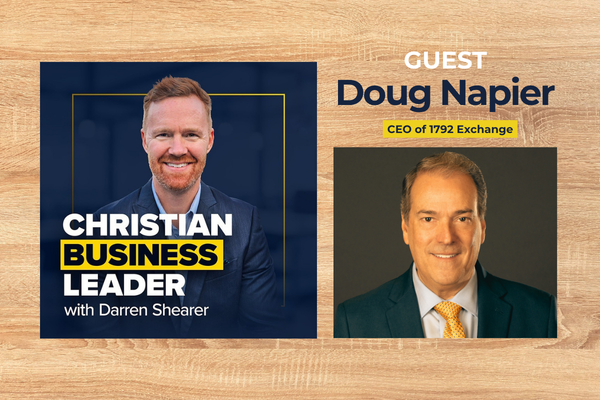
On this episode, we’re joined by Doug Napier.
Doug Napier is the Executive Chairman & CEO of 1792 Exchange, a non-profit organization whose mission is “helping businesses get back to business” by influencing American companies to advance principles including free speech, freedom of religion, and free enterprise. They are the go-to national resource for data, research, and analysis on corporate behavior and governance.
Their flagship resources—the Corporate Bias Rating database, the Board Bias database, and the Back to Business Tracker—serve as leverage to build a durable policy roadmap that protects corporations from activist pressure and are committed to keeping companies focused on sound governance and business excellence.
Doug has been a partner in a private law firm, a senior executive and senior legal counsel for an international non-profit organization, and served as president of an Arizona residential real estate company.
He has been an invited speaker at many national and international conferences and events and has appeared on major network television stations, radio outlets, and online print media, including FOX News, NBC, CNN, NPR, Al Jazeera, EWTN, Wall Street Journal, Washington Times, National Review, Townhall, The Atlantic, Mike Gallagher, Hugh Hewitt Show, and others.
Douglas earned a Juris Doctorate, with distinction, University of Iowa; a Master of Biblical Studies, Dallas Theological Seminary; and a Bachelor of Business Administration, Finance, University of Iowa. Douglas and his wife have two adult children. They reside in Scottsdale, Arizona.
Christian Business Leader is the podcast for marketplace Christians seeking to explore and apply God’s will for business for the purpose of cultivating Christ-Centered Companies.
Full Episode Transcript
Heads up: This transcript was created with AI, so you might notice a few typos or small mistakes. We recommend listening to the episode for the best experience!
SPEAKER_00 0:02
Welcome to the Christian Business Leader Podcast, where Christ-following business leaders explore God’s will and ways for business. This show is a ministry of the Center for Christianity and Business at Houston Christian University and features conversations with today’s Christ-centered business leaders who are representing Christ faithfully in the business world. I’m your host, Darren Scheer, and if you want to make your work, leadership, and company’s culture more Christ-centered, you’ve come to the right place. On this episode, we’re joined by Doug Napier. Doug is the executive chairman and CEO of 1792 Exchange, a nonprofit organization whose mission is helping businesses get back to business by influencing American companies to advance principles, including free speech, freedom of religion, and free enterprise. They are the go-to national resource for data research and analysis on corporate behavior and governments. We were just talking about a congressman that was uh being pitched by a company to do some kind of favor. And he said, I saw your report card on the corporate bias rating database. Uh, you need to go get your house in order. And so this is really making a difference uh even today. Uh their flagship resources, the corporate bias rating database, the board bias database, and the back-to-business tracker serve as leverage to build a durable policy roadmap that protects corporations from activist pressure and are committed to keeping companies focused on sound governance and business excellence. Doug, welcome to the Christian Business Leader Podcast.SPEAKER_01 1:48
Thanks for having me, Darren. It’s great to be with you.SPEAKER_00 1:50
Yeah, it’s good to have you back on. It’s been actually many years. Uh, unfortunately, it’s been many years. Should have had you on more frequently. Um, excited to have this conversation and for you to open our eyes up to what is going on in these companies that we are all patronizing, even today with our dollars. Uh, and some of us work at. Um, so Doug, when did you first realize God wants to be involved in your work in business and law?SPEAKER_01 2:24
Well, for me personally, uh that actually occurred when I was at seminary. I always thought I was gonna be a lawyer. I grew up in a family of lawyers. I went to college, got a degree degree in business and finance. Uh, thought, you know, I really want to serve God, so I guess that means I need to go to seminary. And yet it was one of my professors at seminary that said, Um, you know, what are you gonna do when you get out of here? And I said, I wasn’t quite sure. And he said, What were you gonna do before you came to seminary? I said, I was gonna be a lawyer. He says, Well, don’t you think God needs Christian lawyers? And I said, Does that count? And so this whole concept that, you know, there’s not a sacred secular divide. We are all uh under God’s sovereignty. It’s uh as you know, C. S. Lewis talks about every square inch. You know, it’s claimed by God and counterclaimed by Satan, but it’s all under God’s domain. And when you think about the influence of the marketplace, uh, you know, on any given Sunday, you might have 20% of the population in some church, maybe not even a Bible-teaching church, but on Monday, you’ve got 60 to 70% of the population that are going to their jobs. So the amount of influence that the marketplace has on our lives and on our culture is huge. And you know, I realize that, and you know, as this professor told me, he said, you’re gonna have people that will come into your law firm that will never darken the door to a church. So you’re gonna have access. It’s all ministry. That’s why we call it a vocation. It’s a calling that God has on us to be salt and light wherever we are. So so this has been a long journey and a long passion for me. I’ve been doing this now with like 30 years, and uh various uh various settings and organizations, and now at 1792 Exchange, where we’re focused on that one sector of the culture that really has its thumb on the scale. So that’s that’s that’s been my journey, and that’s why it’s my passion, and it’s why I really uh appreciate the work that 1792 is doing.SPEAKER_00 4:19
Yeah. We’ve talked about the corporate equality index. Maybe you could uh shed some lot more light on that. We’ve talked about that on the podcast, and and as far as I had known, that this is really the only, that was the only resource that I knew you could go to to find out uh how how much against your Christian values these companies are um that are on the Fortune 500, Fortune 1000. But now you’ve created the corporate bias rating database. When did that start and why do we need it?SPEAKER_01 4:53
Well, you know, we’re very data driven. Um and the nice thing about data is facts for facts. You can argue and spin on whatever you want to, but facts are facts, and they speak volumes uh about whatever you’re describing. And in this particular case, we have about 30 data points that we draw from public sources about company behavior. It comes from their SEC filings, comes from their website, their press releases, their advertising, their employee handbooks that are on the website, wherever we can find it. We have a team of roughly 25 researchers that are just pouring through this information, and we’ve profiled over 4,300 companies. And we take that data and we assimilate it into this database that provides an objective overview of these companies. You know, obviously, we pick the criteria that we think is important to the people that will use this, and then we rank them, and they basically get a red, green, or yellow uh score. If they’re red, that means that you’re at risk as a customer, as an employee, as a vendor, uh, as a shareholder. Uh this company making decisions that are not in the best interest of the business, but they’re making uh decisions based on outside stakeholders and activist organizations. So that’s the nature of the database. We’ve uh been building it over the last four and a half years. Uh we can continue to add companies to it. We’re getting close to the 4,500 mark, but we have all the Russell 3000 companies in there. So it’s very comprehensive. Uh we’ve got the source and the receipts for everything. So when a company says, hey, we don’t like this rating, we go, well, um, or we said they say we didn’t do that. We go, here’s the the source. If it’s changed, let us know, and we’ll update our database. But we have to be able to point to it publicly. But we remind them, they go, you know, these these ratings are based on your facts. And if you want different ratings, give us different facts. And here’s some things you can change about your operations, your policies, and your procedures, and that’ll improve your score. And it’s not just improve your score, it’s because it’s good for you, it’s good for your business, it’s good for your shareholders, it’s good for the culture.SPEAKER_00 7:08
Can you give us an example of of um the impact that this has made? You know, you you shared even just that that example of just yesterday about a lawmaker that that was telling another company that, you know, I can’t I can’t do that for you because uh of your report card. Uh what is what has been the impact?SPEAKER_01 7:31
You know, we’ve been very encouraged uh as we have continued to gain traction. And of course, you’ve been doing this, you know, basically started in the in the middle of the Biden administration. So uh now we fast forward, we have uh President Trump in office who’s taken this issue very seriously and has you know talked a lot about DEI and ESG, which has driven a lot of you know company policies and they’ve really driven them off the course a lot. So that certainly helped bring awareness to the issue. Um then it has an executive order out there on federal contractors. So if you want to do business with the federal government, you got to stop this stuff. And it’s not just, you know, we don’t think this is good. Uh the reality is that most DEI, this is the diversity, equity, and inclusion uh policies that companies have are actually discriminatory. So the D should not stand for diversity, it should stand for discrimination. And the Supreme Court uh recently issued a ruling, it was on college admissions, but you know, the affirmative action said this is discriminatory and you need to stop it. And it’s a very short leap from that holding into the corporate world. And most general counsels that we talk to, they’re not trying to argue, well, that just only applies to college. The principle applies widely. So these companies are at legal risk. And I think when we talk to them about the legal risk as well as the reputational and brand risk, and that we will help them chart a course, we call it a roadmap to green, uh, to get out of the stuff that they really don’t belong in. And I think some of them are actually anxious to get out of. If they’ve had these activist organizations with their foot on their neck for years, and it’s an always and a more, we want more, and become more of an activist for us. And they’re tired of it and they’re saying they’re not enough. So that’s why we have this back-to-business tracker. It’s why we work with them directly. We offer to help. And last year, over 250 companies were we had in corporate engagements with either directly or indirectly with our database, and we’re seeing a lot of movement. It’s very encouraging.SPEAKER_00 9:36
Well, you’ve made it so easy for all of us to go on and get this information. So, just in a matter of minutes to show people how easy this is, I was able to gather these numbers. So I was just looking at Fortune 1000, and there were 391 that came up as high risk, 221 came up as medium risk, 259 came up as lower risk. So maybe the rest of the Fortune 1000 um are maybe hybrid or just haven’t been put on there yet. 104 companies are providing abortion travel and lodging for their employees. Again, these are the largest companies in the world. Uh, 479. So half of them were providing transgender health care. Uh, so helping people actually uh mutilate their bodies. And and I know a lot of those are like DoorDash, Nike, are not only for their employees, but they’re they’re putting out scholarships for anyone that wants to get uh wants to mutilate their body, they will help help fund that. Um, 206 are using Benevity for charitable giving, which I was not familiar with uh until I looked at this, but it’s something obviously that we should be familiar with because this is when we support these companies, they are channeling their charitable giving through Benevity. So, what is Benevity and and what are they doing to us?SPEAKER_01 11:15
Yeah, and Benevity is really worth explaining because uh there are a lot of companies that don’t even understand what benevity has done to them. So, Benevity is basically a software as a service organization. They come in and they help these large companies that have charitable match programs. So, you know, we we log companies that are generous, and they have these employee match programs where if you give a dollar to a charity, you can get the company to match it, usually one for one. So that’s a great program. Problem is, um you know, they say, well, you know, we don’t want to know how to manage all of this. So they bring in Benevity, and Benevity sets up the program and the software, and there’s a portal that employees can go in and they can put their receipts in there and try to get the match. That all sounds good and fine until we discovered that Benevity is using uh the Southern Poverty Law Center’s hate map and hate list to filter out worthwhile organizations. I mean, the Southern Poverty Law Center, which has been in the news recently because they’re under federal indictment, uh, we’ve known for a long time that this was just a smear organization and that their hate list, uh, which you know they describe as, well, these are all the organizations that you know foment hate. No, the hate list is all the organizations that they hate because they stand for Christian conservative values. And then that they show up in their filter, and Benevene adopts the SPLC hate list as a filter for these companies. And some of the companies we’ve talked to were unaware that the SPLC filter was actually built into the Benevity framework. And then when they confronted them, they said, Oh, yeah, it’s in there, but it’s, you know, we we can turn the filter off. But the default was turned on. Now, Benevity has tried to backwalk on this and say, well, no, it’s not on anymore. It’s not the default anymore. You have to flip it on. Shouldn’t be in there at all. It’s been so discredited. You know, they’re there the SPLC is paying folks in white supremacy groups to stir up trouble, like the Charlottesville thing. And then they’re raising money off it. And so, I mean, it’s absolutely discredited. And so we wrote letters to over 200 companies, hard copy letters and emails, as well as to Benevity, and say, Benevity, you you are you’ve you’ve been on notice. We wrote to you about this last year. Now they’re under indictment. It is time for you to separate from the Southern Poverty Law Center, come out publicly and come out quickly, and come out absolutely, unquestionably, against using the SPLC list because we knew the groups that were being excluded, groups like Turning Point USA, focus on the families on their list. So, what does that do to all of those employees, those Christian employees, those conservative employees that want to give to their groups, and they can’t because they’re on the naughty list. So that’s why Benevity is so important. And employees need to find out if they’re, you know, they’ll they’ll know because they have to log into the Benevity portal. If they’re using this, they need to go talk to their company and say, you need to be aware that Benevity is using this filter. You need to tell Benevity to stop doing this, get it out. Not just turn off the filter, get it out of their software entirely.SPEAKER_00 14:20
Yeah. And and even if they’re not supporting through their company, they’re supporting through their tax dollars because I was seeing on their website that they have this grant engine where they’re they’re trying to make it real easy for liberal causes to get funding from the government, right? And I just found this out recently that the Biden administration had given away about seven trillion dollars during its uh its tenure to these kinds of organizations. Uh, so so it’s it’s also happening through the grant awarding process.SPEAKER_01 14:59
This administration is very much aware of that. And of course, one of the first things they did, and it was part of Doge, is they got rid of USAID, where a lot of that money was going out. It was going out to other countries, it was circulating to other small organizations. There was no accountability, there was no following the money, no uh audits to make sure that the programs were actually doing. And we saw that we saw this show up in Minneapolis, you know, at daycares that have no kids, and they’re receiving all these federal dollars. So the good news is the administration is addressing that. And uh I think that in the future we’re gonna see a lot of differences in that grant processing. And I think the other thing that we’ll see is there are a lot of Christian organizations who have either been excluded or they were afraid to uh get a grant because of the federal requirements that they were putting on it. You have to check these boxes that you don’t discriminate on all these things that, again, don’t apply to their mission or actually violate their mission. And so uh I think those rules will change too. So, yeah, we see it in government and we are, you know, see it in the corporate world, and uh you know, we’re not as involved on the government side, other than from an awareness standpoint, but also for companies that the you know the government can influence to implement good policies when it comes to DEI, when it comes to charitable giving and philanthropy, and then they’re not supporting these groups that are actually harming our families, our women, our children, and the pre-born.SPEAKER_00 16:23
Yeah. So when you say that the 1792 exchange is helping businesses get back to business, I that totally resonates with me. I mean, if I’m if I’m wanting to go buy some basketball shoes, why should I then uh have to deal with the reality that they’re they’re gonna then give a percentage of those profits toward helping kids mutilate their bodies to pretend that they’re another another sex? Um, but haven’t we already left that station as a culture to where business really no longer is just business? Um, I mean, I is my personal belief that companies are fundamentally marketing culture and not just products and services. Um, isn’t isn’t that a place of helping businesses get back to business? Isn’t that a place that we’ll just never really go back to at this point?SPEAKER_01 17:24
I I you know obviously I don’t believe that. Uh and I’m not gonna give up trying either, because one, we are seeing a shift. Um, so we know it’s possible, and I think it’s possible on a large scale because we’re dealing with Fortune 100 companies. And if you you talking about the Fortune 1000, um, actually, if you compress that to the Fortune 100, there’s gonna be a higher percentage of red companies. So, you know, to your observation, yes, these companies are out there and they are actually they’re pushing stuff that they should. We saw that under the Black Lives Matter, and these companies were doing their virtue signaling, they were giving money that, and then they find out you know, they were duped, and this organization wasn’t actually doing anything worthwhile. They were actually buying cars and houses with the money. And and now they’re embarrassed by that, and they’ve they but they’ve been stung by the left. And they’re going, maybe, maybe we shouldn’t. The other thing that’s really important for us to understand is companies may not change their practices and behaviors for the right moral reasons, but they will do it for economic reasons, and they will do it for business reasons because at the end of the day, they can’t afford to lose confidence of their shareholders, uh, their suppliers, their customers, and certainly their employees. So, you know, there’s a pragmatic reason for doing that. And of course, we know when you apply good principles to anything, you get good results. And when you you deviate from that, then you’re on a ticking time bomb. And so, you know, I talked to general counsels, and I said, your primary obligation, as general counsel of this company, is to mitigate risk for the company. And if we could tell you where those landmines are, wouldn’t you want to know so you don’t step on them? And so we have, I mean, there’s trillions of dollars that are invested in the in the stock market. You know, these are pension funds, these are private wealth funds, you know, they’re your IRA. Anytime you’re buying a stock in a company, you’re investing in the returns that you think that company is going to make, whether you know that those returns come in the form of a dividend due to profit um distribution or it’s growth and value of the stock. So, you know, I don’t have enough to affect that market with my small portfolio. But when we go out and we talk to these state financial officers that control a lot of funds, and we talk to the wealth managers, they’re watching this very carefully. We all remember when some person in marketing uh at Bud Light put a trans guy on the side of a beer can, and overnight they lost a hundred million dollars in capitalization. You know, and they still haven’t completely recovered from that. It’s taken, I mean, it’s been what, a year and a half? So companies are now much more sensitive to the the loss of value, the loss of you know brand reputation, and now they’re also having to face legal risk. Uh if they if they’re discriminating on the basis of gender identity and ethnicity and other things, and not hiring on the basis of merit, they’re gonna be vulnerable to lawsuits. And what company doesn’t want the best people? They were sold a lie years ago to say, well, if you if you just have all these categories and you start hiring all these you know small uh you know groups of people based on identity has nothing to do with their job, that you’re gonna get a better workforce. It’s gonna be a happier workforce, and none of that’s proven to be true. EEOC claims are up, and internal complaints are up because their training materials are telling people there’s a boogeyman out there that’s out to get you, and this is what he looks like, and now everybody’s finding them and they’re they’re complaining about it, they’re filing filing, you know, some kind of discrimination complaint. So it hasn’t worked. But companies are realizing that, and they’re realizing their primary duty as a company is to operate well, deliver goods, uh deliver you know quality goods and services, and return value to their shareholders, get out of the rest of the nonsense. It’s not it’s not helping the bottom line, it’s actually hurting it.SPEAKER_00 21:33
Right. I guess um when I when I say you know, perhaps the train has has left the station, I think about the younger generations, how they weren’t raised on Milton Friedman, you know, they weren’t raised on that that this is really all we’re supposed to be doing is r increasing shareholder value. You know, they want they want buy one give. One type business models. They want um, you know, climate change and they want socially responsible and they want organic and and all of these kinds of um, you know, get get all the chemicals out of the food. And and I think maybe I think you you may have heard the talk from Simon Sinek or read his book where you know he said that people don’t buy what you do, they buy why you do it. And and and that that seems to be what is starting to characterize more and more the the the culture of our of our marketplace and what and why I really do believe that companies are fundamentally marketing culture and not just physical products and and and services. Um I guess let me put it like this. So if if a company was supporting, let’s say TPUSA, um, focused on the family, would you be on board with that? Or are you looking for companies to just be more neutral and more focused on just doing business?SPEAKER_01 23:14
Well, uh, yeah, that’s a great question. And you know, go back to your earlier point. Yes, I think companies are certainly their marketing culture, they’re they’re culture creators in that sense, uh, because they have an impact. I mean, you look at the the you know, the $300 billion that they spend in advertising, and what do those ads portray about our culture? And you see, you know, especially in the last few years, you see this disproportionate representation of some people groups that you know don’t represent the spectrum of our you know, real culture. I mean, you don’t go out and see these same kinds of portrayals when you’re out on the street. And it was a subtle way for them to push an agenda, and but they’ve been pushed to do this. You know, groups like Human Rights Campaign have been on them and say, you need to, you know, need to promote this in your advertising, the LGBTQ uh agenda. And so they have done that and they jumped on board, and that’s why I think Bud Light fell into that trap. They thought, well, we’re just you know we’re just you know embracing the culture and not sure they had an agenda to push it. The person who did the ad, the advertising agency, or the person down in marketing probably did, and then it backfired. So that that’s kind of leads to the second point in terms of our generation right now. The question is, are they really hardwired that way or have they been programmed? Because, as you point out, they didn’t get Milton Friedman. Uh, they’re not teaching economics in school, they’re teaching social justice and whatever that means. And so they’re getting they’re getting sensitized uh or programmed to think that these things are somehow more important. That’s why we have you know really an influx of socialists right now, because they don’t understand economics and they think if I can get something for free, or if I can, you know, the companies are gonna the companies have unlimited funds. You know, these are all big, you know, rich billionaires, and uh we want some of that. We want them to use it for all these you know agendas that we have. Uh so I think we have to do educate them, understand that that doesn’t work. And you know, if you want a job, you want a company that’s successful, that can pay your wages and pay you good wages. And if they’re spending their money on this other stuff, then it’s not coming to you. If if you own stock and they’re spending the money on this other stuff, it’s not coming to you. And it could you know harm the value. Now, as far as your question of, you know, if they were giving to what we would deem you know the good causes, I would separate that into two categories. One, if it’s a part of a charitable advanced program, it should be a level playing field. You know, it’s kind of like free speech. There’s speech we don’t agree with, but we do agree with the concept of free speech. And there are limits on free speech, but for the most part, you know, we’re gonna tolerate bad speech, but the solution is not censorship, it’s not exclusion, it’s more speech, it’s better speech. I believe truth always triumphs. But truth has to have a platform, it has to be expressed, has to have an opportunity to be out there. So the concept of neutrality is that level playing field. Now, you know, we don’t, I don’t think any of us truly believe there’s a such thing as absolute neutrality. Um, there’s always a competition of ideas, and that’s that’s the free enterprise system. It’s free enterprise and and business transactions and product selection and all of that. That if you’re producing a product that nobody wants, you’re probably going to stop producing that product. It doesn’t make sense. So they’ve got to make decisions that appeal to the marketplace. And I think it goes back to your concept of you know, they they are influencing the culture. There’s some companies that come up with a product and they come up with a marketing campaign to make people believe that they need that product. And there’s others that they see a need and they create the product because they’re responding to you know a demand. Um I don’t I don’t think and so the the the other separation is you have charitable match programs and then you have corporate direct giving. I don’t have a general beef with companies you know giving to good causes. Um, but I think they have to be careful and mindful of what the demographic is of their customer base. And I remember sitting down with it was a Fortune 10 company, and they were they were making a decision that I knew from their own data that they were disenfranchising about 68% of their workforce and about 70% of their customer base. I said, Well, how do you justify that from a business standpoint when you’re alienating the majority of your customers and employees? And and they had no answer. It’s like, well, but but uh we just thought we had to do this because we have this very loud minority over here telling us we need to do these things so that they don’t get disenfranchised. So why don’t you come up with a position that does neither? It doesn’t exclude any groups, uh it doesn’t marginalize any belief systems or values. And if you can’t find that, then then probably a signal to stay out. It’s probably not your role. And I they agreed with that uh because they don’t want to get caught in the crossfire. So I think they have to think about that. Um as long as it’s a level playing field, I’m okay with that. But I’m also okay with companies saying, you know what, that’s not what we were designed to do. Uh we weren’t supposed to put our finger on the scale. We’ll we’ll let the shareholders who get the dividends decide where they want to give their money, or we’ll do the corporate match, and we’ll let, you know, kind of a democratic process decide where those funds go.SPEAKER_00 28:36
Yeah. Doug, are there any companies on the list that uh on the corporate bias rating that are in the Fortune 1000 or we’ll say Fortune 500 or Fortune 100 that that haven’t bowed their knee to the spirit of the age, you know, that that really are not just lower risk, but are really the the shining examples of this is what we’re going after.SPEAKER_01 29:06
Well, I you know, there’s been there’s some uh we’re talking about like Fortune 100 companies, which are publicly traded, and they probably have the most pressure. Um, you know, the even the business roundtable uh five years ago changed their definition of what the purpose of a corporation was. Used to be the purpose of a corporation, was to increase uh value for shareholders. That’s from the very beginning when the New York Stock Exchange was formed, it was people were buying in companies so they would see value creation. And they were investing in companies, go out and apply that capital and you know, create products and services. And then we saw this shift five years ago, where then it was not about shareholders, about stakeholders. And the difference is stakeholders are outside, shareholders are on the inside. And when you start mixing in the outside interests, then it’s like, well, who who are you loyal to and where’s your fiduciary duty? So you we you know we have identified some companies that were doing it well, and we saw some companies that were kind of trapped, like tractor supply was one of the first ones. Like, what in the world are you into this? Look at your customers. They don’t even match the profile of these things you’re doing. It’s nonsense. And we realize you got kind of shoved into it. We’ll walk you out and get you to safety. I think one of the good examples that we’ve seen recently and really taking substantial moves to get back to sanity in business was Walmart. You know, they had incorporated a lot of DEI stuff, um, a lot of programs. They um they were being told by their third-party health insurance administrator that they had to include the the coverage for transient minors, and they said, no, you know, we’re we’re self-insured, we control our insurance plan, you work for us. And they created carve out language. And and they’ve you know allowed us to make that available to other companies so they’re without excuse. Say, no, there is a way to do it. You know, the number one company in the world has figured out how to do it, you can too. So there are some really good examples of companies that are moving. You know, one company that we talked to, uh Fortune 50 company, uh, about their charitable match program, and they had no idea that they’re excluding all these groups. They took a look at it, they said, yeah, this is wrong. We found out the filter, the SPLC filter was on, they were using Benevity. And they said, We’re revamping the whole thing. We realize that’s unfair. We we appreciate all our employees, we appreciate a lot of different views, and so we’re gonna make this right. And they even said, we’re gonna look at, so we’re doing the economics of it, but we’re looking at actually matching tithes to churches. Because churches are by definition C3 organizations, and uh and they do a lot of great work, they do a lot of community work and outreach and all of that. So they said, you know, why should we exclude them? Um because a lot of these companies get this false notion, they’ve been you know, been hearing separation of church and state all their lives, and they have no idea that has nothing to do with corporations. I always ask myself, are you a church? No, are you a state? No, well, they don’t apply to you. Uh you can do whatever you you know you want to on this. So, yeah, those are the kind of examples that we are seeing, that they are taking this seriously. And uh, you know, we’re able to help them figure out a pathway for that, and you know, how to talk about it so their employees and their customers understand that this is actually the right move. It’s a noble move. It’s it’s it just makes sense.SPEAKER_00 32:27
Yeah. And I remember um it wasn’t very long ago when it came out of the news that Reactor Supply and Lowe’s and Harley Davidson and and several others kind of all together, sort of, I guess one of them said, We’re we’re heading this way, who’s who’s coming with us? And and so is that part of the strategy is is um, because I mean that’s tough when it’s just your your company alone out there in the headline, but when it’s in uh in in several a list of several different companies, it it sounds more like, oh, this is where the culture is heading.SPEAKER_01 33:09
Well, what we we had a lot of those conversations, and there were a lot of folks that didn’t want to be the first one to come out and do the right thing. They’re worried about the blowback. And you know what’s interesting is the the the conservative right tends to be pretty well behaved. They’re not flamethrowers, we’re not flamethrowers. We don’t go in there and start throwing stones at them. We go in there, we say with an open hand, not a clinched fist. We want to help them. But they know that the left is unforgiving. And uh you’re a friend as long as you’re doing what they you know that they want you to do. And so uh, and we had to let them know you’ll probably get some blowback from some of these activist groups that you know you’ve been doing their bidding for. Um, but here’s how you respond to it, and you’ll be okay because your customers, you probably gain market share. Um, and and where there’s you know companies in the same sector, you know, we have Dick Sporting Good and then we have Academy. Academy’s green, and we know of examples of people shifted their business on the basis of that. I said, so you’ve got to think about it widely. You know, you may already be losing business because of the position. You’re worried about losing more. And then no cases have we seen, you know, there were some you know, folks that tried to rattle their sabers a bit and say we need to boycott. But we know boycotts don’t generally work anyway, and nobody suffered as a result of this. And I think almost every business uh has gained, and uh that none of them have lost market share or market value. And I think being able to show that, say, here’s some bold pioneers, they stepped out front, we got our back-to-business tracker, now we’ve got over you know 25 companies that we have specifically called out. Then there’s another you know 200 that are making moves that we just haven’t been able to update and report yet. And you know, we have calls every week with uh Fortune 1000 companies, and uh, and those are good conversations. Very few are entrenched. There’s a few. They say, nope, we’re not changing. We we we like what we’re doing. You know, Will, good luck to you.SPEAKER_00 35:17
Yeah, yeah.SPEAKER_01 35:18
You change your mind, give us a call.SPEAKER_00 35:21
Well, I could go on on this conversation for hours, you know. I would I would love to just hear uh, but you know, so much to that information again, 1792exchange.com. We can go and we can get the information about these companies that you and your team are so diligently recording for us. And um, and and you know, companies, somebody listening works in one of those those big companies, publicly traded companies, and you’re just I just talked to one of them yesterday that actually was with Duncan and uh now is not, but would have loved to know about your organization to introduce somebody on the uh in in in the executive level of the company, somebody that’s got some decision-making power to know that hey, this is this is not only the company that has the data about this, but can also provide the legal advice and the PR guidance to walk back some of these things that are just really bad for the company and bad for uh society as a whole.SPEAKER_01 36:27
You know, and you make a very good point. And for those uh of your listeners that work for these companies and they look up the rating, they see that it’s you know yellow or red, um, they can download the the profile and the brief on that company. They’ll get the detail of what’s all in there. And I think you know, I think it’s if if they feel comfortable and and brave enough to do it, to go in and ask somebody, make sure that the company’s aware of it, if they and they should be, most companies are, um, and say, why is this in the best interest of the company that you’re doing all these things? Doesn’t it make sense to get out and what are you doing about that? Because as an employee and sure I share the same sentiment as all my fellow employees, you know, we’re concerned about you know, waking up one morning and there’s been this black swan event, and we all get a pink slip because you know you’ve lost market share, you’ve lost uh you know uh capital value. So I think that you know, it does in in it does equip these employees with the ability to point to it, even if they don’t take say, hey, uh, we saw this corporate advisory. What do you guys think about that? What are you doing with that? Start the conversation. Uh my guess is that they will find others in the company that that share those same views. But you know, we’ve been we’ve been told to keep our mouth shuts and just you know keep our head down. But I think it’s time now for us to at least start uh helping with that effort. You know, our whole objective is just shine a light on it. Just shine a light on the facts, let the facts speak for themselves, and let companies, you know, wiggle around and squirm and see if they can come up with a rationale why this makes sense. Because they have a hard time coming up with any reason why they need to do this.unknown 38:05
Yeah.SPEAKER_01 38:05
The only reason they do this is because it had a gun to their head, either by you know, a federal government or by these organizations that they have allowed, and then all of a sudden they go, you know what? You have the power to disarm them.unknown 38:16
Yeah.SPEAKER_01 38:16
Just kick them out. Last year, we’ve been talking to companies about just separating their relationship with the human rights campaign. Last year, 65, we saw a 65% decrease among Fortune 500 companies participating in CI. That’s a seismic drop. I mean, it’s just sets shockwaves through. And now a lot of other companies we know this next year will follow suit because they realize it’s not helping them. It’s toxic, it’s damaging to the reputation, it creates risks, and it reveals the fact that just like we talked about before, they’re transit miners. And uh, we we we have a separate list on just those companies, and there’s a lot of them, as you pointed out.SPEAKER_00 38:54
Yes. Well, this is fascinating, Doug. Thank you for the important work you’re doing. Um, it’s been so good to have you back on the show. 1792exchange.com is the website. Everybody go and check it out. Doug, thanks again.SPEAKER_01 39:09
Thank you, Darren. It’s been great to spend this time with you.SPEAKER_00 39:12
Thanks for listening to this episode of the Christian Business Leader Podcast. Be sure to subscribe, leave a review, and tune in for the next episode as we continue exploring God’s will and ways for business.
BIG THANKS to this episode’s sponsor: High Bridge Books
High Bridge Books helps Christ-centered authors build a legacy by crafting and publishing messages and stories that glorify God in all spheres of culture.
- High Bridge Books’ professional book publishing package: https://www.highbridgebooks.com/publishing/
- High Bridge Books’ proofreading, line editing, developmental editing, and co-writing services: https://www.highbridgebooks.com/editing-and-proofreading/
- Examples of our books: https://www.highbridgebooks.com/bookstore/
We’re extremely proud that …
- 43% percent of our 230+ books under contract were written by authors who have published more than one book with us, and
- 49% percent of our books under contract were referred to us by authors who have published with us previously.
Contact High Bridge Books’ CEO Darren Shearer at [email protected] to get a conversation going about your book!