From Atheism to Chick-fil-A’s Symbol of Success (w/ Wesley Key)
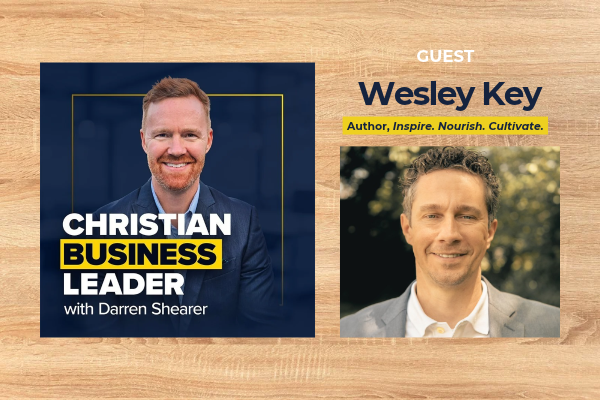
On this episode, we’re joined by Wesley Key.
Wesley Key is an author, speaker, and longtime Chick-fil-A Operator in Bloomington, Indiana. His memoir, Inspire. Nourish. Cultivate., shares his journey from growing up in a pastor’s home and becoming an atheist in seminary to rediscovering faith and finding hope through a life-changing season of anxiety and surrender. With more than 30 years of leadership experience, Wesley speaks candidly about faith, identity, and the pressure to feel “enough.” He and his wife, Kelly, have three children and serve together in their church’s youth ministry.
The guys he plays pickup basketball with call him Rodman … not because he’s eccentric and has pink hair … but because he’s a great rebounder like Dennis Rodman.
Christian Business Leader is the podcast for marketplace Christians seeking to explore and apply God’s will for business for the purpose of cultivating Christ-Centered Companies.
Full Episode Transcript
Heads up: This transcript was created with AI, so you might notice a few typos or small mistakes. We recommend listening to the episode for the best experience!
SPEAKER_01 0:02
Welcome to the Christian Business Leader Podcast, where Christ following business leaders explore God’s will and ways for business. This show is a ministry of the Center for Christianity and Business at Houston Christian University and features conversations with today’s Christ-centered business leaders who are representing Christ faithfully in the business world. I’m your host, Darren Scheer, and if you want to make your work, leadership, and company culture more Christ-centered, you’ve come to the right place. On this episode, we’re joined by Wesley Key. Wes is an author, speaker, and longtime Chick-fil-A operator in Bloomington, Indiana, home of Indiana University, which has got a big game coming up this weekend against Ohio State. His memoir Inspire, Nourish, Cultivate, shares his journey from growing up in a pastor’s home, much like myself, and becoming an atheist, which I did not become an atheist, but certainly had a season of being a prodigal son, and basically lived like an atheist, essentially. But he became an atheist in seminary. Going to seminary, also something we have in common, uh, to rediscovering faith and finding hope through a life-changing season of anxiety and surrender. And with more than 30 years of leadership experience, Wesley speaks candidly about faith, identity, and the pressure to feel enough. He and his wife Kelly have three children and serve together in their church’s youth ministry. And the guys he plays pickup basketball with call him Rodman, uh, not because he’s eccentric and has pink hair, but uh because he’s a great rebounder, evidently, like Dennis Rodman. Wes, welcome to the Christian Business Leader Podcast. Thank you, Darren. It is a pleasure to be here today. When did you first decide to get involved with what God’s doing in the marketplace?
SPEAKER_00 2:00
So I I’ll back up a little bit to high school and you know how you take career placement evaluations and talk to your guidance counselor. My test always came back you’re gonna be an entrepreneur. And being a small town boy from Alabama, I couldn’t even spell the word, but I kept hearing this word over and over. And so I moved to college, went to seminary in Cincinnati, um, and just picked up a part-time job at Chick-fil-A. And that’s really where the spark was lit um to allow me to get into the marketplace and and really live out my faith.
SPEAKER_01 2:36
Yeah. And and so you grew up as a PK, uh preacher’s kid, and and then where would you say you were kind of discipled? Do you feel like um, because I know not all Chick-fil-A operators have the same worldview necessarily, but you know, everybody’s on board with with the mission, which is to honor God uh with everything he’s entrusted to Chick-fil-A and make a positive impact um on everyone who comes in contact with Chick-fil-A. Um how much of your discipleship happened kind of through a Chick-fil-A restaurant?
SPEAKER_00 3:15
I would say quite a bit. To be honest, my I’ve worked for four different operators throughout my Chick-fil-A career, that first 12 years. Um, the first gentleman I worked for, he was kind of a quiet Christian, um, wasn’t, I guess, emphatic about his relationship with Jesus through the business. Um, but he was just like a good guy, lived out biblical principles in his business. The second gentleman I worked for for about two years um did not claim to be a believer. He invested deeply in me personally and as a leader. But then the third and fourth guys that I worked for, that was really where I think faith became really relevant to business. And both of these guys were, I would say, a little bit older, more experienced in business, both came from youth ministry backgrounds. And so they really lived out their faith through their business. And I remember spending hours, um, sometimes hours a week with both of these gentlemen over a cup of coffee, the Bible, uh, devotionals, uh, Christian leadership books. And that’s really where I think the foundation started being built in Chick-fil-A for me.
SPEAKER_01 4:25
And so despite all of that, and despite having a dad who was uh your pastor, uh, you went to seminary and walked away from God. What was that experience like?
SPEAKER_00 4:37
Yeah, so I grew up, like you said, in a pastor’s home. I was surrounded by faith. Um, we were in church on any given week, five to six times a week, you know, between Wednesday night, Sunday morning, Sunday night, nursing home services, revivals, camp meetings, you name it. We were there. Um, I did all the things, like I checked all the boxes, I was the youth leader growing up. Um I mean, I did all the things you should do. I addressed the part, I knew the rules, I knew when to when to do things, raise my hand, bow my head. But as time it came time to select a college, my my passion was to go into the Air Force with my best friend. My dad’s expectation was for me to become a minister, and it wasn’t like a heavy-handed expectation, but it was just there and you felt it. And it doesn’t probably help that I have 10 to 12 close family members that are ministers as well. And so there was just this pressure that, like, that’s that’s what you’re supposed to do with your life. And as I as I got near the time of selecting a college, my friend and I were like, let’s join the Air Force. Um he went ahead and did, and I kind of chickened out just due to all the pressure, and ended up moving to Cincinnati to attend seminary. And after I got to seminary, I quickly realized I had lived 18 years of my life off of my parents’ faith, kind of borrowing that from them. No relationship with Christ. And so I started floundering almost immediately. In my first semester, took an ethics class, and in that ethics class, the professor would divide the class into two groups and they would have a debate. And this debate happened in front of most of the school, which it’s a very small school. You’re probably talking about 250 people, including administration. Uh, we did a lot of research. I was I this was pre-Google, so this was AOL times, uh, dial-up internet. And I would go in and do hardcore research and chat rooms, and then also meet people offline that claim to be an atheist and just get you know their story and why they believed what they believed. Uh, my roommate and best friend at the time was um an award-winning high school debater, and so we just kind of had like this powerhouse going into this debate, and we won the debate, proved that God technically did not exist, um shocked everyone because you’re not supposed to win that debate at seminary, right? And then like my teammates all congratulated each other, high five, go on with life. I did not, and I decided at that point that there was something deeper here, and I just really wanted truth, um, what I thought was truth, and so I started digging and digging deeper and eventually decided that you know God was not for me, and that he was not even a being, really. And so I decided to walk away from from God at that point.
SPEAKER_01 7:47
What was there uh one particular piece of what you would consider evidence for why God did not exist that was most persuasive to you?
SPEAKER_00 7:59
I think the point that we really kind of hammered home was the fact that a a God that is good would not allow suffering in life and all the bad things that happened through national or natural disasters, um, tragedies. And that’s the point that we really drove home. And I couldn’t have drove it driven it home myself, but my my best friend, he was just an avid debater and was able to prove the point that God was not good and he did obviously did not exist because there is just such an abundance of evil and suffering and pain in the world, and so that’s where I kind of latched on was just like, why would something so good allow such bad things in life?
SPEAKER_01 8:41
Yeah, and so your opponents didn’t know how to talk about sin. Yeah, yeah, yeah. Well, that’s really interesting that um they would have that debate in front of the whole school that you would have to. I mean, the the furthest we went with that uh in seminary was in a a pretty small intimate classroom setting where um we had to debate the issue of original sin, and I took the Augustinian perspective, and then my opponents had the Pelagian um perspective, and and that was as intense as it got. But I mean to to stage that in front of the whole school and make you I mean, I mean, it seems like they could find some atheists around that would be happy to take the stage for that debate. I don’t know what they were trying to accomplish with that. It obviously backfired in uh a uh cataclysmic way. I mean, was this like uh what kind of seminary was this exactly?
SPEAKER_00 9:49
Um, it’s a very small denomination. Uh technically it’s a non-denominational school, but it’s tied to the denominations that I grew up in, which is kind of a Wesleyan Methodist background. Um, and I think the point was to help you be able to defend your faith and figure out in the world. And so it just for me personally went terribly wrong. I think I’m probably the only person that walked away, you know, with that conclusion. Everybody else was like, well, of course I believe in God, even though this silly debate proved technically that there is no God. Nobody walked away thinking like, well, I’m gonna walk away from God, except for this guy.
SPEAKER_01 10:32
So right, yeah. And I mean, did you feel like that was that was sort of bubbling under the surface in your life at that point? And then that was just sort of the the the last straw, or was that did that just really kind of blindside you?
SPEAKER_00 10:50
Um I wouldn’t say it blindsided me just because I have spent most of my life being a truth seeker, and so if you tell me this this is truth or this exists, I need absolute proof that it does. And so I think you know, there was a two-year span there where I’m searching and looking for truth, but I think it really benefited me the long run because I spent that time away from God, but it also proved to me during that season and many seasons in my life that God was faithful and he never left me during that season, even when I’m saying this this guy doesn’t even exist, he’s not real. And so you throughout my book and the story that I tell, there’s several chapters of my life where I’m not faithful to God through whatever you know means, but he’s always there being faithful. And a lot of times we look at God as faithful when he’s being good to us or giving us something, healing us, whatever. But for me, the theme of my life is you know, even when I’m not, he is.
SPEAKER_01 11:59
Yeah, yeah. And now you’re in uh well, so were you working at Chick-fil-A during while you were in seminary? Okay, so Chick-fil-A has been kind of the the one constant through all of this, yeah. And yeah, and so did you have people at Chick-fil-A that kind of helped you to as you were deconstructing that that really did help you to kind of get re-anchored in Christ?
SPEAKER_00 12:28
So not early on, and I think it was a good thing because you know I make this decision, I walk away from God and faith. During that time, I walked away from friends, from family, really anything that was anchored to God. And the one thing I didn’t walk away from was Chick-fil-A, but I didn’t know Chick-fil-A as the company that it actually is, because here we are in Cincinnati. Uh Chick-fil-A is very new to the northern region. We’re only located in malls at this time. This is mid-90s, and so people don’t know, like, I don’t I didn’t know the Cathy family. I didn’t know who they were, what they were about. Um, I didn’t know they were Southern Baptists. And I think if we would have known that there’s a lot of people in Chick-fil-A that were religious or connected to God, I probably would have quickly walked away from that as well. And I think God protected me during that season, that two-year season of knowing what Chick-fil-A was, because I would have left it and I wouldn’t have had a 30-year career and I wouldn’t have grown as a leader, and who knows where my life would have gone. Um, so I think it was instrumental that my first two operators were one was a quiet Christian and one was not a believer, but he was still pouring into my life as a person and as a leader, just not spiritually. And then as I came out of that season of my life and I did become a believer, that’s when I actually moved to Indiana and started working for a guy that was a deeply uh faith-filled person. And so the timing of everything was just, it was God’s timing.
SPEAKER_01 14:13
Yeah. And so you and for those who don’t know, to become a Chick-fil-A operator, you really have to kind of come up in the company, right? It’s not like you you just go straight from running a McDonald’s to running a Chick-fil-A. Is that right?
SPEAKER_00 14:31
Yeah, I I think the statistics and they change, you know, every couple of years, but it’s about 70 to 75 percent of franchisees grow up in the farm system. Yeah. And you might spend two years on that, you might spend 12 or 15. I spent 12 years growing uh really slowly, but over time, before they were finally like, okay, you’re ready to go and be be on your own.
SPEAKER_01 14:57
Yeah. And so your restaurant won Chick-fil-A’s symbol of success award six out of seven years, which is something that no other store in the company’s history has accomplished. Um, can you give us a specific example of how the culture of your store, your particular Chick-fil-A stores, and you’ve got two of them now, um, has positively influenced a specific person who’s worked there? Because I know that you’re in youth ministry as well. Like, how are you seeing uh disciple making, even though it doesn’t look like what you know, maybe a seminary-trained pastor might think of disciple making as being, but like what because a a starting off in a Chick-fil-A is is a different experience from what I understand than starting off, for example, in a Bojangles, which is where I started off, or a great American cookie company, which is where also where I worked um as a 16-year-old. Um what’s been different in your experience for these kids?
SPEAKER_00 16:09
Yeah, so and I will say every Chick fil A is different. Um I worked in Greenwood, Indiana for Rick Johnson, incredible guy, former youth pastor, and he was in like a suburb that was surrounded by churches and just pulled from a lot of youth groups. So a lot of these kids that worked with us were already like Christians or believers. I moved to Bloomington and I always wondered why they pair me with Bloomington. But it really, after a couple of years, started to click, and I realized I’m in a college town filled with, you know, half the town is 18 to 22. They’re lost in life, a lot of them. Um, it’s a very, I mean, I I love the college town atmosphere, like the just the energy that it brings, but there are a lot of lost souls here. And so whereas the traditional Chick-fil-A might be more of a suburb youth group fueled environment, mine is like a lot of really lost people. And so you walk into my restaurant, and I would say, I mean, I’m guessing here, 70% of people don’t go to church that work in my restaurant, so it’s kind of a mission filled in itself. Um, I have about 30% that are believers, they they go to church, they witness, um, but it is a different dynamic because you’re very outnumbered. And we basically walk with a lot of people through life while they’re here. And it’s not like uh we’re not pounding them over the head with a Bible, we’re just like trying to meet them where they’re at in school or in life and all the struggles that they’re going through. But I think it was a perfect pairing for me because you know, being stuck in a suburb probably wouldn’t have the same appeal or um it just wouldn’t match my story as well. And so I’ve been able to, you know, sit down with a lot of young people over the last 20 years that we’ve lived here and just have hard-to-heart conversations talk about my faith. Um, I’ve my leadership team is probably a little bit more evenly split. I’d say it’s like 50-50 that go to church or don’t go to church. Um, and even through this book and me sharing my struggles and my mental health battle and my faith, I’ve had leaders that still aren’t believers, but they were highly impacted by just my truth and me being vulnerable and sharing my faith through this book. And so that’s been some of the best conversations have been after this book came out and people read it that were on my team because I felt like this was a great resource for me to give gift to them.
SPEAKER_01 18:52
Yeah.
SPEAKER_00 18:52
Um, and it’s opened up a lot of conversations that I didn’t expect because out of people that have worked with me for 10 to 15 years, we’ve worked slowly with them, but never made any headway from what I what I gathered. We were just planting seeds of faith. And this book has kind of accelerated it because they connected more with maybe the mental health aspect of it. But all of a sudden they’re reading a book that also is very openly sharing faith, and maybe the first faith book they’ve ever read in their life. And so that’s been really, really helpful to see because when I wrote this book, I prayed and I was like, God, I don’t care if this is a bestseller, I just need one person that reads it and it impacts their life. And God has given me person after person after person, and it’s not a bestseller still, probably won’t ever be, but he keeps showing up with that one person that he’s speaking to through this book. And so I I have thousands of books to give, and I just keep giving them to my staff and people that I meet, and it’s been uh a really cool thing to use that through my workplace.
SPEAKER_01 20:02
Yes. So when you say heart to heart um with your with your team members, and let’s say this is like a you know, eight you probably have a lot of IU students there. Um let’s say this is an 18-year-old kid, like what does that typical conversation sound like? Because as I think back to every any job I had up until coming into the Air Force, where you know there’s a lot of vested interest now that the military has in you. And so there’s a lot of conversations about you know what your goals are and things like that. But prior to that, uh at all the fast food, you know, restaurants, worked at a gas station, Mexican restaurant, never did I have any of the leaders of any of those companies show any interest in me as a person, like like um to to ask me about what my goals are or you know, kind of my views on faith and spirituality or or anything like that. I mean, is that is that the norm for you? Like if I come to work at at one of your restaurants, like is as an 18-year-old or whatever, is that kind of what I should expect?
SPEAKER_00 21:28
Yeah, I would I would think so. And it’s not just me, honestly. Like my leadership team is filled with what I call coaches. Um most of my folks have a sports background, so they’re just naturally like wired to be a part of a team or be a coach. Several of them are coaches, you know, off offline, like outside of Chick-fil-A. And so we built our culture on like I think you would see you would look at it first and be like, well, their culture was built on success. Chasing and awards. But at the root of it, it was really just people. And I’ve always said, like, I’m pretty bad at most things. I have about three things that I’m good at. And I learned that probably 15 years ago, I sat down and I was just like, what am I actually good at that I need to be doing in the business? And it always came back to people, people, people. I was not a profit guy. I have folks in my team that are great at profits. I’m good at marketing and networking, but that also is people. Um, so for me, the natural bent is I’d rather sit down with somebody, have coffee, have lunch, hear where they’re at in life, dig into that. And every conversation is different. It, you know, one guy it might be about, you know, his faith. One guy might have nothing to do with faith, but it somehow comes back to faith eventually because it’s more about where he’s at in life and his struggles. Um, every one of them’s different, but I love all of them just because it’s again, it’s back to the people piece and just investing in them. And and really that was like I talked about the second operator I worked for, wasn’t a believer, didn’t push faith at me, which was a good thing. Uh, but he was very passionate about meeting me where I was at in life and helping me excel and grow as a person and a leader. And so I think that’s just that’s where the spark lit for me with Chick-fil-A, and it’s continued. Like if you were to ask me, you know, do you want to stay on here and make this much money? Money’s fine. The winning was fine. Um but what fuels my passion is people and just seeing them grow as either as a person or as a believer, or hopefully they become a believer, and that’s really where I get amped up is doing that.
SPEAKER_01 23:56
Yeah. And so you just your life experience right now, it’s it sounds so fulfilling. It sounds kind of like you’re on the mountaintop. But in 2022, uh, you had you were in a really dark place. Can you walk us through that?
SPEAKER_00 24:15
Yeah. So I’m 48 now. This at that point I was uh 44. But backing up a little bit more than that, I remember being in my late 30s. And at that point in my life, I’m just winning. I don’t know if that song, all you do is win, win, win, whatever. I was winning, like awards at work, in the community, my church, like everything was just clicking. I had a picture perfect family, and I kept hearing people say, Hey, when you turn 40 or around 40, like your life’s gonna get really tough because from there it’s just downhill. And I always just laughed and kind of was like, Okay, sure. I’m not that guy. Like, I’m I’m not a macho guy, but I’m like, I’m emotionally strong, I’m mentally strong, I’m spiritually strong. And those people were spot on. I don’t think it had anything to do with the actual number 40, but God took that middle part of my life, that 40 to 44, and it was like a formation season of hey, I know you think you’re good and you’re strong, and you’re able to do this life on your own, you have your life mapped out, but I’m gonna let you learn some really tough lessons. And it it went from like winning to losing really quickly. And at 40, it was April of 2019, I went down to Alabama, which is home, and I visited my mom, who was at the end of a 10-year battle with Alzheimer’s. And I remember looking her in the eyes, and she called me as I was leaving, she called me by a different name, and it wasn’t my name. And I was like, ooh, like that kind of shattered something inside of me. It was it was tough to hear that. And there’s something about hearing the person that brought you into the world call you a different name and not know you that is just it, it just tears your soul out, and that was kind of the the catalyst for the next four years. And not too long after that, my closest cousin. Um, it was like my brother growing up, died of a drug overdose. And I had seen him two days before. He had been clean for a year, he was celebrating that. He was ministering to recovering addicts, and his sister texted me right after that and said, Hey, Eric is missing. And then right after that, they found him in his car OD’d oh wow. Uh, six months later, my my last living grandparent died. She was like the the foundation of our family. Um, so I lost these three really important people in my life who were just kind of like foundational pieces in different parts of my life. COVID starts in the middle of that. And we all know COVID was not a fun party. It was kind of a train wreck for society in general in a lot of ways. And as a business leader and a father and a husband, and somebody that was, I’m not going to call myself a pillar in the community, but actively involved in the community and church. All of a sudden, I’m I’m feeling this pressure from every direction to still be like this strong emotional, uh, secure person that everybody else can lean on. But inside I’m starting to crumble. Um, fast forward a little bit more. The COVID pressures are slightly easing up 2021, 22, but they’re still there. Like we’re still, at least in Bloomington, living under mandates and wearing masks and all the things that you know you had to do. But then inflation takes off. And so business cost in our business went up 40 to 60 percent across the board. We didn’t raise prices 40 to 60 percent. I think we might have raised them a collective 10%. So all of a sudden, I’m a I’m a successful business guy running two growing restaurants. If you think back, I said I’m not a profit guy, I’m a people guy. If you’re not a profit guy, when inflation hits, that’s a really bad thing. And so costs are mounting. I find myself most of 2022 going into debt just to keep my employees employed because I’m a people person. I don’t want to let anybody go. I want to keep people, you know, I have their families weight upon me. And so all this is builds and builds and builds. Well, I had never experienced anxiety or known anxiety, but um, I’ve heard family members say, hey, I feel anxious or I have anxiety. I’ve had coworkers and friends talk about it, but I was like, I’m here for you, but I don’t know what you’re talking about. Like I don’t, I can’t relate to that. And so somewhere in the 2019 to 2022 phase of my life, I began to feel anxiety like slowly just creeping in, creeping in, creeping in. By the middle of 2022, it was just roaring in my ears. It was like I could hear it and feel it all day long. I wasn’t sleeping, I wasn’t eating right, I wasn’t resting. Uh everything in my life was just falling apart at this point. Even though on the outside you would still look at me and be like, oh, that’s the Chick-fil-A guy. That’s the guy that helps at church, that’s the guy that’s in our community serving and giving. He’s got a beautiful family, but people can’t see what’s happening inside of you often. And if especially if you have walls up and you’re not letting it out, um, it’s really easy to hide. And so October of 2022 rolls around. I went on a couple of trips with family members with my wife on our anniversary trip. I went to Spain with my oldest son to celebrate a milestone birthday. Came back from that, um, went to a Chick-fil-A seminar in Atlanta for a couple days, got home on a Friday night, and Saturday morning, I remember waking up and thinking, I am something is not right. Like I I had been feeling fatigued and kind of sick, but all of a sudden it was like, I’m sick. And I’m not one to run to the doctor. Um that’s kind of a fault of mine. I’m like, I’ll figure it out. I’ll take these vitamins or supplements, and it’ll all work out. By Wednesday, I was at the doctor, and at that point, I’m feeling really terrible. Uh, the doctor goes to list, a list of questions. He’s like, Have you been overseas? and all these kinds of you know, medical things they ask. And he was like, I don’t know what’s wrong with you. He ran tests, he was like, I can’t put my finger on exactly what’s wrong with you, but I feel like if you take this antibiotic, it’ll help you. And if it doesn’t, it’s 10 days. We’ll try something else. And so I started taking this antibiotic, which again, I’m not I’m not big on going to the doctor. Um, but I thought, what can this hurt? It’s gotta, it can’t not help. And so day one, I knew immediately like something in this medication of my body is not jiving very well. My day four, night four, I’m laid in my bed Googling how do I take my own life. And that is a place that never expected myself to be. But I spent the next five nights searching for a painless, um, easy way out of my life. And I’m not sleeping, not eating. I think I lost like 10 to 15 pounds in about a week. Um, I remember waking up day nine and I was like, I can’t keep doing this. Like, I I don’t know if you’ve ever gone to a spell where you’re not sleeping, but if you already have anxiety and you’re not sleeping and you’re not eating, it’s just building like a pressure cooker. And I woke up and told my wife, I was like, I need help. Like, I don’t know what’s going on, but here’s what I’m feeling and experiencing. I’m laying awake at night, you know, thinking about how do I get out of my life. She kind of connected the dots pretty quickly and did some research on this antibiotic. And she’s like, You cannot take this anymore. She took it away from me. This specific antibiotic um has a lot of side effects. One of those side effects, especially for people with anxiety, it’s like pouring gasoline on a fire. And suicidal thoughts and tendencies are just one of those side effects.
SPEAKER_01 32:38
What’s the name of it?
SPEAKER_00 32:40
Doxycyclone.
SPEAKER_01 32:42
Okay, yeah.
SPEAKER_00 32:43
And so she takes this away from me. Um, the anxiety, you know, well, the suicidal thought to subside because I’m off the medication, but the anxiety is still there. I mean, like if you’re looking at a scale of one to 10, I’m like a 12 uh when it comes to anxiety. And so for about a month, I’m kind of put on watch with my family. Like there’s always someone with me, unless I’m driving to and from work. And at work, I’m surrounded by people. And so I’m at that point surrounded by people that love me, they’re checking in on me constantly, caring about me. But the anxiety is still just just there. And I can’t get a hold of it, I can’t control it. Um I’m I’ve been crying out to God for months at this point, asking for you know his peace and mercy and grace. And there’s just nothing. Like I feel like I’m talking to the ceiling. And one Saturday, it was about a month, it was right at a month after this whole incident happened. I just needed some alone time with just me and God that wasn’t driving, trying to focus on the road. It was just like, I just need quiet time. And so my boys were at work this Saturday morning at Chick-fil-A. My wife and daughter went to Target. I finally convinced them, like, I’ll be okay for an hour. You can call and check on me 20 times if you need to. And so they gave me this one hour of just peace and quiet. And it was the most transformational hour of my life. Um, one of the ways that I dealt with anxiety through that span of my life was just turning on the television and going to YouTube and listening or watching and listening to worship music. And I could turn it up so loud that it would drown out the noise in my head that wouldn’t shut off. And so I don’t know if you know the same the song Same God. Um, I forget who sings it, Elevation or somebody, but I listened to the song, it came on and I listened to it four or five times in a row. It was just like speaking to my heart. And I was probably like the fourth time, and I was just like, I’m I’m crying out to God, I’m worshiping God, I’m asking for healing and peace. And I felt like, you know what, you need to get down on the floor and like on your hands and knees and worship God and beg him there. And so I did, and I’m there on my hands and knees, right in front of the television, just you know, crying out to him. And I thought, you’re crying out to the God of creation, the God that created literally everything that we see, feel, touch, smell, like everything, and you’re not totally before him. And so I got down on like face down, hands spread out, as low as I could go on the floor, and cried out to him. And I think there was something about that surrender and like that the prayer that I was praying was like, I’m at the end of myself, God. Like I’ve lived 40 something years at this point on my own strength, doing everything within my power, never fully surrendering everything in my my life, my plan, everything to you. And there was something about that being that low on the ground before him and just surrendering it all that he came into that room with me that day. And it wasn’t like you know, a burning bush. There wasn’t some bolt of lightning that came out of the sky, but it was a voice, and it was, I’ve never left you. I’m still here with you, and I’m still writing your story. And that day, like I didn’t get up from the floor healed or like miraculously ready to charge back into life, but it was a turning point. There was something about that surrender and me fully realizing like I can’t do this on my own anymore, that God began the healing process, and it’s been a long process. I’m still still healing in some ways, but that’s where it it pivoted and began to go in the right direction.
SPEAKER_01 36:40
Wow. So, do you feel like you originally went into the doctor because of the anxiety? And but it was it was manifesting uh physically and not just mentally, and the doctor’s like, I don’t know what to do about this. Let me just throw some antibiotics at it. Is that basically what happened?
SPEAKER_00 37:01
My wife has referenced that several times, that that’s probably a strong possibility, uh, because I know even now, like I haven’t fully overcome anxiety in my life. Like I still will struggle from time to time. I’ll get on a podcast, and for about a day before that or a speaking event, I can feel it and it creeps back in. And I I’ve learned, you know, to sit in silence and meditate with God, and it helps, it helps a lot. But anxiety can create things that sometimes aren’t real, you know, in your mind and your body. You feel things that aren’t actually there. Uh, it’s a powerful, powerful thing that I didn’t understand. I still don’t understand it fully, but the more I’ve lived, I’m I’m learning more and more about it.
SPEAKER_01 37:52
Yeah. Yeah. We were just talking about this last night at our youth group. I also help out with the youth group in my church and um um was talking about where Jesus says that basically you can ask for for anything and and and he will do it. Of course, it has to be in his name and in his will and so on. But but but he says so that your joy may be full. And and so, you know, we were talking about like how can we make sure that our prayers are in his will? Well, I mean, the pr and one of the the girls, you know, she shared that that’s what she’s been dealing with is depression, anxiety, and and and we just pray that the Lord would just break that and restore her joy back to her. Um I mean, if anyone’s listening to this, um actually just as we’re kind of wrapping up here, I’m gonna have you pray over our listeners, you know, anyone that feels like you know they’ve been burning the candle at both ends, or uh maybe they’re just so depressed that they’ve just kind of become lethargic and haven’t really been able to produce much, you know, lately. Um, I want to ask you to pray over uh over everybody. Is that okay?
SPEAKER_00 39:17
Yeah, I’d love to.
SPEAKER_01 39:19
Okay. All right, well, go ahead.
SPEAKER_00 39:20
Father God, we come to you today and we just worship you. We are so thankful for the life and the breath that you’ve given us today. God, we come to you with hearts that are thankful for all these things and the amazing gift of life, the ability to just go through a day and be around your creation. But God, we come to you, and there are people with heavy hearts today, and maybe they’re listening today, maybe they’re not, but we pray for all those people that are out there that are feeling burdened by life, by grief, by sadness, by sorrow, by depression and loneliness, by anxiety. God, these are real things that people battle. We just pray that you would speak life into those people, that you would speak healing, that you would in Jesus’ name bring life to them. God, we believe in you as a healer, just like the song that I referenced, same God, like you help so many people in the Bible that people that we look up to and we’ll read about, and that you’re the same God now as what you were then, and we believe in your healing power and your restoration, and just the fact that you’ve covered us with Jesus’ death and resurrection. And we just pray today that you would bring and breathe life into the listeners today.
SPEAKER_01 40:49
Yes, and amen. In Jesus’ name. Yes, thank you for that, Wes. Um, that was powerful. And I I pray that somebody is experiencing a breakthrough right now, um, and that their joy would be restored that Jesus promised. And um, and it’s it might not be uh it could be kind of a thorn in the flesh kind of thing, you know, where where I mean some of us are more predisposed to be kind of in a melancholic kind of uh kind of a demeanor. And and you know, Paul said, God, take this away from me, whatever that was. He said, My grace is sufficient. And so, you know, in this life, we never we may never come out of that place where we don’t need dependence on God, you know, to to stay out of that darkness. Um, I don’t think we will in this in this life, but one day there’ll be no more pain, no more sadness, no more, no more crying, um, no more depression, no more anxiety. And what a day that’ll be. Um but Wesley, this has been fantastic. Um, WesleyKey.com is the website, and the title of the book when I encourage everyone to go get it, is Inspire, Nourish, Cultivate, where you can hear more of Wes’s story. Um, Wes, thank you so much for spending time with our listeners and uh praying over us and and helping us grow today. Thank you.
SPEAKER_00 42:26
It’s been an absolute pleasure to be here with you all and just enjoyed and appreciate the opportunity.
SPEAKER_01 42:33
Thanks for listening to this episode of the Christian Business Leader Podcast. Be sure to subscribe, leave a review, and tune in for the next episode as we continue exploring God’s will and ways for business.
BIG THANKS to this episode’s sponsor: High Bridge Books
High Bridge Books helps Christ-centered authors build a legacy by crafting and publishing messages and stories that glorify God in all spheres of culture.
- High Bridge Books’ professional book publishing package: https://www.highbridgebooks.com/publishing/
- High Bridge Books’ proofreading, line editing, developmental editing, and co-writing services: https://www.highbridgebooks.com/editing-and-proofreading/
- Examples of our books: https://www.highbridgebooks.com/bookstore/
We’re extremely proud that …
- 43% percent of our 230+ books under contract were written by authors who have published more than one book with us, and
- 49% percent of our books under contract were referred to us by authors who have published with us previously.
Contact High Bridge Books’ CEO Darren Shearer at [email protected] to get a conversation going about your book!