The Burdens of Christian Leadership (w/ Barry Corey)
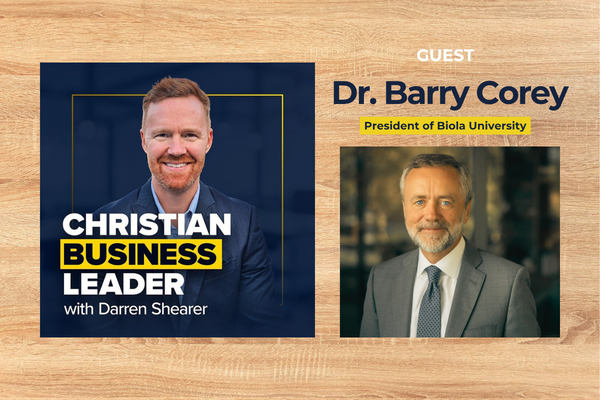
On this episode, we’re joined by Dr. Barry Corey.
Dr. Barry H. Corey is the eighth president of Biola University, a top-ranked Christian liberal arts university, and author of several books, including Love Kindness: Discover the Power of a Forgotten Christian Virtue. A native of Massachusetts, President Corey received his Ph.D. from Boston College and was a Fulbright Scholar in Bangladesh. He currently serves or has recently served on governing boards such as the National Association of Independent Colleges and Universities, Gordon-Conwell Theological Seminary, and the Museum of the Bible. He and his wife, Paula, have three adult children: Anders, Ella, and Samuel.
Along with Dr. John Townsend, he’s the co-author of the new book, Necessary Burdens.
Christian Business Leader is the podcast for marketplace Christians seeking to explore and apply God’s will for business for the purpose of cultivating Christ-Centered Companies.
Full Episode Transcript
Heads up: This transcript was created with AI, so you might notice a few typos or small mistakes. We recommend listening to the episode for the best experience!
SPEAKER_01 0:02
Welcome to the Christian Business Leader Podcast, where Christ following business leaders explore God’s will and ways for business. This show is the ministry of the Center for Christianity and Business at Houston Christian University and features conversations with today’s Christ-centered business leaders who are representing Christ faithfully in the business world. I’m your host, Darren Scheer, and if you want to make your work, leadership, and company culture more Christ-centered, you’ve come to the right place. On this episode, we’re joined by Dr. Barry Corey. Dr. Barry is the eighth president of Biol University, a top-ranked Christian liberal arts university, and author of several books, including Love Kindness, Discover the Power of a Forgotten Christian Virtue. A native of Massachusetts, President Corey received his PhD from Boston College and was a Fulbright Scholar in Bangladesh. He currently serves or has served on governing boards such as the National Association of Independent Colleges and Universities, Gordon Conwell Theological Seminary, and the Museum of the Bible, which I had just got to see recently. He and his wife Paula have three adult children, Anders, Ella, and Samuel. And along with Dr. John Townsend, he’s the author of the new book, Necessary Burdens. Barry, welcome to the Christian Business Leader Podcast.
SPEAKER_00 1:24
Thank you, Darren, for having me on this podcast. And I’m going to start listening to it now that you’ve uh introduced me to it, because I’m sure I have a lot that I can learn by uh exposing myself to some of these great segments that you’ve done, 341, whatever that number is you just shared with me.
SPEAKER_01 1:39
Yeah. Well, thank you for uh contributing here uh today. So when did you first realize God wants to be involved in your work and leadership?
SPEAKER_00 1:49
Well, uh I grew up the son of a pastor, and um and I saw the um the burdens that my father carried um as he led a flock of God’s people through their ups and downs and twists and turns, bumps in the roads. And uh, and I just thought that like uh I knew that um I knew that he knew that he couldn’t do it alone. And um oftentimes would hear him, I’d cut my ear against the door of his study and he’d be on his knees praying for the Lord to give him strength, give him help, give him wisdom, give him margin, give him favor. Um, and that was kind of my eavesdropping um uh experience, realizing that uh good leaders um need to have good counsel along the way. And I also knew, you know, uh good leaders can’t do it alone.
SPEAKER_01 2:40
Yeah, yeah. It’s too the task is is too big. So your co-author, Dr. John Townsend, co-wrote a famous book with Dr. Henry Henry Cloud called Boundaries, which many of our listeners will be familiar with. And then Dr. Cloud wrote a book titled Necessary Endings. Um, so so because sometimes setting boundaries isn’t isn’t enough, and you need to uh completely break off the relationship in some cases. So, was your new book uh Necessary Burdens? Was that kind of written as a counterbalance to uh cloud’s necessary endings?
SPEAKER_00 3:19
You know, the word necessary, I uh John um Townsend came up with it. We’re trying to figure out like what is a book that is about burdens, how can it have a title that isn’t like burdensome in and of itself? I’m not gonna pick that thing up. That thing’s like all about the heavy weight that I carry. And so he suggested necessary um um uh burdens. I actually haven’t read necessary endings, so I can’t say how much it might be a counter uh uh point to that, but I will say that uh that necessary burdens, I mean, they’re necessary because like um you can’t escape them uh in leadership. And I and I in that book I identify 14 burdens that are I think unique to top leaders. If you look at an organizational chart, there’s one person at the top of that chart, and it could be the mayor of a city, it could be the headmaster of a school, it could be the president of a university, it could be the CEO of a company, it could be the senior partner of a law firm, it could be, you know, uh, you know, the lead pastor of a church. Um it doesn’t matter if it’s big or small, the one person, Darren, at the top of that organizational chart faces existential burdens that no one else experiences, at least to the level that they do, and no one else completely understands. And so this this book, um um, I had been thinking about these burdens for a long time because I’ve been experiencing them. I had a mentor that would talk sometimes about the burdens of leadership that he faced. Um and so as I as I began writing it, I invited John Townsend, who I’ve known, he’s a graduate of Bio University’s PhD program in Rosemead School of Psychology. I said, Now, John, would you would you consider, and he had a he’s a busy schedule, he’s writing an academic book, would you consider um doing uh a section at the end of each chapter, these very clear descriptive chapters of these burdens that we all face? Um, kind of like a a bit of a diagnostic and a bit of a prescription of like how do we bear these burdens in ways that strengthen us, that don’t deplete us, that that give us courage and don’t give us fear. So um we had a blast writing this book together. Um it was just uh so much fun getting his input after my descriptions. And so that’s kind of a longer answer, maybe, Darren, to your question about kind of the origins of you know where this title Necessary Burdens came from. And they’re necessary because they strengthen you. Um, they they don’t they don’t tear you down, but you need to know how to steward them well.
SPEAKER_01 5:55
Yeah. Well, necessary burdens uh it isn’t quite as palatable as necessary endings because I think a lot of us are carrying those burdens that we would like to end. Uh, we would just like to uh or or at least get somebody else to carry it for a for a while. Uh, I think about uh Frodo carrying the ring, you know, that was his his burden burden to bear. Uh in the book, you describe leadership as splendid agony. What do you mean by that?
SPEAKER_00 6:27
Um, well, it’s it’s splendid because it is a uh it’s a sacred trust that we have. And those who are in leadership that that kind of understand um um it as more of building a team and a community than building a pedestal to it for yourself. There’s there’s something beautiful about that. There’s something um splendid and glorious about leadership. Um, but there’s an agony to it, and that is kind of what this book gets at. Um, and that is that there is something um there’s something about top-tier leadership that um exposes you to these weights and you know, obviously what we call burdens that you otherwise wouldn’t experience. And um the the the agony are these burdens, but the splendid dimension is like these burdens can empower you, they can make you better leaders, they can make you truer friends, they can make you uh they can give you this like like internal fortitude that but you need to know how to how to really steward uh those burdens. I I basically say in the book, like you want those burdens to go away, uh, they’ll go away uh as soon as you quit your job or as soon as you’re you know shown the door, whatever it might be. They do go away, but but they don’t go away as long as you’re in this role. I mean, I’ve been I just started my 20th year as president of Bio University. Um, and there’s things that are easier, there’s things that I understand now that maybe I didn’t understand before, but these uh these these ongoing, enduring, perpetual weights that leaders carry that again, no one fully understands them. They might understand them like intellectually, but they don’t understand them existentially like we do in these roles. And so I walk through these 14 burdens that are always they they wave, they come and go, they have like higher levels of intensity and lower levels of intensity, but they’re always there. So when I talk, for instance, about you know, the burden of of lonely ship of loneliness, like like the irony is as as leaders, like we’re like we’re never alone or we’re rarely alone, yeah. But but we’re the only person in our institution that we have no peer, right? You know, VPs have VP peers, and managers have manager peers, and you know, faculty members have faculty peers and associates have associate peers, but the top of the order is that you have no peers, so there’s this sense of loneliness that it’s unmatched, and no one fully understands it. You might get some um sympathy, but like you’re not gonna get any empathy because no one like how do you deal with that loneliness? Um, so that maybe that’s an another one. I mean, I talked in in there about the the burden of assaults. Like we have like like always these challenges that come our way. And I was talking to one leader some time ago, and she said, you know what, I always thought leadership was like these challenges before you, like a mountain range you’re flying towards, and you get over it, and then it’s just like clear sailing. And then I realized, like, no, there’s another mountain range and another mountain range. And these these assaults that we face, they’re relentless, they’re inevitable, they come from like the left and the right, inside, outside, they’re direct, they’re indirect. Um, so what is the durability, uh, the resilience of spirit that we need as leaders when these attacks come from from opponents? They also come from friendly fire as well. So these are a number of the burdens, Darren, that just like let’s describe them. And I think there are there are plenty of leaders that feel like um, you know, I’m the only one going through this. And I and this book, you know, here it is right here, necessary birds. This book is like the to to give you some companionship, to give you some camaraderie. And I’m pretty raw on this book. I talk about my own failures, I talk about the lessons I’ve learned through my mistakes, I’ve talked about, you know, times that I’ve I did I thought things were going great, and I find out that there’s some kind of like um turbulence going on uh in the institution. And I think leaders need to be open with each other. Um, there needs to be some kind of like like you have to find some peers at other institutions to be able to walk through those challenges with. And this book is is to be a type of peer to leaders so that they can read that and say, Oh, you know, I thought I was the only one that’s experiencing that, um, and I’m not. And here’s how maybe I can deal with it in a way that’s gonna build me up and not knock me down.
SPEAKER_01 10:50
Yeah. Are there any scriptures or biblical applications that come to mind to kind of make this more clear to us?
SPEAKER_00 11:00
Well, the um the Bible is full of examples of both um, you know, uh bearing one another’s burdens, uh, and also um, you know, Jesus says, you know, um, my burden is easy, my burden, my yoke is easy, my burden is light. Um, but when you read this book, um you’re you you will see that this book was not written uh overtly um for a Christian audience. I mean, I have endorsers on here that um Jewish backgrounds um are leaders of institutions that aren’t necessarily faith-based, um, some who would claim a strong faith, some who wouldn’t. But they’ve read this book, and there’s I think there’s something um universal about this book that you’re not gonna open it up and find that it is gonna be overtly devotional. Um, you could be, you know, the CEO of Boeing, and I think read this book and say, Oh, oh yeah, yeah, that’s me. I get that. You could be the mayor of you know Topeka, Kansas, uh, and uh and and and find yourself there. So the book has certainly based on my own experience as a leader of a Christian organization with a deep sense of what does it mean to to kind of live the virtuous life as a leader? Um, but it’s not um it’s not overt uh in the book.
SPEAKER_01 12:25
Gotcha. So looking back on your own leadership journey, which burden uh would you say had probably the greatest impact on who you became as a leader?
SPEAKER_00 12:35
Um you know, I part of it, I think for me, it’s um it was uh, you know, I would, you know, these again, these 14 burdens that are are laid out in here. Uh it’s the burden of of identity um that was hard. When I became the president of Biola University, Darren, I I I realized that in some ways I embodied the institution. And it not that I had to be untrue to myself, but I had to actually speak in a way that reflects the institution because um the personification of Bioluniversity is is kind of found in its leader, as it would be often in a church and or often in a city. The mayor speaks, it speaks, speaks on or she speaks on behalf of the of the city. And that was a little bit hard for me. There’s a there’s a side of me that’s a little bit more, you know, casual, maybe unfortunately flippant at times. And I just realized that um I had to kind of embody that I am the president of Biology University. I remember my father when he was um, when I was a kid, he was preaching a sermon, and uh, I don’t know, I was like five, six, seven years old, and he he talked about the Queen of England, obviously, there was the queen then. Um and and they asked her about how she handled all of the challenges of royalty, and she said these words, like I never forget who I am. Um, and I and like I am a caretaker for this season of Bio University, and I I have to acknowledge the fact that I represent the university to all of these different constituencies, and I can’t forget that. Um, you know, the the camera’s always running, the mic is always on, and it’s a difficult challenge for us as leaders because sometimes we don’t want the camera running and we don’t want the microphone on. Um, but that doesn’t mean we didn’t, again, deny who we are. Um, but we have to realize you have to steward well that role that you have for the season that you’ve been entrusted to it. But you also have to understand when that season is over, you’re not that role uh anymore. I remember walking down the sidewalk at Bio University about four years after I started the job. I was with some students, and there’s a big photo of my predecessor, an amazing leader, 25 years, 25 years as president of Bio University. And I asked these students, like, who’s that? They said, like, we don’t know. And I said, Well, it’s the former president of you know Biol University. And they basically said, like, all right, well, we’re heading off to lunch now. And I just like like realized that, like, though this is a a role that I steward by God’s grace for the season that He’s given it to me, there’s gonna come a time when the baton is passed, right? The mantle is uh given on, and I’m gonna move on. And and and that doesn’t matter as much. So that a sense of identity is something that we have to think carefully about in our roles as leaders.
SPEAKER_01 15:34
Yeah. I remember when I was much younger, I first heard the term fear of success, and I thought, what a what a stupid concept. Uh, what a what a first world problem to try to invent. But the older I’ve gotten, the more I realize that there’s a lot of truth to that. And I think the fear of success, another way of saying it, are those the fear of the necessary burdens that are that are gonna come along with that success. You know, so I’ve got uh a very small company with not a lot of people uh to lead. And and but then part of me is like, oh man, what if I what if I had a company where I could I could um I could be leading a thousand people, you know, then I’d I’d really be successful. But then when you stop and think, I I mean I I think Biola probably has I don’t know how many hundreds of uh maybe over a thousand employees, I don’t know. Um, but but what a burden. And and no now knowing that you know you don’t just get to uh speak for yourself, but you’re speaking on behalf of in many ways uh everyone that has uh signed on to join the team there at Biola.
SPEAKER_00 16:58
Yeah, that’s it. And I um as you were saying that, Darren, I was I was thinking of Bobby Grunwald, who you might know, he’s president and founder of UVersion. I mean, he was well, you look at about I don’t know, 20 or so endorsers for this book. And he said exactly that. If I could I could read it, he said most leaders are prepared for the weight of responsibility, but not for the weight of success. Necessary burdens names what many of us feel but rarely say, and it reframes what we carry, not as obstacles, but as tools. If you’re leading at a high level, this book will help you make sense of your experience and find a path forward. But as he says, most of us are exp are prepared for the weight of responsibility, but not for the weight of success. Um and I and I think that is true. I mean, I I’m just like a I’m a preacher’s kid from uh uh Auburn, Massachusetts, um, who you know, our family like had like no national like like fame. And um, you know, by God’s grace, I’m in this role. And I remember when I took this role, um one of the professors wrote me a letter and he said, Barry, um there aren’t a lot of prima donnas at Biola University. He didn’t say there were none, but he said, There are not a lot of prima donnas at Biology University. He said, he said, um, we are the kind of place that where we take our roles seriously, but we don’t take ourselves too seriously. And I think there’s this humility of leadership um that we need to understand um that uh we steward this for a season, and then uh we move on, and we’ll have a we’ll have a successor uh when we’re done. And successor is different than success. Um that means uh we are we are I talked to one president and um he um he had been interim president of a pretty big institution here in California, and then he was named president, and he said, I said, Oh, so they took the interim off of your name. There’s no longer like a like a qualifier for president, you’re not interim president. He said, Barry, we’re all interim. You know, we all do this for a season. Sometimes the interim is is longer than others. But as I and as I talk about you know the dimensions of this book there, and I I I talk about the burden of loneliness, the burden of identity, which I mentioned. There’s a burden of initiative, like like we are the ones who have to like make things happen. We have to discern the context and decide on the path forward. There’s this burden of distinctives. We have to like get this vision for our our the institutions that we lead, like how we are different than anything else in our in our ideals and our traditions and our value propositions. I talked about this the burden of assault, but we also have a this burden of um what one person told me was accumulated grievances. And that is like the the most intractable and and and complex challenges that are unresolved at these like lower levels of the university or at the organization that we lead, they they come to bear on the top leader because they’re they are unresolved, and sometimes it’s compounding in the weight of those accumulated um burdens or those accumulated grievances that come your way. I think leaders face um a burden of temptation, like these unhealthy seductions and the dangers that come along with them. And I think for many leaders who are more isolated, they might feel like they have this sense of immunity from these temptations or just don’t see them coming. And therefore, they don’t know how to prepare for inevitable ethical or moral or legal temptations. And I’m telling you, I’ve seen so many leaders like lose it all in the blink of an eye. Um, you know, there’s a burden of like well-being. How are you taking care of yourself? Um, you know, leadership can be um um so heavy at times that we let other dimensions of our life go and we don’t allow ourselves to have this margin to um avoid this this workaholism or obsessing with our leadership and we’re not caring for ourselves, we’re not preserving our our marriages, our family, our friends, our like our health, our our faith. Um I also have seen um um kind of rattling off some of these as they come to my there’s gonna come a time as I you know I’m starting my 20th year, there’s gonna come a time that I’m done. And think like, okay, now those burdens are gone, but sometimes there’s this burden of feeling this this this maybe this obsolescence or even misery, and that you know, I don’t know what do I do now, and the the self-pity or insecurity that can come along with it. So there are, I mean, these are just um a number of the burdens that that that I feel and I’ve heard stories of, and I don’t want you as a leader listening to this podcast feeling like like you’re alone in this or you don’t know how to deal with it. Like I think this book is uh is really a kind of a leader’s guide to helping you bear those burdens in a way that make you a stronger leader and a better leader and a more thoughtful leader. Leader in every way.
SPEAKER_01 22:02
Yeah. One of the burdens that we’re starting to talk about more on this podcast is the burden of recognizing that the people that work in the organization that you lead, they are going to be changed for the rest of their life based on the experience that they have working there in that organization, uh, for good or for bad. And and and and so how do you how do you think about that burden and and steward that?
SPEAKER_00 22:38
Yeah, I mean that’s that’s um I think the something that we don’t think a lot about as leaders when we’re necessarily going into it, but we all we all have, I mean, I think leaders emerge to the roles that they’re in, uh not by luck or by default. I think like you as a leader, you’re in this role because you’re gifted and you’re savvy and you’re extraordinary. And um people who put you into this role did so because they saw in you something that they thought, like, hey, this person can lead. So I know there are folks that helped me along the way to get to where I am. Um, but you also got there because you were you were you’re one of the team at one point. It might be at this organization or another organization. Um, you knew what it was like to be uh um an employee, a staff member, a leader, an executive uh at other levels. And I think um how you comport yourself um as a leader, like people are paying attention to you, um, not just to the organization you lead, but but to you. And I think it’s um the best thing to do is not let this leadership uh role kind of in inflate you in some kind of uh like ego um enhancing way, but um, but you know, kind of um you know shed that that sense of like your own lofty role and and just just be honest with those that you’re working alongside and think about them and realize that many people’s livelihoods um are dependent on you. And I think that’s why you know I talk about this this burden of of presence, um, like being there matters, and and all the employees that you have and your constituents and your customers served by this the organization that you lead, they need you. They need you as an incarnational leader who’s who’s present and you have the spirit of attentive listening and genuine care and and unfeigned humility. And I remember when I started this role at at Gordon Conn, well, uh I’m not Gordon Connell, that’s my old organization, but started this role at Bio University, Darren. Um, my motto was to hit the ground listening. Um, I knew that um if I made decisions right away, um that would probably be foolhardy and arrogant. If I never made any decisions at all, it would be a reckless um type of leadership. So I wanted to make sure I knew the people that I was leading, the people that I was serving alongside. And I remember I did that that first year. My model is hit the ground listening, made some decisions after that season of listening. But I was listening to this uh at a session of a Harvard School of Education uh professor, and she she said to me in the session, she said, um, she said, Um, you probably started it with a season of listening. I said, You said she goes, like, are you still doing that listening? And I said, Well, I, you know, actually, I I I’m not. And she said, you know, you’re probably on the third or fourth presidency at the same institution. The institution changes and your people change, and you always need to be caring enough about those that you are leading that you listen to what they have to say. You may not always do it, but you listen to them. And I think there’s something about that that being in touch and and living into that burden of presence is such an essential part of healthy leadership.
SPEAKER_01 25:57
Yeah. Well said, Barry. So the book is necessary burdens. Anything else you want to say about how people can connect and hear more from you?
SPEAKER_00 26:08
Well, I again, I mean, I I wrote this somewhat autobiographically, and um, there are parts of the book that I you know are I’m pretty honest with um my own shortcomings and my own failures. Um, and I I I tried to to do it in a way that that again, other leaders can read this. If you’re it’s a big organization or a small organization, there’s only one person at the top, and whoever that person is, like he or she, I just need think needs to feel that like there’s a way to get through this. I mean, I I kind of joke around, like I think um, like a lot of people want to be president, uh, maybe a place like like like at a university like I am at Biola, but there’s not a lot of people like want to do president because the glory parts of it and the fanfare and the attention, that’s such a fraction, a fraction of of my time in this role. Most of it’s just like kind of doing the hard stuff, and this is to try to help you get through the hard stuff in a way where you feel like you know what, I’m making a contribution, I’m actually being strengthened as hard as this is. And uh, you know, by God’s grace, that’s been my story for the last two decades.
SPEAKER_01 27:23
Yeah. What’s the biggest reason why somebody should not want to become a college president?
SPEAKER_00 27:30
Um, yeah, I mean, again, I think if you if you just if you there’s something about the title that makes you feel like, hey, it’s a it’d be a fun thing to do. Um, whether it’s a college president or a mayor of a city or a CEO of a Fortune 500 company, whatever it is, like like a leadership can be brutal. I mean, it is, as you said in the beginning, it is splendid agony. Um, it’s tough, but it’s great. And and I like to be able to look back and despite my mistakes and flaws along the way, just seeing how I, you know, I’ve worked with it within a community um to add to you know what I would say, like the good work that God is doing uh in the world through just kind of this faithful presence of leadership.
SPEAKER_01 28:13
Awesome. Well, Barry, thank you so much for spending time with me and our listeners today and uh educating us about the necessary burdens that if if we have a call to leadership, we have a call to bear one another’s burdens and so fulfill the law of Christ. But like you pointed out, the good news is that his yoke is easy and his burden is light. So thank you so much, Barry. Thank you, Darren. All the best. Thanks for listening to this episode of the Christian Business Leader Podcast. Be sure to subscribe, leave a review, and tune in for the next episode as we continue exploring God’s will and ways for business.
BIG THANKS to this episode’s sponsor: High Bridge Books
High Bridge Books helps Christ-centered authors build a legacy by crafting and publishing messages and stories that glorify God in all spheres of culture.
- High Bridge Books’ professional book publishing package: https://www.highbridgebooks.com/publishing/
- High Bridge Books’ proofreading, line editing, developmental editing, and co-writing services: https://www.highbridgebooks.com/editing-and-proofreading/
- Examples of our books: https://www.highbridgebooks.com/bookstore/
We’re extremely proud that …
- 43% percent of our 230+ books under contract were written by authors who have published more than one book with us, and
- 49% percent of our books under contract were referred to us by authors who have published with us previously.
Contact High Bridge Books’ CEO Darren Shearer at [email protected] to get a conversation going about your book!