Christians Who Founded First Certified Regenerative Farm in U.S. (w/ Blake and Stephanie Alexandre)
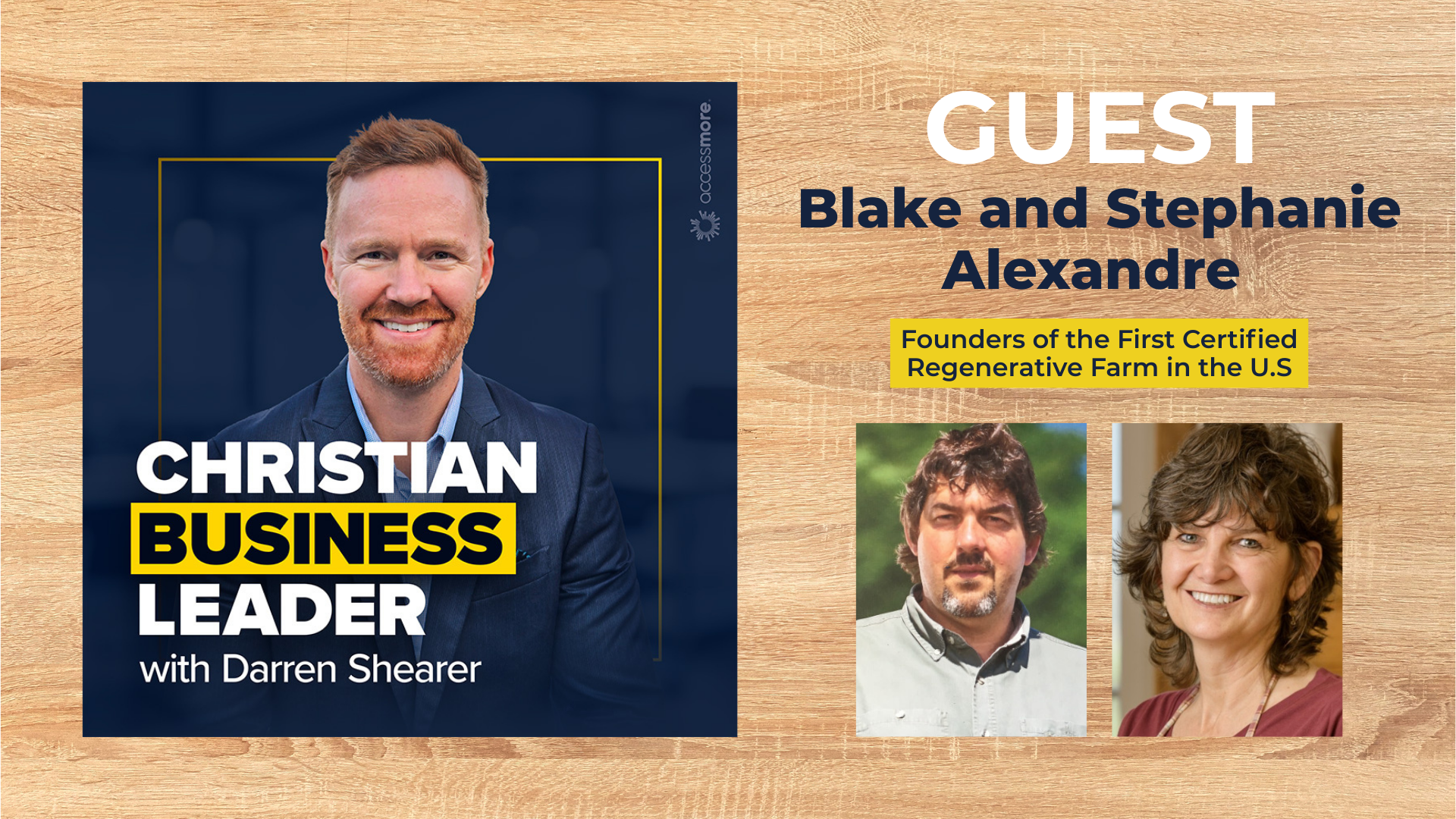
On this episode, Darren sits down with Blake and Stephanie Alexandre (founders of the first certified regenerative farm in the U.S.) to discuss their entrepreneurial journey and Christian business leaders’ God-given responsibility to care for the environment.
Blake and Stephanie Alexandre, fourth-generation dairy farmers and founders of Alexandre Family Farm, share how faith redirected their work after moving to a remote California ranch they believed God called them to steward. Starting with limited resources and facing trials like rising debt and a massive 2001 fire, they learned to trust God for provision while pursuing organic and regenerative practices long before they were common. Through prayer, obedience, and a commitment to caring for land, animals, and people, they built the first certified regenerative dairy in the United States, producing A2/A2 organic milk now sold nationwide. Their farm has become a ministry that shapes employees through character, integrity, and Scripture, proving that business can be both purpose driven and spiritually formative. Rooted in biblical stewardship, the Alexandres demonstrate that when work is surrendered to God, it becomes a means of restoration and a witness to His faithfulness.
Key Takeaways
- Faith at Work – Calling Over Comfort
Blake and Stephanie Alexandre felt led by God to buy a struggling ranch in a poor county, trusting His direction even when family questioned the decision. Their early struggles pushed them into deeper dependence on God as they learned to steward land, animals, and people with purpose. - From Conventional to Regenerative – Obedience Shaped Their Path
Through prayer and a desire to honor God in their work, the Alexandres shifted into organic and regenerative farming long before it was common. That step of faith eventually led to the first certified regenerative dairy in the U.S., showing how God’s strategy often outperforms conventional wisdom. - Building God’s Kingdom Through Business – Discipleship in Daily Work
The Alexandres treat their farm as ministry by praying with employees, modeling integrity, and openly sharing their faith. Their leadership shapes culture, influences lives, and turns everyday work into a platform for discipleship and witness.
Christian Business Leader is the show for marketplace Christians seeking to explore and apply God’s will for business. If you want to learn more about how to do business for the glory of God and shape culture through discipling the business world, this show is for you.
Full Episode Transcript
Heads up: This transcript was created with AI, so you might notice a few typos or small mistakes. We recommend listening to the episode for the best experience!
[00:00:03] Darren: Welcome to the Christian Business Leader podcast, where Christ-following business leaders explore God’s will and ways for business. This show is a ministry of the Center for Christianity and Business at Houston Christian University and features conversations with today’s Christ-centered business leaders who are representing Christ faithfully in the business world. I’m your host, Darren Shearer, and if you want to make your work, leadership, and company’s culture more Christ-centered, you’ve come to the right place. On this episode, we’re joined by Blake and Stephanie Alexander. Blake always knew he would be a dairy farmer. Stephanie prayed she would marry one. Blake studied dairy science at Cal Poly, where he met Stephanie, who studied agricultural business. The couple, fourth-generation dairy farmers, founded Alexander Family Farm in Northern California. The first certified regenerative farm in the United States. Together with their children, a great team, they implemented adaptive rotational grazing, composting, and holistic organic land management on 9,000 acres. We got to thank the cows, too, right?
[00:01:18] Guest: Absolutely!
[00:01:18] Darren: They probably had— were involved in that, right? In fact, their herd of 5,000 organic cows produces A2A2. Am I saying that right? Yes, you are. A2A2 organic dairy products sold in natural food stores across the United States. Some of you know what I’m talking about, probably most of you don’t, but you’re gonna learn. Rooted in faith, the Alexanders feel called to live out biblical principles through stewardship of the land, animals, and people. Blake and Stephanie, welcome to the Christian Business Leader podcast.
[00:01:54] Blake and Stephanie: Thank you. Thanks for having us.
[00:01:56] Darren: When did you first realize God wants to be involved in your work in business?
[00:01:58] Blake: Yeah, great, great question. I, you know, we’ve been married and together for 40 years. We’ve been in business since 1988. And I would say that it was in the early ’90s when we literally bought this ranch and moved north here into Northern California to to start our own farm, really separate and away from our parents on both sides. And as we ventured into this endeavor, you know, we started seeking out organic and unique ways to really identify our farm differently from others. And I think that’s when God really had an influence on the direction that we ultimately take.
[00:02:52] Stephanie: Yeah, when we bought this farm in ’92, it was— we realized as we were trying to buy it, it was the poorest county in California. And our parents were questioning our decision to go this direction. But we really answered them with, “We just felt called to be here. It’s just beautiful here, and no other dairyman really wanted this farm.” So we were able to negotiate a good deal. And we just felt that in our hearts that we had a purpose here. And it didn’t take long for me to come across one of my favorite verses. Now, today, my life verse is Romans 8:28, that we know in all things work together for those who love him and are called according to his purpose. And he just gave us this passion for dairy, gave me a passion from an early age that I wanted to marry a dairyman. That was so important to me because I love cows. And there were like the checkboxes of a man I would date. Kind of thing. Or, and Blake, um, was one of them, and he was the same way, just loved dairies. His license plate said ‘Love Cows’ college, so it was cute.
[00:04:02] Darren: Yeah. So before you bought the farm, did you, did you just always have this sense that God wanted to be involved in your work, or did you— was there a point prior to that where you thought, well, maybe it’s really be a solid Christian, I need to go to seminary, start a church, or do something more of a conventional type of a ministry?
[00:04:28] Stephanie: I think both of us always knew God loved us, Jesus loved us. We both grew up in faith, so we had that. And I think going through trials, you really realize how much you need him when you get on your knees. And that to me was realizing the need for him. But the passion, I think, you start figuring out that when you are passionate about something, it’s really your calling, and your calling is given to you by God.
[00:05:00] Blake: Yeah, I would just add that I’d say in kind of the mid-’90s, as we started stretching our ability, and of course growing our farm and owing money and, you know, employing people and more and more people and being responsible for more animals and more land to steward, you know, we then had to lean on God more and, you know, and pray and listen and hope that we were doing the right thing and look for direction. And so as times got difficult, I would say that’s when we really dug into the concept in the Bible that fruit grows in the valleys. So, it’s the valleys of life. It’s not while you’re up on top pounding on your chest saying, “Gee, we’re good.” It’s when you’re really struggling, and you got to lean on God hard. I think that’s where we get most of our direction.
[00:06:06] Darren:Yeah, and that dependence on God is fairly common among farmers, right? We were talking about this a little bit earlier and how the regenerative farming, that industry, it just sort of— I guess as an outsider, it kind of makes me think of sort of the granola folks that— and A lot of cases are, I would say, more left-leaning, not to get political, but is this what you find that among farmers generally? I mean, it’s hard not— I mean, I saw a live birth of a lamb on a farm one time, and I mean, to see that, it’s hard to not just marvel at God’s power, at God’s creative, and the way that he just holds all things together. And you don’t really miss that when you’ve got 5,000 cows and on 9,000 acres and just seeing just the wonders of God every day.
[00:07:15] Stephanie: You know, that’s very true. When we went organic, and the process started in 1999, and we were like, “Ooh, how do we do this organically? How do we become organic? What do we do here for treatment or whatever? And we went to a conference where the keynote speakers at this conference in the Midwest for agriculture, for farmers, really, was Doctors Making a Difference in People’s Lives by teaching them to go to the farm instead of the pharmacy. And really, that’s when we’re like, wow, we have a purpose. This is purposeful as farmers to make a difference in the food system. And at the same time, animal agriculture was being demonized. And yet I’m going to classes on nutrition where nutrient-dense foods— and nutrient-dense foods are so important to the health of pregnancy, babies, and their growth. And all these processed foods that are out there and all the center shelves versus the perimeter of the grocery store, where the nutrient density is— the milk, meat, and eggs— That’s where nutrient density is. And when that processed food is eaten, it’s displacing the opportunity to give nutrients to children, to babies, to adults, to any of us. And it’s such a purpose to be a farmer in animal agriculture, and where the nutrients lie. And the animal agriculture has been demonized. So again, it comes back to what the Lord called us to do, and that is make a difference in the food system. For nutrient density, healthier foods. And we learned that in 2003 when we went to that conference. And Blake, who’s a cow man, he was a high individual at Madison for college, collegiate dairy cattle judging. He knows cattle, and he knows genetics, and he became passionate about the soil and the pasture grasses and the variety of pasture grasses and what are the deep taproots, and to plant in our pastures and the rotational grazing. And it was just a beautiful thing to see him develop this passion again, because God called him to do that, go that direction. And for me, it was the nutrition. I was in charge of baby calves and, and we had 5 little kids, and it was a struggle. But you just stayed on in that valley. And, and through those times, we would look at each other, and somebody told us once, and I love this, that these are your good old days. Our kids were little, we were struggling in business, and these were the good old days. And God was through there with us through it all.
[00:09:43] Darren: Yeah. What’s a time when you saw God’s hand at work in business?
[00:09:48] Blake: Yeah, I think as we learned first organic principles and management of land stewardship and began to understand the kind of the micro differences between conventional farming that United States is really good at, and of course, what we were taught at college. And then we come into this organic world, which is ultimately a regenerative world, and the understanding, a deep understanding of the soil and how it’s really alive and what it makes and what it’s worth and how it works, really. And so that’s when we learned that we got to farm in harmony with nature and understanding what God’s intention was for soil. And for farmers as stewards of that soil. And then in return, the products and the toil of the soil becomes, like Stephanie says, nutrient-dense or more beneficial for all life—plant life, animals, and then ultimately people. And so I believe that once we understood that part of God’s perfect plan for sequestering carbon and pulling nutrients and nutrition out of the dirt, the sand, silt, and clay of our fields, you know, through those interactions is really when we fully understood that, you know, this perfect plan is— it’s our responsibility to first learn about it, understand it, and then implement it.
[00:11:33] Stephanie: The first, I would say, a good example for me when I really saw God’s hand at work in our lives. I mean, we saw it throughout, we knew it throughout, and it’s always a walk of trust. But we had a huge fire on September 6th, 2001, so 5 days before World Trade Center. And when I say huge, it was a 52,000-square-foot building. It was about an acre big. It was all of our commodities, our equipment, our shop, generator well in this building, and it looked like just a big explosion cloud when it started. It just was instant gone. And a couple weeks or a few weeks after— we had minimal insurance on it. You always think you’re going to lose a corner of a building, not the whole building and all the assets inside. And maybe a month or two later, on a Wednesday, I was just fretting because there was no way we were going to make payroll on Friday. Just no, absolute no way. And I was stressed. I was kind of crying. I just prayed out to God. And Thursday, I got an email from our insurance company, and they found a way to tie the milk barn insurance to that building, and we were able to make payroll and then some. So it was one of those God answered me when I needed it and told me, “You’re gonna be okay.” And we made it through that. And of course, when World Trade Center happened, we were already numb. My parents were in town helping us with the kids and figuring out things, but He was faithful.
[00:13:13] Darren: What a miracle. He’s so kind. And I’ve never heard somebody answer that question, you know, what’s a time when you saw God’s hand at work in business? And say, you know, it was just because everything was just going so well. Yeah, it is always, you know, the— there was a stock market crash and, you know, we were going out of business, had a, you know, our property blew up. I mean, this is just— yeah, it’s amazing how those are the, those are the moments that we’ve if we will allow him, he will reveal himself to us in the most powerful ways. Thank you for sharing that story. Wow. And so everybody was okay? Everybody walked away? Yeah, no one in there, no animals were hurt. Wow. And so, how many team members do you all have?
[00:14:10] Stephanie: We have about 180 when we’re fully engaged. We have about 30 H-2A visa employees that are going home real soon, which is a joy to have them through the summer.
[00:14:21] Blake: So those are temporary work visas from other countries, mostly Mexico. And, you know, 30 of those guys come up for about an 8-month period. And so they’re heading home literally at the end of the week. And then we’ll have 150 full-time all winter.
[00:14:38] Darren: Yeah. So do you actually, Blake, Stephanie, do you all actually cowboy cowgirl up and get out there, you know, like people on Yellowstone? And, um, are y’all driving horses?
[00:14:52] Blake: Okay, here’s the answer with a yes, but it’s slightly different. Okay, well, you know, um, just yesterday I was out. We— I, I carry a clipboard with a group of cows, and I needed to check off about, uh, 30 or 40 of them to, you know, just to get my eyes on them and see, make a plan with them. You know, is it time to keep them or sell them? And, uh, sometimes time to go. And, um, you know, I, I really enjoy, you know, doing that and getting out of the office and, you know, away from Zoom calls and conference calls. And those seem to dominate our day. But, you know, right now we’ve, you know, our, our kids are, are managing the farm in, in different aspects of it. And of course, the people that are involved in that. And then we have a lot of other managers as well that are taking care of our business, uh, kind of from top to bottom. And it still feels good to get out and help where we can and where I can. I was on a bulldozer here for quite a few hours this past week, and on a tractor for a few hours. And so it’s fun to get out and still be a farmer.
[00:16:00] Darren: Yeah, go ahead, Stephanie.
[00:16:03] Stephanie: I like to take walks later in the afternoon around the farm. I have an eye for noticing things where we can just make things better, or ideas and stuff. So I make my list and give it to our daughter, who’s our dairy manager, or talk to the kids about it, nag Blake about it, things like that. I growing up on a dairy farm myself, and I always, like I said, I prayed and married a dairy farmer, but I also knew that I was capable of being a dairy farmer if I didn’t. Yeah. And that was kind of my attitude. But I married somebody that I could respect and love, and we have a great life together. Yeah.
[00:16:41] Darren: One of the things that I believe and talk a lot about on this podcast is that the primary purpose of business is not just to make a profit or to make meaning, but to make disciples. That’s the Great Commission. Is that— what does that look like in your business? Disciple-making?
[00:17:05] Blake: Yeah, I would say in general, it starts with feeding people. I just think of a generic family with a couple of kids across the country eating and consuming healthy meat, milk, and eggs, and dairy products. And so we are now responsible for some of those products across the country. And that’s a really wonderful feeling. And responsibility as well. And so it starts there. I think making disciples out of everybody we come in contact with, I would say it’s first by example, letting them see our faith. And we try to always mention God and Jesus, and, you know, every time we’ve got the microphone, where no matter where it is in the appropriate setting, we pray with our employees, we pray with our friends, we certainly pray at dinner and every meal we can.
[00:18:11] Stephanie: And which includes major retail buyers that come to our farm. We are— we’ve never been ashamed to pray. At our table.
[00:18:22] Blake: Yeah, we hand out little pocket crosses to everyone.
[00:18:28] Darren: Oh, there it is. I love that.
[00:18:29] Blake: Yeah, we always carry them, give them out whenever we have an opportunity, and we always keep a few hundred of them nearby.
[00:18:39] Stephanie: When we’re at a food show, we have a little milk jar with them on the table, and people walk by and notice it and grab one, and we’re able to share our Christian faith and Sometimes they’re like, gosh, I was having such a bad day and you just made my day by giving me that pocket cross. And I said, “Well, can we pray right now? And they’re astounded that they’re at an organic food show and they’re praying with somebody. So other brands know that about us now. So we find friends in the industry that are also Christians, and we just support each other. We smile when we see each other and know that why we’re here and who we do it for.
[00:19:20] Blake: Yeah, I was at our— we’re part of a group called C12. Stands for the Twelve Apostles. At a meeting last week, Thursday. Stephanie couldn’t make it, but I had missed a few meetings. And so the group was really anxious to get an update of, you know, what Alexander Family Farm up to and, you know, how’s the brand doing, those kinds of things. And we meet with a group in Southern Oregon, so they’re not often here at our farm, but they feel very connected to us. And so as we talked and I was explaining to them, you know, the highs and lows and the downs, and I just reminded them that, you know, when I joined or when we joined C12 5 years ago, or so, it was like this wonderful weight off our shoulders. They gave us permission to put God into our employee handbook. God into our, you know, just into our business. And, and, um, you know, don’t be ashamed. And we, we already had Bible verses on our bottles, and they were kind of subtle, and we’re trying to now make that more, more evident. But, you know, it’s just like you’ve got this political correct society working on you every day against you, and, it just felt so good to tell them that, you know, it’s been a year or two since we decided we only want to hire Christians as we move forward in business. And that’s not only, I also don’t believe I can judge everybody. And so we hire and fire based on character, not necessarily Christianity. But I just really think that God’s rewarding us and rewarding our brand for that commitment. And it became obvious that day by the questions that I was getting and answering. And it was certainly one of those moments when I think that God was voting in our favor.
[00:21:21] Darren: You look like you’re getting ready to jump in there, Stephanie. I love joining C12.
[00:21:25] Stephanie: It certainly takes you to a new realm in business on the level of peace I received and trusting the Lord more. I pay the bills, I oversee finance, anything finance and legal stuff, and so I get stressed. And I’ve done a tremendous amount of Bible studies, and sometimes on my own, sometimes in a group. And they’re always— I’m always looking for something that can just walk me through this walk of being in business and growth and debt we’re carrying and things like that. And so it’s really helped me. It’s given me— C12 has given me that peace that’s helped me develop my relationship with the Lord. I’ve always had it, but it just— as you learn more about his words, the story in Kings and 1 Kings and all these prophets before Jesus and their walks in the Old Testament, it was really fun. I think I always concentrate on the new, most of my earlier lives, and then to learn that history has just been a great walk for me.
[00:22:37] Darren: Yes. How would you define the culture of the Alexander Family Farm?
[00:22:44] Stephanie: We’re always working on it.
[00:22:46] Blake: Yeah, yeah. Yeah. Well, we would write a 31-page book. Awesome. Yeah. And it’s our farm family core principles. And it doesn’t mean that everybody’s read it and everybody’s, you know, a firm believer, but it’s It’s the type of thing that Stephanie and I have been working on it for a long while, quite a few years, and we really just kind of got it published this year. And it’s not really a book. It’s just a little pamphlet, really, with 31 principles, you know, how character counts. And then we define character and, you know, just little things. And so the culture here, I would say, is hardworking. Honest, with integrity. And, and, you know, people that don’t share one of those values don’t last long here, and they weed themselves out because they’re uncomfortable.
[00:23:42] Stephanie: Yeah. In this 30, basically, tenets of what we want to have as our core principles, the number one was have faith. Faith in yourself, faith in your In your God-given talents, faith to trust in God’s plan and timing. So that’s the first one. And there’s others too about safety, about humane treatment of animals, about doing the right thing at every turn. And so it’s something we hang up where the employees congregate and have it in English and Spanish. And then we also have a little pocket one that they receive when they’re hired. And we haven’t 100% implemented yet. We just got them printed a few months ago, and we’ve made some changes with our HR to where we want to really have a succinct launch of the whole thing. But we’ve given it to managers, and our plan is that every pay period we change a subject, and at the safety meetings or whatever meetings are had, we would talk about that. Item and just a way of reminding each other of what we stand for, who we are, and what we stand for. And so that’s our goal, to just constantly improve culture and be a team player and things like that.
[00:25:06] Darren: Yeah. And I would say that, and to encourage our listeners, that, you know, if somebody was to ask you, how do you make disciples of Jesus and carry out the Great Commission through your company? That it’s not just from an evangelistic standpoint, of, well, you know, I try to steer conversations toward, you know, about God, about inviting people to church, and, you know, doing what we would think of as evangelistic tactics and methods. But disciple-making is far broader than that. And it is to whatever extent people are conforming to the culture of your organization, which is Christ-centered, they are being conformed to Christ, is, is, is my view, and they might not have even prayed a prayer to accept Christ at that point, because Jesus was discipling his disciples, before they had ever, you know, prayed a prayer of, of salvation. And so it’s getting immersed into a culture, into an atmosphere that is Christ-centered, that ultimately the Holy Spirit uses to lead people to Christ. And so, I mean, if they are more hardworking and have stronger integrity as a result of working in your company, I would say that’s discipleship. It’s not just that they, um, even necessarily started going to church or that they prayed a prayer of salvation, but that they are, they are demonstrating kingdom values and kingdom, uh, kingdom, kingdom habits, really. Is— absolutely agree.
[00:26:58] Blake: And yeah, it makes me think of about 32 years ago when we started a drug testing policy, and we just randomly tested different folks. But I remember one fellow who still works here used it as a reason to quit drinking. And, you know, it’s like he just needed, you know, an excuse to tell his wife or his friends or whatever. And, you know, gave away alcohol at that point. And, you know, 32 years ago, that’s a long time. And so it’s Clearly, yeah, these, these, you know, integrity and character points are an absolute way of discipling folks because, yeah, it leads to, you know, well, God— more godly living.
[00:21:46] Blake:Yeah, I mean, this, this is discipleship. And outside of the workplace, as an adult, where are you going to get that? You know, it’s not going to be— hopefully people are going to church and, you know, hearing you know, having corporate worship, hearing a sermon for 45 minutes to an hour, depending on where you go to church each week. But I mean, the statistics are showing that far fewer people are going to church now than used to, but everybody’s going to work. Everybody’s got to make money. And that’s the opportunity we have as business people to influence them, to cultivate Christ-centered cultures that point people to Jesus, that model the ways of God, the ways of God’s kingdom, which are all embodied in Christ. And we get to make the culture. And every company has a culture, and it’s leading people in the pattern of this world, or it’s leading people in the ways of God, and as followers of The Way. Which is not just a way of doing things, but a person. Jesus, the way, the truth, and the life. But I love the— it sounds like that’s really happening in your organization. Is there, is there a certain person that comes to mind that you’ve kind of seen this play out in their life? You mentioned the guy who, um, gave up drinking as a result of that. That program that was put in place. That’s awesome.
[00:29:23] Blake: Now, there’s actually lots of people that come to mind. Yeah, we’ve got wonderful employees, and we really consider them part of the family and certainly also as friends. And the reason we would call them family is because as we’re raising our 5 kids, we leaned on our employees a lot to entertain a 5-year-old or an 8-year-old or a 10-year-old while they were doing their job, maybe driving a truck, a tractor, or something. And so we realized that that’s when this character counts attitude came, that we’ve got to surround ourselves and our kids with good-character people. And ultimately, good-character people leads to a lot of Christianity and churchgoing. And I would say we did it all more subtly as opposed to this open evangelical, this is how we’re going to do it attitude. And that was just because of who we were at the time and our maturity level. And as we get older, it’s a little more out there and more open. But I’m also thinking of a guy that came to visit us, maybe 4 or 5 years ago, from an African country, and he had written a book called Speak to the Earth. I speak to the Earth. Exactly. And it was all about the concept about God giving us dominion over the, you know, the animals, the birds, the fish, and the creepy crawlers of the Earth. But he also gave us dominion over the Earth. And I don’t hear that spoken about at church very often, or just in conversation, like you have dominion over animals. And so dominion over the Earth is what really hit me as a farmer, because the Earth is truly where absolutely everything comes from. Everything on this planet, everything invented, everything made, it’s coming from earth. The rare minerals in the earth or the soil. And then, you know, and there’s this incredible army of biology making that available either for food or for building or for construction. And, you know, it’s all right there in front of us.
[00:31:37] Stephanie: And God made it all.
[00:31:39] Darren: That’s where food comes from. That’s where you know, God, the way God has set everything up.
[00:31:49] Blake: Let me just put it this way. The sun is the energy of our planet. You know, the sun, you know, created by God. You know, the earth is here turning around daily and floating around the sun, where the energy is coming from the sun, it’s all converted through plants, green living plants through photosynthesis. And then that cycle goes down into the soil and feeds the biology. And it’s literally the fuel that runs our entire world. And that’s a gift from God, of course. I’m just trying to talk about being a responsible steward of that. And trying to have a deeper understanding. That’s all I’m really saying.
[00:32:39] Stephanie: Yeah, in our process of organic regenerative dairy farmers, we are certainly learning more about that biology under the ground. And the more good we do to it, the more we grow that organic matter, we are growing healthier, more volume in our pasture grasses, and that is creating more sustainable business for our cattle and for our pocketbook too. And we’re doing it with biologics and not chemicals. We’re doing it regeneratively to where we’re doing all the good to improve that microbiome biology under the ground. And that’s alive. And it’s like people are starting to understand, I want a healthy gut for my body, and then I’m healthier everywhere. And the soil is the gut for the plant. And as we do more good for that gut for the plant, we’re going to have healthier plants and more vivacious and volume. And that’s productivity. And that’s been doing it with passion that we got from God to learn more about it. Yeah.
[00:33:39] Darren: So, so alexandrefamilyfarm.com is the website, and that’s Alexander, A-L-E-X-A-N-D-R-E, not E-R, family farm.com. What do you want to say about how people can connect and, and, um, start to adopt some of your products?
[00:34:00] Blake:Yeah, I would say that, you know, we talked about a lot of things here, and, and, when you get it right, on the farm and through the animals, then it tastes better. And so our products are, you know, are going to speak for themselves, and they’re going to speak individually to each person that consumes them. And we believe that we’re, you know, doing our, our part in making the healthiest dairy products available that we can possibly do. And so, you know, that— I’m just trying to motivate your folks to understand that there’s more behind the story. And then there’s the story is really what they experience in their house.
[00:34:46] Stephanie: Yeah, we are on Instagram and Facebook, and through our website, you can reach out to contact us. But we love to hear from customers all the time, and excited to meet new customers possibly. And where are our products sold? Yes, we do have a store locator on our website where you can find out where we are in stores.
[00:35:05] Darren: What’s your most popular product?
[00:35:08] Guest: We’re excited about our kefir.
[00:35:10] Blake and Stephanie: It has 300 billion or trillion— 5 trillion living colony-forming units per serving, which is so good for your gut.
[00:35:22] Blake and Stephanie: We’re finding people will reach out and say, “My doctor recommended I take this every day, and now my gut’s so much better.” So it’s super probiotic.
[00:35:30] Blake: Yeah, very, very— I guess it brings a lot of energy, and people that consume it feel better immediately. And, and then, uh, you know, all of our dairy products are more digestible than others, possibly. And, you know, we sell at high-end natural food stores— Whole Foods, Sprouts, those types of stores, natural grocers.
[00:35:54] Darren: Yeah. All right, everybody get into Whole Foods and some of the stores that Blake just mentioned, and also to alexanderfamilyfarm.com. Blake and Stephanie, thank you for the great work you’re doing and reminding us to take better care of this amazing planet God has entrusted to us.
[00:36:14] Blake and Stephanie: Thank you, Darren. Thank you, Darren. We appreciate what you’re doing as well. Yes, love your podcast.
[00:36:19] Darren: Thanks for listening to this episode of the Christian Business Leader. Christian Business Leader podcast. Be sure to subscribe, leave a review, and tune in for the next episode as we continue exploring God’s will and ways for business.
BIG THANKS to this episode’s sponsor: High Bridge Books
High Bridge Books helps Christ-centered authors build a legacy by crafting and publishing messages and stories that glorify God in all spheres of culture.
- High Bridge Books’ professional book publishing package: https://www.highbridgebooks.com/publishing/
- High Bridge Books’ proofreading, line editing, developmental editing, and co-writing services: https://www.highbridgebooks.com/editing-and-proofreading/
- Examples of our books: https://www.highbridgebooks.com/bookstore/
We’re extremely proud that …
- 45% percent of our 204 books under contract were written by authors who have published more than one book with us, and
- 51% percent of our books under contract were referred to us by authors who have previously published with us.
Contact High Bridge Books’ CEO Darren Shearer at [email protected] to get a conversation going about your book!