Helping 600 Franchisors Multiply Virtuous Businesses (w/ Dr. Tom DuFore)
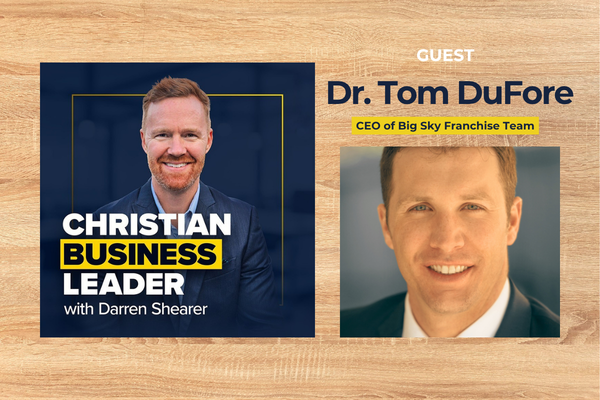
On this episode, we’re joined by Tom DuFore.
Dr. Tom DuFore is the founder & CEO of Big Sky Franchise Team. He is an author, entreprenuer, franchise expert, and host of the “Multiply Your Success” podcast. Big Sky Franchise Team is an award-winning consulting firm specializing in helping growth-minded entrepreneurs franchise their business. Tom and Big Sky have advised more than 600 clients, including Jamba Juice, Two Men & A Truck, Matco Tools, and many others. Tom values building others up, whether it’s an owner looking to franchise their business or members of his team. His leadership focuses on treating people with respect, encouraging them to be their best, and always learning. He seeks to live out his company’s purpose to “Inspire and Foster Greatness” through its three core values: Win-Win Relationships, Professional Excellence, and Continuous Improvement. Tom has an undergraduate degree in business, an MBA, and a DBA. He is happily married with three wonderful children. In his free time, Tom enjoys coaching youth baseball, writing music, and listening to audio books.
Along with Debbie Philpott and Ethan Slaughter, he’s co-author of the new book, Virtuous Business.
Christian Business Leader is the podcast for marketplace Christians seeking to explore and apply God’s will for business for the purpose of cultivating Christ-Centered Companies.
Full Episode Transcript
Heads up: This transcript was created with AI, so you might notice a few typos or small mistakes. We recommend listening to the episode for the best experience!
SPEAKER_00 0:02
Welcome to the Christian Business Leader Podcast, where Christ following business leaders explore God’s will and ways for business. This show is a ministry of the Center for Christianity and Business at Houston Christian University and features conversations with today’s Christ-centered business leaders who are representing Christ faithfully in the business world. I’m your host, Darren Scheer, and if you want to make your work, leadership, and company’s culture more Christ-centered, you’ve come to the right place. On this episode, we’re joined by Tom Dufoe. Dr. Tom Dufour is the founder and CEO of Big Sky Franchise Team. He’s an author, entrepreneur, franchise expert, and host of the Multiply Your Success podcast. Big Sky Franchise Team is an award-winning consulting firm specializing in helping growth-minded entrepreneurs franchise their businesses. Tom and Big Sky have advised more than 600 clients, including John Bajus, two men in a truck, Matt Co. Tools, and many others. He’s got a DBA from Indiana Wesleyan University, home of the virtuous business model. And he’s actually written the book on virtuous business along with Debbie Philpot and Ethan Slaughter. Dr. Tom, welcome to the Christian Business Leader Podcast.
SPEAKER_01 1:24
Darren, thank you so much for having me. It’s really an honor to be here. I’ve been following you for a while. So it’s it’s really a great honor to be here. Appreciate it.
SPEAKER_00 1:32
Yeah, thanks for coming on. When did you first realize God wants to be involved in your work and business?
SPEAKER_01 1:38
That’s a great question. And for me, when I really think back and I reflect back, and I know pre-show, we had some of these uh uh answers that or questions that I thought of. Um, so if I give a different answer, uh I I apologize here. But for me, it’s it I’ve never felt like it’s really been separate. Um, that that’s one thing for me where I’ve always felt like God was always there, but it was whether or not I was ready to accept that as part of my business, if that makes sense, where I kind of compartmentalized sometimes, you know, my my faith and my work. It was kind of like, oh no, well, they’re kind of separate, even though it was always part of what I was doing. I felt like it was part of the work that I was doing. It was just never really externalized in any way, shape, or form. Um, and so uh, you know, I I always um I guess though the I guess that’s that’s really my uh when I think back on it, it it I always felt like God’s presence was has has always been there. Uh, but whether or not I was ready to uh externalize that and and acknowledge the fact that it’s not just you know Sunday morning and in the pews at at church, that it’s uh or at home in my home life with my family, that it’s that it’s part of my uh every day and everything.
SPEAKER_00 3:00
Yeah. And so from what you were telling me, there was a uh great boss that you had who was instrumental in helping you to kind of tear down this this sacred secular divide in in your mind. Um tell us about that.
SPEAKER_01 3:15
Yeah, um, so I was very fortunate. I had a uh an amazing boss, and he was actually a client of mine for a few years and just uh uh just a firm believer. And uh watching him talk, his his business, secular business, people of all different faiths and beliefs and non-beliefs and everything in between. And he always found a way to just uh incorporate his own faith, not in a quote, you know, preachy way, per se, as or as kind of recruiting people, but more as uh an expression. And I I just uh admired him and still admire him and look up to him as a mentor, as an advisor, and just seeing how he’s been able to uh uh externalize his faith and and make sure that it’s uh giving great, giving thanks and praise, um, and recognizing that it’s not just his his own doing, that uh it he’s he’s furthering the kingdom work through what he’s doing and trying to make an impact. And he’s helped so many uh employees and former employees, and uh even opportunities he afforded me when I started my own business. So just his graciousness and uh really he was just a lit uh is and still is a living example of the the hands and feet, uh, really.
SPEAKER_00 4:40
Yeah. Well, that’s that’s discipleship at its finest, right there in the workplace. And so I would imagine, Tom, as you started to do your work without this, that not that it doesn’t still creep in from time to time where we can so easily separate business from our Christian life, um, but your antennas, your spiritual antennas were probably more in tune with what God was doing. Can you tell us about a time when you saw God’s hand at work in your company or in one of the companies that you’ve supported?
SPEAKER_01 5:14
Yeah, uh well, I’ve I’ve seen it when I’m I find it’s a lot easier to see when I’m uh open to seeing. And so uh and uh uh there are several instances, but one in particular that I I specifically recall is when I had uh there there was an issue with a uh collections issue with a longstanding customer. And um I remember feeling so uh frustrated in that moment because it this had just been escalating and and it it had been escalating for a long time. And uh one one morning I was actually at a um at a uh it was a uh business owner’s uh uh basically a business owner’s Bible study group that I was part of for many years. And during that FCCI, you got it. That’s right. Yep, yeah, was was part of FCCI and doing that, and during one of those meetings, whatever the topic was, whatever we were talking about that day, something clicked, and I just said, right, I need to let go, let this, whatever this emotion with this one particular customer, let it just accept it for what it is, put it in God’s hands. And uh I at that moment I said, okay, I you know, I’m going to just uh submit and say, let’s move on and put this, give, put this in in God’s hands. And uh after that meeting, got back to work, got back to checked my email and so on. And uh ironic, not I mean not ironically, I mean really by faith. Uh and uh a prospective customer had messaged over and had said, hey, let’s get a project started. It was for almost the exact same amount that this other customer pre uh owed. And uh it was all and and I know that this is one of those things where it’s like you know, you pray, you let go, it’s like holy cow, there was a an immediate answer. I know that’s uh probably the exception to that, but seeing that alive and actually occur um was one of those moments that that was a uh just one of those moments that will stick with me for the rest of my life. I mean, I just uh at it at that moment said you know, it you know, got down on my hands and knees and just uh praised the Lord and said, uh, you know, just a reminder to say, wait a minute, this this I can’t, I’m not in control, you know, this is not mine. This is uh I’m uh and so anyway, that I may not be articulating that quite well enough here, but just to share that exact story where it was overwhelming to say, wow, and to uh I I thought, wow, so how do I explain this to someone who doesn’t believe, you know, or who doesn’t understand is is it sounds like kind of interesting, but so on a program like yours and speaking to other believers, it it you know, I think people understand it’s it makes sense.
SPEAKER_00 8:06
Yeah, yeah. Especially those for those of us who I mean, if you’ve been in business for for very long, uh or not very long, you have dealt with the need to forgive in business uh when you’ve been made promises that either the the other party could not uphold or would not uphold. And and so, like, how long were you dealing with that term? I would imagine it’s a very emotionally tumultuous and it has been for me uh in those experiences. Um, what was that like?
SPEAKER_01 8:44
Well, the the the issue with the customer had been ongoing for almost two years, and I’d extended lots of grace. Our team, our company had extended lots of grace, and it was kind of on my desk now. And once it gets to my desk and I’m actively involved, it we’re we’re well into well past the point of uh you know, extending lots of grace and understanding and trying to uh uh in many instances renegotiate terms if needed or structure or whatever needs to happen to try to work with the person. We understand things happen in people’s lives and businesses, especially we we work with small businesses. So I have a huge heart for small business and just trying to help in every way uh that that we can. And so in that situation, uh, there was a lot of pent-up just uh emotions, frustration, anger, disappointment. You know, that uh it was a customer that uh had uh we had developed a good, very strong, uh positive working relationship over several years. Um, and so that um uh having that uh sentiment is just something that that day, you know, something I I would pray for regularly, but whatever happened that day, you know, just something finally registered, it’s like got through my thick head and said, and and into my heart that said, no, uh trust the Lord, you know, trust the Lord with this and and accept it, really feel that. And that was the big, big change and transition to really uh uh feel that in my heart and say, wow, uh okay, I have accepted this, and um, and then to have uh uh an uh almost immediate uh uh notification from from the Lord saying, Hey, you did the right thing, you know, you made the right you thing, you know, it’s like hey, you did it, you know, uh the right, right, right decision made there.
SPEAKER_00 10:44
Yeah, yeah. And so just so we understand your business a little bit better, would this have been uh so you’re you’re serving franchisors, right? So you’re helping them to teach them and give them the tools to be able to replicate their business again and again and again, right? So your your business is not you’re not working directly with the franchisees, you’re working with the franchise, and so they would then owe you uh your because they they get their their royalties or franchise fees right from the franchisees, if I understand correctly. And so this was a franchise or that was overdue.
SPEAKER_01 11:24
Yes, that’s right. Yeah, so this was a so our our business, we work primarily with a small to mid-sized business that wants to grow and uh is and franchising is the avenue that they choose to go down, and so we help them launch by preparing things like franchise business plans and manuals and their strategy and structure to go to market and coach them and teach them and train them. And so uh it and turning them into a franchise or so that they can now sell franchises and be in compliance and hopefully build have a solid structure that they can run from over the next run for the next 10 years as they’re launching this this franchise business. That that’s exactly right.
SPEAKER_00 12:08
Yeah, awesome. So you’ve already given us uh a great example of discipleship in the marketplace, which is a theme that I really try to hone in on because that’s really what we’re all called to do is to make disciples. Um, can you give us a specific example of how the culture of your company has positively influenced someone who’s worked there?
SPEAKER_01 12:31
Sure. Um, I I would for for me, the uh uh a couple examples that that stand out uh for me is when uh when I first launched the business, our company values and uh things that were important to me as a leader were not clarified. They were not cleared, they were not communicated. Uh there was uh uh I would say I lumped myself into what a lot of owners do when they launch, which is you just kind of assume that through some version of osmosis, people will know what’s in your mind. And magically, people don’t can’t they don’t know what’s going on in your head. And so a few years into the business, I really clarified our values that really came through um my faith and uh driving these uh values and uh and that that be have become the filters that we use to make decisions at our business. And uh I can give just a couple good examples. One in particular is with a gentleman who’s been with me for oh goodness, seven or eight years now. And when uh he comes uh just as an example, we’ll be on a team call or talking through things, and he is applying this filter. Our number one value at our company is win-win relationships. So we’re saying, where how where is a win-win? And we want to be relational in nature and how we approach uh our business. And so we want to find the win for the client and the win, and and I find myself to be a bit of a, I found myself uh identified that I can be a people pleaser. So I say, well, I have to make sure that I’m also not uh uh uh uh railroaded in at times or uh and and by saying yes, uh right. So making sure that there’s uh uh uh a reciprocal, kind of looking at that through that lens, say, how what how does a rising uh tide lift all boats here? And so uh he he uh this uh employee for for many years, he’s a great employee doing all of the things, and then over the last few years, I see him running this filter and applying this filter through his own life, through his own business, through his own day-to-day activities, and challenging me as the leader to say, hey, uh, how does this how is this uh essentially congruent with our with our company values or what what we find to be important? So, boy, that is a transformation in him where he was he was here prior to these uh uh uh values being instilled and implemented. And so watching the change in him as he’s grown and matured as a professional, and um uh having the uh confidence and comfort level to also then uh challenge me as the the uh founder of the company. So I just think that’s a a great, great little story on on him.
SPEAKER_00 15:22
Yeah, it is. And so on the on the flip side, I I’ll never forget years ago I had uh one of our team members said to me, you know, since I’ve been working here, I feel like I’ve gotten more transactional in my relationships. And that was very sobering to me because that’s not what I’m uh that that’s not what I’m trying to accomplish. Um like one of our one of our authors of a publishing company, uh Ford Taylor, he he says we need to be relational. So the relational, there is a need to be transactional, but also lead with uh with the relational. In fact, uh he called me the other day because we were trying to uh deal with something real quick. And the first thing he said was Darren to have your permission to be uh transactional just for a minute. Uh so he’s very, very sensitive about that. And uh so I had one of my team members uh say that to me, and and I just um realized one, yes, I need to make some change in that in that area, but two, we have such a responsibility as leaders of companies in the cultures that we are cultivating, uh, because even with a super small team like mine, um, you know, that this has even a ripple effect in larger organizations because people are being influenced in oftentimes permanent ways for the rest of their life through the experience that they have working in your company. So um, so you shared a positive example. Can you relate to any uh uh an is there a negative example that comes to mind that you’re maybe not proud of um of of how your your company’s culture has influenced somebody? Sure.
SPEAKER_01 17:14
Yeah. Um so I I would say uh uh from a negative standpoint, one thing that uh I found is that um once we became clear on the values and what’s important and which therefore drove behavior, the types of people who fit in with the organization, I’d say one of the negative or consequences of that was I had longtime people who I worked with and were part of our team that didn’t fit with that culture anymore. And that was really, really hard. That was really hard because I had, by all measures in general, someone who’s a very good team member. They they they’ve done all their work well, and but with this new lens that we were seeing things through, we um this person just didn’t fit. And there were some, it just wasn’t congruent. And so and and uh several people, I should say, and so that transition was really hard because I had connections and relationships, and so we gave opportunities for for people to you know uh adapt to the new structure that was put in place lots of time. And uh eventually for some that weren’t able to move past that, that I would say that one of the negative pieces was that we had to separate, and we just had to say, you know, unfortunately, um, there’s there’s just not a fit for either one of us. And I and normally I found over the years, and separation is just the hardest thing is uh running your own running a company, it’s just it’s the worst. I I I’ve just never uh but uh usually when that separation happens, it’s usually not a fit for that other person, too. You know, it’s it’s not a fit for both in most most instances. Um uh when when something like that happens. So anyway, that that I would say is one uh really um just difficult, challenging, hard time where it it that there were were some negative consequences that it that came out of it.
SPEAKER_00 19:24
Yeah. And so was this was when you were transitioning to the virtuous business model, is that right?
SPEAKER_01 19:30
Yeah, and and really implementing and and getting clear on uh uh these uh values that were important and how we were seen doing business. And part of it, like you had mentioned, was some of the the folks were more transactional versus relational. And uh, you know, there’s you know, two camps to people have different approach, but our approach in mine has in general tended to be more relational in nature first. Um, and of course, you have to in the business, you have to transact, right? Contracts get signed, money gets exchanged, things like that happen, but always trying to understand that the on the other side of that agreement, on the other side of that uh telephone or you know, meeting is another person and trying to really keep that uh keep that focus there.
SPEAKER_00 20:20
Yeah. So tell us about the virtuous business model. I understand this kind of emerged from the business school at Indiana Wesleyan University, which is a wonderful Christian university that is not Christian in name only, but they are really doing the stuff uh to help equip their students with a biblical worldview and uh biblical ways, biblical ways of doing business. And it a lot of it is summed up in the virtuous business model. So what what is it and and what is and I know it’s very robust and we don’t have time to go into all of it, um, but what are the easiest ways to distinguish a virtuous business from the average business?
SPEAKER_01 21:04
Yeah, so in in short, the virtuous business model is a framework that takes a look at is comprised of two main components. The first is the virtuous leader, and then the second is a virtuous organization. And we tend to think that a virtuous organization needs a virtuous leader at the top, helping lead and run that company. And so when we start with, I like to start initially with what’s in the center. So it in our book, when we wrote the book, we the the center of the this framework, there are two triangles in the center of each triangle is is Christ and Christ likeness. And so we uh we’re we’re striving for that as part of the virtuous business model. And one of the things we we ask in our book, and we were gonna have it be one of the last chapters, we moved it more toward the front chapter, an early chapter to discuss what is your center? And so for for For uh Christians, our center is uh, or at least we hope, is following Christ and Christ likeness and pursuing that in uh our day every day. And so that that’s a center, but it but part of it was to open up a discussion for those that are in in a secular setting where maybe we’re in our work setting. And what is someone’s center? If if you don’t know what’s at center, what are what are you tethered to? And so that that’s the the heart of this. So we start uh from a Christian perspective with Christ-likeness. And then the virtuous leader has three elements there’s the professional domain, a personal domain, and a spiritual domain. And the goal or idea behind it is that each one of these three parts we’re trying to apply equal care or consideration to. And so for many of us, myself included, uh, I find at different seasons of my life, I’m focusing maybe more on my professional or more on my personal or more on my spiritual piece. And this is really talking more about uh let’s let’s try to keep it, I don’t want to say balance, but equal attention to each of these to further to develop that that full leader. And then the same applies on the organizational end. And so an organization, it’s interesting to think of a virtuous organization as a uh as a collection of people, but it it talks about the same similar three components. So we have economic capital, social capital, the the relationships between people at the company, co-workers, customers, stakeholders, investors, whomever, and then spiritual capital. And what does that spiritual capital look like? And so some businesses tend to focus on maybe more economic capital or social capital. And this is saying, well, let’s apply uh an equal consideration to each of these. And what are the interpersonal dynamics of the people in the company and work on that? And spiritual capital, uh, you know, for faith, people of faith, it’s a little bit easier to understand, but I always describe it as saying, well, uh, when you you know when you’re in a uh in an environment, if you’ve worked at companies or lead a company where uh the the the values or mission statement or vision statement, there there seems to be an alignment with the people there. And it there’s there’s this uh collective group that said, oh, wait, we’re all rowing in the same direction. Uh or the uh opposite of that, when uh you you maybe you’ve worked at an organization or been a part of a company where uh there’s great mission and vision statements or values, and there’s no congruence. There, that it says, well, that that’s just you know, that that’s just paint on a wall. It doesn’t really mean anything. Um, so uh to uh take a step back on that virtuous business model, those are the two core components, the virtuous leader and a virtuous organization. And so there are nine total virtues for each one of those that we talk about and expand on in the book. And really the purpose of the book is just to get a conversation started. We have over 300 discussion questions and 27 mini essays within it. So it’s easy if someone just you could just read a little essay, two, three, four pages, and then there are 10, 12 discussion questions on each that can just open up a conversation on how this virtue can might be applied with an example and then have a conversation around it.
SPEAKER_00 25:31
Yeah, yeah. And and so you are you equipping your your franchisors with this? Is that is that what’s happening?
SPEAKER_01 25:41
Yeah, so it’s something that uh now with having um something written as a book makes it a lot easier uh to to do some equipping to have a reference point. Uh so there uh that is part of our process that we are starting to integrate into what we’re doing. So um we have um in a in not as direct fashion, but now having the book actually finished and something that we can have tangible and easy to share makes it much, much easier for us to be sharing this information with our with our um uh clients as we’re helping them launch. And uh just in general, uh general coaching philosophy for us with our clients has always been that um it it the franchise or has to be focused on supporting that franchisee, that they really need to be franchisee focused on helping the franchisee achieve their goals, their vision, support to where they want to want to get to. Uh I’ve found over the years, if the franchise or is asking, uh when they stop asking, how can I help my franchisees make more money or get to where they want to go, and they the franchise or starts asking, how can I make more money? That’s where that’s where problems begin. So we like to view that as an overarching theme that we always try that we’ve I’ve coached for years with our clients on, is saying, you know, it’s it’s gotta be focused on helping your franchisees find success for them through your franchise system.
SPEAKER_00 27:15
Yeah. I would think one of the most difficult aspects of that as you’re introducing this to these franchisors that are, I’m sure, coming from all different um areas on the on the faith spectrum, uh, is what is your center? Like you you talked about, that’s that’s uh that’s a critical part. And for us, it’s Christ, right? But for those who Christ is not the center, uh how do you approach that conversation knowing that you are now kind of in a in a sense kind of giving them the keys to go and replicate who they are into these other franchisees?
SPEAKER_01 27:56
Yeah, yeah. I mean, it is a um it’s it’s one of the there’s not a great answer uh to that. It’s one of the big challenges just in general with franchising, even from the standpoint of um keeping the culture that’s made that uh business successful to begin with, how does that culture get replicated? Just from a sense of saying, how do we keep this consistency through throughout so that when you go to pick your favorite local uh um franchise system that that maybe you you’re a regular customer of, how do they how do you keep that company culture alive in a franchise network that might have hundreds or thousands of franchisees and owners that bring their own perspective on an interpretation of those values and uh the virtues that align with it? So uh it is a it is a tall task, but uh our goal and what we’re trying to do is uh help our clients see this and provide a framework where if they don’t have one, that one is readily available and infuse and incorporate some of these guiding principles into into franchising. Because at the end of the day, successful franchising, you it’s not just considering the uh economic end of it, it’s also considering their relationships with their employees and what do those relationships look like and what do the relationships look like with their community? Um, so it’s these are all important factors that that ultimately drive success at the unit in franchise, we say that the unit level for that end franchisee that’s executing the system in the marketplace. So helping them understand that it it provides us a framework now to say, okay, well, it’s not just about driving revenue, it’s building connections and building relationships with your staff, with the community, with others within the in the space. Um, and I think small businesses are uniquely positioned to do it better than most. And it’s why, I in my opinion, why I think when you see surveys that are done by Gallup and some of these others that consistently show small businesses is, if not the number one, it is consistently one of the top most trusted institutions in the country. Uh, and I think part of it is that owners intuitively understand that it’s not building and cultivating uh a real relationship with other people, with their community, with their staff, and so on, also helps drive a culture, also helps drive the revenue uh into their business. And then there are other aspects to that, but uh I think that that uh social capital sometimes uh can can uh uh get overlooked on on that organizational component.
SPEAKER_00 30:48
Yeah. And yeah, it’s interesting. I I think the and I’ve heard that uh about that and how all the the military and you know small business are kind of the two that still have the trust of of people, you know, by and large. Um and I think a lot of that is just the constant exposure that we have to our companies. I mean, we’re working there every day, so it’s it’s not necessarily that the people are better per se. It’s just there’s you have more history, you have more rapport, you have you just know them better. And you know, whereas with what what’s your experience with the government? Well, what I see on TV, you know, with my experience at the DMV, uh, you know, that’s not gonna translate into high levels of of of trust. Um, and and it’s but it’s exciting that even though that a lot of these franchisors might not be Christ-centered, starting their relationship with you and Big Sky franchising, uh, you it’s not as if this is like uh a one-time meeting where they they came to a church service and then they left and they’re never gonna come back. You have this ongoing open line of communication with them where they are looking to you as uh as their guide. And and so, you know, Jesus discipled his disciples over time. It was not uh instant um transformation that they experienced from what I can read in the gospels, and so um you’re you’re in such a uh an important position there, Tom. And um, I want to thank you so much for sharing with our listeners today about the virtual business virtual business, the book, and um and the and the great work that you’re doing for franchisers. And I’m I’m sure there’s somebody is listening who is uh who is currently a franchiser, thinking about franchising their business. And I know they can go to bigskyfranchiseteam.com and also check out the virtual business book on Amazon. Anything else you want to say about how people can connect?
SPEAKER_01 33:04
I would just say uh just thank you so much for the opportunity to be here. And anyone who’s just interested in learning more, they can go to uh about the book specifically. We have free uh download of 10 sample questions. And then we actually have a small group study guide that we give. So if you have if you buy a copy, wherever you buy it from, just we have a second form, you get 20 bonus questions, but then a a guided discussion on how do you lead a study group, or if if maybe you’re gonna do this with a small group or maybe uh a department or a small team at your company, how would I lead that? And uh most of us have been part of this, but haven’t been uh given a structure. So we we provide a free structure. There are no costs for that. It’s just uh if you if you happen to buy a copy of the book, you just fill out a form, say I bought a copy. Uh, we we go on the honor system, uh, by the way. So uh just uh let us know and you’ll get that download. So that’s at virtuousbusinessbook.com. Uh so we’d uh uh that that’s readily available for anyone who tunes in.
SPEAKER_00 34:03
Awesome. All right, virtuousbusinessbook.com. Tom, thanks again for sharing uh your passion and your wisdom with us today. Thanks for having me. Thanks for listening to this episode of the Christian Business Leader Podcast. Be sure to subscribe, leave a review, and tune in for the next episode as we continue exploring God’s will and ways for business.
BIG THANKS to this episode’s sponsor: High Bridge Books
High Bridge Books helps Christ-centered authors build a legacy by crafting and publishing messages and stories that glorify God in all spheres of culture.
- High Bridge Books’ professional book publishing package: https://www.highbridgebooks.com/publishing/
- High Bridge Books’ proofreading, line editing, developmental editing, and co-writing services: https://www.highbridgebooks.com/editing-and-proofreading/
- Examples of our books: https://www.highbridgebooks.com/bookstore/
We’re extremely proud that …
- 43% percent of our 230+ books under contract were written by authors who have published more than one book with us, and
- 49% percent of our books under contract were referred to us by authors who have published with us previously.
Contact High Bridge Books’ CEO Darren Shearer at [email protected] to get a conversation going about your book!