Effective Advertising as a Christian Organization (w/ Dr. Dave Jones)
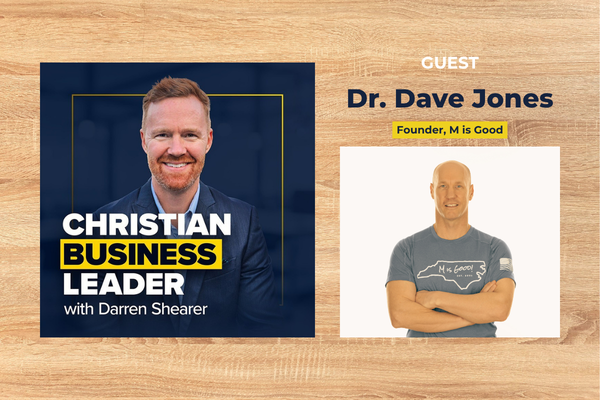
On this episode, we’re joined by Dave Jones.
Dr. Dave Jones founded M is Good, a Christian advertising agency, in 2001. The agency has served over 1,000 ministries worldwide, generating $50 million in revenue and managing roughly $1.7 million in monthly ad spend across 40-50 organizations. A former professional hockey player in Europe, Dave has spent 25 years coaching NHL, NFL, and elite athletes alongside hundreds of executives. He holds a Doctorate in Sport and Performance Psychology. Dr. Dave’s vision is to unify excellence in the marketplace. He lives in Raleigh with his wife Laura and their two children.
He is the author of the brand new book, Plan to Win: How to Manage Your Fear, Lust, Anger, and Pride While Building Your Christian Organization.
Christian Business Leader is the podcast for marketplace Christians seeking to explore and apply God’s will for business for the purpose of cultivating Christ-Centered Companies.
Full Episode Transcript
Heads up: This transcript was created with AI, so you might notice a few typos or small mistakes. We recommend listening to the episode for the best experience!
SPEAKER_03 0:02
Welcome to the Christian Business Leader Podcast, where Christ following business leaders explore God’s will and ways for business. This show is a ministry of the Center for Christianity and Business at Houston Christian University and features conversations with today’s Christ-centered business leaders who are representing Christ faithfully in the business world. I’m your host, Darren Scheer, and if you want to make your work, leadership, and company culture more Christ-centered, you’ve come to the right place. On this episode, we’re joined by Dr. Dave Jones. Dr. Dave founded M is Good, a Christian advertising agency in 2001. The agency has served over a thousand ministries worldwide, generating 50 million in revenue and managing roughly 1.7 million in monthly ad spend across 40 to 50 organizations. He’s a former professional hockey player in Europe and has spent 25 years coaching NHL, NFL, and elite athletes alongside hundreds of executives. He holds a doctorate in sports and performance psychology. His vision is to unify excellence in the marketplace. He lives in Raleigh with his wife Laura and their two children. And he’s the author of the brand new book, Plan to Win: How to Manage Your Fear, Lust, Anger, and Pride while building your Christian organization. Dr. Dave, welcome to the Christian Business Leader Podcast.SPEAKER_00 1:29
Oh man, I’m so excited to be here with you, Darren. Thank you for the invite.SPEAKER_03 1:34
Yeah, we we just found out uh that we had a couple of things in common. Uh, one, that we were both in the Air Force, and two, that we both the Air Force paid for reconstructive nose surgery for both of us. Mine was um from wrestling and yours was from hockey. Tell us what happened.SPEAKER_01 1:54
Um, I was in Kalmazou K-Wing Stadium, and um I think this was back in ’93, and uh, was coming across the blue line and and uh the defenseman had his back to me and uh he turned around to ice the puck because we were he was on a penalty kill and we were on power play, so I was trying to trying to gain possession of the puck. Anyway, he turns around and he takes a slap shot and it just it just I I had a half shield on, but I tried to get out of the way with it, and it just hit me in the nose, and I fell to my knees at the top of the face-off circle, went all the way into the goal line, screaming, my nose is in my brain, my nose is in my brain. The trainer came out with a white towel to put over my nose because every time my heartbeat, blood was just pumping out of my nose. Oh my god, and uh we get over to the bench, and um that white towel was was red. Um they immediately you know took me to the hospital. Um, and so that was that was that was bad. Um yeah, that that was painful. I was I was I was telling this story the other day that that was painful physically, but looking back on it, it was really painful emotionally for me as well, because it really it really kind of uh you know gave me a checkup, um a checkup from the neck up, so to speak, you know, like I would really kind of put things to perspective on what I was doing with my life. And at the time I was, you know, not glorifying the Lord with my talents and abilities, you know. And so it really gave me a time to be humbled.SPEAKER_03 3:26
Yeah, so you weren’t a Christian at this point?SPEAKER_01 3:29
I received Jesus as my Lord and Savior when I was 16. Um, but I really wasn’t a practicing Christian at that point. Um, you know, I was the seed was there, but I wasn’t really, you know, wasn’t wasn’t doing anything to chase the Lord. Um and so this was the first time I said, okay, this is you know, like I gotta do something different here, you know, like I gotta I gotta change my ways.SPEAKER_03 3:53
And so your your ultra empathetic coach walked into the hospital and and basically said, uh pack your stuff, we’re out of here. Not uh how you doing?SPEAKER_01 4:06
Like, yeah, so let’s go.SPEAKER_03 4:08
What was that like?SPEAKER_01 4:09
I still have my I still have my equipment on. I can still see myself when I tell this story. Like I had my equipment on, you know, my jersey on. There’s still blood, you know, everywhere. And um, you know, we lost the game, so he’s you know, he said, Let’s go and get on the bus and from Kalamazoo to Cleveland. You know, I think that’s a two-hour drive. I could have looked that up actually. Um, I think it was a two-hour drive. But anyway, so like nobody really said anything to me when I got on the bus. And I was just kind of there, and then it was probably you know a good hour or so into it. One of my you know, teammates came up to me and said, Hey man, you okay? That was brutal. And so I I really kind of thought that at that time that you know I had my brothers in arms, you know, like like I was battling for something, and we were doing this together as a team, but I realized very quickly that we weren’t that I was alone.SPEAKER_03 5:02
Yeah, yeah. Uh that is awful. Um and um, I mean, just not only physically but emotionally, but you got everything reconstructed and um you’re looking good today, and you walked away with some some hard lessons from that. Um, but but let’s fast forward a little bit. When did you first realize God wants to be involved in your work in business?SPEAKER_01 5:30
So after I was in a real unique situation in the Air Force playing pro hockey, we could talk about that if you want, but when I left um when I left Germany, started working in the workforce. I went to work at uh WKFT TV40 in Raleigh, North Carolina. And again, it was one of those moments where, like, Lord, um, will you use me? And what came back was, are you usable? And you know, that was another humbling moment where it was like, okay, I need to I need to be usable. I was I prayed a prayer right there at my desk, and I saw myself with a list of all the Christian clients on the TV station. I thought, I’ll start an ad agency, what do I call it? And um immediately, I didn’t hear an audible voice, but I, you know, I immediately heard, you know, marketing ministries. And um, I thought that was a dumb name. Uh, I didn’t know what I was doing, but I so I got a lawyer and the lawyer said, No, marketing ministry is available. And so from then on I started the company and went to those 30 clients. I said, Hey, I’m gonna start a Christian ad agency, will you be with me? And um, you know, they said, Yeah, we’re with you. So that was in November 2001. I ended up leaving in 2002, January, went back to those clients and said, Hey, I did it. I left my job. I started this Christian agency. Are you with me? And they said, What?SPEAKER_00 6:49
No, no, we’re not with you.SPEAKER_01 6:50
And so three of those clients are still with me today, but um, you know, I had to I had to build the agency, and it was it was a five-year grind, um, you know, to get it to the point where I could actually, you know, take a take a paycheck.SPEAKER_03 7:06
Yeah, and so you had already been through some disappointment with guys that you thought were on your team, guys that thought were in your corner being there for you, that um turns out not so much, and then going into business, also coming in contact with that dark side of human nature. Um and that I I think what most people feel to some to some degree that uh the people that you think are on your team until it really comes down to until the pressure is on, you really don’t quite know. Um but but you did it anyway.SPEAKER_01 7:49
Yeah, I think this is really kind of what’s led me to write this book, Plan to Win, because I’ve realized that you know having your identity in people, power, and possessions is something that’s you know, just there it’s just not a good identity, yeah. But having your identity in, you know, the Lord, you know, and and understanding that you’re you are trying to glorify Him with your talents and your abilities. And so what are these things that get in the way of us? And for me, for the longest time, it was probably a mixture of fear and lust, and not necessarily lust in a pornography way. That wasn’t my struggle. My struggle is with you know, possessions, you know, a house, a car, maybe a faster car, you know, um, just going after things that are just you know what the world would say you’re successful. And so I’ve looked at these as toxic motivators in my studies. I’ve I’ve found these toxic motivators of fear, lust, anger, pride that drive us, and they drive the world we live in today. And so, you know, being able to recognize those and say, you know what, I’m not gonna give in to this fear, this pride, this anger. I want to figure out or be aware that I need to glorify the Lord with my talents and my abilities, not necessarily with my possessions, my power, or the or you know, look for affirmation through people.SPEAKER_03 9:15
Yeah. That question that I just asked, when did you first realize God wants to be involved in your work and business? Our listeners will know that I’ve asked that to pretty much every guest over the last at least hundred plus episodes. And I and I asked that to people offline as well. And there was a guy not long ago that was at a workshop that I was teaching on the Christ in her company, and this question was asked at the round tables, and his response was that after he thought about it for a bit, he realized that it was when the Lord delivered him from lust that he was able to partner with God in business. Because prior to that, just that that obsession with with looking at women in uh in an ungodly way that he wasn’t married to was totally distracting him from any sense of God’s purpose for for his role there in the marketplace. And and and and I think the same is true. We’ve in different ways we’ve had uh we’ve had responses to that question where people would say it was when God delivered me from greed, to where it wasn’t just about accumulation of possessions and power, that I was able to recognize that what I’m doing in the business world is not about me, it’s ultimately about Christ. Yeah, yeah.SPEAKER_01 10:48
And that’s where for me, when I prayed that prayer, and I, you know, I heard the name marketing ministries, I had just decided I wasn’t gonna do this with my own ideas because up to this point it hadn’t really worked, you know. And so I’m like, I’m done with that. That’s you know, try, fail, and adjust, right? And so that’s kind of what motivated me to say, okay, I am with the Lord, and we’re gonna do this his way, as best to my ability as possible. And that’s been a 25-year journey now.SPEAKER_03 11:19
Yeah. So what’s one of your favorite stories that illustrates the impact being made through your company?SPEAKER_01 11:26
I think you know, we get one to two leads a week from around the world of men and women of God that have a vision from the Lord. And I think we’ve been able to, I don’t think I know we’ve been able to impact over the last, I would say, probably 15 years. The company’s 25 years old. I would say the 15 years it really kind of figured it out that no matter what that vision is, we’re gonna try our to our best of our ability because we’re trying to glorify him with our talents and our abilities to have that vision become a reality. And so I’ve got lots of very successful stories financially, but also spiritually, that I can bring in. But I would just say when you’re really focused on helping others, like that’s a success, right? And other people that you know, I I really whether it’s true or not, sometimes I think there’s some degree of manipulation in that vision that people have, but for the most part, I’ve always taken that as they got that from the Lord, and we need to take it as a gift, yeah, very special for the rest of the world to see.SPEAKER_03 12:34
Yeah. Is there a particular client or story that comes to mind?SPEAKER_01 12:38
Yeah. Um first one that comes to mind is is an organization called Hope Rains. Uh Hope Rains, you know, it’s like rain on a not rain, like R-A-I-N-S, like rains on a horse. They have um they have a special farm where they rescue horses, and um they tell the story of the horses to troubled um teenagers. Um, and that in that story is is uh therapy.unknown 13:08
Yeah.SPEAKER_01 13:08
It’s called equestrian therapy, and it’s super powerful. And um, we were going through um a process where we were really challenging their vision, mission, core values, and we were able to rewrite those for them. We’re in a time where like it was really just providential, man, because like they were at a they were on a farm where they were renting the property, and the the landlord came and said, Hey, we’re not gonna be able to rent this to you. You’re gonna have to pack up and leave in the next you know four or five months. And as we’re going through this process of rewriting their vision, mission, core values, they needed that that messaging to communicate to donors. And it just came at the right time where there were donors, enough donors that fell in love with that messaging that they raised a lot of money to be able to get off that farm and buy their own farm. And it was down the street and twice as good as what it was where they were previously at. So that one really sticks with me because years later, in fact, I’ve got on my cell phone four or five years later, they still call me and go, You can’t believe this. We communicating our vision, and this is what’s happening. Like the ministry is growing, you know. Um, so that’s that’s one uh success story. Um, another one is Upward Sports. I don’t know if you’re familiar with Upward, you know, we’re the we’re the ad agency for them. And over the last, this is I think our fourth year, we’ve been able to just really understand messaging and and how that church administrator does sports ministry outreach and uh being able to connect with thousands of churches on a prospecting marketing perspective and being able to bring them in. And um, they have an awesome like onboarding team and upward, but uh being able to create those top-of-the-funnel impressions so that you know other churches know that that this is um in the marketplace and be able to you know bring that sports mini out ministry outreach to their church has been hugely successful on our end um of of being able to reach those people with a digital marketing campaign. So that all comes down to messaging, you know, and communication.SPEAKER_03 15:17
Yeah. So what percentage of your clients are for-profit? What percentage are churches, and then what percentage are kind of other out of the 40 some clients?SPEAKER_01 15:27
I don’t know, it’s probably 60, 40 nonprofit and 40% for-profit Christian business owners who have a for-profit, you know, organization kind of thing.SPEAKER_03 15:38
Yeah, yeah. Uh Dave, what’s one of the business practices that helps your company reflect the character and ways of God?SPEAKER_01 15:46
Um, I would say that we, you know, I’ve been doing this again for 25 years. Every morning we have a blitz, and that blitz at 940 uh entails us asking, you know, good news, either personal and professional. We go around the room of, you know, kind of what we’re working on for the day, and then we do a devotional, we do a daily devo, and um usually our daily bread. Um we mix it up every now and then, but the ODB, and then we pray for each other every morning.SPEAKER_03 16:19
Awesome.SPEAKER_01 16:20
Yeah, for 25 years. It’s kind of crazy to think about that. I do that every morning, every morning for 25 years, and we we had one employee years ago say, you know, it kind of breaks up my day. Can can we not do the blitz? And they didn’t they didn’t last long in our company, so we’re doing the blitz, man. You know, we’re we’re praying for each other.SPEAKER_03 16:41
So yeah, what kind of fruit have you seen come from that?SPEAKER_01 16:45
Anytime somebody works for me, I always say, you know, I you know, as you come in, I I pray that you would be, you know, um you would learn a skill, you know, like your your skill set would grow. Like that’s important to me. We are we are very agile, and um, you know, so the skill set and your growth and that’s important, but also your spiritual walk would be important. Like if you leave here, you know, knowing more about Christianity and being a better Christian, I’m not your judge, obviously. But you know, that’s kind of my goal with with employees that they’d be better off um, you know, on their skill set and their spiritual walk.SPEAKER_03 17:22
Yeah, and so you’re finding that to be the case? Like, do you have a sense that the Great Commission making disciples is happening through your company?SPEAKER_01 17:33
Oh yeah, one thousand one thousand percent. Yeah, yeah.SPEAKER_03 17:36
Yeah. Is there what what would be some evidence that you would point to?SPEAKER_01 17:41
Um, I would say that you know, people who received Jesus as their Lord and Savior. I’d say that, you know, if you were to talk to them, I’ve I’ve talked to employees years later, that um, you know, that their their time at M is good was a really amazing time to to learn about the Lord, you know, and know that it wasn’t a religion, you know, it’s more of a relationship. So I I would say that the fruits of the spirit with past employees would be a good testimony to that.SPEAKER_03 18:09
Yes. Yeah, that’s one of the questions that I’m I’m uh starting to dig into more is what kind of people are companies producing? So as uh and I I feel like it’s a a very understudied uh part of social psychology, uh, because you know we can tell that uh people have mental health challenges at their workplace because of their workplace in in most cases. Um but what is the long-term impact on those people years after they’ve left and gone on to maybe work at another company or start their own company? How are they different as a result of having worked at our companies?SPEAKER_01 18:57
Yeah, you know, I I’ve I’ve over the years I’ve let people go because it’s just not working. And I’ve been I’ve been you know, it’s hard on both ends of you know, somebody getting fired or you firing somebody. But you know what? If you know, I I read a statistic with Gallup once that you’re gonna spend 88,000 hours at work. And so my point of that is if if we’re not if if you’re not seeing fruit from what you’re doing, then you need to move on. If this is a struggle, right? And I we have struggle at workplace. I I’m not saying there’s no struggle, but I’m just saying, like, if this isn’t a good fit, we need to let you go so you can go find where you’re supposed to be. You know, that’s way more important to me. Um that, you know, because I I I want to champion the person and the client that, you know, when they die, they hear the words well done, good and faithful servant. I want to hear those words, you know, and so I want to be in the right place.SPEAKER_03 19:53
Yes.SPEAKER_01 19:53
And so um, you know, I don’t I don’t want to enable people to be in the wrong place for something as trivial as, you know, doing a you know, whatever we’re doing, and that was good, you know.SPEAKER_03 20:05
Yes, yes. Well, Dr. Dave, one of the quotes that that I love, I I think it’s so it’s it’s such been my experience as well as pretty much any other marketers, advertisers. I’m sure you could relate to it. You probably know it, but it’s it’s from a great man of God named John Wanamaker who said half of my advertising budget is wasted. I just don’t know which half. Uh so how do we how do we avoid wasting money on advertising, uh, particularly in light of the fact that I I think if if I speak for a lot of people, I’m not even really googling things anymore. I’m just I’m I’m going to AI and I’m asking it. And yeah, it’s it’ll give you the references if you want to click over and go read more from the particular website or or that sort of thing. But you you talk about SEO versus AEO. Tell us about that shift and how we can stop wasting money on our advertising going into this AI revolution.SPEAKER_01 21:10
Yeah. So a couple of things before I answer the question. Um, I do want to say that you know, your ad spend or your overall marketing is always in toddler mode. You have to look at it that way. You know, for those out there that have had kids, you know, toddler mode to me is, you know, it’s a Tommy touch-all stage where Tommy’s just touching everything, flipping over things. And as a parent, you gotta watch because they may grab something and poke themselves in the eye or something, you know, or trip down the stairs. And so you you really got to watch your marketing like a toddler all the time. You cannot set it and forget it. It’s just the world we live in now. I would say 20 years ago, when we’re buying television and radio, or you buy a television campaign and you just like buy it, and hopefully the cash register rings. You know, kind of thing. You know, the broadcast media days are over. They’re long gone. And so, you know, finding somebody who understands analytics is super important to your organization. Like you you have to you have to look at the analytics, you have to know what they say, and then you have to know you know how to read them, sorry, and then you gotta kind of have somebody that says, okay, based on this analytics, we gotta we gotta shift. And so I I you know, we look at stuff every week for clients, every week, um, and sometimes daily, because you just have to pay attention to the analytics. And so one thing that’s happening now is we’re going from an SEO revolution to an AEO revolution. This is a seismic shift in the marketplace that is happening. People are still going to Google and looking for search results. But what’s really happening is as we discussed prior to the podcast here, is people are going to Claude and chat and just asking for the answers.SPEAKER_03 23:00
Yeah. And people have always gone to Google to search for things since Google’s been in existence, but but now even Google, the first search result is Gemini, right? It’s Gemini. And we know that the first result gets the lion’s share of the clicks, and so even Google is is kind of people off of their entire business model.SPEAKER_01 23:28
Yeah, I kind of feel like Google Google is more is getting in the Kodak space. Do you remember Kodak? Yeah when like like they were everything cameras and film and paper, and like there was nothing gonna take down Kodak. Yeah, right. Um, I feel like Google’s getting into that realm right now, and people can call me crazy for that. But a AI is taking over, and who really uses Gemini? We’re using Claude and chat, you know.SPEAKER_03 23:56
I was just looking it up. I saw that I in fact I just looked it up earlier today in another conversation that chat has chat GBT has 46% of the market share, and Gemini has like 24%, and then the rest have like 10 and below.SPEAKER_01 24:18
Um I it could be, I don’t know. I mean, I don’t use I don’t use Gemini. I mean, I use Gemini for notes. Maybe that’s what they’re referring to, but I just don’t go to you know, me personally, I don’t I don’t use Gemini, I go to Claude or chat.SPEAKER_03 24:32
It’s hard to believe that that uh Gemini doesn’t win the day considering yeah Google’s entire uh focus has been to organize the world’s information over the last you know three years.SPEAKER_01 24:46
That’s what I’m saying. Like it’s it’s a it’s a it’s a seismic move. Yeah and we’re not looking to Google for that anymore. You know, we’re looking for you know chat and claude to do it. And I don’t know behind closed doors who’s spending the most amount of money on this, but I don’t really hear about Google being there, you know. Maybe they are, but um, as a marketer, as a Christian business owner trying to optimize this, it’s something to pay attention to. And which brings me to another point. You know, for most of the Christian organizations that we’ve marketed over the years, we’ve had some really big clients and we’ve had some really small ones and everything in between. For the most part, I would just say that the Christian organizations don’t have the competing money like like Geico, who has you know two to three hundred million dollars to spend on marketing. We just don’t have that. And so, you know, we we as Christians have to be strategic in finding the tip of the spear in our messaging. It’s the only way to cut through the noise. Yes, you can spend money and you know, kind of bully people, because that’s what you know I think that you know, Geico does is they just they hit you with so many impressions over and over and over and over again that it’s just it’s just brainwashing. Um we typically don’t have that kind of money, so we have to find the heroes and villains in our stories, and we have to like drive that messaging hard in order to rise above the noise. And when I say hero villains, what I’m talking about, like like an example would be um, you know, in COVID, you know, the the villain was isolation and the hero was community. Now, during the time Google actually shut us down using the word church, they said that that was that was uh hate speech. So we had to switch, we had to pivot to community. So isolation villain, community, hero. And so you gotta kind of figure out what that juxtaposition is for your organization and drive that messaging into the the culture of who’s buying your product or you know, making a donation.SPEAKER_03 27:00
Yeah. So we’re shifting from SEO search engine optimization, which is kind of your traditional Google search, to AEO, which is answer engine optimization. Right. So how how do we how do we succeed? How do we position our messages and our content to to get used and discovered to where uh they’re they’re discovered it’s drawing them into our organizations and our our communities and messages more deeply than just them seeing it as oh, this is this is chat GPT, that this is the source to where yeah, yeah.SPEAKER_01 27:48
So there’s there’s like 20 different things that we should be doing. I’ll just get into a couple of them here. You know, one, you gotta understand who you’re talking to. Okay, this is super important. So finding that person, and I just had a call this morning saying, Well, can’t we talk to two people? And I’m like, Well, you can talk to two people, but if you’re talking to Darren, who loves playing the guitar, right? You might be interested in drums, but really you’re interested in the guitar, right? You know, you can talk to Darren about singing in microphones, but guitar, you know, is it so if we talk to Darren about how to play guitar and everything about guitars, we’re more likely that he’s gonna read it and he’s gonna engage in it. So now we have to we have to know Darren’s persona and his interests, and we have to build that profile so we know what the pain points are and talk to him in that. And so now there are questions that come out of that. So one of the things is people ask a question well, what kind of question would Darren be asking about a guitar? So now we build that that carousel of of FAQ bank and we optimize that so that the AI can pull from that. That’s just one of the tricks that we gotta do. But the first thing is you gotta understand who you’re talking to. And so, like for me, if you want to talk sports with me, I’m moderately interested. But if you want to talk hockey, same thing with the guitar analogy, right? Then you’re gonna get me if you want to talk hockey. But you know, football, baseball, basketball, I don’t really care. So really just understand who you’re talking to is the first thing, and build your content around that. So your website, your FAQs, your emails, your social media posts, your engagement, your culture, you know, your your employees. This is who we’re talking to.SPEAKER_03 29:42
Yeah. So like how are the how are the how is the search shifting as far as like what people are typing in to find that’s gonna bring them to a company? So now it’s not just you go Google, like what um what’s what’s a good organization on um this particular this particular issue, you know, like horse, horse therapy. Um and then they’re gonna see the first page’s search results, they’re not even gonna look past the first or second, but now they’re going to chat GPT and they’re saying, what organization is doing this that I can go and support? And they’re probably gonna just port it, put it more in a conversational format, right? And say this is the organization that’s really doing this well.SPEAKER_01 30:36
So in this case, I would say, like, all right, horse therapy in Asheville, North Carolina. What’s the best horse therapy for ash in Asheville, right? So that that would be something that we’d have to look for. We also have some other tools that we use to to pull out what the questions might be. So we use like SCM rush um to basically say, okay, what questions are people asking in this geo? Right? But let’s just use let’s just use horse therapy Asheville, the best horse therapy in Asheville for my troubled teens. With what is it? And that answer is gonna kick out, right? So now on the website, we have to basically write copy around those keywords. We have to build an FAQ around those keywords. Our emails got to be around those keywords. Our reviews, we have to, you know, be strategic. And hey, if we’re gonna do a review, could you could you could you create content around why you think this is the best horror horse therapy in Asheville?SPEAKER_03 31:41
Yeah. So it’s it’s not just about stuffing keywords on the on the home page. It’s you need a FAQ where you can um where you can type in where where it’s gonna mimic the exact ways that people are phrasing their questions in chat GPT or quad or whatever it is.SPEAKER_01 32:05
Yeah, or yeah, whatever, Gemini. And so so yeah, so understanding that’s just one, that’s just one question.SPEAKER_02 32:12
Yeah.SPEAKER_01 32:13
Right? Um, because inside that therapy, there’s probably some very specific therapy that you’re looking for. Again, I gotta know Darren. Right? I gotta know Darren and and and kind of understand that. And so there’s probably 50 different FAQs that you can build, build out, um, and use those keywords for the optimization.SPEAKER_03 32:34
What is the role of creating like in chat GPT? What is the role of creating your own G custom GPT in the way that that could potentially inform the the the broader chat GPT and kind of position you and your your content in uh a more favorable position?SPEAKER_01 32:58
I would probably not be the the expert on that, but now you’re talking about deploying agents for that specific reason and you know getting into that, which is a really good idea.SPEAKER_03 33:11
Yeah, we actually just um and and if people are interested, email me uh Darren at hybridmedia.com. We created a Christian business leader ai through chat GPT, and it is informed on all of my content, all of the past episodes of of the Christian business leader podcast in all of its various forms over the last 10 years. Um and my books, articles, just dumped it all in there and and am now training it. So if you have if you have questions, ethical questions on business that that you want answers to, give this a try. Um, we’ll put a link to it on the website here pretty soon. But but if that’s really interesting to you, um go ahead and email me or contact me through the website. Um but um it it seems like it would it would be the kind of thing that would would um make the AI know that this is this is content that I should prioritize more than than others, and maybe I’m not fully understanding how the AI works, but in a sense, kind of we’re all training chat GPT, right? It’s not just one central um, you know, kind of wizard of oz situation, but it’s it’s all of us, every bit, every article that we upload to chat GPT, you know, like a custom GPT or or transcript from a podcast episode is now training the AI, right?SPEAKER_01 34:55
Yeah, I would think about it a little bit more granular than that. So remember, I was talking about how broadcast media is dead, right? ABC, MBC, CBS, all these are dead. So, you know, it used to be in the 60s that you know eight is enough, and you know, these these TV stations are just feeding this as programming. But with AI now, you could be as granular as you want. So it becomes what kind of in all of your content, Darren, what content is the most powerful that will resonate with that business owner and what they’re struggling with specifically? So, like for instance, I think I saw your chapter one was on core values. So is there enough business, Christian business owners, or maybe they’re not even have a Christian organization, maybe they’re a Christian, so what you have to kind of figure out is maybe they’re a Christian leading a secular business that are struggling with the core values of a secular company and want to change those values to be a Christian. So now you build the you to be more Christian ease, you know. So now you you take that content and say, if you’re struggling with your core values while you’re working at a secular business and you’re a Christian, here’s the here are some sample messaging you can pull from.SPEAKER_03 36:16
Yeah.SPEAKER_01 36:17
Now now you’re delivering a solution, not necessarily, hey, go there and you know, just type in whatever you want. That those days are over.SPEAKER_03 36:27
Yeah.SPEAKER_01 36:28
So that’s what I’m saying. Like when you really understand your audience and what specifically Darren is struggling with with the guitar, like and and how to play the guitar, maybe it’s a bad analogy. But now, because there’s probably some songs that you struggle with because they’re multiple chords, I don’t know. But like, you know, asking the very specific detail, there’s usually an audience for that, and there’s impact for that granular issue.SPEAKER_03 36:56
Right.SPEAKER_01 36:57
Does that make sense?SPEAKER_03 36:58
Yeah, yeah. Uh I I think what would be ideal would not be just uploading like an entire book manuscript or a podcast transcript, but like an actual list of questions that people would likely be typing into Chat GPT with those those curated responses. Of course, that’s the time-consuming part, right? That uh that the AI is really good at uh being able to do. Um, you know, we have uh one of my team members is in Nigeria and is going to be teaching a workshop here in a couple of days to uh eight to 16-year-olds on on um Christ centered business. And um, and so we just asked it, you know, how what would be the best way to to to teach Nigerian youth uh about biblical entrepreneurship? And and and we told it to it’s been it’s been trained to make sure that it’s pulling responses to that to those questions from these podcast interviews. And so it was just amazing and a blast from the past to like see all that it pulled out of these 300 plus conversations that I’ve had with folks like you, um, where they’re talking about the um the things that God inspired them to do at age nine, age 10, uh as as entrepreneurs. And so it would take me forever to go back and to do that, you know what I mean?SPEAKER_01 38:43
Yeah, but see, so that’s a very specific need, and that’s where I think AI shines. Yeah, and that’s that’s beautiful, man. Like to figure out what 18, 16-year-old Nigerian uh teenagers or preteens are struggling with, and how do biblical values, how does big biblical entrepreneurship fill those those struggles? Yeah, what specific topics should we be talking about? Like that’s gold.SPEAKER_03 39:11
Yeah, yeah, yeah. And we’re excited to be able to make a difference in in Nigeria, which as I understand it now, most of the martyrs. I think I I just heard 90 percent the American Center for Law and Justice just said that 90 of their martyrs are in Nigeria today. Um, it’s it’s just it’s so sad. And and what’s going on over there, and and they’re they have a Muslim president and vice president for the first time, and uh they are just turning a blind eye to what the the Muslims are doing, particularly in the north part of the of the country. So um a bit of a side note here, but y’all pray for for Nigeria and this event is coming up here pretty soon. Um so Dr. Dave, uh this is uh this has been really uh really fascinating. Um how do you balance your so you’re you’re doing high performance coaching for high performance athletes, um, and at the same time you are helping Christian organizations with with their marketing. Kind of how do you how do you balance all of that?SPEAKER_01 40:25
Um well, I mean, it’s it’s it’s kind of simple in my mind. I mean, I go to work with MIG from 8 30, well, eight, yeah, 8 30 to 4 or 5 o’clock. And then, you know, I have my athletes in the evening. I usually do Mondays and Thursdays with athletes and um yeah, and play golf on Wednesdays.SPEAKER_03 40:47
That’s awesome.SPEAKER_01 40:48
Yeah, yeah.SPEAKER_03 40:49
What are you seeing God doing through these athletes?SPEAKER_01 40:52
Um, you know, I I’ve sort of put myself in a place where I I specifically worked with Christian hockey players, and so um that’s just where where I just shine well, you know. Um, and I and I think there is outside of the Christian space, I think there’s an identity crisis that we have um where we’re really seeking other things besides glorifying the Lord with our talents and our abilities, and so you know, the world is set up for performance-related identity. Um, and so I think what I see when I’m coaching athletes is you know, how do we navigate this identity in Christ versus identity with the world? And so that’s um that’s a lot of peaks and valleys that are happening there. And so I I look at it mentally, emotionally, physically, and spiritually, and sort of we we walk down that path. And then um, you know, the book Plan to Win really highlights these toxic motivators, so I mix those in as well. Um, you know, we all struggle with at least two of these every single day the fear, lust, anger, pride. And so um, and so uh, you know, navigating that is also a challenge for all of us, not just athletes.SPEAKER_03 42:09
Yes. Plan to win, how to manage your fear, lust, anger, and pride while building your Christian organization is the new book or manage your flap. Um, there we go. Easy way to remember that. Um, and you can go to plantowintoday.com and take an assessment and uh also link to the book as well there. Um, Dr. Dave, uh, this has been a fascinating conversation. I’ve really enjoyed getting to know you a little bit here today. Yeah, likewise. Appreciate you spending time with us. Thank you. Thanks for listening to this episode of the Christian Business Leader Podcast. Be sure to subscribe, leave a review, and tune in for the next episode as we continue exploring God’s will and ways for business.
BIG THANKS to this episode’s sponsor: High Bridge Books
High Bridge Books helps Christ-centered authors build a legacy by crafting and publishing messages and stories that glorify God in all spheres of culture.
- High Bridge Books’ professional book publishing package: https://www.highbridgebooks.com/publishing/
- High Bridge Books’ proofreading, line editing, developmental editing, and co-writing services: https://www.highbridgebooks.com/editing-and-proofreading/
- Examples of our books: https://www.highbridgebooks.com/bookstore/
We’re extremely proud that …
- 43% percent of our 230+ books under contract were written by authors who have published more than one book with us, and
- 49% percent of our books under contract were referred to us by authors who have published with us previously.
Contact High Bridge Books’ CEO Darren Shearer at [email protected] to get a conversation going about your book!