Working from Your God-Given Strengths (Interview w/ Brent O’Bannon)
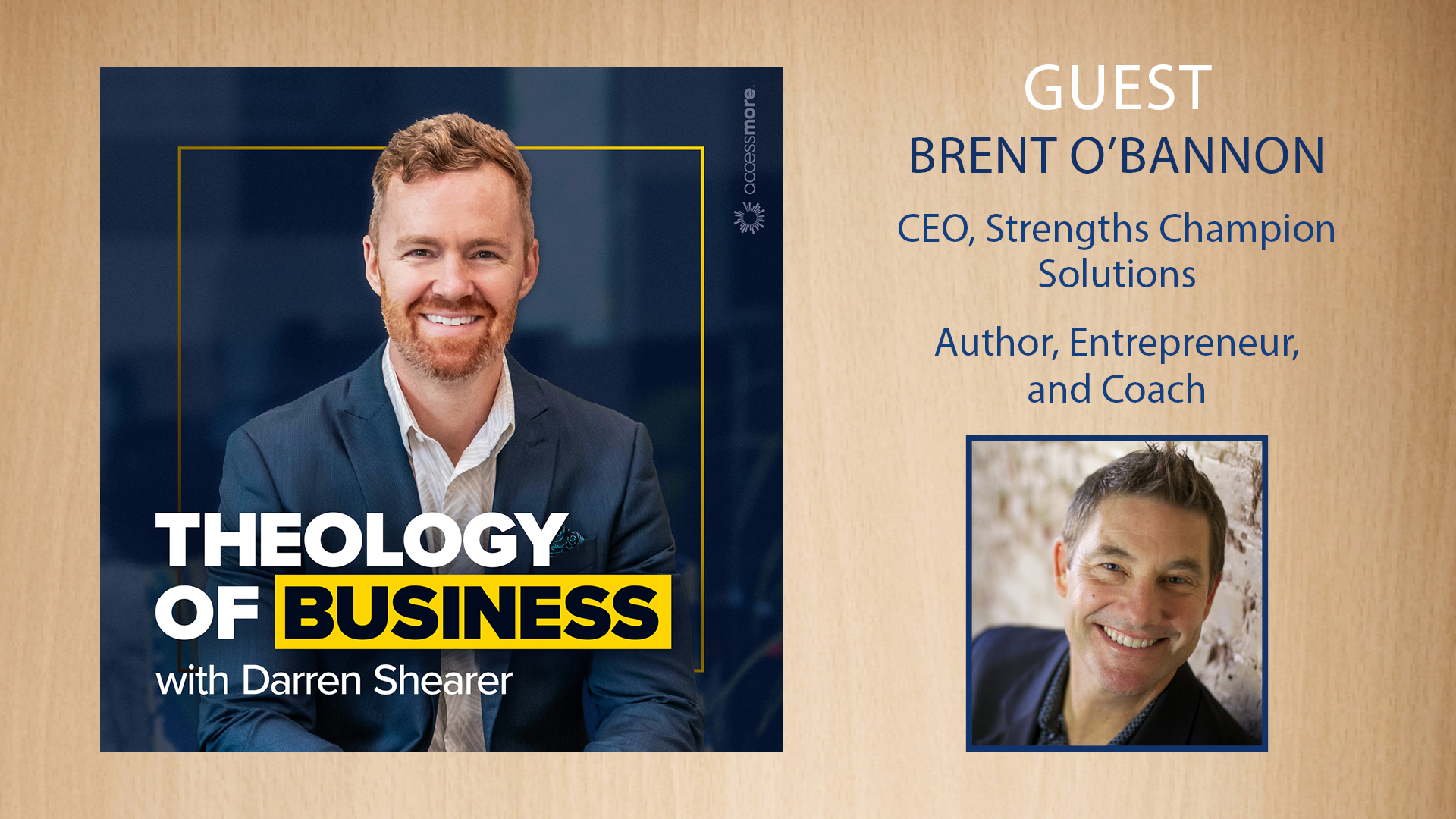
On this episode, Brent O’Bannon (the first Gallup-Certified Strengths Coach in the world) teaches how to do business with your God-given strengths and performs a live strengths-based coaching session with Darren.
Brent O’Bannon, CEO of Strengths Champion Solutions in Dallas, TX, is an ICF Master Certified Coach and the world’s first Gallup-Certified Strengths Coach. With his Top 6 StrengthsFinder® themes of Focus, Individualization, Achiever, Command, Competition, and WOO he has led over 27,000 coaching sessions and 2,000 workshops globally. He is an author, entrepreneur, tennis enthusiast, and thankful grandfather. Brent is called to champion strengths around the world for human flourishing.
Brent and his son Trent were ranked #1 in father-son tennis doubles in the state of Texas.
Brent and I are part of the Christ-Centered Company Group of Christian business influencers.
- Download complimentary Strengths Champion Toolkit at https://brent-o-bannon-llc.ck.page/strengths-champion-toolkit and learn more about Brent at https://brentobannon.com/
Key Takeaways
- Brent O’Bannon shares his journey of discovering his strengths through the Strengthsfinder assessment, which helped him articulate his talents, including the rare strength of command.
- Brent initially felt called to ministry at 17, thinking it meant being a pastor, but later realized his role as a coach and encourager in the business world.
- Understanding each other’s strengths has significantly improved communication and relationships within Brent’s family.
- Brent explains the difference between strengths and spiritual gifts, noting that strengths are inherent talents while spiritual gifts are given by the Holy Spirit.
- The spirit-controlled temperament framework is discussed, highlighting its relevance in understanding personality and behavior in a spiritual context.
- Brent emphasizes the importance of understanding one’s talents and those of team members for effective leadership, advocating for a common language to discuss and utilize these strengths.
- Clifton’s strengths are organized into four domains: executing, influencing, relationship building, and strategic thinking, which differ from but share similarities with the DISC model.
- The strengths finder is described as a talent potential assessment focusing on naturally recurring ways of thinking, feeling, and behaving, rather than a personality assessment.
- The coaching approach involves asking questions to help individuals discover their own insights about their strengths rather than simply providing answers.
- The four domains of strengths are summarized: executing (working harder), strategic thinking (thinking smarter), influencing (motivating faster), and relationship building (caring better).
- Jesus’ focus is highlighted, particularly in Luke 4, where he declares his mission, illustrating the importance of clarity and purpose in one’s calling.
- The speaker reflects on the importance of focus in Jesus’ ministry, particularly in the parable of the lost sheep, demonstrating his commitment to every individual.
- Understanding one’s strengths and weaknesses is crucial for building effective teams and organizations, emphasizing the need for complementary partnerships.
- The speaker discusses the interplay of their competition, achiever, and focus strengths, referring to this synergy as ‘theme dynamics’ that produce a maximizer effect.
- The speaker reflects on their strengths and how they have evolved over time, using the biblical example of Saul’s transformation into Paul to illustrate that while talents remain stable, values change.
- The speaker shares their experience of taking the assessment multiple times, noting a change in their top strengths and expressing interest in exploring their full range of strengths.
- The importance of relying on God as the source of strength rather than solely on natural talents is emphasized, referencing biblical figures like Moses.
- Listeners are encouraged to visit BrentO’Bannon.com for resources and a toolkit for leadership development centered on strengths, and to consider participating in a two-day virtual workshop for certification in coaching others on strengths.
- The episode concludes with a reminder to subscribe and review the podcast, emphasizing the ongoing exploration of God’s will in business.
Theology of Business is the show for marketplace Christians seeking to explore and apply God’s will for business. If you want to learn more about how to do business for the glory of God and shape culture through discipling the business world, this show is for you.
Full Episode Transcript
Heads up: This transcript was created with AI, so you might notice a few typos or small mistakes. We recommend listening to the episode for the best experience!
SPEAKER_00 0:04
Welcome to the Theology of Business Podcast, where marketplace Christians explore God’s will and ways for business. This show features conversations with today’s Christ-centered business leaders who are representing Christ faithfully in the business world. I’m your host, Darren Scheer. And if you want to make your work, leadership, and company’s culture more Christ-centered, you’ve come to the right place. Hi everyone, and welcome back to the Theology of Business Podcast. I’m your host, Darren Shear, and this is a show for Marketplace Christians seeking to explore and apply God’s will for business. On this episode, we’re joined by my good friend Brent O’Bannon. Brent is CEO of Strengths Champion Solutions in Dallas, Texas, and is an ICF master certified coach and the world’s very first Gallup certified strengths coach. So if you’re a uh strengths-based leadership, strength finders fan as I am, and probably a nerd as I am about it, he is a go-to resource for understanding how to grow in these uh and discover and maximize your strengths. And with his top six strengths finder themes of focus, individualization, achiever, command, competition, and woo, he has led over 27,000 coaching sessions and 2,000 workshops globally. He’s an author, entrepreneur, tennis enthusiast. By the way, he and his son Trent were ranked number one in father-son tennis doubles in the state of Texas and also a thankful grandfather. And he’s called to champion strengths around the world for human flourishing. And Brent and I are part of the Christ-centered company peer advisory group of Christian business influencers. And it’s just been a joy getting to know him and um hearing his heart for people and business and helping uh people, particularly Christians, to walk in the fullness of the gifts and abilities that God has entrusted to us. Brent, welcome to the Theology of Business podcast.SPEAKER_01 2:19
Hey, Darren and friends, it’s great to be here. And also just to let you know, Darren, the the way I first even found out anything about you was reading marketing like Jesus. Yeah, that’s taken back. I thought taking it back. No one else had ever used that term before, and I had already started talking about marketing and strengths like Jesus, but you had the book already written.SPEAKER_00 2:47
Well, standing on the shoulders of giants, you know, that there was already Lead Like Jesus by by Ken Blanchard. And so why not marketing like Jesus? I was in business school, and everyone was like, Oh, Steve Jobs is the greatest marketing genius of all time, or Richard Branson and Lady Gaga. Nobody’s got anything on Jesus when it comes to strategically influencing people. So thanks for thanks for that shout out. Um, excited to have you on the show today, Brent. When did you first realize God wanted to be involved in your work and business?SPEAKER_01 3:26
17 years old for me was when I first felt called. Like Joseph. Even though I became a believer at 13 and was discipled by these wonderful five sisters in my uh community. And then when I was you know getting ready for my senior year in high school, our youth group was putting together a Sunday night service, and they asked me to do the preaching for the very first service. And you know, during that time, I had talked to my pastor several times about what kind of work or ministry God was calling me to. And I remember him telling me, he just said, Brent, you’ll know when you know. And I remember this was in a Baptist church uh way back then, and I walked the aisle and came up and said, you know, I’m I’m committing myself. I thought at that time it meant being a pastor inside the local church, which I was a youth pastor and a senior pastor before I ever became a counselor or a coach.SPEAKER_00 4:41
So that’s where that’s where it began. 17, uh, you were called to lead, speak, and teach. And um, and it didn’t necessarily take on the the exact um appearance that a lot of people assume pastoring looks like, but you are a coach, you are a pastor, and and you are so gifted in that. And I just appreciate your heart. And you spend any time with Brent, he’s gonna be just pulling out the best in you and be being an encourager as you’ve been to me, Brent. Brent, what’s one of your favorite stories of someone discovering their strengths and the uh the ensuing impact that was made on their life and work?SPEAKER_01 5:29
Well, first of all, when I discovered my own strengths after a business coach introduced me to Strengthsfinder is what it was called back then. Now aka rebranded Clifton Strengths, it gave me a language that I absolutely like. For example, I knew I was an achiever and I knew I had competition. So those weren’t really new to me. But the word command was a talent and a strength that Strengths Finder had shown me that was my number four, you know, top talent. And so, you know, I’ve gotten to understand what command means more over the years. And you also have command in your top five strengths as well. So it’s more of a rare theme. A lot of of our out of 34 million people who have taken the assessment now, self-assurance is the most rare, and command is the second most rare theme out of all the people who have taken. So it’s easy for us to be misunderstood and for us to even think of the the raw and the uh immature part of our command versus uh the superpower of it. But I will also say when I first experienced discovering my own strengths, my wife, you know, when she also took the assessment reluctantly uh at first, and then my then teenage daughter, and of course, now all of my family have taken the strengths assessment, and we use that language almost in everything we do. And of course, they it really helps uh understanding that my wife has adaptability, and my daughter has a strength also called intellection. And so discovering even how my communication with my daughter had to be so I had to wait for her to be ready to talk. And because with her intellection, she would be in her head, she loves to think, she loves time. So talking on the cuff is a little bit harder for her. And so being able to realize that oh, I need to give her space. When she’s ready to talk, she’ll talk my ear off. But I have to respect, and so it all starts first with my family, and of course, from there, you know, it’s it’s been with leaders and teams and you know, people who are championing causes, even knowing the strengths of leaders like you is one of the fascinations that I have.SPEAKER_00 8:31
So let’s take command, for example. Do you believe that’s a spiritual gift per se?SPEAKER_01 8:37
That’s a big question that a lot of people ask is is a spiritual gift, which is written about in uh the New Testament, is it the same thing as Clifton Strength Finder themes? And I think there’s a crossover. However, I don’t think they’re exactly the same thing. The way we would define a talent, which is what Strengthfinder actually measures, 34 talent potential, these are genetic, hardwired thoughts, feelings, and behaviors that are inherently in us. So when the scripture talks about that we’re fearfully and wonderfully made in the womb, already God’s imprint and genetic predisposition is there. And so I would see that as a talent. And of course, that talent has to be has to be invested in with practice and knowledge and skills to go from raw to refined. But when we think of spiritual gifts, which I am a strong believer that those spiritual gifts are still alive and they are still uh for the body of Christ now, that those spiritual gifts are gifts totally given sometimes in the moment by the Holy Spirit. And so whether we have the talent or not, the Holy Spirit comes upon us and gives us that ability. Now, at the same time, many of our talents and spiritual gifts may be interconnected. So if you look at even Moses, who possibly had command when Moses was protecting and fighting for the Israelites, he murdered obviously one of the Egyptians. But that command was also protecting God’s people. And so obviously he was even misunderstood by his own people for that uh command strength. But later on, we see a transformation with Moses’ values, his relationship with God, his knowledge, his skills. And so God even used that talent to be able to use Moses as a mouthpiece with writing, with teaching, which you can see him even as a teacher, uh, the spiritual gift of teaching, teaching the the Israelites that the Ten Commandments and the Laws of God.SPEAKER_00 11:27
Yeah. Are you familiar with the spirit-controlled temperament uh framework from Tim Lahay?SPEAKER_01 11:35
That was probably one of the first books that I read, you know, when I was way back when uh in psychology. Yeah, those were temperaments. And of course, you know, the the research behind that was more not as well developed as we have researched today.SPEAKER_00 11:54
But still kind of based on that that disc model, the DISC, the dominant driver, the inspiring influencer. I may be getting this wrong, the the supporter, and then the conscientious calculator. I remember in that he was saying that Paul is your archetype for the dominant driver.SPEAKER_01 12:18
Yep.SPEAKER_00 12:19
You know, maybe the command um theme. And then Moses, he says, was this he didn’t say the C, but the what is the the the the Greek version of that where they thought that it was actually in your blood. Your was it not not colo so choleric, I think was the sanguine, choleric, melancholy, melancholy. That was the the conscious calculator. Okay, yeah. Yeah, I mean, because it would take somebody that is has that much attention to detail, what some people might call anal, to codify all of this this law. And I mean, I d down to the very dimensions, like you because like I think if God was speaking to somebody that’s just sort of like a you know, they’re a command, like dominant driver, like let’s just get it done, and then we’ll figure out what it’s supposed to look like after it’s done. Um they wouldn’t have been able to have the the capacity to even be able to hear from God about all of these fine details that God uh had prescribed for the building of the tabernacle.SPEAKER_01 13:41
Yeah, like Bezalil uh was a craftsman, the Bible talks about, and God had gifted him with uh talent and abilities, and obviously he was he had mastery in that, and God was using him. And that’s really the same principle with Clifton strengths, is that it helps us to have a language to name these talents and potential strengths in us. And Donald Clifton was a man of faith. He actually started his research on what made people resilient, what made people successful, what made people people of um of even what makes them a good attorney or a good salesperson or a good insurance person. And so what he found were these 34 themes of talent. And so that is what the original Strengths Finder and Clifton Strengths Now rebranded measures. And so it’s important as leaders to know what your talent is and also your people’s talent. Because if you want to get the best out of yourself and the best also of your team, your organization, you need a language. And of course, what do you do with those talents and strengths once you’ve identified them?SPEAKER_00 15:11
And that’s the big question for a lot of people. The strength finders model is also based sort of on that DISC model, right? Or but it’s but it all goes back to that that choleric, sanguine, phlegmatic, melancholic model uh from the Greeks. But all of those, how many themes are there? There are 34 in Clifton strengths, and then they’re organized according to executing, influencing, relationship building, and strategic thinking. Or is that just for the the strengths-based leadership?SPEAKER_01 15:48
All 34 strengths are organized in those, what we call the four domains of leadership.SPEAKER_00 15:54
Okay.SPEAKER_01 15:55
What you just named, the executing, strategic, influencing, and relationship building.SPEAKER_00 16:02
Yeah.SPEAKER_01 16:03
But those are different, even though they’re different from disk, even though you may see some similarities because it’s trying to group certain behaviors into four quadrants, just like uh the temperament, you know, had four different uh temperaments, but the way that those tools get to their strengths is different. Like technically, we don’t call strengths finder a personality assessment. It is a talent, a potential assessment. And talent is defined as naturally recurring ways of thinking, the way you feel, and the way you behave.SPEAKER_00 16:52
Yeah. Yeah. And I just love how the the strength finder framework, it it nuances those four categories as opposed to I’m just a D, I’m a D I or I’m a D S or whatever. It’s it’s it kind of sorts of like for example, I have I have three that are under the the influencing category, and then I have one in executing and then one in relationship building. And if it just said that I’m a I’m a DI or a ID, I wouldn’t really have the nuance of what my specific strengths are. So mine are it’s focus, that’s out of the the executing or the D category, uh, and then influencing, I have activator, command, significance, and then relationship building, I have relater. So how would you coach me in those? Because I know we talked about you doing live coaching on a podcast. Um, what would you say to me? Uh, if you were to start working with one of our listeners who maybe just recently has taken their assessment or they’re gonna they’re gonna go take it right after this, where do you start?SPEAKER_01 18:16
Yeah, true coaching is where I’m asking questions out of curiosity, helping you to discover your own wisdom about your strengths, versus if I was a consultant and I was educating or teaching, I may do a little bit of that. I’ll take my coaching hat off, sometimes put on that consultant hat for a moment. But if I was coaching you, I might ask you, Darren, out of your top five strengths, which one surprised you the most and why?SPEAKER_00 18:55
I think maybe the one that surprised me the most was Relator. I think, you know, because I had always thought of myself as because I would usually score highest in like the D or the I category. So I’m like, I’m I’m a D I or I’m an ID, but the one that comes out of that uh relationship building category kind of surprised me because I I have generally felt like I’m a very task-oriented person. But even the I category is not necessarily that’s more of the uh the people-oriented category or quadrant, right?SPEAKER_01 19:38
Yeah, one way of looking at those four domains is you know, the executing is about working harder. You love production, you love a project, you love to get your hands and feet and boots on the ground. Then there’s the strategic thinking, which typically is about thinking smarter. So it’s about systems and innovation and you know being able to disrupt in the marketplace. And then when you think of influencing, think of motivating faster. There’s that part of you that as an influencer, you want to motivate people and inspire people and move people and challenge people to become more to get things done. And then finally, the relationship building, I like to say it’s about uh caring better.SPEAKER_00 20:36
Yeah.SPEAKER_01 20:37
So these are the folks that have that emotional intelligence and social intelligence, and they’re the glue of the team. That’s one way of looking at those four domains. When you look at writing books, but you have three published books right now. Which of your strengths enjoys the writing production more than any other?SPEAKER_00 21:06
As I’m looking at these five, I would say probably focus, because one of the things that that really bothers me about a lot of the books I read and just just content in general is the lack of focus and just trying to trying to go after too many too many different things. Um, and it I think it’s part of what has helped me to continue to kind of stay in this conversation about theology of business through the years is is that strength of being able to focus. Because I mean it it’s in particularly on what is God’s will for for profit business and how can we how can we partner with God specifically in business? Because the faith in work movement, you know, tends to want to emphasize like everybody’s work. And there are other many other types of work, like in the medical field or being a stay-at-home mom, um, as my wife is, uh, or or serving in the military, things like that. But I just really sense a calling to focus specifically on business in particular.SPEAKER_01 22:27
Yeah, and that focus probably gives you a perseverance of really going deep into your topics and not letting anything derail you from delivering that book and finishing that book. And so, yeah, if I looked at someone who had intense focus, well, let me ask you this. Um, when you think about Jesus with focus, what particular scripture or story comes to your mind?SPEAKER_00 23:04
Oh, particular scripture um that that speaks of Jesus and his focus. Um, I think when he in Luke 4 just declaring what his mission is, that it’s to proclaim the favorable year of the Lord, to see blind eyes open, to see the lame walk. And then when John the Baptist is questioning Jesus, are you really who you say you are? And Jesus says, Report back to John. All the stuff that I said in Luke 4 is happening. And and so he was just, or, or when Jesus said that I’ve come for the lost sheep of the house of Israel, um, certainly his vision was for all of humanity, but during his finite time on earth, he was called to focus specifically on a very a very particular demographic and the people who were on the fringes of that demographic.SPEAKER_01 24:11
Yeah, great examples of of Jesus and focus for sure. And as you were talking, uh I was thinking about when he was on his way to Jerusalem, and of course, everyone was pulling at him for healing and for help. And and remember the scripture, I believe this is in Luke. It says that Jesus set his face like flint to go to Jerusalem. And of course, he was going there to die, to be on the cross, because it was at the cross that he was going to bring ultimate salvation. But that resolution of setting your face like flint.SPEAKER_00 24:58
Yeah.SPEAKER_01 24:59
Wow, what focus and not getting distracted by everything else around you.SPEAKER_00 25:05
And leaving the the 99 to go after the one. You know, he was really focused on the one, and that just comes through, just throughout his uh his ministry and and behavior. But I mean, you’ve got to have a massive amount of focus. If you got a hundred sheep to care for, I mean, most of us, especially coming from different um, you know, themes or or temperaments or whatever, would think, uh, you know, 99 out of 100 ain’t bad. Um, but when you’re focused, uh, all 100 matter.SPEAKER_01 25:47
Yeah, that one was the priority.SPEAKER_00 25:49
Yeah.SPEAKER_01 25:50
And I think something that’s important for all of us as Christians to understand is that in Jesus, you can see all 34 strengths in their brilliance. Yeah. All 34 strengths are ultimately fulfilled and lived out. And as you read the scriptures, Old and New Testament, you can see the example not only of Jesus, but also of uh prophets and the disciples and the kings. You can see these strengths, themes, and talents even at play. And it it helps you to to better connect and understand, like, oh wow, you know, when I think of David fighting Goliath, and that whole story is just amazing to me how David, he really, I think, had the the gift of belief in God because he did not want God to be taunted. He was standing up in his mind to fight Goliath to glorify God. And so that belief gave him that passion. And of course, I think he also had strategic because he he picked up five smooth stones. I like to think of those as your top five strengths. Yeah. And David didn’t fight Goliath using the same battle techniques that Goliath wanted to use, which was hand-to-hand combat. He was strategic. And of course, he had armor on, and I can picture David strategically placing that stone in his sling, which by the way, he had knowledge, skills, and practice with that sling because he’d killed a bear. He’d killed a lion. He had already used that talent and that tool that God had given him. And now he was running at Goliath, and of course, hits him in the one place that his armor was not covering, so that it stunned him, knocked him down. And of course, he finished the job. Isn’t that amazing seeing those strengths even in David?SPEAKER_00 28:23
Yeah, and there’s and there’s such um spiritual gift correlations there with the ones that Paul mentions. Um, you know, for example, you said uh as is as is as it’s labeled in the strengthfinders model belief, the that theme, there’s a gift of faith. And my wife has that gift, and she’ll start speaking in faith. And I’m like, you know, somebody’s gonna have to actually like do something to make that happen, right? You know, and she’s just like she just has such a gift of faith that like we’ll we’ll figure that out later. But the the first step is we have to believe that God can do this and that and that the battle is truly the Lord’s. And you know, as you point out there, David, David had that gift. Do you believe that that we all have every spiritual gift in some measure? Or even um we have some measure of all of the the themes in the strength finder model.SPEAKER_01 29:39
And that’s exactly what Donald Clifton and Gallup teaches, is that every one of us has all 34 talent potential in us.SPEAKER_00 29:48
Yeah.SPEAKER_01 29:50
So when we as believers have the Holy Spirit living in us, even if we’re weak, then we know God makes us strong through the Holy Spirit, through the anointing. It’s true that these 30-4 talents, for example, let’s just say, do you happen to know what your number 34 strength is?SPEAKER_00 30:12
My number 34.SPEAKER_01 30:14
Uh-huh.SPEAKER_00 30:15
Your last one. I’m looking on the the document right now.SPEAKER_01 30:19
This you only did top five, you wouldn’t know your full 34, but there is the uh a way to.SPEAKER_00 30:28
It’s really interesting. Yeah. I mean, maybe I could uh if the what the the website dashboard that I took it in is still active, maybe there’s a way for me to see that.SPEAKER_01 30:39
Oh, yeah, it’s all there. But I can give you a code and you you can unlock your full 34 from your original assessment. Oh, wow. And so we you’ll know you’re six through 34. And so I like to say we we use not just our top five, we use our top 10, kind of like your dominant hand and your non-dominant hand. You’re using your right and your left hands. But those strengths that are at your bottom, those are what we call lesser strengths. And all those other strengths between 10 and your bottom five are what we call supporting strengths. So that means, for example, you know, I’ve I’ve coached leaders who maybe empathy was number 34 for them, dead last. So that means it’s not natural, it’s not energizing for them to feel and to express empathy. However, that doesn’t mean that they aren’t empathetic or they can’t learn how to be more empathetic to other people. You know, if I ask them, hey, how do you use empathy with your spouse or with your kids or with your friends? Of course they’re going to be able to give some stories around that. However, it may be unnatural, uncomfortable, draining and even de-energizing by those things at the bottom of our strengths.SPEAKER_00 32:15
Well, that is that’s fascinating. Uh that you can see what your your bottom strengths are. And that should also indicate these are the kinds of people that I need around me.SPEAKER_01 32:27
Exactly. Right.SPEAKER_00 32:28
I mean, if you’re building uh, especially if if you’ve got a really small business or small organization, I mean, it’s great that you have those top five, but who’s doing the things that, like, for example, empathy? And that’s where, for example, a lot of leaders will turn to hiring a marketplace chaplain. It’s like, this is not, I just am not trained in this. I’m not gifted to provide this spiritual and emotional care for my team members. So let me go, let me go hire somebody who can provide that because we we’ve got to bear one another’s burdens, but you don’t necessarily have to be the one to put it on on your back per se, but you can just make sure that that need is is met for your team members. Because the temptation is to want to, I’ve got to, I’ve got to increase, I’ve got to be more for uh for this organization. And that’s not necessarily the case. I mean, it’s hard for to make a place for Christ to really uh be lifted up in the organization because he wants to do it through other people, uh is what I’ve observed, is that he’s wanting to when John the Baptist says he must increase, I must decrease. Um, that’s that’s for me a big takeaway is I need to stop trying to be Superman and allow other people to step in and use the gifts that God has uniquely wired them with.SPEAKER_01 34:08
And you see this within the body of Christ of how every gift is created to serve one another, to glorify God. And so we need those complementary partnerships. You know, I’ll give you a very practical example. For me, maximizer is my number 34 strength, which really baffled me when I first saw that. I was like, what? You know, however, I think for me, my competition, my achiever, and my focus tend to be my when they’re when they uh work together, we call that theme dynamics. When they work together, they produce maximizer, but I tend to only maximize those things that I’m most focused on. Like anything and everything around strengths, I’m a maximizer because I I want to know and learn and become an expert in that area. However, disc or other type of assessments, even though I’m I’m I’m learned and I’ve used them, they’re not my focus. But when I hire other people to help me in my business, like even with my books, my website, my materials that I create, I’m an achiever. So I I can work on things and get it done. And sometimes, like one of my good friends said, he says, My achiever is a good enough. A good enoughher. I just get things done. And then people with maximizer, good enough is not good enough. They are polishing the pearl, they are taking what is good and they make it great. They give you that whole nother level of excellence. So I partner with people who polish and they have these incredible gifts and talent to maximize what I originally just produce.SPEAKER_00 36:29
Well, thank you for um helping to provide some insight for me on just the way God has has wired me and some of my strengths. It’s been so long since I took this, and I need to go back. Do you find that your themes generally change over time like quite a bit, or is it usually just like maybe one will kind of get switched out?SPEAKER_01 36:51
Yeah, a good a good way of looking at this is looking at Saul turned into Paul. When God called Saul, he was think about his behavior. He was passionate, he was zealous, he was phariseical, um, he was attacking the church. When he had his encounter with Christ, and God called him to be an apostle, was Paul still zealous? Sure. Was he still the same passionate, like bold leader for the church as much as he was as a Pharisee? Absolutely, yes. So what happened? So here’s my point. The point is that our talents and strengths remain relatively the same over our lifetime. We become more and more who we really are the longer we’re alive. What changes is our values. Our values determine how we express our talents, our gifts, and our strengths. So as your values grow and evolve and emerge, then you’re gonna see a different expression of your talents and strengths. But it’s the same core hardware that God created inside the womb. So Gallup actually says most of the time you do not need to retake the assessment. And what we recommend is if you’ve taken it 10 years ago or a long time ago, is go open up your full 34 from your original assessment, and then that will give you even more insight to how you’re wired. Now, the only exceptions is if someone had a trauma in their life, or there was some major radical shift in their life, or if they took the assessment maybe when they were really young, like even teenage years, like 15, 16, 17 years old, and now they’re 40 years old, then because the brain is still growing and changing the neuroscience, then yes, it might be wise to retake that assessment. Otherwise, talent is stable, and the test, retest reliability is about 75-80% when you take Strength Finder.SPEAKER_00 39:46
Yeah. Yeah, I think I took it about maybe uh five years, three to three to five years apart. And um, it one of my strengths changed, or at least in my top five. But I’m I’m really excited to go back and see if I can get all 30 uh 34 and look at the ones down at the bottom so I can show my wife uh so she can uh understand me a little better and I can uh but but no, that’s that’s probably uh a way that Strength Finders gets used in a counterproductive way is well, let me just use this as a cop-out to not try to grow in some of these areas where I’m I’m not I’m not strong. You know, certainly you need to get people around you uh that can provide those things, but also to help disciple us, right? To pull out the potential that we have in those areas, like if if you’re weak in um in mercy uh or weak in empathy, as it as it’s said in strength finders, get around people who are merciful. If you’re wise, you’ll if if you if you walk with the wise, you’ll be wise. I mean, if you walk with the merciful, you’ll at least be more merciful than you are today, right?SPEAKER_01 41:10
And I have a perfect example of that. My wife, who has empathy number one, living with her for 40 years now, we’ve been married. And when when psychologists talk about mirror neurons in the brain, this is when you’re around someone who is masterful at empathy, you can’t help, yeah, but start learning and soaking up and growing in your own experience of that. And vice versa, by her being around my achiever or my command, or even our my my woo, it gives her some sense of strength. It’s like people can borrow from our natural strengths because of being around us with the mirror neurons in our brain.SPEAKER_00 42:06
Yeah, and in a way, they become, they be kind of become heroes, they become like teachers to us, people who inspire us. It’s like, I mean, if you don’t want more empathy, um, you know, they might not rub off you on you quite the same way they would if that’s an area that you really want to want to grow in, you know, like Paul said, like desire the the greater gifts. Um, I mean, I I think in a lot of ways he’s talking just about gifts that you’re not strong at, the gifts that you’re not really um really walking in too much. Like ask God for those things because there’s always gonna be a demand uh for for those for those gifts and and those strengths.SPEAKER_01 42:51
Um as believers, that’s where the supernatural comes in. You know, God can I like to think of Moses with the staff as an example of a talent because we say God is the source, everything else is a resource. Strengthfinder is a resource. God is the source, his word is the source. So God actually gave Moses the staff as a resource because he was used to using that staff as a shepherd. And so he had the knowledge, the skills, and the practice. It was natural to him to use the staff, but God came on him supernaturally and the staff to use it with the Pharaoh and the Egyptians, as we all know. However, part of as Christians, I think, instead of being so attached to our natural talents and strengths, we have to be willing to lay it down. And throw it down. Because it is when God is honored when we depend on Him and His strength and not in our own strength. Yes. And so that’s when Paul says I boast about my weaknesses. And so technically, when you admit I’m gifted in a certain area, what you’re actually also saying is I am weak in certain areas with my strength.SPEAKER_00 44:31
Yes. Yes. Well said. Brentobann.com is the website. Brent, what else do you want to say? I know people can go download. Uh you’ve got a toolkit for our folks. What do you want to say to people about how they can hear more from you?SPEAKER_01 44:47
Yeah, if you want to flourish as a leader and help your team and help your organization to flourish, using strengths is an accelerant. And so God has called me to champion strengths around the world. And so, first of all, download that Strengths Champion toolkit on my website, BrenoBannon.com. And it is just full of resources and tools to help you. And if you feel called, like God is wanting you to use this as a tool, whether it’s in your church or your business or in a nonprofit, whatever it is, then I have a strengths champion certified coach two-day virtual workshop in which you can become grounded and certified in using strengths and also learning how to coach others using those strengths.SPEAKER_00 45:46
Yes. And and how do people take the assessment?SPEAKER_01 45:51
Yeah. If you want to take the assessment, either top five or the full 34, you can actually go on BrenoBannon.com and you’ll see under resources or my shop page where you can purchase the Gallup assessments. And there’s some extras that you get when you do that off my website. But you can also go onto the Gallup website and you can purchase the assessments there. So either place, that assessment is available.SPEAKER_00 46:24
Brent, thank you so much for um helping to coach me today. And I’m sure that uh a lot of our listeners felt that you would coach them as well. Everybody reach out to Brent uh if you want more of that one-on-one coaching to help you grow and your strengths and take advantage of the great resources that Brent has. And uh, if you want to join us in a Christ-centered company peer advisory group uh for more discussions like this, uh reach out to me and um we will get you in the conversation. Brent, thank you so much again, everybody. Brentobanon.com is the website. Appreciate you, brother. Blessings. Thanks for listening to this episode of the Theology of Business podcast. Be sure to subscribe, leave a review, and tune in for the next episode as we continue exploring God’s will and ways for business.
BIG THANKS to this episode’s sponsor: High Bridge Books
High Bridge Books helps Christ-centered authors build a legacy by crafting and publishing messages and stories that glorify God in all spheres of culture.
- High Bridge Books’ professional book publishing package: https://www.highbridgebooks.com/publishing/
- High Bridge Books’ proofreading, line editing, developmental editing, and co-writing services: https://www.highbridgebooks.com/editing-and-proofreading/
- Examples of our books: https://www.highbridgebooks.com/bookstore/
We’re extremely proud that …
- 45% percent of our 204 books under contract were written by authors who have published more than one book with us, and
- 51% percent of our books under contract were referred to us by authors who have previously published with us.
Contact High Bridge Books’ CEO Darren Shearer at [email protected] to get a conversation going about your book!