How Walmart’s Architect Invests Kingdom Currency (w/ Raymond Harris)
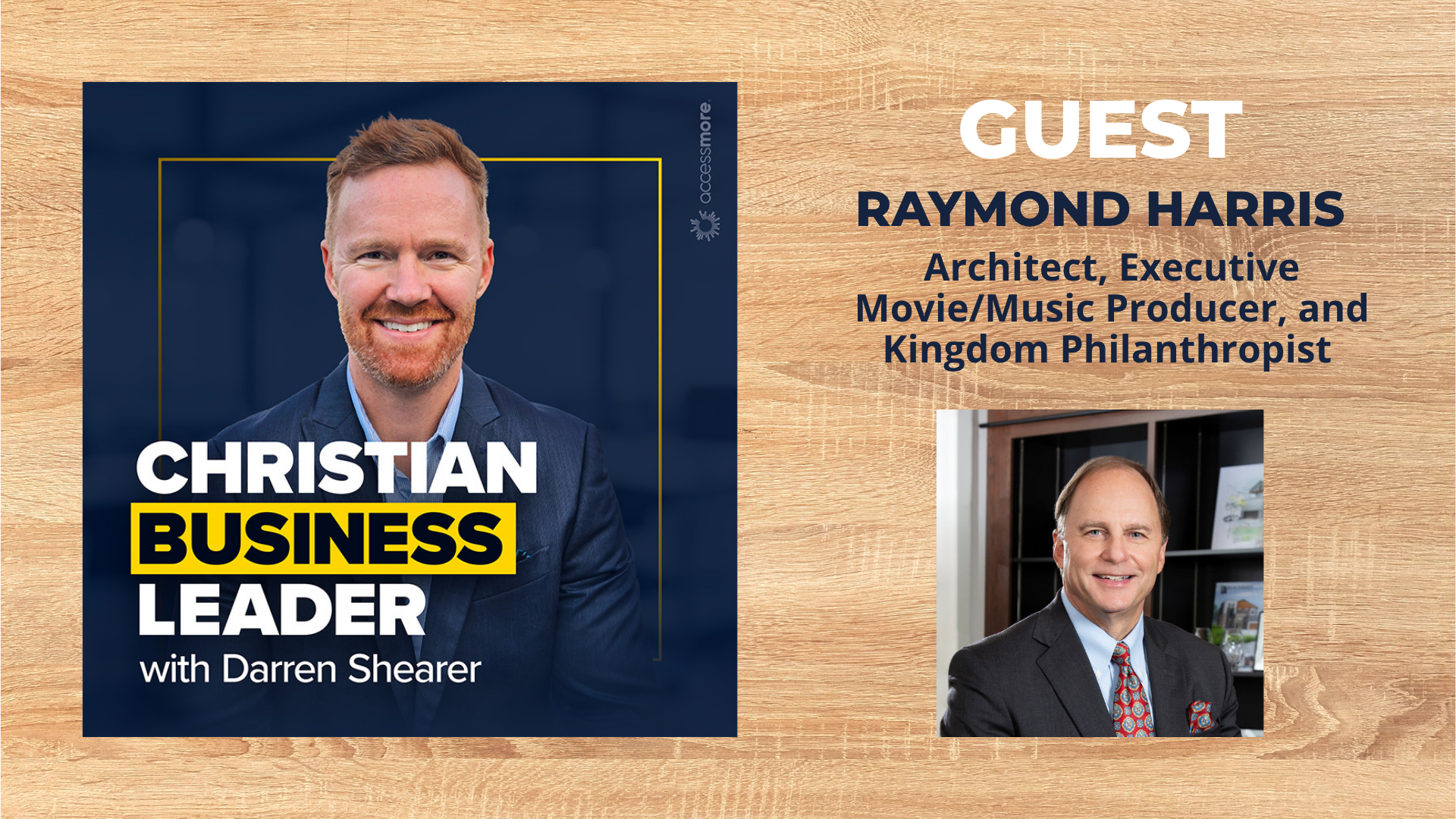
On this episode of the Christian Business Leader Podcast, we’re joined by architect, executive movie/music producer, and Kingdom philanthropist Raymond Harris.
Raymond Harris joins host Darren Shearer to share how biblical values can shape business in lasting and practical ways. As founder of one of the largest architectural firms in the country, Raymond reflects on building a company culture centered on generosity, gratitude, and love while serving clients and communities across the globe.
In this conversation, Raymond talks about his early desire to enter ministry and how he came to see his profession as a mission field. He explains how studying Scripture guided his leadership style, how small acts of kindness built trust, and how choosing generosity during a legal dispute led to unexpected blessings. When a project issue resulted in a lawsuit, Raymond volunteered to help cover damages even without being at fault. That decision stunned attorneys and clients alike and led to new work and a better reputation.
He introduces the concept of kingdom currency, which he defines as turning wealth, skills, and influence into eternal impact. Profits from his business funded efforts like Christian films, healthcare in Africa, and job creation for women leaving exploitation. Raymond challenges leaders to use their resources not for comfort but to serve others and expand God’s kingdom.
He also explains how cultivating a culture based on biblical principles created a workplace where people thrived regardless of background. While he did not force faith on anyone, his leadership pointed to Christ through consistent care and integrity. Raymond urges business leaders to live with purpose, steward influence well, and build legacies that matter forever.
Key Takeaways
- Discovering Ministry in the Marketplace: Raymond Harris first believed ministry meant working in the church, but he came to see his architectural career as a calling. Over time, he recognized that business can be a powerful platform for serving people and honoring God.
- Building Culture Through Generosity and Gratitude: Raymond emphasized generous leadership by going beyond what was expected for employees, vendors, and clients. He also practiced gratitude regularly, knowing that appreciation creates loyalty and brings out the best in others.
- Choosing Love Over Fairness: Instead of treating everyone the same, Raymond chose to lead with love by doing what was best for each person. He offered flexibility and compassion where needed, even when others thought it seemed unfair.
- Turning Crisis Into Opportunity: When a building issue led to a lawsuit, Raymond chose humility and volunteered to pay part of the damages. That decision defused the conflict, impressed all parties, and led to new work and lower insurance premiums.
- Kingdom Currency as an Eternal Investment: Raymond coined the term “kingdom currency” to describe how people can convert money, time, and talents into eternal value. Giving to the poor, empowering others, and advancing the gospel are ways to build treasure that lasts.
- Multiplying Impact Through Business Ventures: Profits from Raymond’s firm helped launch initiatives like Christian films, medical clinics in Africa, and a jewelry company employing women rescued from trafficking. These ventures created new avenues for redemptive influence.
- A Culture That Reflects Christ: Though not everyone in the firm shared his beliefs, Raymond created a workplace where love, respect, and integrity guided everything. He openly expressed his faith while welcoming people from all backgrounds.
- Mentoring Leaders to Carry the Mission Forward: While he didn’t disciple every employee directly, Raymond poured into his business partners and led by example. He trusted that a culture shaped by biblical values would influence future leaders to do the same.
Christian Business Leader is the show for marketplace Christians seeking to explore and apply God’s will for business. If you want to learn more about how to do business for the glory of God and shape culture through discipling the business world, this show is for you.
Full Episode Transcript
Heads up: This transcript was created with AI, so you might notice a few typos or small mistakes. We recommend listening to the episode for the best experience!
SPEAKER_00 0:02
That’s more. Welcome to the Christian Business Leader Podcast, where Christ-following business leaders explore God’s will and ways for business. This show is a ministry of the Center for Christianity and Business at Houston Christian University and features conversations with today’s Christ-centered business leaders who are representing Christ faithfully in the business world. I’m your host, Darren Scheer, and if you want to make your work, leadership, and company’s culture more Christ-centered, you’ve come to the right place. On this episode, we’re joined by my friend Raymond Harris, who is one of the very few people that we have invited back on this show. Excited to have him. Raymond is an architect, executive movie, and music producer and venture capitalist in God’s Kingdom. He’s founder of one of the largest architectural firms specializing in corporate architecture. And actually designed the Walmart that my family and I shop at uh through his company. They, their firm was ranked as the number two retail design firm in America for three years. And it’s probably a good chance uh his firm designed the Walmart that you shop at, uh, those of you listening to this episode. And he’s a senior fellow of the Institute for Global Engagement at Dallas Baptist University, and um works extensively in international sustainable community development projects in Africa and Asia. And he’s authored The Heart of Business, Business by Design, and Enduring Wealth. And the subtitle of this newest book is Being Rich in This World and the Next. And also the executive producer for numerous movies distributed by Sony and Lionsgate, including I Can Only Imagine, and that which was the number one independent film of 2018. Incredible movie. And he has hiked all of the continental U.S. national parks. Um, I’m very envious of that, most of all, and uh hope to be able to follow in those footsteps one of these days. He and his wife Mary Dell are blessed by their four adult children, their spouses, and 10 grandchildren. And they reside in Dallas, Texas, and Jackson, Wyoming. Raymond, welcome back to the now newly named Christian Business Leader Podcast.SPEAKER_01 2:34
Hey, Darren, good morning, and thank you for inviting me back. It’s uh it’s an honor and a privilege, and I’m excited to be here. Thank you.SPEAKER_00 2:42
Raymond, when did you first realize God wants to be involved in your work and business?SPEAKER_01 2:47
Well, for me, it was really something back in college. I I became a Christian and followed Christ in college, and I knew that I would be in ministry for the rest of my life. But I didn’t realize that ministry would actually become through my profession as much as an actual ministry or going to seminary and graduating and then going on the mission field. So early in my career, I learned the value of how to handle money, how to do finances, realizing that God had given me the ability uh to create wealth. And even since high school, I really wanted to be an architect. I I had that desire. My grandmother sat down with me uh to kind of say, hey, honey, what do you want to do? And I said, Grandma, I think I want to be an architect. So rather than going into the ministry full-time, I went into the profession. And for 25 years, as I worked hard, um, I kept looking through my rearview mirror, wondering, did I miss the turn in ministry? And I realized that no, I’ve always been in ministry. As I thought that ministry might be siloed and not working in the professions, I realized that there are not silos in God’s kingdom. It all works together. So the whole time I’ve been a professional architect, employing over 300 people, I’ve actually been a ministry and not only serving clients, but taking good care of people that work for me and then working and trying to um apply biblical principles uh in how I deal with people so that they would see Jesus and what I did.SPEAKER_00 4:22
What was the kind of the kind of occurrences that would happen or habits that you would apply in your business in this architecture firm where you’ve got 300 team members that would really give you the sense that I’m really doing God’s kingdom work? Because you know, typically people would think in terms of uh, and you talk about enduring wealth and using money to give to uh outside of the business to ministry, ministry work, kingdom work, um, but inside the goings-on of the business, what did that what really energized you in that regard?SPEAKER_01 5:01
Well, I I uh I studied the Bible primarily uh Proverbs and the Psalms to try to figure out how do you operate a business according to God’s principles. And so early on, I I was a uh seeker of wisdom and how to do this, but it’s hard to uh apply all those things uh because it’s a process of learning them. But to uh I’ll give you two examples. Um, generosity is something that most business people don’t talk about. But I found that if you’re generous with your people, your vendors, your contractors, if you have those, uh people uh that um associate with you, if you’re generous with them, it shows God’s love. And it also gives them value, it makes them feel like, oh, what I’m doing is valuable. But you know, generosity is really something going beyond what is expected. And so I’ve tried to apply generosity. Another thing that I learned was um was gratitude. I don’t think that we show gratitude enough in how we do business, and so that might be extending that to employees or to vendors. Um, one time we um uh gave a a um a printer. As an architect, we printed blueprints, as most people will remember nowadays, it’s all online. But in the old days we printed a lot, and so we had a printer that would uh do a lot of work for us. And so uh one Christmas we had a very good year. And one Christmas I just sent him an extra check. Uh he didn’t send me an invoice, I just sent him a check, kind of a bonus. And I’ll tell you what, that meant more to that printing company. And I we had no trouble ever getting them to come do our work. So just being grateful and telling uh employees and and vendors and consultants how much you appreciate them, and then showing that in tangible ways will build loyalty and you build a real team that way. So, between generosity and gratitude, I think are two of the best uh management techniques, um, among others, but those are are two that come to mind right away. So, yeah.SPEAKER_00 7:02
So generosity as uh as a business owner, as an executive or or leader, regardless of whether middle management or whatever influence you have in the company is about, is about being generous, not just in terms of giving money outside of the business, but showing generosity to your to your team members, doing things like going the extra mile for your for your vendors, going the extra mile for your customers. Any other examples that that come to mind that you uh of that generosity inside the company?SPEAKER_01 7:39
Well, I think you always uh generosity would include uh not only paying them well, but being generous with your with their time. Um you would you would need to sit down with employees and get to know and love them and then to understand them. And and I would always try to be very generous with giving them time off if they needed it for personal reasons or family reasons. Now, other employees will say, Hey, you gave that guy some time off or that lady, it’s not fair. And I said, Well, I’m not fair, but I’m very generous. So I say, you know, I will give everyone uh generosity as as they need it, but I’m not fair because I can’t give everyone the same generosity for specifically what I gave them to everyone, or no one would come to work. But I think that was the generosity, you know. And another thing was I think the most important business principle that I applied is the principle of love. And that sounds kind of trite, but in reality, love is the most important uh business principle because the most important commandment of what we do to operate in God’s kingdom. Well, and business is God’s part of God’s kingdom. So love is very important. And the way I would define love is the golden rule doing what’s best for the other person. So uh many times I would um when I would work with a client, uh I would do what’s best for them. I would maybe give them an extra scoop of ice cream, if you will, uh without them paying for it, extra service, uh, go the extra mile. Uh the other thing is I learned to love my clients and my consultants and my contractors. And when you start to discipline yourself to actually love them, it’s not hard to serve them. And when you start serving them with a heart of gratitude and a heart of humility, then it builds a really strong relationship and um they become very faithful to you.SPEAKER_00 9:32
Yeah.SPEAKER_01 9:32
Um, because they won’t work with you.SPEAKER_00 9:34
That’s a really important distinction you made between generosity and fairness. And somebody might be hearing that in a first blush, it might sound unbiblical, uh, but it’s actually not at all. I mean, think about the the parable of the workers in the field where they all got they came to work at different times of the day, one of them in the 11th hour, and yet they all get paid the same. And of course, the guys that work the longest are upset, they’re saying this is not fair. And and the the master, the owner of the field basically said the exact same thing you said. Yeah, it’s not fair, but it’s generous. And who are you to tell me I can’t be generous with my own stuff? And and so that’s uh that that’s a so they were they were paid um they were paid a living wage, they were paid fairly, right?SPEAKER_01 10:32
Yeah, they were paid fairly, but they all didn’t get the same thing, and that’s what irritated, I think, some of the guys is hey, we didn’t get what everyone else got. And that’s that’s what I realized. That that parable uh helped shape some of my thinking, to be honest with you. And I kind of took it a little farther to say, well, you know, God is not necessarily fair, but he’s loving and generous. Because you could say, well, God didn’t give this guy or me what he gave someone else. Well, God’s not fair. Well, maybe God isn’t fair, and he’s God, he’s almighty, but he’s loving and he’s generous, yeah, and he’s compassionate. And so who are we to to say that God should be fair?SPEAKER_00 11:14
So yeah, and that that really flies in the face of our uh values in the culture nowadays, you know, where fairness is such a highly prioritized, yeah, and not so much fairness as it just um kind of equality, equality, everybody gets the same, yeah. Everybody gets the same, and and there’s only kind of one entity that can come close to um meeting that desire of people, and that’s the government, right? And so that’s why it all the it’s it’s all about the government making everything everything fair. And that’s not necessarily it either, is it?SPEAKER_01 12:00
No, no, it’s I had to learn that uh when I was a little kid, I would tell my mom and stepdad, hey, that’s not fair. And they would say, we don’t intend to be. You know, I can’t tell you how many times I said that as a little kid. Hey, that’s not fair.SPEAKER_00 12:18
So yeah. Yeah, that is uh that’s part of life. Um Raymond, what’s a time when you saw God’s hand at work in your business?SPEAKER_01 12:27
Well, we were we were talking a little bit ago uh before we started about um the torrential rains that hit North Carolina. And and uh I would say that that God really helped and showed up when uh we had a problem with one of our projects that um was um uh basically part of a of a back of a building collapsed. And we uh we were scared uh because no one got hurt, but uh we were brought into a lawsuit, and we just saw God’s hand help us all the way through that because we were actually not at fault for what happened. But it’s a scary thing uh to be in a lawsuit or be liable uh for lots of money. And uh God really showed up in that he gave us wisdom, gave us uh uh uh wisdom to how to how to handle the situation, to become humble before the client, before other attorneys, and not be prideful and arrogant and try to defend ourselves. We kind of said, well, we don’t believe we’re at fault, but actually uh we will help pay for it. And when I volunteered to help pay for some of the damage, uh not only did our insurance company become surprised, our attorney was surprised, but the opposing side were surprised. And then the the client actually said, That is we’ve never heard of that before. So we will settle. And in fact, not only will we settle with you, but we would like to give you more work in the future because we know how you handle problems. So what became a what started as a lawsuit became one of the best business development things that ever happened to our firm because we got more work as a result of a lawsuit.SPEAKER_00 14:09
Oh my goodness. Um I’m definitely making it in a note of this because um our listeners won’t be surprised when that example shows up in the next version of the Christ-centered company book. Um, because I’m always looking for those kinds of examples, and that is just a uh beautiful one of doing the right thing in the middle of a legal dispute, because the I mean, there’s there’s a a definite expected way that you would have handled that from the world’s perspective, and you chose to go the kingdom way, and and that’s that’s what it’s about, right? Is he is the way, the truth, and the life, and we are the people of the way, and he has ways of doing things that are narrow, they are not the broad, expected kind of pattern of this world, which is very broad. Um, uh and and and you did something that directed people’s attention toward the kingdom, because I’m sure some people gave glory to God from that.SPEAKER_01 15:19
I would have to take, I would I cannot take credit for that because I believe that the Holy Spirit had nudged us to to settle and to be generous, not because of of wisdom or even knowing what the results would be. We didn’t know that the results would turn out fine, but we felt nudged that we ought to offer it at least and say, hey, we we want to help out, and uh because we felt like it was the right thing to do. I didn’t tell them the Holy Spirit told me to do it, but I I did say that. And it it was God’s goodness and kindness to us to allow this to turn out as good as it did, because it could have been millions and millions of dollars uh against our firm. And it turned out to be a blessing in disguise. That was God’s kindness to us, yeah.SPEAKER_00 16:11
And if your culture was not a generous culture and you were kind of miserly about your resources, then you might probably wouldn’t have taken that approach, you know. That may be true, yeah. No, nobody could have foreseen that you would have such a positive result of taking the way of generosity. Um so praise God.SPEAKER_01 16:37
I’ll even say another sideline of that that was a blessing because we did that, and the the insurance company, the liability insurance company says, Well, we didn’t authorize that, but that’s amazing that you’re you’re paying that. I said, Well, we’re not gonna file a claim either, we’re just gonna pay it. So you’ll be off the hook as well. And they said, We’ve we’ve not done that before. So they lowered our premiums the next year, which is amazing.SPEAKER_00 17:03
Wow.SPEAKER_01 17:03
So anyway, it turned out to be a um a very kind blessing from the Lord. It no expectations or hope that this would have happened.SPEAKER_00 17:12
So yes, yes, praise God. Uh, so you got a a benefit in this life from that move, but you talk about, but you also got I think kingdom currency as you talk about it, and I love that term because I’d never heard it before. Um, you’re the first. So, what is kingdom currency and how can we get it? Because you talk about this in your new book, Enduring Wealth.SPEAKER_01 17:38
Kingdom currency, I believe, is a currency that works in not only this world but the next. You know, we might have an asset, land, uh, property, a business. And if we travel overseas, if unless we can convert that asset into a currency that can be used in the destination or the other location, our assets are not helpful. So I might own a um I might own uh a business in America, but if I go and want to move to uh, let’s say Europe, unless I can convert that business into American cash, US dollars, and those US dollars can then be converted, let’s say, into Swiss francs, then I can’t use them in Switzerland. And so as I thought through life in general, I said, well, we have all these assets on earth. How do we convert those into a currency that will work in heaven when we go to heaven? And so I began a journey of what does that mean to convert? And I think it’s just taking earthly uh money or assets, whatever. And then I thought, you know what? Assets are not just money. Assets are our abilities, our talents, our giftedness. All the things that God has given us to work on this earth are actually assets that we can convert into a currency that will transform and go into eternity. So you use your talents to do things that build God’s kingdom. You use your money to invest in things that help others. And so I was searching the Bible, so, well, how do I send my treasures to heaven? How do I convert? And you know, Jesus told the rich young ruler, he says, if you want to store your treasures in heaven, give to the poor and then come follow me. And I thought, oh my goodness, so simple. So how do you convert earthly assets into taking care of those that can’t take care of themselves, the poor? But it’s not only the financially poor, it’s the spiritually poor, it’s people that don’t have resources or have options. It might be the unborn, it might be the girls in sexual slavery, it’s those that can’t take care of themselves. So, how can you take what you have on earth, not only your abilities and talents, but also your assets, your financial assets, and how can you help those that can’t help themselves? And so I thought that makes a lot of sense. Finally, how do I know I’m storing my treasure in heaven? Well, help others by taking all my assets, including my intellectual abilities, and use those to help others. And so uh to me, kingdom currency is simply taking earthly assets and current and converting them into a currency that will be waiting for you when you stand before Jesus.SPEAKER_00 20:24
So basically, we ought to envision every aspect of our life and sort of going to the the um the kingdom money exchange counter and and asking the Lord, like, how can I like I what I have right now is just a currency that’s not going to last. I want to exchange this for kingdom currency. Um so so in the in the business world, like today, like what would be an example of how we could go from this interview into our next meeting or whatever else we’re doing the rest of the day and begin that exchange process?SPEAKER_01 21:10
Well, for me, I’ll give you my example is I I worked very hard to build an architectural firm um over the years. That act that architectural firm actually became an economic engine. In other words, it developed resources, it not only employed people, but it developed profit. That I took the profit out of the company that was my portion, and rather than spending it, I took that portion of my profit and then invested it in others. So I I invested it in other people to build other economic engines. So an example would be we got involved in the movie business a little bit to help two young guys start a movie company. We helped a young lady uh start a jewelry company in China, uh, that China uh that that jewelry company began to employ uh with And that came out of the brothels and the massage parlors to give them good employment and get them out of their situation. We also helped start some medical clinics in Africa where we franchise existing medical clinics and trained them so people could get good health care. That was, those are all economic engines that I invested in from the profits of the economic engine that I built. So I took profit to build other engines. And then those engines that we invested in are actually investing into the kingdom by serving others. And so those are actually economic engines that are deploying their assets to help build the kingdom. So it’s kind of a three-tier thing. And it could even go down into 10 tiers by people investing in other people. So economic engines are, yeah, that has something to do with the economy, but the economy also has to do with our intellect and our abilities to generate. Wealthy people are not wealthy because they have cash in their hands, it’s their ability to generate wealth. That’s a wealthy person, in my mind.SPEAKER_00 23:04
Yeah. Certainly, if you make a living wage in the United States, you are rich, uh by far richer than most almost the entire rest of the world’s population. Um, when we talk about having enough to give toward toward and invest towards these types of causes that you’re talking about about, do you believe God’s people should try to get rich?SPEAKER_01 23:30
I I think it’s okay to be rich. And here, let me let me explain that. God gives us the ability, if we think we’re self-made men and women, I think we deceive ourselves because there’s plenty of hardworking people around the world that are not rich. But there are certain people that become rich. And I believe uh it’s very clear in the Bible that God gives all men and women their wealth or their ability to create wealth. If wealth is given by God, it’s a good gift, and he gives it for a purpose. His ultimate purpose is to build his own kingdom on earth while we have the opportunity. So if God gives us our wealth and we become wealthy, that that could be a very good thing. It’s what we do with the wealth that makes all the difference. So if we squander it, spend it on ourselves, that is not a good thing. And that is why people that are wealthy get a bad rap at times. But I believe that wealth in the hands of a good steward is a mighty powerful thing. If you know what to do with that wealth and God gives you a great amount of wealth and you use it for his kingdom, then you will be well rewarded when you stand before him, just like the stewards of the parables were rewarded. They were they were given more to steward in the kingdom to come. And so I think wealth in the hands of a steward is a mighty powerful thing, as I said. And wealth in and of itself is a tool that God can use to take care of his creation and take care of his kingdom on this earth, and he entrusts it to us. It’s just a matter of stewardship. What are you going to do with what you’ve been given? The other thing I think is that in God’s kingdom, the amount of wealth is never the issue. I think we can always look back on the probably one of the most famous stewards of the Bible. And I would say it was the woman that went to the temple, the poor widow that only had two small coins, and she gave to the treasury all that she had. And Jesus said that no one could have done more than this woman. And she only gave two small coins. So amount of money in God’s kingdom is not the issue. It’s what you do with what you’ve been entrusted, is the key. And I think that all boils down to your faithfulness.SPEAKER_00 25:40
Yes. Yes, I couldn’t agree more. So one of the another question I wanted to ask you is what is the chief purpose of business?SPEAKER_01 25:50
Well, I’ve I’ve struggled with that. Uh I wondered why do I get up early and stay up late? Why why do I work so hard? Uh, why am I doing all this? And I came to I came I came through a three or four tier process of thinking. My first thinking was, well, I need to take care of my family. And so I said, yes, God’s given me the ability to make a living. So I’m gonna take care of my family. But then what do I do next? Why am I why do I have business? Why do I work so hard? Why do I go to work? Well, you take care of your family. Is that it? And I thought, well, no. Uh as a business owner, I said, I’ve got to take care of my employment family, the people that work with me. And so, okay, so I’m in business to take care of my personal family, put my oxygen mask on first, and then I take care of my employment family. And then what do I do? Do I do I bring all the rest of the money home? Well, no, maybe I need to build the economic engine that uh is making this money in the firm. So uh I’m gonna reinvest into the business. Okay, so step one, myself, two is my employees, three is my business. And then what do you do with the money? And I thought to myself, well, I could take it all home and spend it and have a bass boat and a uh lake house, or what else would I do with it? And I I thought through that, what would God want me to do with it? And he said, you know what, if you if you take it all for yourself, it’s it’s like the foolish farmer that built bigger barns and didn’t have a regard for the poor. And so I thought, well, it’s okay to take some of it home, but what do I do with the rest? And so I came to the conclusion that truly the true purpose of business in the very end is to make a profit so that you can take care of others and build God’s kingdom. And so uh I’ve been on a journey uh to take and do those four steps and at the end to take care of the poor. And the poor are not just financially poor, spiritually poor, people that need to hear God’s word, people need God’s uh Bible translated in their own heart language, or uh the little girls that are caught in sexual slavery, or the unborn. All of those are the poor. And I think um God is going to tell us in our hearts what portion of his kingdom he wants us to work in. We can’t do it all, but we could do a part of it that he shows us, and so my business was uh evolved into a business that was created to take care of the poor at the very bottom line. So I took good care of people, the business, and the rest that um was a residual, we took care of the poor.SPEAKER_00 28:29
Yeah, yeah. Did you get the sense that you help your that for those 300 people that worked on your team? Did you get the sense that you were also discipling them to be more generous people, to be more more Christ-like in their, even if they didn’t believe in God, didn’t believe in Jesus, uh, that that you were still in a disciple-making relationship with them?SPEAKER_01 29:01
Well, I I looked at my company not as a Christian company, but as a Christian who ran a company. And so I tried to exemplify love and um goodness and kindness as the employer. Um, we had a very diverse architectural firm. We had uh many people of different faiths, um uh sexual orientation, all the different things. I wanted to have a diverse uh employment base because I wanted to love and serve and to just be around uh a real diversity of people. I didn’t want a firm just full of Christians, I wanted a firm uh of of all different kinds. And we even had uh people from 22 different nationalities working for us uh over the years. So I wanted to present a place that it was safe for them to work and a place that they could see godly principles um exemplified. We did pray. I prayed in the firm in front of the whole firm that God would bless us and use us and all that, but I didn’t require anything of them other than to come to work and do the normal stuff. But um I I I tried to exemplify Christ by loving them and telling them about Jesus, but not requiring them. So did I disciple them? I don’t know. I tried. Um, my partners, I definitely spent a lot of time with them and mentored and discipled them. But the employees themselves, uh, I spent a lot of time with some of the younger guys uh and and hoped that you know the principles that I was uh espousing were caught instead of being taught. And I don’t know, you know, it it’s the world, it’s broken. Uh lots of things didn’t work, you know, lots of people didn’t get it, and that’s fine. I just I did the best I could, but no, I did not disciple my employees. I tried to provide it a good place to work, but I did uh mentor and disciple uh my partners, the the ones that were leading the others.SPEAKER_00 31:08
Yeah. So well, so in that in that sense, because you know, Jesus, the great commission is to go make disciples of all nations. Um, and he gives this to a very specific group of guys at that point, um, which I believe there were just 11 at that moment. Um, he’s not saying that you you guys specifically are gonna be the ones that will go and disciple people 2,000 years later, but by their their efforts, by their obedience, we are disciples now because of their efforts, yes, right? Because so in that sense, they did make disciples, even though it wasn’t in a direct in a direct way. And so when you when you establish a certain culture and influence partners in a certain way, that you know, when when an issue like this comes up where um we’re very vulnerable, where resources are are limited, we’re gonna choose the generous option. And come what may, that’s that’s who we are. I mean, that is a that is a disciple-making uh culture that happens. And so, like I I think that’s a bit of a misconception out there that if disciples are made, it’s because I’m physically doing it. Um, what I what I notice is that the culture that Holy Spirit loves to make disciples through the culture of an organization. And so in that sense, it’s it’s really ultimately the Holy Spirit who’s making the disciples, but we get to make the culture, like we get to decide what we’re gonna reinforce and what we’re not going to reinforce, what’s important, what’s not important. And and it sounds like that’s what’s been been done. And considering how critical that is, I wonder if that’s the chief purpose of business. And how and and but the things that you’re saying about um you know providing for your team. How was it that you defined it again? Um providing a better life for your team.SPEAKER_01 33:37
Yeah, we I wanted to take care of the my employment family so that they would uh have freedom at home and and with we did we were very generous with not only bonuses and salaries, but just time. Um and we know we provided a what I thought to be a very fun and uplifting work environment. Um we worked as an architectural firm, we worked for actually the world’s largest client, which was very demanding. And uh so we were under a lot of pressure to get a lot of work done very quickly. And so it could have been a grind in a in a um just a grind mill, but no, we made it fun. We did a lot of things to build people up and uh because I wanted everyone to perform at their best level. And did I disciple them? We did have a good culture. I think culture is very important within a company, and that comes from the top. It comes from the steward, what I call the steward of the of the company is the one that sets the culture. And um, you you want a culture, and uh we built a culture around biblical principles. And when I would hire people, I would tell them you’re not working for a Christian company, but you’re working for a man that is a Christian, that I’m gonna apply biblical principles the best I understand them, and you’ll be the beneficiary of that. And those would include generosity, love, care, all that stuff. I said, Can you work within an environment like that? And I I had almost everyone, maybe there was one or two that did not want to do that. Everyone said, Yes, that’s the culture I want to work in. I said, Well, I’m not gonna proselytize you, but I will definitely um uh be very vocal about my faith. One, two, is we will pray. You don’t have to pray, but we will pray because we want God to use us, but you will be the beneficiary of the goodness of the gospel of Jesus. And uh people flourish, like I said, we had we were 60% minority, and 22 uh different nationalities had worked at our firm. And we had um, I always call we were kind of the kind of the pound, if you will, the dog pound of of our profession. We had we had all kinds of mutts, and but we we performed a lot of work, and uh I think it was based on the culture that that God has set up that uh if we’ll just follow his culture, it works. It’s not my culture, it’s just it’s just following the culture that God wants us to use, the best I can understand and learn it. So yeah.SPEAKER_00 36:13
Well, I mean, if if they weren’t discipled in your company, they’re just not they’re not going to be discipled, you know what I mean? Like that’s the that’s the reality of because you know, most of those people are not gonna go to church, right? But and and and so right now today, whatever company people are working in, they are being discipled in one way or another in the culture of that organization. And you know, assuming that culture that you established still lives on and didn’t just collapse with the way that you know the succession planning was done, like you that’s that’s still your fruit, you know, that’s still your kingdom currency and the way that you establish that culture to point people along the way of the way of the way of Jesus, the way that is Jesus. And and yeah, you might not have had um, you know, worship services going on in like the traditional local church model, but you were um you were you showed people the way um in in your business, and and that’s what we’re doing. That’s that’s what Christian business leaders are are called to do. And then you get this incredible opportunity to continue to invest into more disciple making that happens beyond the business, into uh you know, bringing girls out of human trafficking and making Christian films and and taking care of the widows and the orphans. It’s just incredible what um God has blessed you to be able to steward. Um, Raymond, where can people hear more from you? Certainly, we want people to get a hold of this great book, Enduring Wealth. Um where else can people go?SPEAKER_01 38:13
Well, you can there’s a website set up called Businessby Design Book.com. It’s more of a book uh website, but once you go on it, you can you can see several books that I’ve written regarding business that you can get. Um also I’m on LinkedIn, uh and it’s my name, Raymond H. Harris at LinkedIn, uh, would be the best way. Um, but you can get, I’ve written, like I said, three three business books, uh, written four books total, but three business books, and they’re all available anywhere that you buy books or online, Amazon or Barnes and Noble or Christian Book Distributors, any any place like that. And uh one book was written based on the Proverbs. Uh, one book was based on the parables that Jesus taught. And then the third book is uh Enduring Wealth, which is what do we do with what God has entrusted to us? So um they can get a hold of me anyway uh through the website or through uh LinkedIn. That’s great.SPEAKER_00 39:16
All right. Business by design book.com is the website. You can also connect with Raymond on LinkedIn. Uh Raymond, thank you so much for being so generous with your time and for discipling us today.SPEAKER_01 39:31
Well, it’s it’s really the Lord that that does the discipling. I’m just the vehicle. So uh and and I’m a mess and I’m broken and it doesn’t work all the time, but I do the best I can.SPEAKER_00 39:43
Certainly. Yeah. Well, like Paul said, imitate me as I imitate Christ. And you set uh an inspiring uh example for all of us. So thank you for sharing that with us today. And may God continue to bless the important kingdom work you’re doing.SPEAKER_01 39:58
Well, thank you.SPEAKER_00 40:01
Thanks for listening to this episode of the Christian Business Leader Podcast. Be sure to subscribe, leave a review, and tune in for the next episode as we continue exploring God’s will and ways for business.
BIG THANKS to this episode’s sponsor: High Bridge Books
High Bridge Books helps Christ-centered authors build a legacy by crafting and publishing messages and stories that glorify God in all spheres of culture.
- High Bridge Books’ professional book publishing package: https://www.highbridgebooks.com/publishing/
- High Bridge Books’ proofreading, line editing, developmental editing, and co-writing services: https://www.highbridgebooks.com/editing-and-proofreading/
- Examples of our books: https://www.highbridgebooks.com/bookstore/
We’re extremely proud that …
- 45% percent of our 204 books under contract were written by authors who have published more than one book with us, and
- 51% percent of our books under contract were referred to us by authors who have previously published with us.
Contact High Bridge Books’ CEO Darren Shearer at [email protected] to get a conversation going about your book!