Christian Ethics in Advertising (w/ Dr. David Hagenbuch)
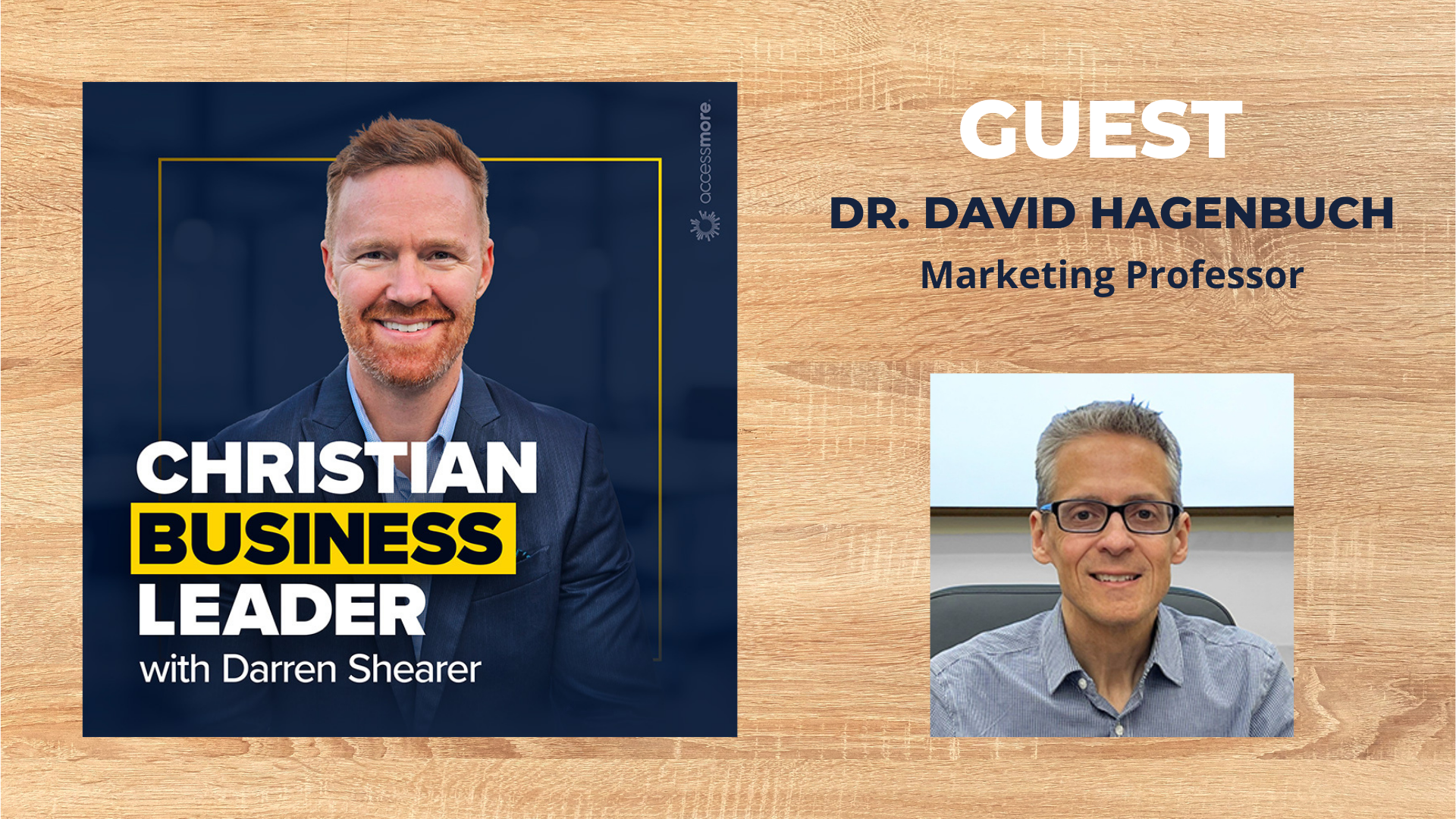
On this episode, Darren sits down with marketing professor Dr. David Hagenbuch to discuss Christian ethics in advertising.
Darren Shearer hosts Dr. David Hagenbuch on the Christian Business Leader podcast to discuss how biblical values shape marketing. David, professor of marketing at Messiah University and author of Mindful Marketing, shares lessons from his family’s business, where his father modeled fairness, generosity, and integrity like covering indecent catalog images to uphold biblical decency.
He highlights modern examples such as CVS refusing Photoshop in ads, Martin’s Potato Rolls maintaining fairness with a Christ-first culture, and the OnSong app, which started in church worship and now impacts people worldwide.
David emphasizes that ethics must be intentional, built on values of decency, fairness, honesty, respect, and responsibility. He urges leaders to translate biblical principles into accessible language, tell memorable stories, and pursue marketing that reflects Christ, not just by avoiding deception, but by choosing righteousness.
Key Takeaways
- Discovering God’s Role in Business: David Hagenbuch grew up in his family’s promotional products company where his father modeled how faith could guide work. He saw business as a way to serve people, treat customers fairly, and reflect Christ.
- Marketplace Discipleship: Christian leaders around him used their businesses as ministry. His father showed integrity by covering indecent catalog images with decals, demonstrating how small choices can uphold biblical values in the marketplace.
- Modern Models of Ethical Marketing: Examples include CVS deciding not to Photoshop ads, Martin’s Potato Rolls maintaining fairness with a Christ-first culture, and the OnSong app starting in a church worship team before becoming a global tool that also supports giving and volunteer work.
- Values That Guide Decision-Making: David teaches that ethics must be intentional and grounded in principles such as decency, fairness, honesty, respect, and responsibility. These values come from Scripture but are also understood across worldviews.
- Translating Faith Into Practice: He urges leaders to express biblical principles in language others can understand, to ask questions instead of making accusations, and to use stories that make lessons stick. In doing so, marketing can reflect Christ in practical ways.
Christian Business Leader is the show for marketplace Christians seeking to explore and apply God’s will for business. If you want to learn more about how to do business for the glory of God and shape culture through discipling the business world, this show is for you.
Full Episode Transcript
Heads up: This transcript was created with AI, so you might notice a few typos or small mistakes. We recommend listening to the episode for the best experience!
SPEAKER_01 0:00
Before we start, if you have little ears near you, I suggest you hit pause and listen to this episode when you’re alone, because the nature of some of the content may not be suitable for all ears.SPEAKER_00 0:12
That’s more.SPEAKER_01 0:14
Welcome to the Christian Business Leader Podcast, where Christ-following business leaders explore God’s will and ways for business. This show is a ministry of the Center for Christianity and Business at Houston Christian University and features conversations with today’s Christ-centered business leaders who are representing Christ faithfully in the business world. I’m your host, Darren Scheer, and if you want to make your work, leadership and company’s culture more Christ-centered, you’ve come to the right place. Hi everyone, and welcome back to the Christian Business Leader Podcast. I’m your host, Darren Schear. On this episode, we’re joined by repeat guest, Dr. David Hagenbu. Dr. David is a professor of marketing at Messiah University, the author of Mindful Marketing, Business Ethics That Stick, and the book Honorable Influence, a Christian’s Guide to Faithful Marketing. He also is the creator of mindfulmarketing.org, a unique model for promoting ethical marketing. Before higher education, he worked as a corporate sales analyst for a national broadcasting company and is a partner in a specialty advertising firm. He’s an award-winning educator with articles published in top academic journals and national news media. And above all, he wants his life to shine a light to God. David, welcome back to the Christian Business Leader Podcast.SPEAKER_00 1:40
Aaron, thank you. It’s an honor to get to talk with you again.SPEAKER_01 1:44
Yes, sir. David, when did you first realize God wants to be involved in the market in the marketplace?SPEAKER_00 1:50
It was very early on for me. And it’s one of those things that was kind of more of a evolution than um like a specific revolution or a specific revelation. Um I grew up in a in a family business. Both my parents were involved in it. My father was uh uh the founder of the promotional products company back in the early 1960s, and um very strong Christian. And growing up in a family business, you kind of always do whatever jobs necessary. It was a small business to try to help out. Um, so I would see him and the things that he would do, even at a young age, that you know, I kind of filed away. And uh later on have told stories about to my students and to others that really had an impact on me. Um, but then later on, uh, as I got older and started to do some sales for the company, and then eventually, after working uh for another Christian business in the Philadelphia area, moved back and became a partner with him in the in the company. Now, really seeing how he and he certainly wasn’t perfect. Um, none of us are, but how he always tried to treat customers, for instance, fairly in terms of price and the product that they got. And that also um, you know, kind of goes by the um, I think it was John Wesley who said, um, earn all the money that you can, save all the money that you can, and give all the money that you can. And he really followed that uh mantra, both of my parents, in terms of the generosity that they had in their church and to others. So using business really as a tool to impact people um beyond the business um in ways that reflected Christ and helped to further the gospel. So um, so again, for me, Darren, it was really uh kind of something that I saw throughout my life and probably a lot of it have only really appreciated, like often we do in in retrospect, when it’s in the rearview mirror and you can kind of look and say, you know, that was different than what a lot of people do, or what some people do at least. So yeah, so I’m very thankful for that experience.SPEAKER_01 4:09
Yeah.SPEAKER_00 4:09
So did you work in the family business? I sh I sure did, yeah. Um, growing up, it was more um being volunteered to do things in the business. But yeah, you’re you know, you’re a kid and you know, you you kind of some of it was more exciting than others. Um, it was a promotional products company, so there were imprinted glasses and mugs and embroidered hats and things like that. So sometimes it was splitting shipments, which meant if a customer was getting a hundred and are getting um 288 mugs, we needed to split them into 144 each so that they would get 144 now and the rest six months later. So doing things like that, you know, basic counting skills. But then again, later on, um, I actually was working doing all kinds of things. It was a business that employed just like seven or eight people, um, which is still it’s it’s a good impact. You don’t want to diminish that. A job is one of the most important things that you can give a person. But um, I wore a lot of different hats when I came back to the family business and was doing things like um doing the graphic design for for the organization and uh managing a lot of my own accounts in terms of being a salesperson and then also overseeing operations as my dad started to step away from the business um in the later years. So yeah, I yeah, I sure did. My my name was actually on the company, it was called John David Advertising. And uh the fun fact that I sometimes share is that I was named after the business. So I don’t I’ve never run across anybody else, other than maybe um someone that would be like uh Johnson and Son Plumbing, and the the son comes along later. So it’s sort of that, but yeah, they picked the name for the business, and there’s a more of a backstory to it, which I won’t get into. Um, but they picked the name David before I was born, and then I was named David. So it was guess it was uh you know kind of meant to be in more than one way.SPEAKER_01 6:14
Yeah, wow, what a blessing to get that discipleship training in a business context. Um, is that is that a was that a big part of what you understand to be your uh uh discipleship journey as a as a young person, the that marketplace uh discipleship.SPEAKER_00 6:37
It sure was. And uh again, as I look back and you know, things become a little clearer with you know years or decades in between, um, I kind of just took it for granted almost at the time that business people were were a vital part of Christianity in the church. Um, as I mentioned, my my father and my parents were both very involved in their church, uh, First Baptist Church of Danville, Pennsylvania. Um, the youth leaders who led the youth program that I were in owned a uh owned the local Chevrolet dealership. And so I just, and there were others that I could talk about. So I just kind of thought, um, not just from my father, my parents, but from others that, you know, seeing what they were doing in their businesses, but also outside of their businesses was very influential. Um, there’s one particular story I can tell here briefly that really impacted me early on. Um, we used to uh get catalogs from calendar companies, and calendars were a very important part of the promotional products business, probably not as much now as they were back then. But you think of if a bank, if an auto dealership buys calendars, it’s it’s often a repeat order that they’re gonna replace every year, you know, their name on the wall calendar. So we would get, there were only though uh a few vendors of those calendars, and you kind of had to, if you’re gonna sell calendars, you had to go with them. And almost all of them, probably all of them, at one point in time, sold calendars in their catalogs that we would get and used to sell from um that were not very appropriate in terms of decency. They they uh would depict women in um very uh well scantily clad, um sometimes with even half nude. And um you didn’t have much choice in terms of using those catalogs. So my father had a very interesting approach though. Um, we would sometimes have, I say, you know, rejected decals. We or maybe the the vendor um got the phone number wrong on a decal that was supposed to go on like the side of a truck for something. So we end up you know keeping those. And my father would would every time these calendar catalogs would come in, um, you know, probably um this time of year, you know, in the summertime or in the fall, he would methodically take each of the dozen or so catalogs and paste over the pictures on the particular pages that had the women depicted like that with these decals. So you had no idea what was under them. They were just completely blotted out. So it never happened to me, but I can imagine that for some of the salespeople, it would be a real conversation starter as they would be showing the count the calendars to their customers and you know, a customer’s flipping through and saying, What’s under that page? You know, you can’t see anything. And, you know, my father would say, Well, that’s something we’re not gonna sell. And, you know, if they pressed on that, you know, he probably would have a conversation about that kind of thing and say, why? And a real opportunity to kind of, you know, unpack of his value on that and decency, you know, and coming from the Bible, you know, what God says about lust and um and just trying to show people at their best and you know, not wanting people to stumble, well, that that value of decency stemmed for him from the Bible, Old and New Testament. So yeah, so those kind of things, um I think that’s why our actions for ethics, um, even if we never take the time to explain to someone, like he didn’t he never talked to me about that. And it wasn’t like he brought me into the room when he was doing that, but you know, I just kind of noticed that that was happening, and people filed that away. And stories are powerful, you know. Think of all the stories Jesus told. Um, they have an impact on us more than we can ever imagine.SPEAKER_01 11:06
Yeah. Wow, what a powerful example of righteous advertising. And just say I’m sure it uh there must have been a follow-up conversation after he said, We’re we don’t sell that, you know, to just explain. I’m sure, like, wait, wait, why?SPEAKER_00 11:25
Um Yeah, yeah, I’m sure that happened more than once. And again, I I never I don’t know why, because I sold calendars, would never ended up in that conversation myself, but um, I’m sure it did with him. And there, there were there were some real characters that we we had as customers, and they I’m sure that they, you know, the first time they saw that, they they wouldn’t let it go. I mean, they they would press on that, and who knows, maybe even would come back to it every year just to kind of you know play around a little bit. But he had a great sense of humor too, and you know, he would he he he would roll with the punches on things like that too. But yeah, it was definitely a a witnessing opportunity in the marketplace, yeah.SPEAKER_01 12:06
So um, so he wouldn’t have been on board with the latest American Eagle advertising campaign with uh, you know, this this beautiful actress. Yeah, Sydney Sweeney.SPEAKER_00 12:19
Yeah, yeah. Yeah. I don’t think so. Yeah, I don’t think so. Um, yeah, that that’s a really interesting campaign. It just I as someone who tries to keep his finger on the pulse of what’s happening in marketing and advertising, it it wasn’t long before that came in, you know, my newsfeed and you know, read different articles and advertising age and others. Um yeah, and I I think he would have um put that in the same category. It may not have actually been as bad. I don’t think it was as bad as some of the things that I was describing, which again, this is like in the some of this happening in the 70s, which you know really was the Wild West in a lot of ways that things have tamed down since then. Um, but yeah, he I don’t think he would have been on board with that. He would have looked at that in this through the same lens of uh decency and trying to, whether someone’s a Christian or not, um you want to think of am I bringing them closer to the kingdom or is this moving them further away? And of course, most of us have heard about studies or just news articles, whatever, that have been written about um pornography and just what a slippery slope it is, and how just one instance can be kind of an impetus for someone um looking into something else and just kind of you know, kind of pushing the needle one step further. Um, I had I don’t know if you remember several years ago, there was a Super Bowl halftime show that featured um J Lo and Um there was um a Shakira doing pole dancing during the Super Bowl.SPEAKER_01 14:19
Yeah.SPEAKER_00 14:20
Now the Super Bowl, and I mean that might kind of be on the same level for a lot of people in terms of you know how much was shown or the innuendo and things like that. Um, of course, with Sydney Sweeney, also the the issue of genes, and I I won’t tackle that right now unless you want me to, but um to try to I honestly I haven’t given that a lot of thought. Um, but the pole dancing thing, it was interesting. I wrote an article about that for mindful marketing. And as I I try to do as much research as I can to kind of inform myself and often bring in people too, because I often don’t know areas that I’m wanting to write about. So whether it’s medical or sports or whatever else, you know, if if I can find an expert, I’ll tap on them. But anyhow, I was looking online, um, just doing a basic Google search to see, and you can see in Google, um, anybody can like search terms over a period of time. And if you looked at that, that specific time when the pole dancing was being done during that halftime show, um, searches on pole dancing increased like exponentially during that time, which for some people you look at that as oh, okay, that’s that’s interesting that that happened. But I don’t think it’s too hard to connect the dots on that and think like, because they’re the Super Bowl reaches like a third of the American population. So we have about 330 million people in the United States. So you think a third of them are watching the Super Bowl, including the halftime show. Now that’s going to include everybody from four-year-olds to 94-year-olds. And particularly as you look at the lower end of that spectrum, like, do you want them to be watching certain things? Or just for anybody, um, do you want them to be searching pole dancing and you know, following up to, okay, you know, here’s a video that shows more pole dancing. And it, I mean, it could, I’m sure it can be a slippery slope for for people, men and women. Um, so those those kind of things you you want to be careful about. Um, I I’m I’m not the one who would say that there’s no place for sex and advertising. I think that God created us as sexual beings. And I mean, and some people would argue with this, but I think there’s places, if it’s for um a vacation for honeymooners, that it’s probably okay to show a man and woman in bathing suits for something like that, because it’s appropriate, it’s contextual. And there’s a lot too that goes in with like, and I I’m not the best one to talk about this, but what are the camera angles and how how long is the camera on a certain body part versus just a quick pan at a distance, you know, versus a close-up on something like that? So you can’t necessarily put everything in the same bucket in terms of like whether it’s sex or not. You know, there’s there are gradations and levels, and I think even Jesus did that too. Like, I I don’t look at Jesus as being legalistic. Like there were definitely times when he came down harder on things than any of us would imagine, but there were also times when he said, Hey, look, look at let’s look at the Sabbath here and the fact that I’m Lord of the Sabbath. And like, so I think that’s important for all of us to have that kind of discerning minds, not just our own, but also with the Holy Spirit, you know, calling the Holy Spirit in to help lead us and certainly reading the Bible, and then having others that can be sounding boards for us, yeah, and that can be um uh people that we look at for even specific issues that are experts in the field to kind of fill out some of the the factual knowledge. So yeah.SPEAKER_01 18:39
And there’s so many uh negative examples. We could talk for you know days and weeks and months about all that. Um what are some more examples? You shared the one uh from your father’s company uh about putting the decals on the uh the scantily clad women in the catalog, which is just it’s such a just a great uh example of faith in the marketplace. Um, yeah, not that we’re uh faith in the marketplace is all about uh saying no to things, it’s saying yes to things, is saying yes to righteousness, it’s saying yes to to God’s ways. What are some examples of how companies are doing uh marketing and advertising in a Christ-centered way? What are some some of those best practices you’ve seen?SPEAKER_00 19:28
Yeah, an example that always comes comes to my mind that I actually used in my book, and I I have this um man who I now would say is my friend, Jason Kickline, come into my uh capstone marketing class, marketing management strategy, because it just is such a good example of this. And I want the students in that class, well, students in all my classes to to be exposed to Christ Center business leaders, but he’s one of the best examples. So um, this is probably well, what now over a decade ago, I lose track of time that the iPad came out, and he was working for another company at the time um in marketing-related role. Um, but he’s a serial entrepreneur, and he he’s also very involved in in church. Um, he has musical skills, so he serves on worship teams. But um, Jason, um, in his particular one particular time when he was in with a worship group and in his church, and the iPad had just come out, and they were having issues with sheet music, fumbling it around and stuff. And and I’m not a musician, but uh I have family members that are, so I kind of vicariously through them, but it can be a real challenge to manage sheet music. And one of the um he said to one of to the team there, he said, it’d be great if this could be done digitally. And one of the um his fellow worship team leaders said, that can’t happen. And Jason took that as a challenge. So he went out and he started to write code, and he’s not only a musician and entrepreneur, but he can also write computer code. So before the iPad was actually available, he wrote code for it. And you know, he’s waiting for it to come in. And as soon as it came in, he ripped open the package, took the iPad, and then started to use the code on the iPad. Anyhow, the short of it is he came up with um a product called OnSong, O-N-S-O-N-G, with one word, and it became instantly one of the most downloaded apps. Um, of course, there weren’t as many at the time, but um in the in the app store, and I believe is still the most popular um music app for digitally handling music. So the very direct um Christ centered application to this is using. His app is used widely among in churches with worship teams to manage their sheet music to help you know you and I and our church services worship. So, you know, it’s hard to get more direct than that in terms of a kingdom purpose. Um that you know, worshiping God. A lot of people would say, Why, you know, and to answer the crush question, why are we here? Well, we’re here to you know love God and love others, and a big part of that is is worship of Him. Well, that’s doing that very directly. Um, but it’s the product isn’t just used for worship teams, it’s and he’ll he’ll you know say this, it’s also used by people in in bars and other venues and things like that. But he’s having an impact on them too as they interact with him through um, he’s very involved and still, he he’s now the um, he’s no longer the CEO of the company, but he’s like a lot of CEOs, they kind of move into more of a emeritus type of a role. And he he’s still very directly involved in problem shooting and just based upon his music skills and his coding skills. Um, but he’s rubbing shoulders with people in all kinds of areas and having um a Christian influence on them, even if they’re not Christians because they’re using it in other places. But the great part of it is, and I I’ve I wrote a paper, uh published a paper about this of different ways of doing social responsibility. So he’s integrated his social responsibility through the way that I was just mentioning. Like every day he and others in his company do what they do, they’re having um an integrated influence on others in terms of you know helping people enjoy the gift of music, which certainly in churches, but in other ways, I think it’s a gift that God gives all of us, um, regardless of whether it’s Christian music or what quote unquote secular music. Music is from God, I would think. And, you know, there’s it’s it’s a it’s a vehicle that he uses to bring people closer to the kingdom. So they’re doing that, which is integrated social responsibility, but they also allow employees to take off a week a year to volunteer. Um, and they’ll go around the globe. Different people, they’ve they’ve helped um churches in a lot of several different countries in Africa by employees volunteering, but then also donation, and that’s the third way. So integration, donation, and then volunteerism, I should say, and then donation, donating money. They they tithe 10% of their earnings um to nonprofits, often Christian nonprofits that employees can nominate. So that’s the that’s the donation. And then the volunteerism, I said that secondly is the third one, where employees can take off a week a year and volunteer for a nonprofit organization. So what a beautiful way to impact um businesses, nonprofits, impact people’s lives, impact the people, not only that are on the recipient end, but the people that are on the giving end of those things, volunteering, or or knowing that part of their their company’s earnings go to those things. But yeah, volunteer um integration, volunteerism, and donation impacting for Christ-centered ways explicitly, but also implicitly. I’ve had a hard time coming up with a better example than that um in anything that I’ve ever seen.SPEAKER_01 25:39
Yeah, yeah. Wow, what a great example of a really full spectrum Christ-centered company that seems to be getting it right in so many different areas. HR and their marketing practices, the product itself is uh of of great value and use to people. What are some other uh best practice? Because you could even take it, even if you had a product like that that had so much potential for good, um, you know, there’s a way to advertise and market even a product like that in a way that could be deceiving, um in a way that, you know, for example, I’m just thinking off the top of my head, like, you know, this is uh um, you know, once in a lifetime opportunity uh when that same deal is going to be available like next month anyway, you know, and those sorts of uh gimmicks that are that are used in marketing practices. I mean, there’s a lot of examples of companies getting it wrong, but can you think of any companies that really are standing out in their industry where here’s a certain practice that everybody sort of understands is not being um ethical, or at least it’s not um it it’s it’s just it’s questionable, we’ll say it’s ethno ethically questionable. But then there’s a company over here that because of their values, they say we’re not going to uh we’re not gonna operate that way, we’re gonna operate this way because we are stewards of what God has entrusted to us.SPEAKER_00 27:22
Yeah. Um there certainly are companies. Some of the ones I think of are ones that aren’t explicitly Christian, but more implicitly so. Um, or or they might just have specific very large, you know, multinational corporations that do things that you look at and you think, well, you know, I wonder if there’s somebody in there that um has a faith focus and decides not to do that. I mean, one of the things that all of us are gonna have to be increasingly in tune to with AI is just what’s truth. And whether it’s visually or verbally, um, I mean, deep fakes, most of us have read about that, maybe come across them. So, I mean, I think of a company like CVS, and they did this quite a while ago. Um, and again, this is like a publicly traded company, but just deciding not to Photoshop um ads that they would run because of the potential for misleading people. And I like I I I still use Photoshop. I used it a lot when an illustrator in the promotional products company, our family business, and I mean, I’m I I love playing with it. You can do some pretty powerful things even without AI, let alone with what AI can do now with generative fill and things like that. But CVS taking a stand and saying, like, we’re not gonna Photoshop, particularly, and I think it was particularly related to ads or not allow ads, even from companies like Lancomb and others for makeup, just because makeup is a product where um you know covering blemishes and things like that is what the product is intended to do. So you want people to get a good sense of the capabilities of the product, not the capabilities of the um the graphic software. So something like that, I think, is an example of again, I have no idea where that came from, but it’s taking a stand to do something that um is kingdom consistent, I would say. Um, Alexander Hill, who is a Christian, and there’s a book that he wrote called Um Just Business, uh he I’m not sure if he still works at Intervarsity, but um he he had and he said in his book, I use this in one of my classes, um, that uh honesty or I’m sorry, deception, which for a lot of people is the opposite of honesty, deception is making someone believe something that you don’t believe yourself. And even as I talk about honesty with mindful marketing in my business ethics classes, I constantly go back to that. So when we think of what you know, we’re on the press press prepitus, precip, I can’t say it. Um precipice. Thank you, Darren. I won’t try to repeat it. Um that with AI and deep fakes and things like that, that that that covers a lot of ground. That no company should be doing something that they wouldn’t want others, um, getting people to believe something that they don’t believe themselves. Another company that is specifically Christian, very kingdom focused, is Martin’s. Now, as I say Martin’s, probably a lot of listeners, maybe some would think, well, there I know five companies named Martin’s. Well, I’m talking about one that probably most of the listeners are familiar with, maybe not all. It’s the potato roll company. Um, Martin’s famous pastry shop it used to go by. Now it just goes by Martin’s. Martin’s is a company that’s headquartered not far from where I am in um Chambersburg, Pennsylvania. They’re now global because of their potato rolls. And they it started with Shake Shack. Um, if you’ve ever eaten in a Shake Shack, you’re eating a Martin’s potato roll or Dave’s hot chicken. They’re they’re around the world now. Um, I think of them in terms of another value, which is fairness. And anybody that I think you would talk to in terms of their um customers or the vendors that sell to them would say, hey, this is a company that treats us right in terms of the price that we’re paying for their products. I mean, who would buy potato rolls and have them and say, because you can’t ship to Dubai or the United Arab et Emirates or other or into Germany, fresh potato rolls, they have to be flash frozen. That’s the limit of my knowledge on this, um, and put in shipping containers and shipped over the seas to get there and still come out delicious. Um, but you wouldn’t do that um unless you’re getting those at a fair price. So they they’re you know, they’re not overcharging for something like that. And or the their suppliers who they’re getting the you know potatoes from or other ingredients, they’re paying them a full price. And I mean, I I don’t know what their income statement looks like. I’ve never seen it, but I know some people that are very directly involved there. My my former collegian may have to name drop a little bit, Scott Heinzelman. He’s the vice president of finance administration for Martin’s, and uh he travels to the um Middle East. Um, why does someone like that do that? Well, it’s for credit reasons, not for marketing reasons, but it’s more financial reasons. So they they treat people well, they don’t treat them as um, there’s an article that we use in my capstone class as a share of the wallet, meaning like let’s try to exact as much profit as we can, but no, let’s make sure that we’re earning a fair profit, but they’re also making they’re they’re gonna be able to make a fair profit too on the burgers that they sell in Dubai or wherever else. Um, so they’re they’re treating people fairly. That stems from the gospel. Um they have, if you go in there, and I can’t remember exactly what it says, but on their floor mats, um, as you walk into the buildings, it you know, says something along the lines of Christ first, put Christ first. Um, so that’s out there for everybody. And they mean they they employ people from a lot of different um worldviews. They’re not all Christians, but anybody there respects the values that they hold that do stem from the Bible. Um, and I think of probably verses like ones from um uh Colossians or from Proverbs, uh, specifically, I guess, where uh God talks about abhorring unfair scales, and that you know, you don’t put your hand down on the scale when you’re selling to someone else, but you treat people fairly in terms of price. They live by that. They live by that, and it’s they’re again very specifically Christian. So anybody that wants to go to their website or go to their business, they see that that’s the reason that they do. Um, that’s that’s beautiful when you can connect the dots like that for people to see. It’s very powerful kingdom um witness.SPEAKER_01 35:26
Yeah, yeah. And the Bible does say that a false weight is an abomination to the Lord, but a just weight is his delight. It’s not just about what we’re saying no to, it’s what we’re saying yes to, and and that God actually uh delights, he doesn’t just delight when you open your Bible or go to church, he delights when you uh are ethical in your marketing and business practices, David. If you could just uh just kind of rapid fire some um uh very practical ways that we can be more Christ-centered in our marketing and advertising, just real quick, just examples that if somebody was gonna jot these down real quick, like what would you say we need to be keeping in mind?SPEAKER_00 36:17
Yeah, I would say one of the top things is you need to have a model, I can kind of call it different words, um, or a framework for your ethics. Like ethics need to be intentional. Like everything else that’s done in business is done intentionally. Um, whether it’s you know, an HR and or wanting to be the leader, the CEO of an organization. I mean, they’re CEOs, um, as they should. Like they’ll have consultants or they’ll have business coaches, you know, very intentional types of things. Ethics can’t just be a back burner, like, well, let’s, you know, this it we’ll we’ll try to be ethical and you know, we’ll we’ll try to remember that. You need you should be intentional about it. And one of the best things to be intentional is to like have a model or framework. Um, it could be a code of ethics for a company, but a good model, a very basic one, is love God and love others, right? That’s Jesus’ greatest commandments. But I think it’s also important to have something that you can be ethically multilingual with. And what I mean by that is, and I have to give credit to Dennis Hollinger, who has been um the president now emeritus at several different seminaries, and he was the college pastor at Messiah University for several years, wrote a book called Choosing the Good, which is where this is from. We need to be able to translate our ethics to others. So, I mean, you and I, as we’ve done here, can talk about Bible verses, and that’s wonderful. That, you know, edifies both of us. But if we’re dealing with which a lot of listeners are with their employees or their coworkers who don’t have a Christian worldview, we need to be able to translate um on the fly sometimes things that we know are biblical, but in ways that they can appreciate. So, five values that like so the model is the general thing, five values that I often go back to, which are in the codes of ethics of a lot of different companies. I’ve done research about this, are these decency, and we’ve talked about these along the way, decency, fairness, honesty, respect, and responsibility. And I have Bible verses that I you I can connect to every though, every one of those, but those are verse, those are values that almost anyone from every any worldview can relate to, or or if you want to distill it down, back down, the golden rule, right? Treat others as you would want to be treated. That’s biblical. You can find that in at least a half a dozen dozen different places in the Bible said in different ways, but it’s also found in every major world religion. So you could talk to someone that um is Muslim or Hindu, and you know, they probably they they do have something in their scriptures that relates to that. Um, and to me, that goes back to Romans 1.20, that um God’s imprinted on everybody’s hearts ideas of good. So um, you know, this isn’t, I’m not saying that to try to support Islam or Hinduism, but just we have we need to talk to people. We need to make decisions with people that come from different worldviews. So those five values, they cover a lot of ground, as does the golden rule, do unto others as you would have them do unto you. Um a couple other things here quickly is it’s always better to ask questions when it comes to ethics than it is to point fingers. So I try to remind myself, like, and I’ve had things even not long ago that have come up in you know, different associations that I’m a part of and things. So if you can, if we can remember to say, rather than say, like, that’s really indecent, like back to the Sydney Sweeney thing, or you know, that boy, that’s really terrible. Like, say, you know, I I wonder if that’s something that that would be better to to try to find a different approach to, or I wonder if if that’s the right way to, so just framing something as a question, which doesn’t seem like a big thing, but that will tend to lower the defenses for people much better than an accusation. So that’s another thing that I think so um that that along with the model being ethically model multilingual, asking questions. And then one final thing I’ll mention here, Darren, which we’ve done along the way, is try to think if there’s a story that you can tell. Because those stories stick with us more than anything else can. And like that’s the reason that I called the book um ethics that stick, or one of the reasons is we we need to make faith, our faiths, and Jesus did that with the parables. Like they would have rolled off the disciples at the time and off of us if he didn’t use them and like never would have remembered them. But when he talks about the parable of the lost coin or the prodigal son, or you know, um the the wedding and the lamps, like they we remember that. So to have stories that we can tell, whether it’s about ethics or other business principles, that will go a long, long way. So I highly recommend to everybody, if you’re better at remembering things than I am, and then put them up. I’m pointing to my head right now, um, put them up there. Or if you’re con if you’re continually forgetting things, like as I do get older and to write them down, which is also biblical, you know, um, right on the door post of your house or on your iPad or laptop, type them, keep a file of these stories so then you can go back to and remind yourself of them and use them. Use them to teach biblical principles, use them to bring across ethic, ethical, moral principles. Powerful, very powerful if we can all remember stories.SPEAKER_01 42:15
Yes. Well said, David, mindful marketing is the book, and mindfulmarketing.org is the website. Uh, David, anything else you want to say about how people can hear more from you?SPEAKER_00 42:28
Yeah, I I love to connect to people on LinkedIn. I’m pretty easy to find. Um David and Hagenboo, H A G E N B U C H on LinkedIn or in other ways. Um I, you know, love if people subscribe to the blog. I put that out once a month at mindfulmarketing.org. You can see it there. And and hearing people’s perspective on things. I’m constantly wanting to learn um in that way and interact with people through that. Um, and then also just my email, um, first and last name at gmail.com. Feel free to reach out to me that way. Or um or my email at messiah is a little tricky, but it’s d h a g e n bu at messiah m-e-s-s-i-a-h.ed-u. So I’d love to, I’m I’m kind of old school, Darren. So, you know, email still works great for me.SPEAKER_01 43:31
Awesome. Well, David, thank you so much for spending time with me and our listeners today and helping us to be more Christ-centered in our marketing and advertising. My pleasure, my honor. Thank you for the great work that you’re doing. Thanks for listening to this episode of the Christian Business Leader Podcast. Be sure to subscribe, leave a review, and tune in for the next episode as we continue exploring God’s will and ways for business.
BIG THANKS to this episode’s sponsor: High Bridge Books
High Bridge Books helps Christ-centered authors build a legacy by crafting and publishing messages and stories that glorify God in all spheres of culture.
- High Bridge Books’ professional book publishing package: https://www.highbridgebooks.com/publishing/
- High Bridge Books’ proofreading, line editing, developmental editing, and co-writing services: https://www.highbridgebooks.com/editing-and-proofreading/
- Examples of our books: https://www.highbridgebooks.com/bookstore/
We’re extremely proud that …
- 45% percent of our 204 books under contract were written by authors who have published more than one book with us, and
- 51% percent of our books under contract were referred to us by authors who have previously published with us.
Contact High Bridge Books’ CEO Darren Shearer at [email protected] to get a conversation going about your book!