AI, Robotics, and the Labor Crisis (w/ Matthew Chang, PE)
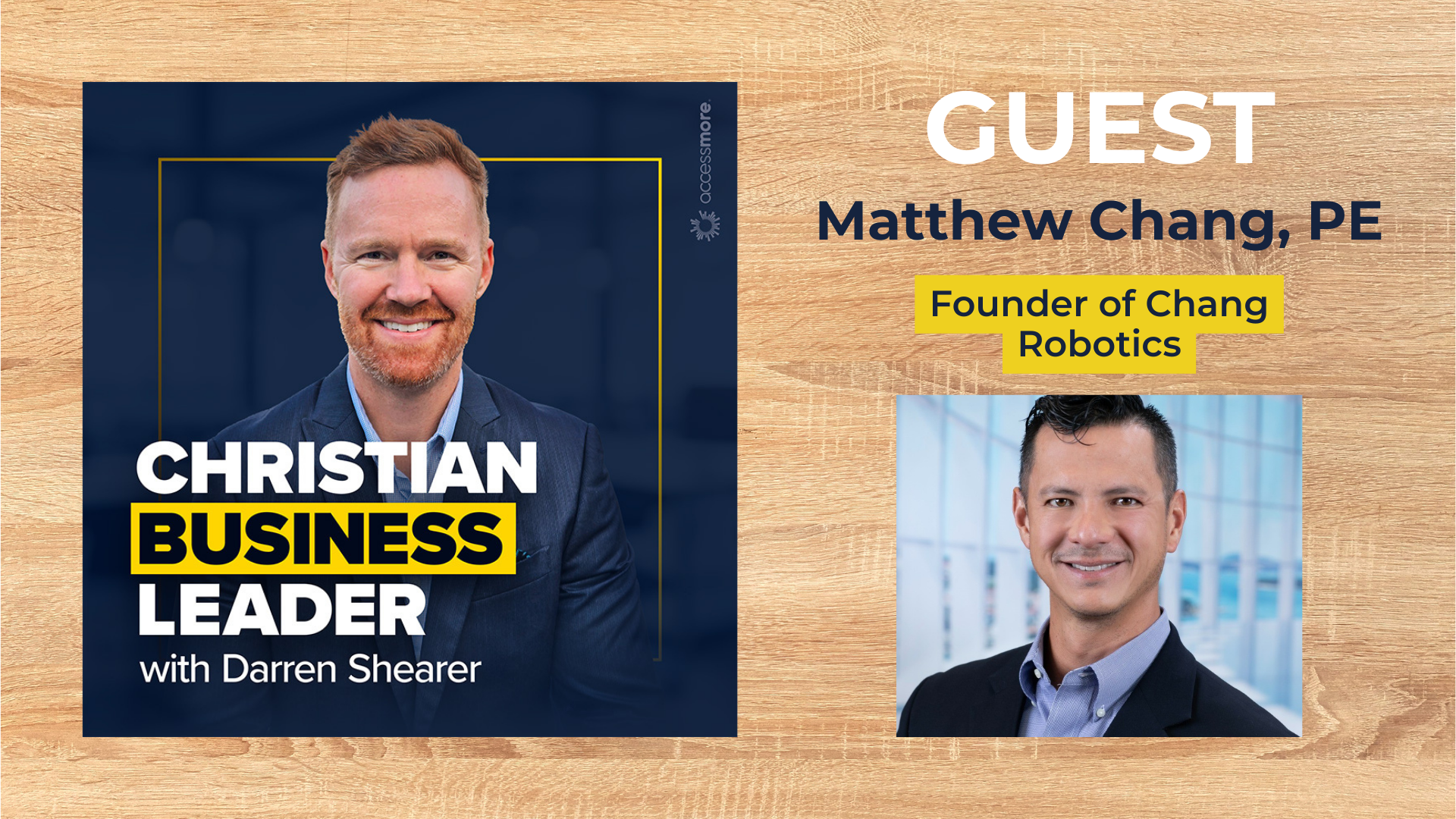
On this episode, Darren sits down with Matthew Chang (Founder of Chang Robotics) to discuss AI, robotics, and the impending labor crisis from a Christian perspective.
Matthew Chang, PE is a visionary engineer, entrepreneur, and author of Risk-Taking Is Biblical. As Founder of Chang Robotics, he has led some of the world’s most advanced autonomous technology projects while building his company on biblical principles of stewardship, excellence, and courage. A TEDx speaker and Executive MBA graduate, Matthew blends faith and innovation to show how Scripture informs bold leadership in modern business. He also serves on the boards of Lifework Leadership and Jacksonville University. Matthew lives in Jacksonville Beach with his wife, Jamie, and their four children.
Key Takeaways
- Faith and business can reinforce each other. Matthew shows that openly integrating Christian beliefs into a company’s identity attracts meaningful conversations and strengthens internal culture.
- Automation creates opportunity instead of eliminating it. He argues that modern robotics upskills workers, improves safety, and boosts American competitiveness rather than replacing people.
- Risk is central to impactful leadership. His story and book highlight that stepping into uncertainty with preparation and conviction can lead to major breakthroughs and expanded influence.
Christian Business Leader is the show for marketplace Christians seeking to explore and apply God’s will for business. If you want to learn more about how to do business for the glory of God and shape culture through discipling the business world, this show is for you.
Full Episode Transcript
Heads up: This transcript was created with AI, so you might notice a few typos or small mistakes. We recommend listening to the episode for the best experience!
[00:00:03] Darren: Welcome to the Christian Business Leader podcast, where Christ-following business leaders explore God’s will and ways for business. This show is a ministry of the Center for Christianity and Business at Houston Christian University and features conversations with today’s Christ-centered business leaders who are representing Christ faithfully in the business world. I’m your host, Darren Shearer, and if you want to make your work, leadership, and company’s culture more Christ-centered, you’ve come to the right place. On this episode, we’re joined by Matthew Chang. Matthew Chang is a visionary engineer, entrepreneur, and author of the new book Risk Taking Is Biblical. As founder of Chang Robotics, he’s led some of the world’s most advanced autonomous technology projects while building his company on biblical principles of stewardship, excellence, and courage. A TEDx speaker and Executive MBA graduate, Matthew blends faith and innovation to show how scripture informs bold leadership in modern business. He also serves on the boards of LifeWork Leadership and Jacksonville University and lives in Jacksonville Beach with his wife, Jamie, and their 4 children. Matthew, welcome to the Christian Business Leader podcast.
[00:01:24] Matthew: Thanks, Darren. Great intro. Appreciate that.
[00:01:27] Darren: So, when did you first realize God wants to be involved in your work in business?
[00:01:31] Matthew: I was an engineer at a large company in Jacksonville, Florida, and that’s when my— I’ve been a lifelong Christian. I was baptized when I was 12 at the church I grew up in. But then I felt really convicted to merge faith with everything when I was in my early 30s. And so, about 30 years old, And I started what I called a cubicle ministry. And what I learned about ministering to people, witnessing to people, is sometimes you have to be right where they are to reach them. Engineers are a comfortable bunch, you know, so they have, you know, good salaries and 401(k)s. They’re very smart, very good at calculating things out. They’re very deliberate. So there’s a tendency to have trouble finding a need for God when you don’t need anything. So what I found was that me as an engineer right there in the office with them, that it put me in a unique position to tell them about Jesus because we came from the same place. And then the kind of catalyst for really doing that was I signed up for my first short-term mission trip as an adult, and I had to raise money. So I went around, and I asked all of these colleague engineers. There was probably over 100 that I asked, hey, I want to go to Africa, and I want to do this mission trip. Will you support me? And so that took— I had to go talk to each and every one of them and then send them an email explaining what I was doing and send them a fundraising page. And for those that were interested, oftentimes I had to go have a longer conversation before I could pick up a check. Right. So, that was a great way for me to kind of rip the Band-Aid off and share my faith openly with every single person that I worked with.
[00:03:31] Darren: Wow. And so, how did you get into the robotics business?
[00:03:37] Matthew: Totally by accident. You know, this is the God’s plan type of story. I was a professional engineer. I had traveled to and lived in many countries, as you kind of alluded to in your opening. And I was recently married. I was about to graduate with my executive MBA, which was sponsored by a company that wanted me to build a new department for them. And then I got fired right before graduation. And so in the last 6 weeks of business school, I became the greatest student of all time. But the previous 2 years, I was the worst student of all time. So, I made an about-face on that because I suddenly had free time. And my wife looked at me the day after I got fired, and I was very sad. They took my company truck. I was really proud of it. And she said, well, you always wanted to do your own thing. Maybe this is God telling you to do that. And so whether it was God-inspired or, you know, trying to pay a mortgage-inspired, I was like, yeah, I should do that now. And so I opened a company, um, the week after I got fired. And I had this like really interesting moment where I got fired on a Monday, uh, and then my wife gave me the pep talk on Tuesday. On Wednesday, I was the middle school boys’ youth group leader at my church. And so Wednesday night— and I get, if you’ve ever been a youth group leader, you get it.
[00:05:10] Darren: I am right now actually with the middle school boys. That’s my group. Yeah.
[00:05:14] Matthew: Yeah, that’s my jam. 6 to 8 and no farther, right? Yes. Wrestling, I want to win. And once I get to high school, it gets dangerous. And then once they get too high in high school, they’re too smart, and they know all the answers. So I like them right in the middle when they’re kind of goofy, and you’re still stronger and smarter than them. So we were learning about covenants. That was the lesson for the night. And you know how it is, we get these kids when they’re tired, they’re worn out, they haven’t eaten probably. And it’s really hard to keep their attention, you know, in the evening.
[00:05:45] Darren: But they eat like 4 bags of chips that the youth pastor lets them have, and, uh, and they crinkle the bags the whole conversation. It’s great.
[00:05:53] Matthew: That’s right, that’s right. Or if we have, uh, if somebody blesses us with a bunch of pizzas or something, I mean, it’s just a mess. But so we, we were learning about covenants, and just to take it back to a 7th-grade level, you know, a covenant is a promise, not a contract. And so we all took turns doing covenants on a card. The purpose is we’re going to make a covenant with God, and we’re going to lay it at the altar. And so as the leader, I always went first to show them how to do it. And theirs were very typical. I won’t kick my sister. I’ll clean my room. You know, I’ll do my homework. Those were the covenants. And mine was Dear God, I will start a Christian engineering company. And that’s all it said. And then I put it at the altar. Um, our— one of our executive pastors is a tech executive turned pastor, and I always joke with him, I know you upload these to like a Web3 database and then send it up to heaven. He’s like, “Oh yeah, we got a permanent record of any card you ever submitted. So I’ve always felt a strong accountability to that because that was a covenant. It was laid at the altar, and then our pastors, you know, sweep them into a collection bin or whatever, and we don’t know what happens to it, but we have to assume that it is still there and it’s permanent. Um, so that was it. Uh, Monday, Tuesday, Wednesday. The following Monday, I got a call from a former customer back when I was at a company. She said, “What are you doing? Said, well, I’m sitting on the couch in my pajamas on my wife’s laptop. I didn’t have a laptop, and, uh, because my company took mine a week ago. And she goes, why are you doing that? So, well, you know, I got fired. She goes, “Well, I need you to be up here Monday, and before you get here, I need you to get a suit, get a job, and get a haircut. So if you’ve seen videos of me online, I like to joke; I did two of the three. Right. So everything about the haircut and flew up to see her. That was our seed capital from the family bank account, was booking that flight, booking that hotel, you know, not knowing what was in store. And she put me to work all week in a factory, leading her team through an innovation and manufacturing optimization exercise. And at the end of the week, she walked me to the accounting department, told me to give them my information, and fill out the paperwork to get paid. That was it. We had a company. We had one client, and we had a company. So we’re in business. And I say we— that’s what, when you’re a founder, that’s what you do in the early days. You say we. We, yeah. Sounds like more than just you.
[00:08:39] Darren: Yeah. CEO, um, right? Yeah, it’s a big, uh, it’s got a lot of weight to it. So what aspects of robotics are you involved in?
[00:08:52] Matthew: Yeah, we’ve grown a lot over the few years, and now it is we. We have a large team, an excellent world-class team. In the first year, we learned what our purpose was as a business, and that is very often the case. It’s your client— you don’t tell your clients what you do, your clients tell you what you do. And so we ended up getting asked to design the first autonomous bus system in the country in the city of Jacksonville. And that was a high honor. It was crazy intense, very political. You know, we had to work through the council and mayors, and eventually we worked all the way up to President Trump and won the seed funding to build this autonomous mass transit system directly from the first-term Trump administration. [Speaker] So that was project one that said, oh, we can figure out how to do autonomous things. And in high-stakes environments, kids with skateboards could go in front of our vehicles, people in wheelchairs or with vision or hearing impaired are gonna need to use our vehicles. So we had to really think it through carefully because it’s a public service. Then at the same time, we got recruited to develop the next generation technology for one of the nation’s biggest coffee companies, which is Keurig. And at that time, Keurig was looking to do a radical transformation with robotics and automation. It was 2017. And, you know, God is funny how he works. We didn’t have much of a resume, but no one else did either.
[00:10:33] Darren: Yeah, right.
[00:10:34] Matthew: And it was kind of the early days of next-generation robotics, and some of the first instances of what we call AI today was machine learning at the time. And so before you knew it, we were traveling the entire country, automating and deploying advanced digital technologies for Keurig. And so by the time we had completed both of those assignments, we had more resume in autonomous systems than really anybody outside of maybe Elon Musk or Waymo.
[00:11:05] Darren: Wow. So the bus system, is it functional? I mean, is it widely used? Yeah, like, how many people are traveling on or commuting on autonomous buses in Jacksonville today?
[00:11:19] Matthew: Anyone downtown can ride it. It’s, um, it’s what we call a circulator. Uh, and so circulator is, if you’re not too far from Charlotte, they have a light rail, and some cities have a trolley or streetcar. So the problem with those is they’re really expensive, and they’re never going to get expanded. There’s always this grand vision that one day this, the transit system will go out forever. Look at MARTA in Atlanta. It was always supposed to be more, and they got stopped because it’s just so expensive. So what our goal was to totally disrupt the cost model of deploying public service transportation. Our thesis was autonomous vehicles provided the pathway. We’re using existing roads, and the vehicles are really not that expensive. So we have 14 fully autonomous buses downtown Jacksonville. They operate on a fixed route in mixed traffic, so they commingle with the other cars. They go from our major regional bus transportation center. We have a monorail. They connect to the monorail, and then they go to the Jaguars Stadium. And along the way, you get museums and City Hall, and, you know, you get some of the main features of downtown Jacksonville. So you can hop on it. It takes Apple Pay. You know, it was one of my requirements, and it goes to the Jaguars stadium. That was another requirement. So if we get those things right, you know, people will use it. So it’s fully operational. And I invited you before the showdown in Jacksonville. When you’re down here, we can go ride it together.
[00:12:57] Darren: That’d be awesome. Have you gotten Trevor Lawrence on it yet?
[00:13:00] Matthew: I don’t know. You know, I’m out of it now. It’s very much the city’s property these days.
[00:13:06] Darren: What you got to do, get the Jaguars to go take a team ride on it.
[00:13:11] Matthew: Yeah, absolutely. Yeah, we’ll have fun with that. Well, it’s kind of crazy to think that a city can go just build an autonomous vehicle.
[00:13:19] Darren: Yeah.
[00:13:21] Matthew: And that was what we were trying to prove, is that that was possible. So I’m glad that history played out. Technology worked out. You know, uh, the project was completed through the pandemic, so there was a couple of headwinds. Um, but yeah, we proved that you can.
[00:13:36] Darren: Anybody get hurt in the process?
[00:13:38] Matthew: No, no. So, so far as I know— I’m not plugged in, it’s not like I have a dashboard to their data— but so far as I know, it’s a perfect safety record so far.
[00:13:47] Darren: Wow, praise God for that.
[00:13:50] Matthew: It would be in the news if it did happen, so I’d probably—
[00:13:52] Darren: oh yes, no doubt, no doubt. People would love for that to happen. So Matthew, on this show, we believe that the primary purpose isn’t primarily just to make a profit or even to make money to donate to Christian ministries, but fundamentally to make disciples of Jesus. And that businesses are the primary places where that happens because that’s where we spend most of our waking hours. So can you give us a specific example of how disciple-making has happened through your company and is happening?
[00:14:24] Matthew: Yeah, absolutely. The first is really your public declaration of faith. So we know as believers we’re going to go in front of people and we’re going to say that Jesus Christ is our Lord and Savior. In our business, we had to figure out how do you do that as a company. You know, legally, a company is a person, right? Legally, a company can be liable or own things. So a company is a person by the law. But obviously, we know that a company is just made up of people. So we had to figure out how does our company publicly declare our faith. So what we elected to do was we put it front and center on the website first. Well, I should say it’s second. So you go on there, you see robots and engineering, and then as soon as you want to read about us, we make statements about our biblical worldview, and we have a statement of faith that we think captures the way we view the world. And then we go into further elaboration of our principles and values that are all Bible-based. So that’s the first step, is that— and no sooner than we went live with the website did I start having people contact me and want to schedule calls just to talk about that. You know, I was probably excited, like, hey, this is a customer, they want to buy something. And, uh, and they said, no, I’m really just here because I just want to understand how can you have a business and say that you’re Christian? I’m like, well, it’s— I don’t know, we just did it, right? So I can’t tell you how, we just decided to do it. And so that’s the first, is it makes a public influence on other people enough to where they’re going to want to kind of get through the friction of wanting to schedule meetings and just learn more. And the people that I still remember, the first 4 or 5 calls I had like that were pretty influential executives. And they must have been wrestling with that themselves. So I know it’s had an impact on other businesses and executives, where they see it enough to want to reach out and talk about it. The second thing that’s happened is it’s been a huge encouragement to our own flock, the people inside our company. It is not a requirement to be a Christian to work at Chang Robotics. Absolutely not. But you will get a heavy dose of Jesus if you work there.
[00:16:37] Darren: Yeah. Right.
[00:16:39] Matthew: So what’s happened is I’ve had agnostics and atheists, you know, engineers probably are outsized in that population, and they will reach out and say, “Hey, can you pray for this?” And it’s a really cool thing to have people that, quote, don’t believe in God, ask for prayer. Yeah, because they witness the power of prayer. When we— when our business is struggling, and if anyone scaled a company and tried to be ambitious, you’ve experienced this. When we’ve had tough times, and we call the entire company to prayer, or I might lead by letting my executives know that I’ll be in a fast for a season as we wrestle with something, and then a miracle happens, which has always happened. Like when it seems darkest, the next day is the brightest. And that has been, I think, a huge encouragement to our team. What it’s resulted in is we have maybe the lowest turnover you’ll ever find. So for our first 6 years in business, we had zero resignations or retirements, and the team kept growing every year. We’ve gotten bigger every year. We broke that streak. So we’re closing in on 9 years in business, and we’ve had a total of 3. Yeah, but at, you know, at some point in a decade, you’re going to start to lose people for whatever reason. Uh, and I still remember our first person to resign came to me, and she gave me a 6-month notice. I was like, “Oh, well, that was nice.” And she goes, I don’t want to leave. I— but she wanted to pursue, actually, of all things, full-time ministry. And I said, well, I can’t— obviously, I can’t offer you that here, and I can’t compete with that, but we can support you. So we designed a special package for that young woman to make sure that we sent her equipped, just like you would a missionary, into the mission field. So I know it’s had a huge impact on our people. And I would say the third thing is families. Our company gatherings— we’re a remote company, we’re spread all across the United States. We hire for talent. We don’t care where you sit. We trust you to be responsible and do your job, and deliver world-class work. And that comes with the benefits of all of our, all of our workers that have children get to drive their kids to school. If you need to take time off to go to the special function at school or your, your aunt is sick, and you need to be with her, there’s no questions asked. You take care of your family first. And so at all of our company meetings, I’ll get to meet a spouse that I’ve never met before. And I’ll usually just get a big hug, and they’ll just say, thank you so much. The way the culture that you guys have built has been so empowering for our family. My spouse is suddenly way more present, the kids are more engaged. And so I think the spillover into family life is where it starts to have, you know, kind of that next generation impact because those are kids and spouses that are being positively impacted by the way we do work.
[00:19:48] Darren: So the executives— so y’all are contending for, I mean, huge contracts with Keurig, with, you know, the city of Jacksonville and, and others, which was the DOT, right?
[00:20:02] Matthew: That was that. Yeah, sponsored as their pilot project.
[00:20:06] Darren: So, yeah, so, so being so faith-forward on your website, through your, your reputation, you find that that that’s a turnoff for some of these big clients, or does it open up more positive conversations? Like, what’s been the experience?
[00:20:27] Matthew: The short answer is I don’t care.
[00:20:29] Darren: Sure.
[00:20:31] Matthew: But the longer answer is it has made no impact. In fact, what we’ll find is these large corporates or elite organizations that you know, let’s face it, not everybody’s looking for an autonomous robot system. So the elite organizations that are, I’ll usually always get pulled aside by one of the principal executives within this corporation that’s like, “Man, that’s so cool.” You know, I’m so happy for what you’re doing. God bless you for sharing your faith. And what I think it actually does is for the people that wouldn’t care for Christianity, they don’t, it doesn’t change anything for them. For the people that do and really wish they had a more bold way to share their faith in the workplace, it causes them to be our advocate. They know what we stand for. They understand our integrity. Our word is our word. We do contracts for a living, but my handshake is the contract, right? And we support audits for a living. Companies trust us with a lot of money. And so one of the culture traits we have in our company is you be audit ready all the time. Customer shows up to the office and wants to look at the books, get them a nice chair, and print the books. So our customers trust us because they know that we’re operating with a higher mindset than legal compliance, right? It’s not about legal compliance for us. It’s about biblical compliance.
[00:21:57] Darren: Wow, that’s a great answer. I mean, with such high stakes, you want to know with whatever degree of certainty you can get that these are people that will do what they say they will do and are held to a higher standard beyond just the legal one. You know, just that— I don’t know if you ever read that Harvard Business Review article that business bluffing is ethical, where, you know, it should be fine to do business like you’re playing a poker game. And everyone expects everyone at the poker table to bluff and be dishonest because it’s, hey, it’s part of the game. But when it’s your money on the line and your reputation, you want to work with people that are held to a higher standard than that. So I love to hear that. And I’m sure that it emboldens them to be more Faith Forward? I mean, you find that a lot of these decision makers are believers, that like they— it’s not that they are just indifferent to it, but that they’re actually encouraged by that testimony?
[00:23:14] Matthew: Yeah, I think— well, I can say firsthand for a number of our executive sponsors, so in my role, you know, we become very strategic for our customer, and obviously they’re important to us. And so in all those relationships, we have what’s called an executive sponsor. It could be somebody on the board or the C-suite that is really championing this robotic transformation that we’re trying to deliver. And for all of our executive sponsors at our customers, they come to really appreciate it. It creates— they’re not afraid to ask for things when they need it. And businesses like that, you know, we have what’s in the contract, and then we have a lot of stuff that’s outside the contract. So when our customers call and say they need something, they know that they can call us with 100% certainty. We will do everything we can to get it done, even if it’s, quote, not in the contract. On the flip side, if we’re spending a lot of money, it would be nice to get paid back. And sometimes we have to operate on trust, right? It’s like, okay, I’m going to do this for you. You know, hopefully, that next budget cycle coming up, you can cover me on that. And I’ll tell you what has been really powerful is we— you might be headed here in the interview, but we are a tithing business. We tithe directly out of the corporate profits every period, and it’s the first pre-tax. So, just a side note, if you tithe after tax, let’s just ask ourselves, is that the first or is it maybe the last? But because of that, they know that if they cause us to not make a profit, that they are having a direct impact on our ability to support ministry. And so what we found is it’s so far it’s worked 100% of the time, is that we can operate outside of our contracts on a trust basis. We will do what we say we will do. And then our clients have always delivered back for us.
[00:25:11] Darren: Yeah. So what do you say to those who say, “Hey, Matthew, you guys are trying to take jobs away from people by building these robotics?” How do you respond to that from a Christian biblical perspective?
[00:25:28] Matthew: You’re going to get an engineer’s perspective on this one. So, okay, let me run through the. We’re going to start macro econ, then we’re going to zoom in. If you’re an American manufacturer, which is probably my favorite sector overall, is factories and manufacturing. Your competition is not within the factory, and it’s not down the street at Joe’s factory. It’s another country. And we’ve seen that. That was our thesis in starting the business. And it’s been put on the national spotlight over these last few years. The vast majority of things we rely on in everyday life are made overseas. So automating an American factory is not taking away an American job because that factory is competing with a factory in another country who may not be playing by the same rules we’re playing by, maybe getting government subsidies and maybe dodging things like tariffs. So by equipping the American workforce that’s in a factory with the latest and greatest tools. We’re just helping them be globally competitive. So we’ll start with the individual worker. Let’s say you’re a line operator in a factory, and then your company invests with Chang Robotics in a bunch of advanced autonomous robots, collaborative robots, digital systems, IoT, all the latest and greatest. Then you have been upskilled. By the time we’re done with our work, that employee has received multiple certificates in new technologies. And what I like to say is for the first time ever, they want to open a LinkedIn page, right? Because previously they were a blue-collar factory worker. What’s the point in having a LinkedIn page? Now all of a sudden they’re certified robotic technician, certified robotic repair technician, certified software program. So it’s an upskilling, and upskilling results in higher pay. So, for the people that embrace our technology, they will get paid more, and they will become absolutely essential to their business because they know how to run the technology. We know how important the IT guy is, right? You can’t live without that person. So when it applies to robotics and the direct operation of the business, it’s even more critical. The second is, this is gonna be hard to understand for a lot of people in the audience. We don’t have the manufacturing workforce we need to reindustrialize. It’s something like 11 million people in the country work in manufacturing right now. If we are to double manufacturing in the country, we can’t just produce another 11 million people. What we need to do is take that group of people that’s currently dedicated to manufacturing, add some new guys, add some young bucks into the equation, and then we need to give them tools so they can produce way more and outcompete our overseas rivals— the European Union, Japan, China, Vietnam. These are the places we’re competing against. So to have a manufacturing renaissance, we need to do more with less. The next is when we look at automation, we don’t look at the job. We’re not like, okay, Darren runs a Christian podcast, let’s build a robot that can do that. You’re gone, Darren. We look at the task being performed, and we start with the most arduous. So these are the injury-prone tasks, repetitive lifting, that’s always the number one for injury, unsafe tasks. Where are we putting workers in harm’s way? If you’ve been to a warehouse, you’ve seen a pallet stored way up next to the ceiling. Who’s gonna fish that out, right? And so that can’t, there are a lot of jobs that are very hazardous. So the first place we’re gonna look to automate is the hazard task. The second is the repetitive motion, which leads to injuries and workers’ comp. We’re gonna get that out of there. And we interview the workers intensely. We always have workers involved in our design process. And the best example I’ll give you is earlier this year, we delivered the first autonomous hospital in the nation. In this hospital, every patient room is supported by autonomous robots delivering supplies. Every nurse is supported by autonomous robots so that when they ask for supplies, they don’t have to go get them. A robot brings them to them. In that process, we didn’t lay off a single nurse. What we did was we brought the nurse manager into the engineering team. She probably tells her kids about it, all these dorks she had to meet with, you know, for a year straight to figure this out. And we were able to get real nursing feedback into what the system should look like. When we finished the system, we surveyed the nurses. We gave them enough time to learn to use the system every day, and we surveyed them. 96% of the nurses approved of and were happy with the robotic system, which is a really high score for any workforce. So that’s an example. The nurses are happier, they have an easier job, it’s less hard on their feet and running around, and they’re more present with patients because they have robots doing the running around, not the nurse. Another example, our bus system in Jacksonville was approved by the Bus Drivers Union of Jacksonville. So we worked not against the workforce, we worked with the workforce to say, what would it look like to make you feel like this was a win for you? And the attributes that went into our design were largely influenced by the bus drivers’ union. And I’ve got endless use cases. We’ve done it in factories and e-commerce. One of our next ventures is going to be autonomous ports in the United States. So, you know, we’re going to be having long, deep conversations with the longshoremen. Those guys made the news last year pretty strongly, but we’ve already gotten the endorsement of the truck drivers’ union. So that’s one of the things we’re gonna do, always is think about the worker when we do the work. It’s about multiplying, it’s not about keeping static. After we’re done, the company that we’ve helped should be making multiples more products or multiples of more efficiency.
[00:31:26] Darren: How is the truck driver or the bus driver more happy now that they’re not driving a truck or a bus?
[00:31:35] Matthew: Well, we didn’t take any bus jobs away. We didn’t have a downtown circulator, right? So going back to that example, we didn’t have a streetcar, we didn’t have a light rail. Um, so we were not replacing— there’s two two modes of bus driving. Well, there’s three. There’s bus rapid transit, the long haul, those are the express buses, fixed route, which is the one that stops at every corner, and then there’s paratransit.
[00:31:58] Darren: So these are just different routes that they were still driving their pre-existing route, but they just added a new route, a new mode of transportation, just like adding a trolley to the city.
[00:32:11] Matthew: And then the other part was they have first rights for their bus drivers to join the autonomous system and get certified. So what you’ll find if you go there today, and you go to the maintenance shop, more than half of the workers came over from the bus drivers’ union, and they said, I want to work with technology. So that was an upskill for them. So it’s not a zero-sum game, right? We’re— I believe in a multiplication economy. I think that’s biblical. When we look to do something, it’s about multiplying. And if we’re multiplying, that means we have to take the people we’ve got and equip them to do more.
[00:32:46] Darren: And the principle that you talk about in your book is that risk-taking is biblical. And to upskill, to go from being a bus driver to now you are a robotics technician, you know, able to operate these autonomous vehicles in whatever ways that that’s done, you have to take some risk to step out of what you’ve always known. Just like you had to take a risk to go from one industry to start up something that hardly anybody was doing, and you’ve been rewarded in spades for that. And that’s biblical. So what do you teach in your book, Risk Taking Is Biblical?
[00:33:40] Matthew: Yeah. It’s a how-to guide with practical advice, steps, and scripture.
[00:33:48] Darren: So I give you—
[00:33:49] Matthew: of course, I give you a story. I know you know a lot about book publishing, so there’s a fun story in there, but there’s a lot of substance because an engineer wrote it. So I explain exactly how to do it, how much time things should take, and where money is required, suggested amounts of money to go through 12 steps to taking a kingdom-changing risk. To some of your listeners that are pretty advanced, they’re probably already on chapter 6 or chapter 8. They’ve progressed through the beginning portions. They’re just not quite at jumping off the deep end yet. For some folks that always had a dream but are just working that job and never thought about how they could step out, they need to really ground themselves in chapter 1. And so it’s focused, you know, if you look at Christ’s ministry, He spent 30 years in preparation, and then before he actually went and did anything, he gathered disciples, right? And then after that, his ministry took off, and it had different phases. Even within that kind of short 3-year ministry where he changed the world, it had different phases, and ultimately, obviously, it ended up with succession. So, you know, I take them through that, but obviously, we’re not Jesus, so I make it more any person can do this if they have an idea how to find out what their kingdom-changing risk is going to be. Could be starting that nonprofit, going into full-time ministry, or obviously starting a business. And if you’re going to do that, is it a startup like I did, you know, an ambitious, likely-to-fail startup, or is it something a little more safe. Like, hey, I’m going to start to grow franchises so that my family has a business to call our own. We might keep working our jobs, but we’re going to now own rental properties or franchises or something. So I give people some real, practical steps to figure out what they want to do. And then once they know what they want to do and it’s in alignment with their God-given talents, then how to be in a state of preparation to go do it.
[00:35:57] Darren: And the Parable of the Talents is really the foundational parable that you kind of build this on, right?
[00:36:04] Matthew: That is the base text, and it’s in the first part of the book. I think it’s right immediately after the foreword. We have the entirety of the Parable of the Talents laid out. I’ll give you the inspiration behind that. I’m part of a very exciting, fast-growing church in Jacksonville. It’s called the Church of 1122. It started as a second service at a Methodist church. And then today it’s, you know, I think they’re up to 20 campuses and, you know, millions of people watch their sermons globally. So it’s making a huge kingdom impact. But related to the parable of the talents, I can remember in the early days when it was clear it was catching on, our lead pastor prayed in front of the church, Dear God, I pray that this church would be a 5-talent church. And my head almost exploded. And I, you know, but scripture is funny. You can read the Bible 10 times, and it’s gonna have a different impact every time. And I just thought, I didn’t know you get to choose. I didn’t know you get to choose which servant you are— the 1 talent, 3 talent, or 1 talent, 2 talent, or 5 talent servant. I didn’t know. Yeah. And he prayed, I would— “Dear God, I pray that you would bless us and make us a 5-talent church, because if you give us 5, we’re going to be able to put that what you’ve entrusted to us to work and return 5 back to the master. The more you give us, the more we can return.” And so that took a couple of years probably to set in. But now it’s in everything we do. We want to be 5-talent servants. We want to be a 5-talent organization. We want to go at once to the marketplace and wager not a portion of what the master gave us, but everything.
[00:37:46] Darren: Yeah.
[00:37:46] Matthew: And so is that exhausting for my team? I’m sure it is, you know, because they’re like, are we betting the farm again? I’m like, that’s all we do. That’s all we do is bet the farm every single time. And God has been faithful. It’s not without tough moments. You know, I told you there’s been some dark days where we thought, oh, it could be over tomorrow. But the next day, often these things go in months. So after the dark period of months, the next month is the best we’ve ever seen. And that God has just blessed us in terms of our human resource, the people that we have, our customers. We love our customers so much. The impact we can have on charities and ministries has just been transformational.
[00:38:34] Darren: That’s so awesome. Well, everybody can learn more about what you’re teaching and your experience that it’s based on, and the biblical framework around it. And your book, Risk Taking Is Biblical, everybody go get a hold of that. Matthew, this has been fantastic. What else do you want to say about how people can hear more from you and get involved in what you’re doing?
[00:39:00] Matthew: Yeah, you know, we dedicate a lot of energy to our website, chickenrobotics.ai. So for the tech curious, you know, especially if you want to know how factories are actually built, we put a lot of effort into a deep teaching model on there with thought leadership, case studies, white papers. So that’s certainly a resource that we make free for everyone. And there’s more on there than you could ever read. So don’t try. But, you know, if something looks interesting, click on it or watch the video. And then, you know, another interesting way is because we’ve found the success in the engineering and robotics community, we are always seeking to multiply. So we have launched a Christian venture capital company focused on manufacturing tech. The purpose of this VC is to support startups to then change American industry for the positive— environmentally, efficiency, technology, worker safety, all those things. And so I got the same challenge when we opened that VC. They said, “You can’t have a Christian venture capital company. No one will invest in you. And I said, “Well, we’ll find out, right? And so as we sit here today, we launched that, did our first investment, the first week of May.” We’ve now invested in 9 companies, which means investors are sharing their capital with us. Yeah. So we can make them money. And then startups are trusting us to be their venture capital company because we’re going to help them. And, uh, we found is that just continues to have a positive impact. Now it’s not just my company. So far, it’s 9 companies, and we’re going to keep going. We’re going to blow the lid off this thing, you know, over the next couple years. And so that just multiplies the number of other enterprises that have gotten to experience our business model, our faith conviction, of course, our innovation and technology, and those sorts of things. But we view it as a people thing. If we— the only thing we can take to heaven is more people. And so this is, in the marketplace, a way we can touch more people.
[00:41:04] Darren: Yeah, I love it. Love how God is blessing you and rewarding the risk that you’ve taken to step out in faith and see God build through you what has been built and continues to be built. And thank you for this book that you’ve and risk-taking is biblical. Matthew, thanks so much again for spending time with us and helping us grow today.
[00:41:26] Matthew: Thanks, Darren. It’s been fun.
[00:41:28] Darren: Thanks for listening to this episode of the Christian Business Leader podcast. Be sure to subscribe, leave a review, and tune in for the next episode as we continue exploring God’s will and ways for business.
BIG THANKS to this episode’s sponsor: High Bridge Books
High Bridge Books helps Christ-centered authors build a legacy by crafting and publishing messages and stories that glorify God in all spheres of culture.
- High Bridge Books’ professional book publishing package: https://www.highbridgebooks.com/publishing/
- High Bridge Books’ proofreading, line editing, developmental editing, and co-writing services: https://www.highbridgebooks.com/editing-and-proofreading/
- Examples of our books: https://www.highbridgebooks.com/bookstore/
We’re extremely proud that …
- 45% percent of our 204 books under contract were written by authors who have published more than one book with us, and
- 51% percent of our books under contract were referred to us by authors who have previously published with us.
Contact High Bridge Books’ CEO Darren Shearer at [email protected] to get a conversation going about your book!