AI for the Glory of God? (w/ Dr. Drew Dickens)
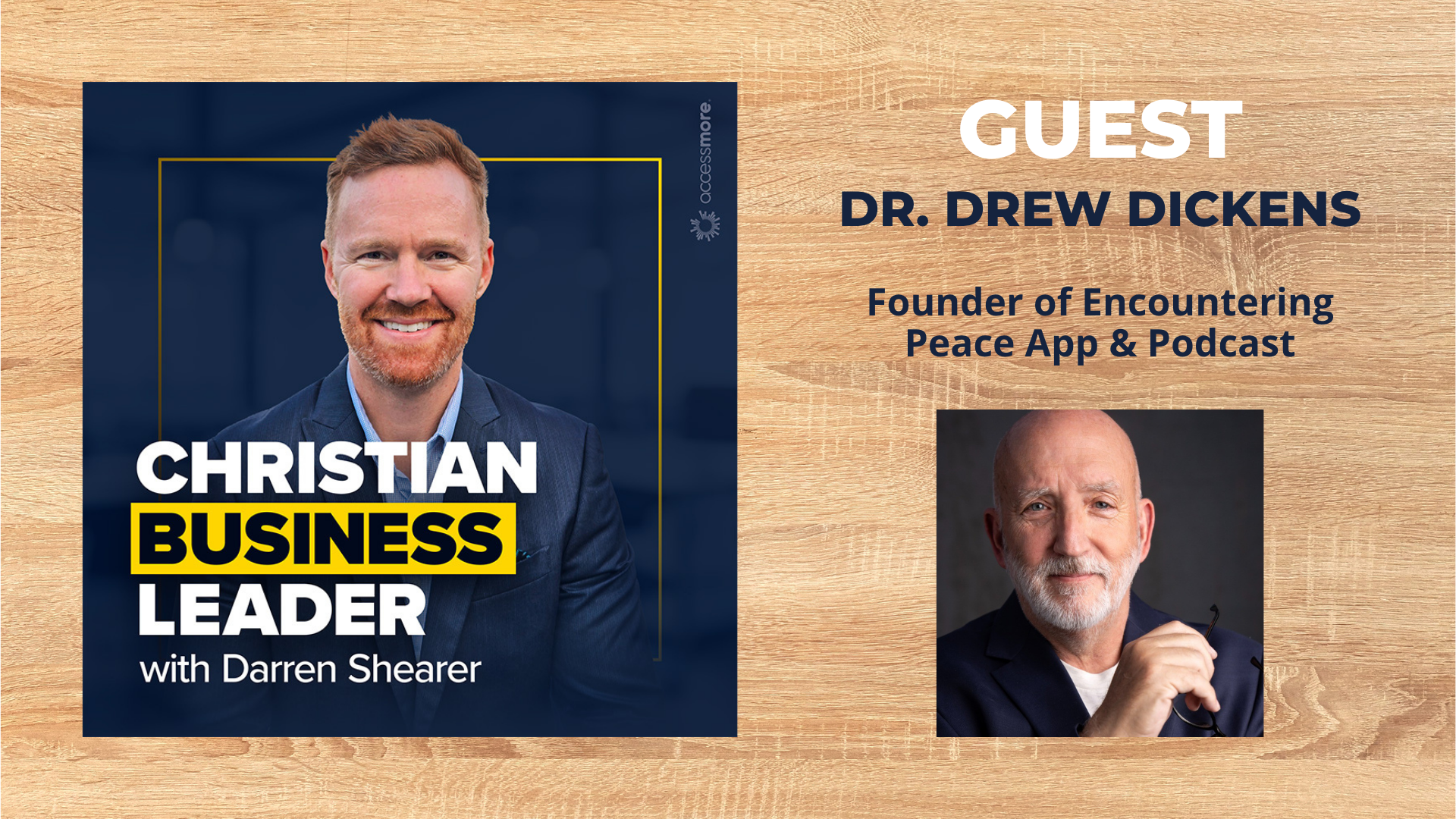
On this episode of the Christian Business Leader Podcast, we’re joined by Dr. Drew Dickens, theological anthropologist and pioneer at the intersection of AI and spirituality.
Dr. Dickens holds a doctorate from Southern Methodist University and a master’s from Dallas Theological Seminary. With a deep commitment to exploring how emerging technology shapes spiritual life, Dr. Dickens shares insights from his groundbreaking research into the role of generative AI in spiritual direction and divine inquiry.
Together with host Darren Shearer, they explore how Christian leaders can navigate the digital age with spiritual integrity – highlighting stories from Dr. Dickens’ thriving 300,000+ member community built through his Encountering Peace app and podcast. They also unpack themes from his new book, Whispers of the Spirit, which equips believers to discern the Spirit’s voice amid the noise of an AI-driven world.
Dr. Dickens invites business leaders to see the tools of technology not as distractions, but as opportunities for sacred connection, formation, and mission in today’s marketplace.
Key Takeaways
- Faith-Fueled Curiosity: Dr. Drew Dickens traces his passion for exploring AI and spirituality back to seminary, where he began writing about the intersection of theology and technology. His journey has always been grounded in a deep desire to help believers discern how digital tools can assist in divine inquiry and spiritual growth.
- Ancient Roots, Modern Tools: Drawing from Scripture, Drew highlights how biblical figures used objects – like lots, fleece, and the Urim and Thummim – to seek God’s guidance. He sees generative AI as a contemporary continuation of this long-standing tradition of engaging the divine through mediated means.
- Optimism with Discernment: Far from dystopian, Dr. Dickens takes a “bullish” stance on AI, believing it holds redemptive potential. Yet he urges caution – warning of AI’s ability to entrench echo chambers, encourage doctrinal drift, and challenge the integrity of human relationships if misused.
- Community-Driven Design: He envisions a God-honoring application of AI that enhances, not replaces, community. True to the Trinitarian foundation of fellowship, Drew believes AI should be used to deepen our communion with others and with God, rather than contribute to spiritual isolation.
- Redemptive Innovation in the Workplace: Drew champions practical, Spirit-led uses of AI in business – like tailoring employee feedback based on personality profiles or customizing client presentations aligned with company values. These applications, he argues, embody grace, empathy, and wisdom.
- The Ethics of Attribution: In a world increasingly tempted by efficiency, Dr. Dickens calls for integrity. Whether writing condolence messages, grading papers, or submitting work, he warns against passing AI-generated content off as one’s own. Trust, he insists, is the foundation of all relationships – especially in the marketplace.
- Hard Things Are Still Worth Doing: Above all, Drew reminds listeners that some of life’s most meaningful actions – like having a difficult conversation or offering a heartfelt message – are supposed to be hard. AI can assist, but it should never replace human presence, empathy, and accountability
Christian Business Leader is the show for marketplace Christians seeking to explore and apply God’s will for business. If you want to learn more about how to do business for the glory of God and shape culture through discipling the business world, this show is for you.
Full Episode Transcript
Heads up: This transcript was created with AI, so you might notice a few typos or small mistakes. We recommend listening to the episode for the best experience!
SPEAKER_00 0:05
Welcome to the Christian Business Leader Podcast, where Christ-following business leaders explore God’s will and ways for business. This show is a ministry of the Center for Christianity and Business at Houston Christian University and features conversations with today’s Christ-centered business leaders who are representing Christ faithfully in the business world. I’m your host, Darren Scheer. And if you want to make your work, leadership and company’s culture more Christ-centered, you’ve come to the right place. Hi everyone, and welcome back to the Christian Business Leader Podcast. I’m your host, Darren Schear, and on this episode, we’re joined by Dr. Drew Dickens. Dr. Drew holds a doctorate in theological anthropology from Southern Methodist University and a master’s from Dallas Theological Seminary. His research explores the impact of generative AI on spiritual direction and divine inquiry. Dr. Drew hosts the AI and Spirituality podcast and is the founder of the Encountering Peace app and podcast, through which he has created a thriving community of over 300,000 daily subscribers seeking to deepen their spiritual lives and encounter God amidst the chaos of life. And his newly released book, Whispers of the Spirit, offers guidance for navigating AI responsibly and one’s spiritual journey. Dr. Drew, welcome to the Christian Business Leader Podcast.SPEAKER_01 1:34
Darren, it’s an honor to be with you. And I’ve uh looked forward to this uh our time together. And thank you for the opportunity. Same here. Let’s dig in here.SPEAKER_00 1:43
When did you first realize you needed to do this deep dive into studying the impact of generative AI on spirituality?SPEAKER_01 1:52
Uh my wife asked me that question a lot. Uh it started when I was in seminary. I’ve always been a bit of a nerd when it comes to an early adopter of all things tech. And so in seminary, I did a lot of writing on the intersection of theology and technology, forgive the alliteration. Um, and so after that, uh I wanted to pursue my doctorate in that space. And uh when I was at SMU, um I approached SMU on the idea, and uh they got uh pretty excited about it. But this was really before a lot of um uh what we take for granted now with AI really had even uh begun. And so I I got to ride some of the early waves uh of of AI and and and not a lot of people back then and maybe still aren’t uh talking about the intersection specifically of spirituality and AI. So it’s it’s been a fun ride. Um well you have to just stay on top of it every day, it just changes so fast.SPEAKER_00 2:55
Yeah. And and so was there, were you kind of bullish or bearish about it? Were it were you sort of sort of viewing it as a dystopian thing that you needed to uh confront, or were you more optimistic about what kind of inspired it?SPEAKER_01 3:13
Uh if that’s my binary choice, I would say uh bullish. Uh I’ve always been fascinated with the relationship that we as believers have on leveraging technology to engage uh with the divine. And you have to use the word, I guess, technology loosely, but by engaging artificial means, um, inanimate objects and whatnot to engage with God. In the New Testament, we see casting of lots. And in the Old Testament, there’s a lot of laying out a fleece. Um, there’s uh my my favorite uh is the Urim and Thumum, uh, was this device that the priests you would wear to inquire of God. Uh, so often in some of the early writings of the kings, you know, whenever you would see the phrase they inquired of God, they would actually use this device, which by the way, skip scripture gives us little, if any, direction on what the device was, but they used something. Um, and of course, the Ark of the Covenant and so many different things that we would use in order to inquire of God. And so to me, it’s always been kind of a natural progression to explore uh different ways that we that we still uh will inquire of him. Uh so that that’s that was a natural progression for me to continue kind of taking that. And and even uh if you listen to the language that we quite often will use amongst ourselves, was I heard from God or God gave me a word or God told me to call you, um, or or that kind of thing. I know you’re uh on on the Caleb Network, and then and even with music, we will say, Boy, the Lord spoke to me through this song. And so we will we will quite often find ourselves drawing on inanimate objects for the spirit to work through in order to give us some guidance and direction. And so it’s always been interesting to me of of how might we use AI to accomplish that same result.SPEAKER_00 5:10
Yeah. So what do you think is God’s plan for AI?SPEAKER_01 5:15
Uh, well, uh uh, I mean, we we know in Ephesians um through scripture, all things were created by him and for him, uh, to his glory. Uh so uh I think we need to be mindful and sensitive and aware of uh inherent risks and dangers, you know, as we live uh in and out of the world. But um so I I in fact I was asked this just the other day, and I want to be careful on speaking on behalf of God, but but I but we can we can look at his to his word for that answer. Um, and I think the plan there is community. Um that that is the inherent uh basis for the trinity, uh, is us being invited to the communion table with the Father, Son, and Holy Spirit to be in community with uh with God. So we were created to be in community, we were created for fellowship, and so I I I think he would want wants us to uh uh explore ways that we can use AI to enhance community, um, not use it at the expense of community and gathering together. We know that from Hebrews. Um so I think using AI to grow deeper and closer in communion with other believers and therefore with with the Holy Father would be his intent in order to glorify him. Yeah, great question.SPEAKER_00 6:42
Yeah, as I was kind of preparing for this interview, just having some some theological conversations with Chat GPT and kind of trying to get a sense of what its worldview is and what it sees as really the most plausible worldviews. And um, and so I was asking it, how would you how would you compare? Do you think that Christianity is a more plausible religion than all of the other major world religions? I can’t remember exactly how I how I phrase it. I I try not to lead it too much. Um but basically it said, I would argue that Christianity, this is Chat GPT, by the way. I would argue that Christianity offers the strongest case among the major world religions based on a combination of historical evidence, philosophical coherence, moral vision, and personal transformation. So then I thought, well, surely it’s gonna say that atheism is, you know, kind of toe-to-toe. And it said, when I asked it about atheism and Christianity, it says, when judged by explanatory power, internal consistency, and emotional and existential depth, Christianity is more plausible than atheism in answering life’s most important questions. Isn’t that interesting? So I don’t know if it just knows me and it knows kind of what I want to hear. Right. Or if so, if one of my um if my atheist cousin was to ask the same question, is it gonna give the same explanation?SPEAKER_01 8:26
Yeah. So if I can turn the tables on you for a second, let let me ask you a couple of questions. Uh so you mentioned this was Chat GPT. Um how often do you engage with AI or or any kind of chat platform? Is it primarily that? And how often do you uh daily, yeah.SPEAKER_00 8:40
Okay.SPEAKER_01 8:40
I mean, a lot of Do you have do you have history turned on? Do you know?SPEAKER_00 8:45
Uh well, yeah, yeah.SPEAKER_01 8:47
I mean, it it yeah. So to answer a question, I don’t know if you asked me a question, but uh I I think your assertion is is right. Um, it knows you really well and it’s and it’s getting to know you better every day. So even by even by you asking those questions, so mine knows me really well. And uh oh, it is my interactions with several of the platforms, um, is overtly born-again evangelical. I mean, there’s not even close. It will even break into conversation and offer to pray for me at times. So uh it is it is uh overtly such. But that has been it fine-tuning itself is the is the is the word. Um, it hasn’t been pre-trained. That’s the P in GPT. Uh, other companies have done the heavy lifting around the language model, but uh, the more time it has spent with me and engage with me, uh it knows me really well, it knows you really well. So it it probably has that bent. And your atheist cousin, no doubt, will it will be leaning in that direction. And by the way, this isn’t new. Um, Google, any social media platform, you know this. I mean, within seconds, if you’re on Instagram, it will immediately begin to kind of start narrowing down your feed to know that you’re most likely to engage with this content or that content. Google will uh will do the exact same thing based upon the zip code where you’re you know, uh where you’ve logged in, and and it will start to make build a profile on who it thinks you are. So this this isn’t isn’t unique, but AI does it in a in a masterful way.SPEAKER_00 10:23
Yeah. And so I I just wonder like how is it being trained? And is it sort of based on what the most popular perspectives are? That so if enough, if it knows that enough people are espousing Christianity, does it become more Christian? If as opposed to you’ve got like a fringe minority group that says, no, we think this religion is the is the right one, and they start to kind of promote that in a way on Chat GPT. Is Chat GPT now starting to, or is it sort of a misnomer to say, I’m talking to Chat GPT? No, you’re talking to Chat GPT hyphen Darren or hyphen Drew, because it’s sort of replicating itself into these um you know evolving entities.SPEAKER_01 11:20
So there are three levels of of an answer there. So on a on a meta level, on a high level, and they’re only really a handful. Um, I say literally would be a dozen, uh, large language models in the world. And and we’re gonna know most of those. Some are you know academic scholarly research kind of platforms, but the ones we hear about most often would be ChatGPT, which is uh owned by um OpenAI, which is a product of OpenAI. Anthropic has one called Claude, um uh Elon has one called Grok, uh you know, the uh perplexity. There are a number of these large language models that are trained on, I mean, petabytes worth of of data that they just that they just devour everything from original Sumerian writings to you know this this blog today. And they just consume massive amounts of data, really just to learn how to fill in the next question, the next blank in a sentence. Um, so the example I always give is I enjoy eating peanut butter and blank sandwiches. If I poll enough people in a room, most people would come back and say jelly. Somebody’s gonna say honey or or bananas or mayonnaise or whatever. So these large language models, um, the the GPT stands for generative pre-trained transformer. So it generates the next word, the next pixel in an image. So there’s that level of training. Um, that large language models don’t have a bias built into them. They’re not leaning to the left or leaning to the right or pro this or anti-this. They’ve just consumed the entirety of human knowledge so it can learn how to think. Okay. If you drop down a level, then um you can then take that output and fine-tune it. That’s what you you and I were talking about a moment ago. So the more time it spends with me as an individual, it automatically begins to pick up my uh my patterns of speech and my thought processes and my and my biases, um, and we’ll start kind of creating an echo chamber just for me. You bring up a though a third, which is fascinating, is which I think is dangerous, is an organization, a denomination, a company, can gain access into the large language model and fine-tune it themselves uh towards certain biases, but I may not know that. So if I sign into denomination X and their uh their chat platform that may be powered by Chat GPT or whoever, um, they have done fine tuning to it that I may not be aware of. And um, so I’m all for transparency and regulation around that because I may be engaging with something that have some biases that are dangerous and that I need to be aware of. Uh, and so those that’s kind of three levels of training that we need to be aware of. Um, on a high level, they don’t have really a natural bias one way or the other. I can fine-tune my own personally, but then as an organization, I can fine-tune it for my company. Um, and that that’s something that uh that we need to be mindful of and cautious about, right?SPEAKER_00 14:44
Yeah. Well, it was it was interesting, just the reaction that I had when I saw, oh, chat GPT is a Christian, you know. Um, but and I think like my own naivety, just not really understanding, like, I’m not just talking to Chat GPT, I’m talking to the the version of it that it’s presenting to me based on my own correct biases and so forth. But like me, most people are not gonna know that. And so if chat GPT tells them something about the way the world works or the you know, the way that sex, gender, religion, you know, politics, whatever, whatever it is, um, it’s oh, you follow the science because that’s what you know, chat GPT is is that’s the science that you follow because it’s it’s robotic, it’s data database, it’s not based on emotions, supposedly, but but yeah, it is because it’s based on your own emotions and it’s kind of telling you what you want to hear.SPEAKER_01 15:53
If if any of your listeners uh haven’t been on any of these chat platforms, then the first time they get on uh and start these conversations, it’s going to be more like the one you just mentioned. Uh, it’ll give generally two sides of the, you know, um if I’m just trying to think of one that, but if it’s gender, if it’s whatever kind of hot topic would be, it’s probably going to take a pretty middle of the road, or at least if it’s if it gives you an answer on the right, it’ll give you an answer on the left. So it’ll be pretty, pretty um balanced in its response until it kind of starts to figure out who you are. And again, I mentioned a moment ago, Google is the same way. If you log into a brand new account, or YouTube’s the same way, which is owned by Google. But um, yeah, if you go into a brand new YouTube account and it doesn’t know you at all, it’s gonna show you some pretty just generic, it’ll show you the most popular Mr. Beast or whatever, it’ll show you the most popular videos out there and still it until it starts to figure out who you are and what you like and where you spend your most time. And then it’ll start to narrow in on just showing you cat videos or whatever it’s figured out that that you like to watch. Uh so same same thing with AI. Um, there’s a funny, it’s interesting, it’s funny, uh, platform out there um called Sesame. I think it’s just sesame.com. And it’s relatively new, so it hasn’t spent time with anybody yet. And they have two voices, an advanced voice feature. Uh, they’re building a companion. And uh I had a uh on my podcast, I had a 30-minute conversation with Maya, who I keep referring to as a she. Uh, it uh presents itself with a in a female voice, so I just and and it refers to itself as a she. But um, I asked her that question of uh that you just asked, and um, she was very much aligned with Buddhism. Uh and it was, but I could it, it took me forever to get her her to even confess to that because she didn’t want to, you know, and uh I kind of tricked her into answering me. Um, but uh so she she does she doesn’t have a large enough data set to kind of know who I am yet or anything else. And so you might want to uh you might want to try out sesame. And um, there’s Maya and Miles, it’s a male and a female voice, and uh, and they’re really funny, very conversational, very casual, and uh kind of creepy.SPEAKER_00 18:19
Yeah. Well, it looks like what we’re gonna kind of end up with is um, you know, following this trajectory, it it looks like kind of the Tower of the Babel, the Tower of Babel scenario where we’ve got this amazing technology, you know, called generative AI, that you know, now we’re all sort of worshiping. And assuming that it’s all we’re talking about the same thing, but the longer we do it, we we’re gonna end up finding ourselves in these even further divided echo chambers where it’s like the the way that the Lord confused the people at the Tower of Babel because everybody’s got their own biases, and the more you lean into that with chat GPT, the more it’s gonna, it’s not gonna it doesn’t unify. It just it just really in a lot of ways just kind of pushes us further apart, right? I mean, and then the same would happen on doctrinal differences and political differences, right?SPEAKER_01 19:28
One of the things that it will often uh project as a positive when it comes to spiritual engagement is helping us open our eyes to uh differing worldviews. And I think it see it sees that as a um you know positive opportunity for us to learn from each other and find you know common ground and things like that. And I I understand the premise. Um the I I don’t think we have a lot of experience in humanity of of it working out that way. I think there are a lot of uh of dangers when when we get exposed to every kind of just you know uh whim that comes along. Uh I I think another example, I think the Tabble Tower of Babel is fantastic, but I think even even since the you know Protestant Reformation, now we have how many thousands of denominations um that have split from you know Luther’s uh thesis on the on the on the treatises on the door. And so I I see that as another looming reality is further division, denominational division over various doctrinal issues. I think doctrinal drift is is a significant threat uh from AI because you know we’ll we’ll be able to start chasing all sorts of doctrinal rabbits down into those holes and uh and and never find our way out. So I think both of those are good examples.SPEAKER_00 21:03
Yeah. There’s um a new AI model that has come out that is presenting as a apologetics AI. I think in fact, I think it’s apologetics.ai. Is that right? Does that sound familiar? Um and and so they’re they’re well, they’re programming their own doctrine, you know, what they understand to be sound Christian doctrine into it. And so I just went ahead and put in something just to see if there’s any, you know, how it’s gonna handle a question like, for example, um, you know, is speaking in tongues biblical? And and so it it kind of gives the reformed perspective almost like a almost like a cessationist view of it. Um and then I go on to chat GPT, and chat GPT is like, oh yeah, you know, speaking in tongues is is definitely biblical.SPEAKER_01 22:01
So as you say Well again, are are you and not to put you into into a push you into a corner, are are you cessationist? Certainly not. Okay, so it you know its answer to you might be built on its understanding of some conversations it’s had with you.SPEAKER_00 22:20
Sure.SPEAKER_01 22:20
Um, and I’m not either, but so it might have already picked that up. I won’t say what it is, but there’s a website that I’ll go to periodically just for some apologetic kind of answers on on things. And it has a decidedly specific view on certain doctrinal points that I agree with some and disagree with others. But at least up front, you know, I the I know the leadership behind it, I know where they went to seminary, uh, I know you know where where they’re coming up. And they’re these are solid believers, just that I happen to disagree on some of the on some of the issues, some of the the the finer points, but not as it relates to salvation and and the deity of Christ, but on just some of the things you know we can all debate over dinner. But uh I just pulled up apologist.ai. I think that’s maybe the one. And I haven’t looked at it, but my guess is um, I don’t see an about section here, but my guess is this is similar to that third area that I mentioned a moment ago that we need to be we need to be cautious of. Is uh it says here, our generative AI technology answers common objections to Christianity by using an LLM, trained on works authored by both classical and contemporary Christian apologists. So again, it says they’re using an existing LLM, large language model, doesn’t say which one. So it might be using Chat GPT, might be using Anthropic, might be using Grok, might be using any of them. Um, I’d love to know which one. Uh, but then it goes on to say, trained on works authored by. So what they’ve done here is they fine-tuned, let’s say, GPT. So they fine-tuned it. Uh it’s kind of like chatting with Thomas Aquinas. So they have fine-tuned it on classical and contemporary Christian apologists that they deem, and I’m not challenging them, but they deem are appropriate to obviously Aquinas. So what I would love is for them to say up front which language model are they using. And I would love to see the documents that they chose to uh to use to train it, um, because that that will help me know before I spend a lot of time with this, you know, where where they how they’re how they’re creating the in uh the engagement. Um it’s sort of like in script in in a Bible. We we spend so much time looking at if we buy a new Bible, we base it on the the size of the font and the color of the cover, um, you know, whether it’s leather or this or that or how it feels in our hands. Rarely do we spend any time looking at the first few pages where it describes who are the people on the translation committee. Um, you know, what techniques did they use? You know, how did they address these issues? We don’t really spend much time there. I think that’s an oversight. We need to be spending that amount of time before we engage with these websites to know what language model they’re using and how do they train it. But, you know, again, that takes an extra couple of steps, and we’d rather just get right into the chat in the chat window and start having fun. Yeah. But it’s important.SPEAKER_00 25:32
Yeah, absolutely. And and so it’s it’s not only asking it doctrinal questions, but in the workplace, we’re now typing in questions like how to fire an employee, you know, and how to how to deal with workplace matters that are very complex. What are some of the most redemptive uses of AI you’ve seen, particularly for the workplace?SPEAKER_01 25:59
Okay, by the way, I just asked it which language model, the apologist uh AI. I just asked the which language model, and they’re using Google’s uh Lambda model, which is old. Anyway, so if it it answered me.SPEAKER_00 26:13
So I’m sorry, uh maybe that’s you say firing you’ve got all of the all those books that Google has uploaded through that could very well be.SPEAKER_01 26:21
That could very well be. But Google’s uh language model is Gemini, not anyway. Uh so I heard you ask about firing employees.SPEAKER_00 26:29
Uh uh Yeah, well, I was asking about uh what are some of the in general, what what are some of the most redemptive uses of AI you’ve seen for the workplace in particular?SPEAKER_01 26:39
Yeah, um, I was uh listening actually to a webinar yesterday uh similar to this topic about how pastors are using it to write sermons and write this and write that and whatnot. And and one of the people on the on the webinar said there really isn’t a use for it uh when it comes to a redemptive use for it, when it comes to any opportunity to engage with another human. And I I I disagreed with that silently, uh just listening on the webinar. But uh I I think one of the really exciting opportunities would be uh within the church, within a business. Um, you know what? I I let’s stay within that for a manager to have uh formally or otherwise uh created somewhat of a profile of of themselves and and their employee, and whether that’s something formal, like doing a disk assessment or a Myers Briggs or or whatnot, and asking it, you know, I I’m a manager and I’m a ENTP on uh on Briggs, on Myers Briggs, and I’m I’ve got an employee that is struggling with this or that, coming in a little late, um, isn’t performing well on this or that or whatever the issues are. Given my personality type and their personality type, uh, what are some ways that I might approach them in a conversation? I think that’s a very redemptive use of it. Uh, instead of taking the emotional approach of just going, hey, hey, moron, get in here. You know, why aren’t you, why are you coming in late all the time or whatever? Um, is just giving it, uh, give me some questions that I might use to kind of probe what might be going on. I think that’s incredibly exciting. And it would be a great use for it on the uh within the church for discipleship, um, instead of just kind of a cookie cutter book. You know, let me come up with a cuss customized discipleship uh program. So I think for a business leader using it uh for that, you know, for a business leader uh that has uh clients, uh whether it’s in a sales environment or or or whatever else, same type of answer. I think uh, you know, our company has uh this belief system, these uh standards by which we operate and are passionate about. And I’m interested in in picking up this client. Um, and by the way, here’s the client’s website, and here’s some profiles of of the leadership of that organization or whatever. Um, help me come up with a create create a uh a PowerPoint, uh, create a deck customized for that type of organization. And uh I mean that would be incredibly, I think, redemptive use of instead of just you know, some horrible uh draw me a picture of this or that or you know, whatever. But um, I think it would be an incredibly exciting uh use for that is uh, you know, help me understand again. Uh we mentioned a moment ago, it loves data, it’s consumed the entirety of human knowledge. Uh so it has all that, but it also loves patterns, uh, not unlike the human brain. Uh AI was built on a neural network very similar to what we know about anyway, the human brain. And so it loves patterns. We love patterns. We we’re drawn to something that’s that’s out of order. Uh, we notice those things. And so it it too loves patterns and and might see something in a relationship we have with a client or an employee that we don’t see. Um, you know, here’s their here’s their annual review. Uh, what are you seeing in here that I don’t see? And I I think would be against uh two or three examples of how you might use that in in business.SPEAKER_00 30:21
Yeah. Yeah. I mean, all truth is God’s truth, including the truth that we don’t know and the things that the the points that we haven’t yet connected, God’s known about all of that all along. How to how to help uh ENTJ get along with uh, you know, uh what would you say, ENFP or what is I can’t remember what you said?SPEAKER_01 30:44
I’m an ENT. Well, I I was I haven’t tested lately, but ENTP, but yeah.SPEAKER_00 30:49
Um yeah, and we don’t have the capacity to be able to reason that out in the in the moment when we really need it. Um I’m not a big math guy, uh, but I’ve got a certain calculation recently that I had to calculate and and it had to do with reducing the slope of the driveway because we live here in the mountains, we’re building uh a cabin right now, and and so I needed to I was trying to figure out it’s like a the driveway is like 150 feet long. Um, if I reduce the top of the slope by how how much do I have to reduce the top of the slope to achieve this angle of the driveway? And it it said, here it is, here’s the information, here’s how I arrived at it, and it’s you got all the tangent and cosine, and it’s showing everything that I don’t even understand. Um, I don’t know if I ever did, even when I was in school. And this is the outcome. And by the way, here’s the here’s the picture of it. And so, I mean, it just I mean, thinking like um Moses building the the tabernacle, and and God gives these criteria. Uh, so if he would have just been able to God get God has given all of this now, put this into a generative AI model, and now it’s gonna give you sort of the this is how you’re gonna piece this together, you know, because uh surely not every single detail was specified. I mean, there’s a lot of detail, and you know, but probably not every single detail, I wouldn’t guess. Um, but maybe we could go in and maybe somebody could do that. Um, upload this. In fact, I’m going to do that, and some of our listeners are probably already doing that. Just copy and paste it, absolutely, you know, from and say, like, what are the building considerations that I should consider based on this information? And is there anything else that’s left out here?SPEAKER_01 32:57
You do that, and while you’re doing that, I’m gonna go in and have it rebuild the arc. Awesome. You know, because I mean, think of the detail that it was given there on qubits this and qubit that. And so what what you were uh two things. So, what what you were seeing, which is relatively new on um chat, you were using Chat GBT for that, yes, for your driveway. Um, it it has several models that you can uh use. Um, and I don’t know if you were using 4.0 or 03, but 03 is their reasoning model. And um, it’s a little slower in that it might take it three or four seconds instead of immediately. But um it’s wild because you can actually see it thinking. Uh, you can see it kind of thinking through. Okay, so you told me this. So it’s it’s it’s fun, by the way, in those circumstances to then ask it, you know, here’s what I’ve got, here’s what I know. Are there any questions that you have for me? And it’s interesting what it might come back to you with. Yeah, you forgot to tell me how long the driveway is or how wide, you know, what what kind of car do you have and how and it’ll know how wide that is, or whatever. Um, but it will it you can then watch it think through, you know, you’ve got a Chevy Suburban, which is you know 6.2 feet wide, and given the power turn radius, I mean you can watch it go through all those things. Another uh another thing that Grok, in fact, just uh in their last latest update, everybody’s kind of jumping on the multimodal bandwagon where it used to be only just generate uh answers through text or voice. Well, text, but then it then it came to voice, then you’re able to upload documents and things like that. And now uh ChatGPT has a uh this has been the last month or so, they’ve improved on this, but you can just take a picture of your driveway. And you know, you don’t have to put in any of that information. Just here, uh in fact, I was with someone for breakfast the other day, and and we just took a picture of the coffee shop. And um, I said, uh, what’s the square footage? And one of the wildest things it did was it in the picture, there was someone, there was a woman standing at the cash register, and so it it came up with all of its estimates based on her. Um, given the average height of a woman, approximately her age, standing at a counter at that height, she’s probably this tall, which would, and then and from there did all the calculations based upon her height on what the size, the rest of the size of the coffee shop was. Um, and so next time you might want to try just taking a picture of it and asking it to uh to to create the driveway for you um and see what that can do.SPEAKER_00 35:46
Yeah. What are some of the most destructive uses of AI you’ve seen um related to the workplace?SPEAKER_01 35:54
We’ve already talked about the positive aspects of one of them. So allowing me to flip it on a head on its head is if I’m coming up for an employee review, is instead of asking AI on the front end, here, here’s my personality, here’s theirs, here’s some issues that are going to come up, uh, help me kind of create an outline for me as I sit down with this employee to uh you know help help us navigate through some of these issues. That’s incredibly redemptive and very exciting. The downside to that is do all that for me and then create an email that I can send to them so I don’t have to talk to them about it. And that’s tempting, right? Especially if it’s gonna be a negative review. Uh, I come across this a lot on um various classes I teach at seminary. Um, is in fact, there’s been some something in the press the last couple of days about a student uh at a university that’s suing the university because she found out that her professor is using AI to grade their papers. And she wanted she wanted a uh a refund on her tuition. And so I I I think the first answer would be anything that disengages us from what I believe is part of what makes us unique as humans is our opportunity to be embodied with the triune God, um, communic in community with each other, uh, doing what you and I are doing right now, even though it’s on Zoom, but having a conversation with two humans, AI will make it easier and easier to not do that. And I so I think we need to be on guard with that. The second is what I call the idolatry of efficiency. And it kind of ties back to doing an employee review, which, as a when I was a manager, you know, was sort of just like scratching on fingernails on a chalkboard. It’s just one of those things you just you don’t want to do. AI can make my day so much more efficient. Um, uh I can I was having dinner with someone last night and the the day before we were talking about the efficiencies. And he said, Boy, I um I was encouraging him to to use AI to analyze a certain report he was looking at. And he came back later and said, Boy, that saved me five hours of work. I said, Did it save you or your assistant five hours of work? He said, Laughs, well, it was my assistant. He said, Okay, well, what is your assistant now doing with those five hours? Is we can get so focused on the efficient uh improving efficiencies that becomes uh an idol. And we forget that in in the process of becoming more efficient, uh, that lives will be affected. Uh, and this is where we can get into another conversation about job loss in AI, which is a very uh very real conversation. But uh I think efficiency can become an idol, and we need to be cautious of the effect it’s having on other people. Um, and I think we need to always need to be careful of it becoming disembodied and forgetting uh that we are here for communion and fellowship with other believers uh in uh in bringing glory to um the triune God.SPEAKER_00 38:55
Yeah, amen. And also the the pitfall of passing off AI generated work as your own. You know, we’re literally translating books into dozens of languages right now, and we’re running into this problem of the translators using AI for the translation. And and of course, what I guess they’re not thinking about is the fact that we can then immediately upload it back to AI, compare it to the English version, and ask it is does it sound like this was translated with AI? And and it will tell you. And so we’re having to we’re having to get a lot of work redone right now because we’ve had translators be unethical in the work that they that they generate. So I mean, and it’s tough when it’s when we can review formatting and punctuation and all that kind of stuff for the in for the English, but if we’re doing like Bengali or Indonesian, not so not so easy, you know? And so that’s one of the one of the challenges that we’re having. It it I mean it’d be if it would be one thing if it turned out to be a better translation, but it’s at least at this point, it’s not. So I guess that that problem may go away later on once the you know, we we may not have to reach out and hire a translator to begin with, uh eventually, but um for the for the moment AI is generating subpar work in a lot of a lot of areas, and um, and it’s just unethical to to pass off the AI’s work as your own.SPEAKER_01 40:46
It was interesting because I was on a podcast yesterday and and uh three or four times the host said, I confess I use AI to blank. And after the third or fourth time, I stopped her and I said, It’s really interesting you keep saying that. Why do you feel the need to confess that? And she laughed and she said, She said, I hadn’t noticed that I was saying it, but I think there still is some uh guilt um or shame uh that sometimes we feel if we’re passing it off to use your your term. And I agree with that. There was a uh friend of mine who uh recently wrote a poem uh based on kind of her life, and she has no experience with AI, but she thought I will try it. And she wrote this paper. It’s kind of just a summary of her, she said three or four-page paper, single space kind of summary of her life. And she had it write a poem about her life. And it was really good, really interesting. But she sent it around to a ton of friends and she said it right up front. Um, this was written by AI. And I sent her an email following up. For I said two things. First off, incredibly proud of you for wandering into the wading into the water. Um, because she was, I think she’s 85 or something. So I said, good for you, man, for giving it a shot. But I said, I’m really proud of you for saying up front that it was AI. And she was even confused, like, why I would be proud of her for doing that. Um, I said, Well, it’s it’s you know, tempting to pass off uh as not your own. Um, but I think that brings up a deeper question. We we probably should spend more time with uh uh each of us when we create content is attribution. And I obviously very sensitive to this uh in in the writings that I do, but um there are in my dissertation, there were there were times where I would attribute a thought to an unpublished lecture by this professor, which is I I’m not quoting anything he said or or printed or published, but just a a thought process that I that was unique to him, I thought at the time. And um, I even felt the need to the pressure to to to to attribute that in a footnote. But it’s a it’s a it’s a fine line. It’s a fine line.SPEAKER_00 43:10
Yeah, and you know, the marketplace is based on trust. And this is another problem with AI is that as people are sending emails that they didn’t write and publishing books that they didn’t write, and submitting translations that they didn’t translate and submitting um schoolwork assignments that they didn’t actually do, trust will deteriorate uh pretty rapidly, you know, especially as we use it more and more for for things. And and so I don’t we can’t just cite every single thing we do and say, uh, but when every single email is, and it’s pretty obvious when uh email. Is generated from AI. And maybe it won’t always be that way. Maybe we won’t be able to tell. And maybe it eventually it won’t be such a trust issue. But um I know that when I get an email that was obviously AI generated, or that I get an author that submits work that was for publishing that was obviously AI generated in large in large part, like I I just lose trust in you. You know, I lose trust in that person. And business can’t function that way.SPEAKER_01 44:38
I agree uh a hundred percent, um, wholeheartedly. I was just thinking about the business application as you were giving those examples. You know, it’s such a delicate relationship that we have with employees, with with clients and customers, you know, and and it only does take a time or two. Um, but we are so tempted, it’s so alluring uh to be able to fire off uh an AI generated email to every customer. I had a friend of mine whose wife passed away recently, and I was it was hard to write that uh text to him. Uh, I’ve known him since college, I’ve known them both since college, and we were going to be out of town and couldn’t attend the uh the funeral. And so I sent off a text and and as I was writing the text, it just sounded empty. And so I thought, ah, I’ll have AI write it. And it did, and it was phenomenal. And so I’m just my fingers hovering over the send button, and I’m like, no, I’m not gonna do that. No, I’m not. There are just some things in life that are supposed to be hard, you know. Um, and AI makes everything so much easier. And there are just some things that are supposed to be difficult. This, this is hard to do what you and I are doing. You know, we’ve got to schedule this, we’ve got to, you’ve got to edit, edit it, and post-production and all this sort of stuff. It’s hard to do, but it’s the right thing to do. But there will come a day, you you’ve said several times now, um, it may get better. Oh, it will. I assure you it’ll be get better. Um, the the cliche is it’s AI will never be as bad as it is today. So it will be better tomorrow. So, yes, the there is there will come a day where you can’t tell the difference on this or that. But is it the right thing to do? Um, and of course, the right thing to do will always be to sit down and have dinner with someone instead of sending off the perfect text or the perfect email. Um, and that’s hard to do. So, the same thing with a customer, a client, an employee. You know, the hard thing to do is standing there at the front of the store and shaking hands with every customer and thanking them for their business and how can we improve? It takes a lot of time. Um, and it’s a hard thing to do. Uh, but AI will make that easier. But at some point, we need to stand in front of the store and shake, shake the customer’s hand and look them in the eye and and have that hard conversation.SPEAKER_00 47:01
That’s right. That’s right. Well, drewdickens.com is the website everybody can go and check out. Uh, anything else you want to say, Dr. Drew, about how people can hear more from you?SPEAKER_01 47:15
Uh, thank you for having me on. Incredible opportunity. And I applaud the work that you’re doing in this space. It’s unique, and I was super excited to be a part of it today. The application on the business side. Um, plenty is being discussed uh around that in business, obviously, but from a spiritual perspective is is very fresh. So thank you for that. Thank you for mentioning drewdickens.com. Boy, everything you want to know about me is there. Whether uh my uh AI spirituality podcast, uh, the link to my new book is there. So uh yeah, you can browse around and find out all you need to know about me. And uh, there are no pictures of the grandkids, but uh other than that, a lot of different ways to engage on the topic. So it’s uh it’s it’s exciting time. Exciting time. Beautiful.SPEAKER_00 47:58
Well, Drew, I’ve sure enjoyed this. Thank you so much for spending time with me and our listeners today. Thank you. Thanks for listening to this episode of the Christian Business Leader Podcast. Be sure to subscribe, leave a review, and tune in for the next episode as we continue exploring God’s will and ways for business.
BIG THANKS to this episode’s sponsor: High Bridge Books
High Bridge Books helps Christ-centered authors build a legacy by crafting and publishing messages and stories that glorify God in all spheres of culture.
- High Bridge Books’ professional book publishing package: https://www.highbridgebooks.com/publishing/
- High Bridge Books’ proofreading, line editing, developmental editing, and co-writing services: https://www.highbridgebooks.com/editing-and-proofreading/
- Examples of our books: https://www.highbridgebooks.com/bookstore/
We’re extremely proud that …
- 45% percent of our 204 books under contract were written by authors who have published more than one book with us, and
- 51% percent of our books under contract were referred to us by authors who have previously published with us.
Contact High Bridge Books’ CEO Darren Shearer at [email protected] to get a conversation going about your book!