Virtual Assistants for Christ-Centered Companies (w/ Mary Elaine Baker)
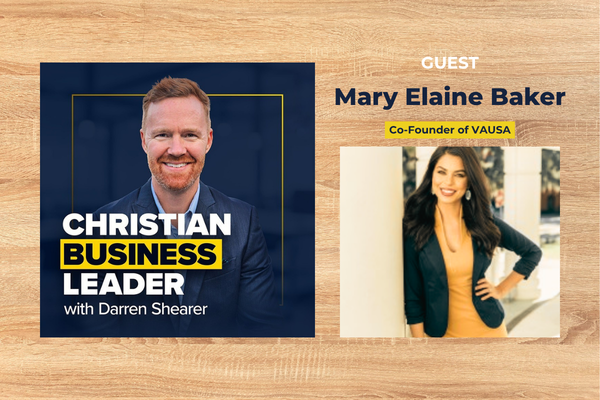
On this episode, we’re joined by Mary Elaine Baker.
Mary Elaine (along with her husband Brett) co-founded VAUSA®, a virtual assistant staffing company that helps businesses grow by providing remote team members, while intentionally integrating Christian values into how they operate.
Download the Freedom Framework Integration Plan: https://hirevausa65705.activehosted.com/f/59
Christian Business Leader is the podcast for marketplace Christians seeking to explore and apply God’s will for business for the purpose of cultivating Christ-Centered Companies.
Full Episode Transcript
Heads up: This transcript was created with AI, so you might notice a few typos or small mistakes. We recommend listening to the episode for the best experience!
SPEAKER_01 0:02
Welcome to the Christian Business Leader Podcast, where Christ following business leaders explore God’s will and ways for business. This show is a ministry of the Center for Christianity and Business at Houston Christian University and features conversations with today’s Christ-centered business leaders who are representing Christ faithfully in the business world. I’m your host, Darren Scheer, and if you want to make your work, leadership, and company culture more Christ-centered, you’ve come to the right place. On this episode, we’re joined by Mary Elaine Baker. Mary Elaine, along with her husband Brett, co-founded VAUSA, which is a virtual assistant staffing company that helps businesses grow by providing remote team members while intentionally integrating Christian values into how they operate there at VAUSA. Mary Elaine, welcome to the Christian Business Leader Podcast.SPEAKER_00 0:58
Thank you. I’m so happy to be here.SPEAKER_01 1:00
When did you first realize God wants to be involved in your work and business?SPEAKER_00 1:04
Well, I don’t think when we first started the company that it was top of mind or first of mind. My husband and I were both believers when we started the company. We grew up in homes with faith. And uh he was active duty in the military before uh we actually while we started the business, and I was an elementary school teacher. So we both worked in workplaces that weren’t um you know Christian organizations. So we didn’t really understand that concept of integrating faith and business when we started our business. We just knew that we were Christians ourselves, and we just try, you know, on an individual basis to um walk the walk and not just taught the talk and how we treat people and how we love others. Um but over time, God really started revealing to us that our people that we have under our wings, uh, we were there to shepherd them. And as the weight of that grew over time, and as my team grew and as the business grew, I felt a tremendous amount of pressure and fear kind of wrapped around that because I felt like it was all on my shoulders. Um and I think a lot of business owners kind of, especially when they start a business for the first time, uh, it’s I think that’s a common thing. I’ve heard it from other business owners too. I used to wake up in the middle of the night in a panic of I cannot believe that these families, like this weight of responsibility, I’m I’m impacting families now. So this concept of this business isn’t ours, this is actually God’s business, didn’t really start clicking for us. I don’t think God really made that known until about 2021, 2022. And my husband and I started having more conversations around it, under uh around it, thinking or understanding that we’re the ones not in charge. We think we are, we think we’re the ones in in control of this business, but the reality is this is God’s business. And so we both made a decision in 2022 together to surrender this business to God. And we had already been doing things to love our people a little bit out of the norm that you would find in corporate America. Um, we had already had a Bible study that was ran by team members going. They came and approached me and asked me if that would be permissible. And I said, Yeah, of course. Um, we hired a chaplain for a company in 2021, and that was starting to make a difference in our culture. Uh we were already, you know, handwriting letters to team members when they were going through a hardship or just words of encouragement, we would send that. So there were little things that we were already doing to let people know that they were loved. We just weren’t very open and bold about and honest about where this love came from. And um so in 2022, we made an intentional surrender. We decided to um implement values and declare that those values were rooted in scripture. We changed who we were working with. We said, hey, we are here to serve faith and purpose-driven companies because you don’t necessarily have to be a Christian forward company, but we want to know that you actually care about people and you’re here to make an impact with that profit that you’re making, that there’s something bigger at play with your company, um, not just you’re doing it for the money alone. That was very important to us. Um, and that happened to be, I don’t believe it’s coincidence. I know this is a God, this is all God. When we made that declaration and we completely surrendered to God, our business, that was the same time, and we had already had a chaplain for almost for for a while, our first salvation in our company.unknown 5:18
Wow.SPEAKER_00 5:19
And ever since then, that we have really let go. One, I don’t wake up in fear anymore. I don’t wake up in panic because I’ve I was so happy to let go of the reins once I realized that this wasn’t all on me. This is actually, I’m just here to steward what God’s given me. And if He’s in control, then I can be at peace. Um, we’ve had so many lives impacted. It has been incredible. Um, I it’s hard for me to put words around what’s happened since we’ve let go.SPEAKER_01 5:53
Yeah. So how many uh virtual assistants do you have on the team? And are they are they employees of VA USA or do they become, is it are y’all more like a staffing agency where they end up wanting to be? Okay.SPEAKER_00 6:11
Um, it’s kind of a hybrid. So we have um our our contractors that we have currently on payroll right now, we fluctuate between 70, 80 currently, but we do offer direct hire options. So not everyone’s with us, I would say, for the long haul. You know, they may be here for a few months, a few years. It just really varies on the needs of our clients and really how that working relationship progresses. Um, so we’ve staffed lots of people over the years, but that number kind of goes up and down depending on also we do uh just straight recruiting as well. So we can uh do that as well. So we do signature staffing, which is basically monthly with contractors, and then they are um able to be hired directly by our clients, or we do offer just straight recruiting. So that’s that’s the team. I call it like the external team. Um, and then we have our internal team that helps operate the business as well.SPEAKER_01 7:12
Got it. So by VA USA, does that mean they’re all based in the US or they’re all based in the US?SPEAKER_00 7:23
I I say that loosely. We do have some team members that have because they’re military, they’re now getting stationed in other countries at times. So, for example, I have a team member that’s in Italy right now, and we’ve had team members in Germany, UK, things like that.SPEAKER_01 7:40
So yeah. But what percent and there are as you were a military spouse, are there a lot of military spouses?SPEAKER_00 7:51
Yes, so we are predominantly military spouses. We have, I was a military military spouse myself, as a as I said, and we have about 75 to 80 percent of our team. Again, it actually is like 70 to 80 percent, are military affiliated. Um, some are veterans, we have uh, you know, a decent amount that aren’t, you know, about 20 are not military affiliated. What’s most important to us is that our values are aligned. Um, and you know, we have team members that are super happy working here, and so they tell a friend, hey, you really should work here. Um, but we we have a big heart for the military, just given my husband and I our experience. I grew up in a military family myself, and it we just know how difficult it can be to uh find good, meaningful work where you’re still using your gifts that doesn’t take your evenings and weekends, and but also allow flexibility for the crazy military lifestyles that we have. And many of our team are being uprooted every few years, and so it’s very difficult to start over. And uh, and we have you know young families on our team, and most people can’t afford to put all their children or put their children in daycare and you know go to work. And unfortunately, a lot of employers also dismiss resumes from a lot of military. If they can see you’re bouncing around a lot, they don’t they see that as a risk, and so it’s hard to find employment.SPEAKER_01 9:29
Sure. Mary Elaine, what’s a time? You’ve already shared some stories, but what’s another time when you saw God’s hand at work in your business?SPEAKER_00 9:38
All the time. I we um, you know, I mentioned salvations and I I want to be clear. I believe what we’re doing is kingdom work here. Okay. I I think that’s that is, I mean, the best uh news that we could ever hear is when we hear that a team member has decided to um give their life to Christ. And if only one person did it, then I would say this whole thing was worth it. Um but we just got, you know, I just got notified that last week we had a salvation. Um but I want to be clear that I think that can be a little overwhelming for a lot of people who haven’t taken that step of integrating their faith into their workplace because um that can seem just so far out there. And we didn’t start with just uh telling everyone the gospel. We had to start with a lot of people who have, frankly, a lot of distrust in employers. Um, we’re dealing with uh a nationwide uh a huge amount of distrust in companies and organizations. And uh frankly, if you just have the title of CEO, uh you are you’re likely just not going to be trusted. So when when we think about that, and that really sank in, I thought, well, how can we build trust with our team? Um where that when the opportunity does present itself to present the gospel, we already have a relationship there and they know it’s it’s coming from a genuine and caring place. So I believe that how we get there is by being the hands and feet of Jesus and meeting immediate needs of team members. So I’ve created what’s called over time, this has been through years of evolution, okay? It’s called the freedom framework. That’s what we call it. And it encompasses areas of faith, finance, family, fitness, and fun. I believe that those are kind of essential elements of our life that if gone unchecked. Let’s just take finance, for example. When you experience um financial burden, stress, high amounts of debt, um, those become invisible shackles, I believe, in your life that can lead to marital issues, that can lead to um, you know, poverty. It can lead to all kinds of things. And so I believe that as a business, we can provide resources and not necessarily we’re generating these resources ourselves. We can just collaborate with third parties who who are experts in those realms. I’m not a financial expert, for example. So I’m gonna hire a financial expert or financial coach, is what we use, to come to our business. And I can support by providing scholarships essentially for them to have that resource. So I look at all of these resources we we provide as a company as a buffet. You take what you want, you leave the rest. None of it is mandatory, but we’re immediately we’re meeting some immediate needs for people so that they can experience freedom within those areas. And through that freedom, we’re also in providing that, we’re showing like, hey, we don’t just say we care and we love you. We’re gonna act on this. We’re gonna act on this because we actually see the needs that you have, and through that action, and over time, my hope is that you trust me, that you trust us, and that you see that we actually are different. And you’re not just a number on a piece of paper. And I don’t believe that you’re here to build this business. I believe that we’re here to help build you. And so through that consistency of doing that over time, um, if the opportunity presents itself and the timing is right and God wills it, um, my hope is that they accept Christ into their life. Um, but I don’t stress about that. That’s all in God’s hands. God’s only calling me to just love the people. That’s all he’s calling me to do. He’ll do the rest. I don’t have to worry about that.SPEAKER_01 14:00
Yeah. How have you seen the culture of your organization rub off on your team members?SPEAKER_00 14:08
Uh it’s funny whenever people experience it the first few um months, a lot of times I call it the defrost period because we do have people who are they they see us from the outside and they they can tell something’s different here and they’re attracted to it, or maybe they heard from a friend and they apply and they get the job. But it’s a little bit of a culture shock for people to to come and attend these meetings where people are just um lavishing each other with encouragement and praise and um, you know, there if if a person posts, we have an internal chat system. Um, we we use Google Chat, and we have a channel that’s specifically for prayer request. So, and you’d be surprised how many people just being hired will go in there and say, Hey, I have this thing going on with my child, with my spouse, with my grandma, with my dog. I mean, complete non-believers, they’ll ask for a prayer when when times are hard, they’ll ask for it. And not only will people pray for them, people will call them and pray for them. People will um, I have team members that will mail letters to them, people um send them meals, you know, either through Instacart or DoorDash. And a lot of this, we have certain people on our team call them outreach ambassadors that help with this, but a lot of it is so organic from other team members who aren’t on my internal team. They just see what’s happening around them, and this is normal. And so they feel like they have the freedom to express that to other team members, or because they had been here for a while, they had received those blessings themselves. And so now they want to kind of pay that back and pay it forward to someone else on the team and let them have that experience. So I think it’s infectious. Um, and it only takes a cut um a couple people, like a spark, for it to take fire in your company. Um, but I tell my my my leadership team and my outreach ambassadors, like, you’re the torch bearers. Like this isn’t just my job and my responsibility. This is your responsibility to go out there and and and hear and see the see and hear the needs of people and then intentionally slow down and think, how can I act on this?SPEAKER_01 16:45
Yeah, that’s so good. I mean, teams need wins, team members need to celebrate wins with each other. And you know, sometimes in business it’s it’s hard to really identify what are those wins, you know, as a virtual assistant, like you know, let’s say you’re cleaning up a spreadsheet. Um, and yeah, there’s intrinsic value in that work to God. Uh but as people, we don’t always we don’t always see that or appreciate that, but to to also be able to have uh, you know, a prayer chain, a prayer inbox, Regent Bank is another great example of of a company that has a a prayer inbox like what you’re talking about out of Tulsa, Oklahoma, and they have incredible stories, just like you, of how their team members and their their customers and clients will send in those prayer requests, and they have team members designated to respond uh as soon as those requests come through. And it’s just such a a way to also bond the team together, right?SPEAKER_00 17:54
That’s right. That’s right. Um, I heard before, how do you know someone needs encouragement? And the answer is they’re breathing. Everyone needs it. And uh one of the practical ways that we have implemented that in our business, uh, we came up with we call it the Regal Eagle Awards. Our logo is the Eagle, you know, we use the whole patriotic thing. So we call it the Regal Eagle Awards. And what we created was a form that we send out to our clients and we send it out to our team members, and they can access it anytime they want. Um, but once a quarter, we do an award for the Regal Eagle winner who has embodied our values. So our our hope is that our clients fill it out when they notice that their assistant has just gone above and beyond or just did something special for them. And so they can fill that out. And team members, if they notice something from other team members embodying our values, they fill it out and they just state what it was. They just have put a little short story in there, why they should be nominated. And this quarter, we test it out um by putting money on each nomination. So we’ll we as a company actually will pay the recipient of the nomination$10 per nomination, and there’s no cap. That we could end up very broke. I don’t know. We’ve we have received a record amount of nominations this past quarter. Have not looked at a total bill. But to me, it’s so worth it. Um, so once a month we meet virtually and we’ll start shouting out. It’s at the very end of this meeting, we call it meet and greet. All our new people are are invited to join. We welcome them to the team. And at the end, we start shouting each other out uh publicly on team members that have embodied our values, or we’ll read some of the nominations, and then once a quarter, we give out an award uh to a team member based on the amount of nominations that came in. And that has been one of the single most impactful things that we we do on a consistent basis, that again, that that positivity, that encouragement, it just catches fire. And it teaches it’s it’s teaching our team what is expected out of you. And when you hear those stories consistently, time and time again, it’s especially important, and I think in a virtual environment, um, because you don’t really see everyone. And you you know you have the you you’re behind a screen and um and it’s kind of hard to not only notice other people, but to give praise and encouragement and and it can feel like no one ever noticed. Um but I can see how this could be super powerful in a brick and mortar traditional business, but it has been awesome uh to see what it’s done for our people on a virtual environment.SPEAKER_01 20:57
Is is there a a story, an example that comes to mind of one of those awards that was given out or a nomination and how the people responded?SPEAKER_00 21:08
Yeah, I mean oh my goodness. Um so we have had um we this year we’ve actually had a couple of honorary Regal Eagles that have been clients. And our team is really used to this. You know, it’s they look forward to it every month and they’re used to this. We’ve only and those two times have been the only time that we’ve invited anyone from the outside to come, our clients. And um we honored two two clients, and they had no idea that this was coming. They were just asked to come join, you know, this meeting, and they came in there and they were brought to tears because they had no idea the impact that they were making on the lives of our team members. So every referral. Team members are blessed. That’s the job that they’ve created. Um, and our team members just kind of went around sharing stories about what this job, this opportunity has allowed for them to do in their life. And, you know, we we have um mothers that are able to be there for their children, be there for um their their parents as they’re aging and going through a hardship. Um, we have team members that have walked through divorces and um really um traumatic events in their families. And we have heard from team members that they have this was the only place that they have felt actually loved, period. Wow, even within their own personal lives. Like not just I’ve never worked at a place that actually loved and cared for me. No, I’ve I’ve never felt love. This is the first place that I have felt actually seen and loved and cared for because of the own brokenness of their own, you know, family lives that they were born into. Um I’ve had team members say they’ve never, you know, heard um someone just say, I love you, outside of you know their spouse. Like they never heard that growing up.SPEAKER_01 23:20
Yeah.SPEAKER_00 23:21
Um, so I mean, I I have so many stories um I mean and and messages that I get from team members just being so grateful. And I there some of the most of them are just so very personal. I can tell you, um, one of the things that we do is we send couples on marriage retreats and we pay for the scholarship for them to attend. So we cut we cover the cost of the hotel and their tickets to go, and um they just essentially have to get there. And every couple that we have sent have come back and said, I can’t tell you how perfect the timing was. Um, I’ve had a couple say that they’ve had a like the longest standing friction point of their marriage was resolved because of that weekend. Um and I’ve had couples say that because of that experience, they realized that there were so many issues like that were being swept under the rug over time. They did not realize that this gap was forming between them, pulling them apart until they were able to have that weekend and have that intentional time where they were actively working on the marriage and shining light on those issues. So my husband and I say all the time, like, we feel like we’re here to be hopefully a preventative measure that’s being put in place to prevent divorces from happening. To I don’t know if you’re familiar with you know the the suicide rates in the veteran community, but um the spouses are normally very ill-equipped to to handle the transitions out of the military. No one’s there with the spouse of like, hey, your husband might or or wife more than likely might go walk through a very dark time. And this is how you can look out for these things or um you know get ahead of it, or here’s some tools in your toolbox to be able to come together in unity to um help with this transition because it’s a hard and rough transition for so many people.SPEAKER_01 25:36
Yeah.SPEAKER_00 25:36
Um, but yeah, I hope I hope that answers your question. Okay, yeah, yeah.SPEAKER_01 25:42
We we definitely got a powerful sense of how you all love your people and that they they believe you. That that’s that’s incredible. Um so I would imagine that not every um free, you know, not freelancer, but a VA client relationship just goes perfectly. Um, do you ever have issues where you either have to fire a client for maybe being verbally abusive, you know, just really like like harming the the mental health of your team member? Um, how do you respond or or have have you responded in those situations?SPEAKER_00 26:29
The first interview I’ve ever been on where anyone’s thought to ask me that question. That’s a good yeah.SPEAKER_01 26:34
Well, it’s because I I also work with virtual team members and I’ve seen this. You know, when they work with with our our clients, sometimes uh, you know, the clients don’t always behave themselves.SPEAKER_00 26:47
Yeah, yeah. So I will say that since we back to my story about in 2022 when we made that intentional surrender and we shifted our focus to who we serve much more intentional on our um clients that we let through our we let go a lot of clients at that time. We actually downsized during that time. Um and that’s because our business really exploded in 2020, 2021, especially um when everyone suddenly was working remote. Um we just we just had a big boom at that time. And most people would be really excited about that. For us, it almost broke us. Um we were not prepared for that kind of growth. And my team went into just saying yes mode. Yeah, I mean, very little vetting. We we had people banging down our doors needing our help, and we said yes to a lot of people. And we made a lot of um, we said yes to a lot of team members. Um so after we made that intentional downsizing and um letting go of clients that were just not treating our people well, we became very, very uh careful on who we allow through our doors moving forward. Um and however, a lot of people can make great first impressions and you you and say all the right things, and you really don’t know until you actually start working with them and um situations arise to really see and start to understand the true character of someone. And thankfully, it’s not very common, but when it does happen, um we we have very little tolerance for for um just mistreatment of individuals or a lack of respect. Um and sometimes it’s just a simple of someone’s expectations, and this is you know, we’re talking about two different things right now, but sometimes we just let clients go because their expectations are just unreadable, and that’s different than someone actually having poor character and mistreating others or being disrespectful, um, chronically, you know, disres disrespectful individual. But um but I have learned because that painful growth experience, it’s not worth any amount of money to allow allow someone of poor character, and that goes for team members as well. I mean, because a lot of people are attracted to our culture, um, I think they feel like like they want it on one hand, however their hearts aren’t prepared for it and um through the cracks and and we’re quick to part ways with anyone whose values are just not aligned with ours. I want to be clear, that does not mean they have to be a a Christian at all. Um, and our values are authentic connections, selfless service, and intentional growth. Um and it used to be hard for me because I don’t like to hurt people or disappoint. Um, but we’re called to as Christians to be strong and courageous and to to stand for truth and to um advocate for the people who can’t advocate for so that’s my job as a shepherd is to protect my people.SPEAKER_01 30:20
Yeah. And there there is a some level of a covenant relationship that you have with the client, you know. Certainly the scope is not on the scale of like a marriage covenant or something like that, but there there are there is a covenant, and there’s and there’s both parties have to uphold their end of the the deal. And if they’re not willing to treat your team member with respect, I mean it’s it’s one thing if if it’s you subjecting yourself to that treatment, it’s like maybe I have the temperament to just grin and bear it, but when you’re putting, you know the this uh this military wife who’s already having a hard time, you know, dealing with the deployment or you know, something like that, uh, is now being subjected to some boss that’s just irate with everything they do. Um, I mean, that’s uh that that’s not good for it. It’s certainly not treating others the way that you want to be treated to as the employer to put them in that, you know, we have to we have to protect our people.SPEAKER_00 31:31
And we’ve and and honestly, the cost of finding good people is so high. I we uh that’s that’s literally what we do is we go and we find people and we vet for them and we put them through so many different um assessments and levels of interviews, and so we invest a not not to mention all of the ways that we market and we find so we invest so much time, money, and energy into finding really good people, and uh you know, someone who is putting me at risk for losing an extremely valuable team member that I’ve already invested so much in finding that person, yes, absolutely not, no, not worth it.SPEAKER_01 32:18
So yeah, um well said, but we got to take care of our people and love them like Christ loved us.SPEAKER_00 32:26
Um and I think our team members are looking at what we allow, what we permit. And if we say we hold the bar up here for you, but certain other people don’t have to, that’s a complete misalignment. And it, I mean, the people aren’t blind, they can tell.SPEAKER_01 32:45
Yeah, and those those Regal Eagle awards are are so powerful because they they also show they they remind people of what we allow and what we expect and what we celebrate, you know, because what is celebrated by a culture does as much as anything to perpetuate and grow that that culture. And nowhere is that more true than in a in a company. Um, Mary Elaine, you’re doing incredible work. Um, you and your team, hirevausa.com is the website. Anything else you want to say about what you have to offer and how people can get connected?SPEAKER_00 33:28
Yes. So I have created, I mentioned earlier the Freedom Framework. Um, it’s essentially a matrix of how to care for your team. And it gives you a great visual on different levels of care. I call the different levels are connect, serve, and grow. So connect is opportunities for building relationships with each other and team members. Serve is how do you um support that team member in those areas of faith, freedom, um, faith, finance, free, family and funds. Sorry, you get the picture. And it’s a tongue twister. Um and in times of hardship within those categories. And then grow is how are you providing educational opportunities for them to learn? And hopefully those are more preventative measures put in place. Um, and I’ve created a seven-phase process on how we create that matrix, how we create that and sustain it within an organization because I can give you and you can go to Chat GPT and look at ideas all day long, but it’s the implementation, where to start, how to prepare, how to implement, and then how to sustain it and making sure that it’s having its intended impact is I is where I think a lot of people hit a um hit a wall. And so I just took all of our years of experience of doing this and built it into um essentially ebook for anyone to have. And I would love to offer it to any of your listeners.SPEAKER_01 35:02
Awesome. We will put that in the show notes and the email that goes out with this episode as well. Um, thank you so much for offering that to us. Uh again, hirevausa.com is the website. And if you were going to the U.S. Christian Chamber of Commerce conference in Orlando in April, you’re gonna get to hear Mary Elaine uh talk about more of more of their story and um and also get to meet Mary Elaine in person. I’m looking forward to meeting you in person as well. Um, I will certainly be there and uh look forward to seeing you down in Orlando, Mary Elaine. Thank you so much for sharing your time and your wisdom with our listeners today.SPEAKER_00 35:46
Thank you so much, Darren. God bless.SPEAKER_01 35:50
Thanks for listening to this episode of the Christian Business Leader Podcast. Be sure to subscribe, leave a review, and tune in for the next episode as we continue exploring God’s will and ways for business.
BIG THANKS to this episode’s sponsor: High Bridge Books
High Bridge Books helps Christ-centered authors build a legacy by crafting and publishing messages and stories that glorify God in all spheres of culture.
- High Bridge Books’ professional book publishing package: https://www.highbridgebooks.com/publishing/
- High Bridge Books’ proofreading, line editing, developmental editing, and co-writing services: https://www.highbridgebooks.com/editing-and-proofreading/
- Examples of our books: https://www.highbridgebooks.com/bookstore/
We’re extremely proud that …
- 43% percent of our 230+ books under contract were written by authors who have published more than one book with us, and
- 49% percent of our books under contract were referred to us by authors who have published with us previously.
Contact High Bridge Books’ CEO Darren Shearer at [email protected] to get a conversation going about your book!