Getting the Best Results from AI (w/ Mike Burkesmith)
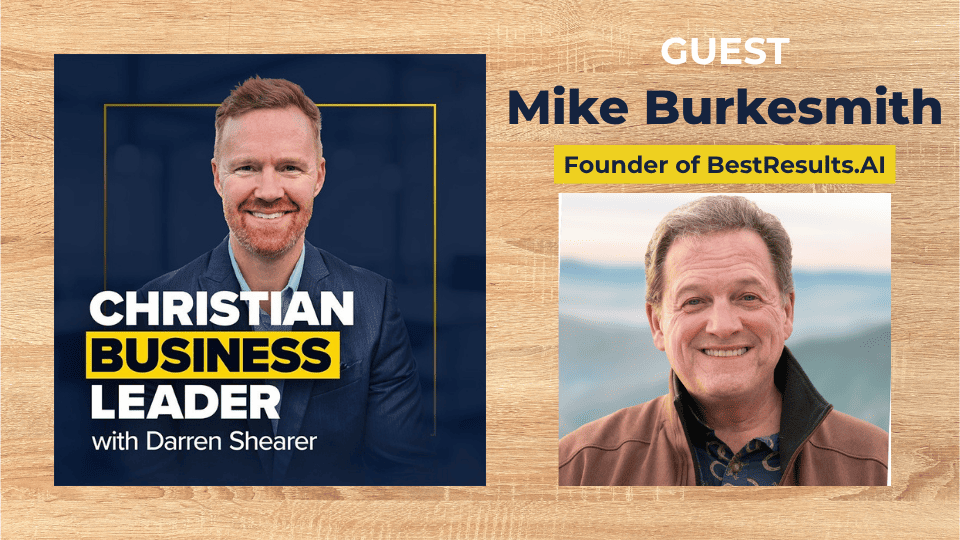
On this episode, Darren sits down with BestResults.AI founder Mike Burkesmith to discuss how Christians can achieve AI productivity gains without sacrificing authentic human connection. He and his company specialize in helping companies achieve the best possible outcomes from AI.
Key Takeaways
- AI drives real ROI fast — One client completed an 8-week AI workshop series and identified over 2,000 hours of annual time savings before even finishing week six, translating to roughly $150K/year, depending on the team.
- Prompting well = guiding well — Mike’s team invested ~7,000 hours in building “universal accelerator” prompts designed to produce high-quality outputs without hallucinations, and has since expanded into building AI agent frameworks with built-in quality assurance and self-scoring.
- Faith and marketplace influence go hand in hand — Mike’s core mission is to equip Christian business owners to use AI not just for efficiency but to expand their capacity for relationships and influence — framing AI stewardship as a faith responsibility.
Christian Business Leader is the podcast for marketplace Christians seeking to explore and apply God’s will for business for the purpose of cultivating Christ-Centered Companies.
Full Episode Transcript
Heads up: This transcript was created with AI, so you might notice a few typos or small mistakes. We recommend listening to the episode for the best experience!
Darren [00 0:02]: Welcome to the Christian Business Leader Podcast, where Christ-following business leaders explore God’s will and ways for business. This show is a ministry of the Center for Christianity and Business at Houston Christian University and features conversations with today’s Christ-centered business leaders who are representing Christ faithfully in the business world. I’m your host, Darren Scheer, and if you want to make your work, leadership, and company culture more Christ-centered, you’ve come to the right place. On this episode, we’re joined by Mike Burksmith. Mike is a seasoned innovator and founder of bestresults.ai, helping businesses and mission-driven nonprofits turn AI into real results fast. With decades of experience and leadership roles, including C12 principal chair and eMyth mastery consultant, he’s coached hundreds of CEOs to outperform industry benchmarks in growth and profitability. Known for his relentless focus on ROI and practical execution, Mike brings battle-tested strategies that translate vision into measurable gains. He equips leaders to cut through AI hype and drive meaningful impact, often within a single quarter. And he’ll be one of the speakers at the upcoming U.S. Christian Chamber of Commerce conference. It’s happening in April. Everybody, go and check that out. Hopefully you can join us, especially if you’re somewhere in that Orlando, Florida, Central Florida area. Mike, welcome to the Christian Business Leader Podcast.
Mike [1:44]: Oh, thank you, Darren. It’s great to be with you. When did you first realize God wants to be involved in your work and business? Boy, that’s a fabulous question.
Darren [1:44]: I realized initially back in the 1990 timeframe where we were doing a church plant, and a couple of brothers in the church were involved with the Christian businessman’s connection. And we prayed by name for people every week at a breakfast meeting, and every quarter, we’d have a very noteworthy but also Christian business executive come and share their testimony at a luncheon. And it was amazing. And that was followed later by getting into Fellowship of Companies for Christ International, which is one of the founding, original, kind of marketplace ministry groups in the US. And a lot of organizations have spun out of that, including C12, where I was a chair for 15 years. And so it’s been a great journey. The beauty of it is that God knows every business owner better than they know themselves, and He can provide everything they need to do everything he’s called them to in the marketplace, which is a fabulous truth and builds hope and builds motivation to press on with Jesus with every step in the marketplace.
Daren [2:55]: Yeah, I love that you’ve been a part of these incredibly influential organizations in the history of, I guess, what we would think of as the modern faith at work movement, but but uh we use the term modern loosely because CBMC, I believe, started about a hundred years ago, right? Doing isn’t it amazing? The same thing that you just described.
Mike [3:20]: Yes, it is a beautiful thing. And you know, Jesus worked in the marketplace all the time. He worked in every sphere of cultural influence, and here we are just following in those footsteps.
Darren [3:33]: That’s right. So, Mike, what’s one of your favorite stories that illustrates the impact being made by your company, bestresults.ai?
Mike [3:42]: There are many, but one that comes to mind is a friend, Chris, and I’ve been an advisor for his business for a little over 20 years. And one of the motives that we had to begin Best Results AI was to make sure our clients would not fall behind in terms of being competitive in the marketplace. So in the latter part of 2024, we took Chris and a dozen of his team members through an AI workshop series. And that was a, at the time, an eight-week series, one hour a week. Before they finished the sixth week, they had discovered more than 2,000 hours of time savings per year for that team. And since then, they’ve discovered thousands more. What he’s done with that is they’ve applied it to elevating the quality of customer service, and they’ve built more relationships in the marketplace, thus expanding their reach. And as a believer, then Chris has more influence. The more business we conduct, the more relationships we have, that means the more influence we have for Christ in the marketplace. And so he’s just one illustration of our mission, which is to equip Christian owners and CEOs and their teams to apply AI to expand their influence.
Darren [5:09]: Yeah. 2,000 hours a year. What does that come out to in a dollar amount, roughly?
Mike [5:16]: Well, you know, depending on the industry you’re in, probably that comes out to 100K to 150K a year, could be more, depending on the type of professionals you have on the team. Now the dollars are interesting because time savings is one way that we measure results. Uh, there are other ways to measure results like growth in revenue or cost efficiency or cycle time reduction. If you can actually deliver more value more quickly, then you can have a greater capacity. And capacity is huge when it comes to influence and impact in the market.
Darren [6:02]: Yeah, that’s that’s an excellent point. So what are the AI applications that typically give small businesses their biggest gains that you see? There’s many.
Mike [6:16]: I love that nowadays the large language models like Chat GPT, Copilot, Claude, Grok, all those, you know, Gemini.
Darren [6:25]: I guess when I say applications, not necessarily the exact AI tool, but like the application to the specific business processes.
Mike [6:37]: Right. So, regardless of which tool set you’re using, nowadays they’re rapidly connectable to things like email, calendaring, and shared folders. All of a sudden, that means we can apply them to all the functions of the business easily. And so we’re seeing people literally apply AI in marketing, in lead generation, in sales communications, in sales support, in estimating, and bidding proposals. After closing a deal, we’re seeing people do onboarding with AI support, service delivery, product delivery, deployment, and project management work, and we’re seeing them work in finance, in supervision and management excellence, and in coaching. We’re seeing really every functional dimension of the firm, including leadership and management, uh elevated by applying AI.
Darren [7:43]: And what would be a specific, like in a specific industry, a specific business process that …
Mike [8:07]: One of the big breakthroughs that we’ve seen working with construction firms is that they are perpetually struggling with, say, a multi-page request for proposal, which could be hundreds of pages, depending on the situation. They have to pour through all of that, identify every requirement, make certain they’re compliant with every requirement, craft a proposal, pull takeoffs of requirements for material and labor from, say, blueprints and other documents. And all of that, as you can imagine, takes a lot of time. Also, there’s so many details, they tend to make mistakes, leave things out, get things crosswise. Well, with AI, in minutes, of course, you can read everything the images, the text, summarize, categorize, organize, prioritize. And even then, based on the knowledge that the company has about its own estimating techniques, it can very quickly generate a proposal for them in draft form for their experts to review. And so we’re seeing this across the board. The bidding estimating lifecycle is collapsing from what could be weeks of work to a half a day or less, depending on the context. So that’s just one example. And that isn’t so that they can get rid of estimators, that’s so they can expand their capacity, right? Do more for more people, more efficiently, and even with less rework, less back and forth, because the accuracy is higher.
Darren [9:34]: Yeah, like I was telling you before we got on the call, I started my MBA about 15 years ago and just decided to finish it up. Got one more course, but I did a course on innovation recently and did a report on an estimating tool, such as the one you just mentioned, for construction companies for doing their takeoffs. And it’s just amazing. You just upload the blueprints, and it tells you exactly how much material you need for all of the you know, for the flooring and for the framing. It couldn’t do the elevations, and it couldn’t do electrical, it couldn’t interpret those plans for some reason yet. But maybe you have one that does that.
Mike [10:34]: How long ago was that?
Darren [10:35]: This was, I don’t know, maybe two months ago. We’re probably already there, aren’t we?
Mike [10:36]: Well, we are. We did very recently, within the last 90 to 100 days, see some extraordinary advances. And the reason is that AI is now enhancing the code that runs it, so it’s just now moved into the innovation stage of AI’s evolution to enhance its own performance, and so yeah, it is getting smarter at an accelerating rate.
Darren [11:00]: That’s crazy. So we haven’t been just waiting on some programmer to like put some drop some code in there to tell it to do elevations and show it how to do electrical, it’s just learning itself how to do that. Is that what you’re saying?
Mike [11:20]: It’s at the core level, it’s getting smarter because AI is now a co-developer with human beings on its own system. It’s a weird abstract idea, but it is what’s happening. Thus, its ability to learn and reason is going up. Also, its ability to do things autonomously is going up. This is both an exciting opportunity, as well as for some people, very scary, right? Because our hope is that AI doesn’t take over. And thus, it’s one of the reasons we want believers to be in front of the AI movement because we want high-integrity users influencing the entire ecosystem of AI, so that we retain control, we retain good boundaries, we uh elevate data security and data privacy as well as policy and governance when we’re using it. And yeah, it’s evolving quickly. And , so it’s as a steward in Christ, we want to make sure we’re doing the very best with what these tools can do.
Darren [12:33]: Yeah, yeah, it’s amazing how quickly they’re learning. Mike, what’s a time when you saw God’s hand at work in your company or in one of the companies you serve?
Mike [12:46]: Oh man, so many really neat things have happened over the years. They range from very personal, like being on an airplane for three hours with somebody I’ve never met, and being able to build a relational bridge because I was on a business trip. And this person opened up, and I was able to share the gospel and give them the gospel of John, and they came to faith on an airplane. So that is, you know, one of the dimensions of just circulating in the marketplace, isn’t it?
Darren [13:17]: Yes.
Mike [13:17]: Now, others are God showing up and creating divine appointments, which could never happen apart from his oversight. And in the divine appointments, doing things like providing for cash flow when there was a gap, or providing a person who’s a perfect fit, like a needle in the haystack, without having to recruit them. They just show up. Well, we know that they don’t just show up, right? God is orchestrating, and so these are just a couple of little examples. God is showing up all the time, and especially when we begin our mornings asking him to reveal where he’s working and invite us into it, and when we trust him enough to stop the hamster wheel we might be on and pay attention to the ministry that’s right in front of us, even though we’re busy human beings.
Darre [14:15]: Yes. Yes. And can you give us a specific example of how disciple-making has happened through your company and its culture?
Mike [14:25]: You know, we have a colleague that I just so highly appreciate. And this person is still on a journey spiritually of seeking, and we have the privilege of, in a sensitive manner, talking about the things of the Lord in our business meetings, in a way that is not talking about religion, not talking about churchianity, but talking about Jesus and a relationship with the living God. And guess what? You know, this person is praying with us, enjoying the time, and it is definitely a season of spiritual discovery for this person, and that’s just in this little company called Best Results AI, you know. I’ve had lots of examples over the years. For example, one of the C12 members that I used to work with decided to open up at an all-hands meeting with 85 staff and say, “You know what, a lot of you have known me for 10 years or more here at this company, and you know I’m not perfect. And you may have heard we started a prayer meeting recently on Monday mornings before working hours. And, I just want you all to know there’s nothing weird going on there. And I’m not perfect, but I am a follower of Jesus. And so if you ever have any questions about that, or if you ever want to submit a prayer request, we’d be happy to pray for you.” That’s all he said. Within six months, two people got saved on the job in those offices because he basically told them it’s okay to talk about spiritual things at work.
Darren [16:00]: Wow! Incredible!
Mike [16:02]: And so, what a beautiful thing. We don’t have to be, you know, an evangelist as powerful as Luis Palau or Billy Graham, right? We just have to be real about our relationship with the Lord.
Darren [16:15]: Yes, yes, I love that. In addition to seeing people come to know the Lord for the first time, how have you seen the culture of your organization rub off on the people that come in contact with it?
Mike [16:34]: Yeah, that’s a good question because the fragrance, the aroma of Christ, is attractive even to those who do not yet know him. And so it shows up when we walk in integrity, it shows up when we sacrifice our time and our treasure to meet the needs of people in our midst. So if we have an employee and they’re hurting for some reason, they had a flood in their house, they had a bad diagnosis medically, and we are there for them. What are we doing? We’re building trust, we’re building uh a bridge. And what happens, of course, is the bridge becomes a bridge for the gospel message eventually, when the timing is right. And so it is both serving practically, being present as a caring human, and being awake to when the Holy Spirit says, “now is the time.” Let’s ask them about their spiritual journey. Let’s see if they want to go there. And uh yeah, that’s so cool. Because again, it doesn’t require that we’re fabulous at anything other than being real about our walk with God.
Darren [17:57]: Yeah. And you mentioned, you know, one of the benefits of having a very robust adoption of AI in your business practices is that your company doesn’t let get left behind, and then it can grow and it’s hard to influence through your company if there is no company, if there are no profits. But do you feel like that AI is eroding trust in the marketplace? Because I mean, I have to be honest, when I get an email that is very clearly AI generated, it damages trust with the person that sent me that email.
Mike [18:41]: Right. Yeah, I had that experience just a couple months ago, and I could tell it was not their regular tone, it was a different topic. It was clearly AI generated. Um, now one of the things that we teach, we do workshop series for people who are either getting ready or are ready to ramp up their AI deployments. We always recommend that every output be reviewed by a human being, unless it’s a very finite workflow, like bookkeeping arithmetic, in which you can build in quality assurance, like a reconciliation step, you know. But if it’s anything that has to do with relationships, communications, that kind of work, the last thing we want to do is take an output from AI and just publish it as if it’s going to be perfect, because it’s not. Even though it’s brilliant, it’s not contextually perfect. It just isn’t. It’s not relationally perfect, it’s not. And, our opportunity as stewards is to do the formula, which is the great formula for AI, which is that human ingenuity plus generative AI equals value, greater value. So it’s always about us owning it, really, at the end of the day.
Darren [20:06]: Yeah. And is it it’s probably not just a matter of well, AI just has to get more sophisticated so that it can uh know your voice, know your tone, instead of giving you the ChatGPT or the Grok tone, it’s gonna give it’s gonna know you well enough to say things in a way that you would say it. I mean, I think that’s not the solution either. I don’t think we would ever get to that point, would we? Where people would just, or maybe we will get to that point where people just don’t care anymore. I mean, as long as they get the information and the data that they need, they don’t care that, you know, it doesn’t seem like I mean one of my issues is when I get an email response, it’s AI-generated. I don’t really know if you actually read what I said, and I don’t know if you actually read what you said in your response.
Mike [21:05]: This is this is our stewardship opportunity, Darren. This will be a personal choice for every AI user. And I think if I want to be other centered, I want to care about another, I will read everything that goes out of my inbox. And if I want to appeal to a positive relationship-building style of communicating, I’m gonna say things in every communication that have to do with the individual I’m writing to or the team that I’m writing to. How is AI gonna do that? It’s not. I’m gonna do that.
Darren [21:40]: Yeah.
Mike [21:41]: And yes, it is true. The more we interact with AI, and if we use the memory and the context capture tools that are available in modern AI, yes, it will start to mimic our tone more. It will start to see the patterns of thinking more. Nevertheless, we get to own it, right? And I want a relationship. If I want a relationship with you, Darren, I want to be talking to you, not to the transaction that we’re involved in. Right. I want both. I I want to talk to you and talk about the transaction.
Darren [22:19]: Yeah. You know, I remember seeing I and I haven’t seen one of these in a little while. ut people that participate in like the the one-sentence email club, you know, where, and then it’ll have like a disclaimer at the bottom that says, I’m participating in this movement to cut down on the amount of of email that gets sent out and that we have to that we have to process. But now you can have email or AI generate your response, and it’s gonna be much longer than probably what you would have actually said, and it’s gonna dump more work and more pressure on the person on the on the receiving end, which is what what what we’re starting to see now. In the way that some people that rely heavily on AI for their email, is responses that just get inflated far beyond what they would have been had a human processed it and responded. You know, certainly there are those humans that are going to write paragraphs and paragraphs of you know worth of an email, and have all these different issues in one email that probably should have been in multiple emails with separate subject lines, but I digress.
Mike [23:50]: Well, I understand the underlying issue, and this is true with AI whether we are writing an email, or whether we are producing a project plan or whether we’re identifying a workflow roadmap and whether we are incorporating the expertise of a dozen experts in this domain of knowledge to apply to our challenge or our problem or our opportunity. AI can generate vast, vast, vast amounts of information, just huge amounts. We need to guide it and say, ” Look, I don’t want more than 200 words on this, or this has to fit on a page. Don’t waste the time of the executives who are going to read this summary. Make sure it’s tight.” You know, these kinds of guidance matter. And so if we’re using it tightly integrated with our email, and we’re setting up business rules and we’re setting up response frames, we need to guide it and say things like don’t overdo it. You know, I’m paraphrasing here, but you get the point is we are in charge. We’re ridiculously in charge when it comes to AI. We just need to know how to guide it really well.
Darren [25:01]: Yeah. What are some of the other guidance that you add into the prompts that you’re using for your clients to help them with their different business processes to, as you say, to guide the AI as opposed to just letting it just do whatever it thinks it needs to do? Once.
Mike [25:23]: Yes, exactly. So in the summer of 24, I joined a group of 60 people who worked 90 minutes every day for four months, about 7,000 man hours, person hours, to build a set of prompts called universal accelerators. And these are universally applicable and they get incredible, incredible things done, and they do it well, and they don’t allow it to take off and hallucinate and that kind of thing. Well, that was in 24. It turns out in 25 and now 26, especially. We have recently built a framework for building agents. Agents are the more advanced manifestation of using AI and workflows, and they’re more autonomous. We built a framework to build agents. And the framework includes quality assurance, it includes self-reflection and analysis, and even scoring the quality of its own work before it recommends a draft to us. And so we’re getting to the point now where when you ask questions about data privacy, data security, compliance, let’s say it was healthcare related, financially related, other sensitive data related, all of those can be tightly woven into the way that we guide AI. And this is encouraging to me because we don’t want to deliver junk to anyone. We want quality, security, privacy, all those things woven into the process. It that applies to virtually every aspect of what we do with AI. And it and we’re we are a living testimony, the word says. If we’re not doing those things, what kind of testimony are we? You know, and this is part of the stewardship journey for believers with AI is let’s be the best we can possibly be with it every time we produce something with it. And so I I don’t know if I exactly answered your question, but that’s part of it.
Darren [27:32]: Yeah. And adding into your prompts things like cap the word limit at this. And what are some of the other phrases that you might drop in there?
Mike [27:45]: Oh boy, we really enjoy bringing experts to the table. So let’s say I’m writing a tool to assist an executive coach in reviewing the transcript of a coaching session, and in prompting for that, I want to bring in the expertise of a lot of Christian coaches, not just the one that I’m helping, but widely published Christian coaches. And they could be Ken Blanchard, or they could be any number, right, of those leaders that could be brought in with AI and help interpret the explicit and implicit implications of that coaching session and make it really clear and well organized for the executive coach. So after the fact, they can do a great job of holding that client accountable and identifying the issues that need to be addressed ongoing, as well as those that have been wrapped up and need to be celebrated. And all of that can be woven in through the guidance in the prompts. Both the expertise integration as well as the quality of the output and the appropriateness of its use by that professional executive coach. And so I’m just giving you one illustration, right? That would be the same kind of pattern for any functional area. Yeah.
Darren [29:09]: Excellent. Well, Mike is the expert on AI, and wants to encourage anyone to come to the AI lab, which is happening at the U.S. Christian Chamber of Commerce conference in Orlando. And Mike will be facilitating that workshop. I will be helping to facilitate the Faith and Work Lab. And hopefully those won’t all be happening at the same time. So I can come and be a part of yours as well. But really looking forward to seeing you in person at this conference, Mike. Thank you so much for spending time with me and our listeners today. Bestresults.ai is the website. Anything else you want to say about how people can get connected with you, Mike?
Mike [29:57]: Oh, you know, my email is the easiest one ever. It’s just Mike at bestresults.ai. And I would love to hear from people if they want to explore this. Our journey is in the body of Christ to encourage, equip, sharpen, comfort, and support one another. And that’s part of what we want to do with our brothers and sisters in the marketplace.
Darren [30:21]: Yes, excellent. Well, Mike, thanks again. Bestresults.ai, everybody. See you in Orlando. Thanks, Darren. Thanks for listening to this episode of the Christian Business Leader Podcast. Be sure to subscribe, leave a review, and tune in for the next episode as we continue exploring God’s will and ways for business.
BIG THANKS to this episode’s sponsor: High Bridge Books
High Bridge Books helps Christ-centered authors build a legacy by crafting and publishing messages and stories that glorify God in all spheres of culture.
- High Bridge Books’ professional book publishing package: https://www.highbridgebooks.com/publishing/
- High Bridge Books’ proofreading, line editing, developmental editing, and co-writing services: https://www.highbridgebooks.com/editing-and-proofreading/
- Examples of our books: https://www.highbridgebooks.com/bookstore/
We’re extremely proud that …
- 43% percent of our 230+ books under contract were written by authors who have published more than one book with us, and
- 49% percent of our books under contract were referred to us by authors who have published with us previously.
Contact High Bridge Books’ CEO Darren Shearer at [email protected] to get a conversation going about your book!