Leading with Brain Science and Biblical Purpose (w/ Kim Hanson)
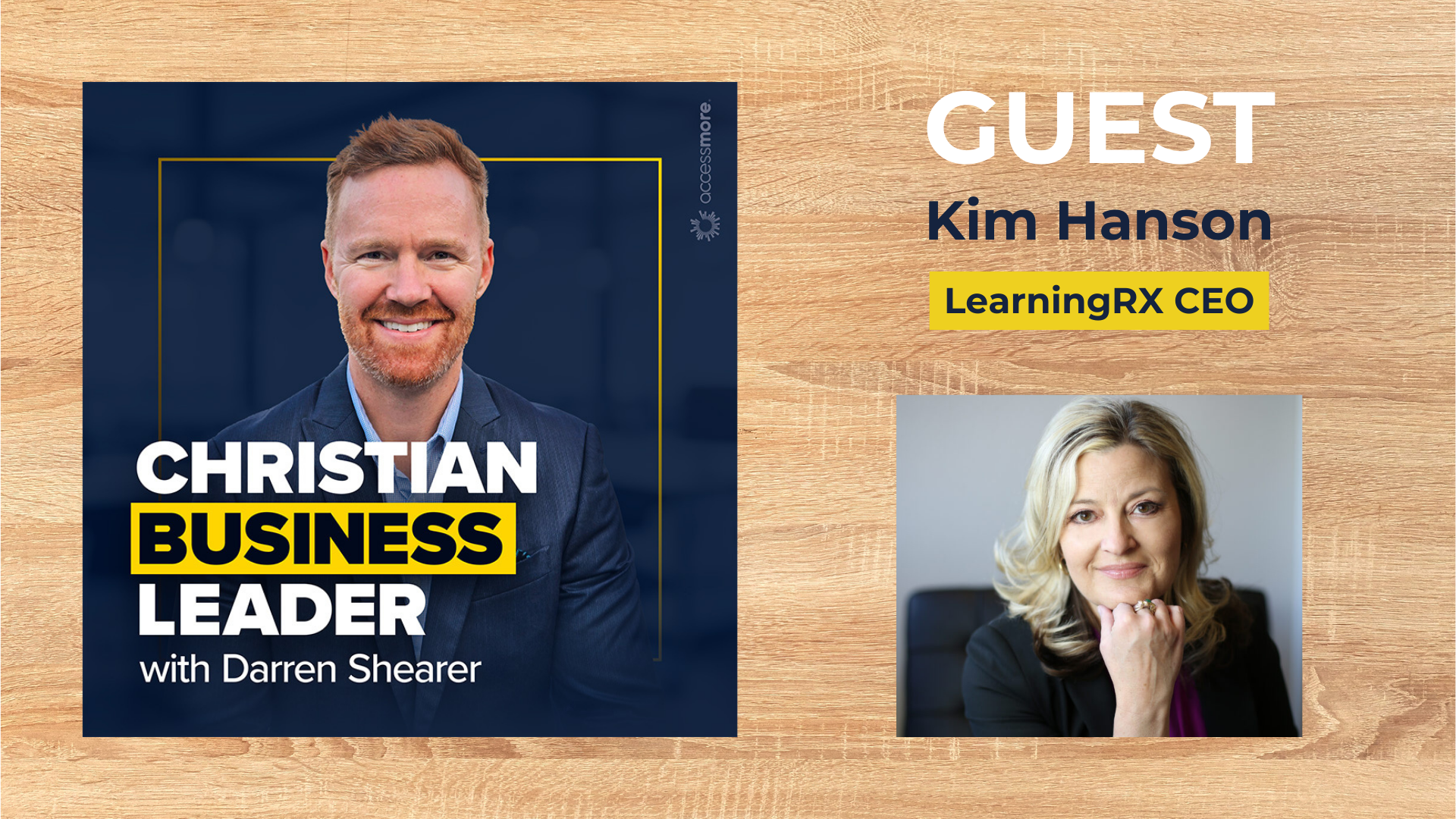
On this episode, Darren sits down with LearningRx CEO Kim Hanson to discuss the Kingdom impact made through LearningRx’s 178 brain training centers around the world.
Kim Hanson serves as CEO of LearningRx, which now has 178 centers in 45 countries. With a heart for impact, Kim equips professionals, educators, and parents to unlock God-given potential through cognitive skills training that transforms real-life performance. A former inner-city educator, Certified Franchise Executive, and co-author of Unlock the Einstein Inside, she blends business leadership with mission-driven purpose. Kim is passionate about mentoring the next generation and advocating for individuals with intellectual and developmental disabilities. She and her husband, Dr. Wayne Hanson, have been married over 25 years and are raising four children together.
Key Takeaways
- Faith integration in business begins with intentional alignment and visible values. Kim Hanson openly integrates prayer, shared values, and servant leadership into LearningRx’s culture, demonstrating that faith in business is not forced proclamation but consistent alignment between belief and action By framing the company as God’s and seeking daily wisdom, she models stewardship over ownership, shaping a culture rooted in purpose rather than profit alone.
- Targeted cognitive training unlocks confidence, grit, and long-term transformation. LearningRx strengthens seven underlying cognitive skills such as attention, processing speed, and memory through structured, personalized exercises that begin at a person’s point of difficulty. By working specifically on weaknesses, students not only improve performance but also develop resilience and confidence, often reshaping how they see their potential and future possibilities
- Mission-driven leadership combined with strategic foresight sustains impact. Eighteen months before COVID, LearningRx proactively developed online delivery systems, enabling the company to retain 89% of students during shutdowns and continue serving families globally. This preparation reflected disciplined focus on mission and a willingness to say no to distractions, demonstrating how clarity of purpose and operational excellence work together to advance long-term vision
Christian Business Leader is the podcast for marketplace Christians seeking to explore and apply God’s will for business for the purpose of cultivating Christ-Centered Companies.
Full Episode Transcript
Heads up: This transcript was created with AI, so you might notice a few typos or small mistakes. We recommend listening to the episode for the best experience!
[00:00:02] Darren: Welcome to the Christian Business Leader podcast, where Christ-following business leaders explore God’s will and ways for business. This show is a ministry of the Center for Christianity and Business at Houston Christian University and features conversations with today’s Christ-centered business leaders who are representing Christ faithfully in the business world. I’m your host, Darren Shearer, and if you want to make your work, leadership, and company’s culture more Christ-centered, you’ve come to the right place. On this episode, we’re joined by Kim Hanson. Kim serves as CEO of LearningRx, which now has 178 centers in 45 countries. With a heart for impact, Kim equips professionals, educators, and parents to unlock God-given potential through cognitive skills training that transforms real-life performance. A former inner-city educator, certified franchise executive, and co-author of Unlock the Einstein Inside, she blends business leadership with mission-driven purpose. Kim is passionate about mentoring the next generation and advocating for individuals with intellectual and developmental disabilities. She and her husband, Dr. Wayne Hanson, have been married for over 25 years and are raising 4 children together. Kim, welcome to the Christian Business Leader podcast.
[00:01:26] Kim: Thank you. It’s awesome to be here. I’m excited and honored.
[00:01:31] Darren: Good, good. I’m excited to have this conversation with you. Kim, when did you first realize God wants to be involved in your work and business?
[00:01:41] Kim: You know, actually, I was a little bit of an entrepreneur as a kid, and I actually started my first business at age 9. I started a little card, greeting card company. And I had 4 cards that I drew up, took to the printer, and then I’d go around the neighborhood, knock on doors, and sell packages of cards, mostly to old ladies, because they wrote people. And on the back of my card, I wrote, so for example, I actually have a picture of it right back there. But I had a little frog that was on a mushroom, and it said, “You’re special.” And on the back of the card, I wrote, “I believe you’re special because God made you. And if you would like more of my cards, write to me at 312 North Union Street, Appleton, Wisconsin 54911.” And so, even as a kid, I knew and loved business, and I also knew that I wanted to do something meaningful, and that I wanted God to use me.
[00:02:49] Darren: Wow, I love that. And I love that you have that card framed behind you as, uh, just to remind yourself of how God has wired you. And so, and also your dad, you’ve— was a strong influence in helping you get into the particular business that you’re in now. Tell us about LearningRx and how that came about.
[00:03:15] Kim: Yeah, so LearningRx is a one-on-one brain training. We have one-on-one brain training centers. And so most people don’t know this, but there are two parts to SMART. There’s what you know, and then there’s how you process information. And we are on the how you process information side. So on the what you know side, that’s really academics, that’s what would help you do well in Trivial Pursuit. It’s what schools work on, and even tutors, you know, reteaching what you should have learned the first time. But at LearningRx, brain training is really 7 underlying skills that are important to how you learn and perform. And so, they are skills like attention, processing speed, visual processing, memory, how you process things, logic and reasoning, and also auditory processing. So, what we do is we do one-on-one exercises to strengthen those 7 underlying skills.
[00:04:20] Darren: Got it. And so you started franchising this back in, was it 2002?
[00:04:27] Kim: 2003. In 2002, I joined my dad and learned franchising so that we would, from the beginning, start doing best practices. So we kind of studied it for a year, and then we started to franchise our programs.
[00:04:46] Darren: Gotcha. And Kim, on this show, we believe the primary purpose of business is about more than just making a profit or making or donating to Christian ministries. It’s about making disciples of Jesus, because that’s where people spend their time, right? So can you give us an example of how disciple-making has happened through LearningRx?
[00:05:10] Kim: So we are a faith-based company, and I openly share faith. You don’t have to be a person of faith to be a franchisee, but you do have to have values that align with our values. And so there are a lot of things that we do. I do open any executive meeting with prayer. I ask God. In fact, every day I pray for two things. To God, I ask him first of all to give me wisdom, because I need it, and I ask him to use me. And so I find that God gives me opportunities every day to be used. So a lot of times, if a franchisee is going through something, we will pray for them. So we have devotions on Wednesday mornings. Everyone’s invited to come. And we throw some leadership and some biblical things into it. But probably the overall thing is really just serving people. One of our values is to be helpful, and that means that you’re easy to work with, that you have an attitude of helpfulness. So if someone walks in with two big boxes, you jump up and help them. So just showing servant leadership, through everything that we do.
[00:06:44] Darren: I love it. I love it. Yeah, I’m glad you, you said that as well, because, you know, sometimes when I ask this question, I’ll sometimes forget to clarify that when we talk about making disciples, we’re not just talking about that you have a Bible study available for employees, team members, or that you are passing out tracts in the, in the break room. We’re talking about something much, much more comprehensive and impactful in the overall culture of the organization and culture of service. I love that that’s central to who you are. What’s one of your favorite stories that illustrates the impact being made by LearningRx?
[00:07:34] Kim: Oh, there are so many. In fact, I try to set up my whole week with the why behind it. And one of the things that I do every Monday morning before I start my day is I watch one of our testimonials that have been sent in, either as a video, sometimes it’s even just a story of one of our center owners. But A kid that comes to mind is a kid who has autism, and I think he was probably around like 3rd or 4th grade, and he really struggled in the classroom to pay attention, and he had a hard time making friends, and he even had difficulty with noises. And so he started to go through our training, and he just did really well. We really were able to extend his ability to attend, to not be easily distracted, and just gave him the confidence because reading was really difficult for him, too. You know, being able to blend, segment, and analyze sounds is something that we really worked on. And it just kind of opened up his ability to read. And what I love is, you know, he talked a lot about how now he’s so much better socially, and that he can get his work done at school, doesn’t have to spend as much time at home, so he has more time to play. And, you know, he’s just, he told his mom, I think now, Mom, I’m unstoppable.
[00:09:28] Darren: Wow.
[00:09:29] Kim: And his mom said, “yeah, like, you could probably go to the moon.” And he said, “Why to the moon? Can’t I go to Mars?” And so I just love the fact that as we help people learn better, faster, and easier, they start to see the possibilities of who they could be and how they could help the world be a better place. So I love that by helping their potential, and that they can live out their purpose that God’s put inside of them. I believe God has given everyone a purpose. We’re all here to do something. And when it’s always hard to figure out, okay, well, what is my purpose? But whatever God has put in their hearts and whatever they’re good at and the talents he’s given them, You know, the ability to serve and to learn and to perform better, faster, and easier is kind of what we’re about, so that, you know, they’re not held back by weaknesses in their cognitive skills, but so that they can really be successful in what God wants them to do.
[00:10:49] Darren: Yeah, I love that story. Why can’t we go to Mars? What a great question.
[00:10:56] Kim: Isn’t that awesome?
[00:10:57] Darren: What percentage of your clients, you refer to them as clients? Yeah. What percentage of them have, or are on the autism spectrum, would you say?
[00:11:11] Kim: I would say it’s maybe 10%, 8 to 10%. So, yeah, we, I mean, our most likely student is someone who is either struggling to read, but yet, they’re smart, like a smart kid who struggles to read. In fact, that’s how our whole programs were born, ’cause that was my dad. My dad was a genius when it came to math. He was just a math whiz. That’s why they tested him as a kid. But reading was really difficult for him. And that is what started his curiosity. If I’m a genius, if I’m really smart, and I can do so many things well, why would reading be hard for me? And so that’s kind of what set my dad on a journey to look at intelligence and what does it take to learn and to read? Yeah, I would say the other typical client that we have would be someone who has a hard time paying attention. Most people don’t know this, but there are three types of attention. There’s sustained, which is how long you can do something, there’s selective, which is honing in, but ignoring outside distractions. And then there’s divided, which is doing more than one thing at a time. And we train all three of those attention abilities. The other interesting thing about people that have ADHD or attention issues is that attention is not always their weakest skill. Usually processing speed and working memory are even lower than attention. So if you’re not addressing all three of those, it’s just kind of a Band-Aid solution.
[00:13:07] Darren: Yeah, yeah. And when you encourage, when you show them, start to show them what their potential is, and that they don’t have to be defined by their their disability or weakness, it’s amazing how their performance changes. I was thinking about, we have a young guy in our church who’s on the spectrum, and so he won’t come and sit down in the service, kind of early 20s. He’ll kind of walk around the perimeter of the church, and everybody’s fine with that. Everybody knows what’s going on. About Two weeks ago, I was telling you, we were talking about how you were a children’s minister. My wife also is. And I was teaching the lesson for the 3rd to 5th grade class two weeks ago, and we needed a, like, a treasure box with a lock on it because the lesson was that you don’t come up to the lockbox and try to figure out how to how to open it just on your own when there’s probably a key somewhere, and the key is prayer, and the key is going to God. So that was kind of what we’re trying to teach because there was a special message inside. And so we had to teach that, but we didn’t have the lockbox. So this young guy with autism, he. On this particular Sunday morning, I see him and his mom getting out of the car next to me, and he’s got a treasure box with a lock on it. He has no idea what the lesson is for that particular Sunday. And so we’re walking in, and I was like, did you know that we were going to be teaching this lesson? He says, no, I just— I felt last night like I wanted to bring this and give it to the children’s ministry. Oh, is that wild? Like, it was literally like, you know, one of those take the coin out of the fish’s mouth type of miracle. One of the most remarkable things I’ve ever been a part of or witnessed God do. But just the way that he provided that through this young guy. And but, you know, if he felt like he didn’t belong or felt like he didn’t have anything to contribute, then he never would have done that, you know. And so what you’re doing is you are helping them tap into their potential and realize that you are capable of great things, and it might look a little different, right?
[00:16:07] Kim: Yeah, yeah, yeah. That really touches my mom heart because I have 4 kids. I have a set of twins. My kids are all adults now, 30. I have twins that are 27 and a 24-year-old, but my son, who is a twin and is 27, has autism. And God uses him, and I just love to watch him serve at our church. He does, you know, like the words on the screen. And yeah, I feel like he has always, since a little kid, he’s just been really close to hearing God, and he pays attention to people, and he pays attention to God’s voice. And so God’s able to use him even though, yeah, He didn’t speak hardly at all in school.
[00:17:00] Darren: Yeah.
[00:17:01] Kim: Yeah, and when he was real little, doctors told me he’d never be able to read or speak in sentences, but he does, mostly because of our program. Yeah, yeah, we only work on what you can’t do. So if you can do it, then we don’t work on it ’cause you have that skill. And so we start where it starts to get hard, and then we just continue to work on it. What we do is not easy, but it’s impactful. And, you know, we used to think science used to think that whatever you’re born with, you’re stuck with, but it’s just not true. In fact, every study in the last 40 years has shown that you can improve your underlying skills, and we do every day all across the world. And so, yeah, yeah. And you don’t have to be struggling to get a benefit either. Anyone can. Sometimes we work with quarterbacks or football players or people, Olympic, it’s the Olympics right now, Olympic athletes, because if they can visualize things better, if they can process things faster, then, and they can pay attention to more than one thing at a time, you know, as you’re dribbling the ball, running across the court, and listening to your coach, and, uh, you know, picturing the ball going into the hoop. So all of that, um, helps at the, at the top of your game, and then also, you know, when you’re learning.
[00:18:39] Darren: So what would be one of the main go-to practices or trainings that you take somebody through? Because I’m sure people are listening, a lot of people listening to this right now probably have some kind of attention deficit disorder. Maybe they didn’t get diagnosed with it. I mean, I know it’s incorrect, but when I hear ADHD, I immediately think of a child. And yet children grow up, and many cases don’t grow out of that. And so there’s a lot of adults in the workplace that are struggling and don’t have the tools and the training to be able to work through and even leverage what would otherwise be considered a disability. So what are some of the main go-to trainings that you use?
[00:19:38] Kim: Yeah, so what we do we start with actually a cognitive skills assessment. So we actually test all 7 underlying skills. And so you get to see like where your strengths and weaknesses are. But honestly, we have like over 100 exercises that work on those 7 underlying skills. And in each one of those exercises, there might be anywhere from 12 to maybe 28 levels. And so the very first time that we sit down, one of our exercises is called Attention Arrows. And we sit down, and we start to advance and advance and advance until it starts to get like a little difficult for you, and that’s where we actually start.
[00:20:28] Darren: Hmm.
[00:20:29] Kim: So now every time, it’s a little bit like a video game, but it’s human delivered. Right? So, you know, if you were to play a video game that was really hard, it would be no fun because it’s too hard. And if it’s too easy, it’s no fun. So we get right there at where it’s challenging you. And then we take small steps and just increase the difficulty as we go. And so, because we start at that difficult starting spot, every time we go up a level, we’ve improved skill. And then we test it at the end too. But we do target the skills that are the weakest first. And as we bring those up, then— and also, it depends a little bit too, if you’re an adult or a kid that’s struggling. A kid that’s struggling in school, they can’t hire someone to do their books or to do math for them, right? So they’re faced with their weakness every day. So we start at their weakness. But then towards the end of their program, we also like to work on their strength. And so we kind of increase all of those across the board. We get some really cool results. We have over 40 studies that have been done on our programs, on our programs, not just that we’re based on, and we’ve been written up in 17 peer-reviewed journals. So we’re We’re like the real thing.
[00:22:02] Darren: Yes.
[00:22:02] Guest: We’re not just like a, you know what I mean? Like weird practice. We’re really targeting those skills and strengthening them.
[00:22:12] Darren: Yeah.
[00:22:12] Guest: Yeah. I don’t know if that answered your question.
[00:22:14] Darren: Yeah. I mean, and the fact that you have 178 centers in 45 countries, you know, there’s a strong amount of credibility just wrapped up in that.
[00:22:26] Guest: Yeah, the hardest thing is that people just don’t know that our programs exist. And so I think that that’s the hardest thing is explaining what brain training is. 10 years ago, no one knew what it was. And now a lot of times they think it’s a digital game, or they think it is, you know, just getting exercise will help your brain, and that can, but if you target and train these underlying skills, then you’re really doing something healthy for your brain.
[00:23:02] Darren: Yeah, you’re not just telling people to play Sudoku, right?
[00:23:07] Kim: Right. Yeah, yeah. Well, we might do something that’s a little bit like Sudoku, uh, but it might also be on a metronome, and you’re adding numbers. And yeah, so I give out little exercises every once in a while, you know, so that people can kind of experience them. But that’s the best way to understand, oh yeah, I get it. It’s like mental sweat. And what I love too is because we only work on what you can’t do, it also builds grit. And I love seeing grit in my own kids. I love seeing grit in the students that we help. So, and confidence, those are two things that we don’t really target, but they just happen because when you can learn better, faster, and easier, you start to feel good about yourself, and you’ll try new things.
[00:24:02] Darren: Yeah. Well, Kim, you’ve shared some amazing stories. Is there another story you could tell of a time when you saw God’s hand at work in your company?
[00:24:11] Guest: Yeah, I would say about 18 months before COVID, we were looking at our mission. And one of the things we were looking at in our mission and our vision is helping more people, even where we didn’t have a center. And so, what we did, and again, we have over 100 exercises, and it involves a metronome, and they’re kind of complicated with manipulatives and different things. But we thought our mission is to help anyone anywhere. And so, we decided to figure out how could we do our training over Zoom. We actually started with Skype, and then we found this little program called Zoom that no one even knew of at the time. And so we worked on it at our home office for about 6 months, and then we rolled it out to some pilot centers, 7 pilot centers, and we wrapped things up the last day of February. It was kind of like March 1st, 2020, on how to do all of our training over Zoom. And you kind of know what happened that next month was COVID and shutdowns. And wow, was God’s hand on our company that we had figured out. And in 6 weeks, we were able to roll out to all of our centers how to do our training so that they didn’t have to lose their students who had to be at home. And so we retained, I think it was like 89% of our students. And so that meant that our businesses could still be open, and we could still be helping people. So that’s one of the stories that I love.
[00:26:16] Darren: Yeah, 89%. That is amazing.
[00:26:19] Kim: Yeah, yeah, that’s miraculous. God came through just in time.
[00:26:24] Darren: Yeah, March 1st. That is amazing. God knew what was coming. Like Noah building the ark, you know, you don’t know exactly why, but you knew that you needed to get online, but you didn’t know how much.
[00:26:42] Kim: Yeah, yeah, that’s why focus. One of the best things I do is say no to ideas and stay focused. Stay focused on our mission and our purpose, and stay close to what God is leading us to do. I don’t consider LearningRx my company; I consider it God’s company. And so even when I have a problem, then it’s easier. I can just say, “Hey God, this is your company. You gotta figure this out.” You need to give me wisdom. You need to give us answers because this is your company. So I give it to them every day.
[00:27:19] Darren: Well, we have a lot of Christian business leaders listening to this podcast. What kind of franchisees are you looking for?
[00:27:28] Kim: So I am looking for people who want to do something meaningful and they want to serve their communities. And, uh, and, and want to have a small business. So that’s who I am looking for— people that are difference makers. Um, and I actually have a people analyzer. I don’t know if you’re familiar with EOS.
[00:27:54] Darren: Yes.
[00:27:54] Kim: Are you familiar? Okay, so yes, yes. So we run our company on EOS, and, uh, there’s a people analyzer that is part of that system. And so we, I took that, and I made it into like a discovery day. And so I took who are our top performers in our company, and I made a people analyzer that has all of those things that I look for. So I want someone that a mom would buy from. I want someone who is a problem solver, someone who takes responsibility. And so we kind of put all of these things across, someone who wants to make a difference, someone who is passionate, someone who’s value match. And so, when I look at possible candidates, and I’m pretty picky also, because I don’t want to get that wrong. Because, you know, our license agreement is for 10 years, and I want to do life together. And so, anyway, that’s kind of what we look for in an owner is someone who’s passionate and just really wants to help people. Wants to do something meaningful.
[00:29:06] Darren: What percentage of your franchisees are female?
[00:29:09] Kim: A lot. I haven’t looked at it for a while, but for sure it’s over 60%. And we have a lot of couples that run one of our centers. So a lot of times it’s a husband and, you know, wife team.
[00:29:32] Darren: Yeah. And are they typically the only employees there in those franchises, or?
[00:29:39] Kim: So most of our centers have two full-time people. They have a director and an assistant director. And then they’ll have maybe 8 to 10 part-time brain trainers who do the brain training. And so there we look for someone who’s fun, almost like someone who’d make a good soccer coach, because you have to— first of all, we want them to follow our systems, but you also have to kind of be a motivator, because we’re working on what they can’t do. And so, it has to be someone who is warm and friendly and fun, but will push you. So, that would make a great coach. That’s what we look for in trainers. Yeah, we don’t want boring teachers. I say that, my background’s teaching, but you can’t be a boring teacher and do it. So you could be a teacher, but you should be fun and not teach, but train. So training is very different than teaching.
[00:30:40] Darren: Well, Christian business leaders listening to this podcast, if any of that describes you, definitely go to learningrx.com. And reach out to Kim and her team and get a conversation going about possibly getting a center started in your area.
[00:30:58] Kim: Yeah, I do have a business book too that I wrote with my dad called The Purpose-Directed Business, and it is written to our franchisees, but it also— anyone who has a small business, it has great principles in there and how to do things with purpose, and but also how to be profitable and look at your cash flow and do marketing right. So there’s a lot great information in here, and I wrote that with my dad.
[00:31:26] Darren: Okay, and what was the title of the book again?
[00:31:28] Kim: It’s called The Purpose-Directed Business. So you can have a copy sent to you on Amazon, but you can also go to thepurposedirectedbusiness.com and you can download a digital copy for free.
[00:31:43] Darren: Okay, and you also co-authored Unlock the Einstein Inside with your dad, which is a very important one.
[00:31:50] Kim: Yeah, yeah. And so this one, just, it’s really written to a parent who has a child who is struggling in school. So it’s about finding the why and then doing something about it.
[00:32:03] Darren: And what year did you publish that? Because I’m sure you’ve learned just so much over the decades.
[00:32:09] Kim: But yeah, this one, you know what, that is a great question, and I don’t even know the answer. I’m sure it’s in here.
[00:32:17] Darren: It might be time to do an updated edition.
[00:32:20] Kim: I actually am working on updating it right now.
[00:32:22] Darren: Oh, awesome.
[00:32:24] Kim: It’s one of my rocks. But so this is the third edition and this is 2018. So we’ve updated it 3 times. We’re working on the fourth because we always have more research that we’re putting in.
[00:32:40] Darren: Mm-hmm. Well, Kim, anything else you want to say about how people can hear more from you and get connected?
[00:32:47] Kim: I think learningrx.com. We do have actually a podcast that my psychologist does called Brainy Moms.
[00:32:57] Darren: Okay.
[00:32:58] Kim: And so you can check that out. It has a lot of followers. A lot of— we work with a lot of homeschoolers too. There are a lot of people that are doing homeschool these days. And yeah, if you are interested in opening a center, you can go to openacenter.com. And you can look at kind of, you know, who we’re looking for. And yeah, download any of— uh, you can go to Unlock the Einstein Inside also, and you can do a free download of that book, or you can get it off of Amazon if you like to touch the book.
[00:33:34] Darren: Okay, okay. Well, thank you for all of those helpful resources. Uh, learningrx.com, openacenter.com, Brainy Moms podcast, the Purpose Directed Business. Kim, this has been a fascinating interview. May God continue to bless you and your ministry in the marketplace as you continue to serve families around the world.
[00:33:57] Kim: Thank you.
[00:33:58] Darren: Thanks for listening to this episode of the Christian Business Leader podcast. Be sure to subscribe, leave a review, and tune in for the next episode as we continue exploring God’s will and ways for business.
BIG THANKS to this episode’s sponsor: High Bridge Books
High Bridge Books helps Christ-centered authors build a legacy by crafting and publishing messages and stories that glorify God in all spheres of culture.
- High Bridge Books’ professional book publishing package: https://www.highbridgebooks.com/publishing/
- High Bridge Books’ proofreading, line editing, developmental editing, and co-writing services: https://www.highbridgebooks.com/editing-and-proofreading/
- Examples of our books: https://www.highbridgebooks.com/bookstore/
We’re extremely proud that …
- 43% percent of our 230+ books under contract were written by authors who have published more than one book with us, and
- 49% percent of our books under contract were referred to us by authors who have published with us previously.
Contact High Bridge Books’ CEO Darren Shearer at [email protected] to get a conversation going about your book!