Fatherhood and Biblical Entrepreneurship (w/ Adam La Barr, Sr.)
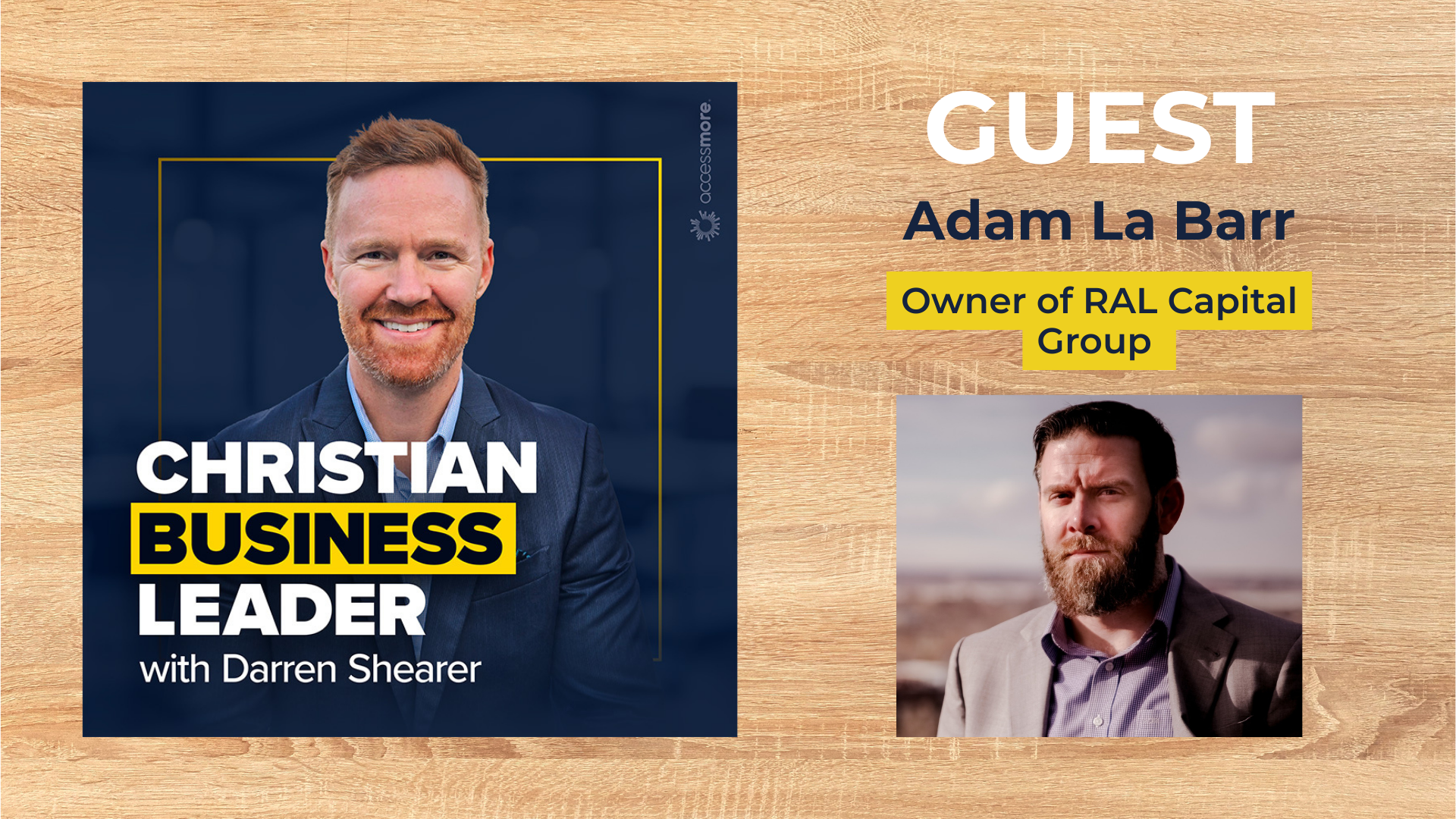
On this episode, Darren sits down with Adam La Barr to discuss his journey in simultaneously raising kids and businesses for the glory of God.
Adam is the owner of RAL Capital Group, through which he has owned and operated hundreds of doors of real estate and helped build and run amazing businesses, from an education company to escape rooms. Adam also hosts two podcasts, The BizDad Podcast and the Delegate That Podcast. He’s a follower of Christ, husband to an amazing woman, father to three great kids (who he helps to homeschool), and a military veteran.
Key Takeaways
- Conviction reshaped how Adam viewed partnership and leadership. Adam Lebar’s integration of faith and business began not with a dramatic moment, but with a quiet conviction about being “unequally yoked.” As he reflected on past partnerships, he realized that misalignment wasn’t about bad intentions, but about fundamentally different motivations—his increasingly shaped by faith, and others driven primarily by profit. This awareness led him to rethink how he partnered, led, and made long-term decisions, seeing business alignment as a spiritual as well as strategic necessity.
- Discipleship happened through presence, generosity, and example before proclamation. Rather than forcing faith conversations, Adam focused on creating environments where Christ’s character was visible through action—serving communities, mentoring employees, and opening his life to others through business relationships. Whether blessing apartment residents with school supplies or inviting a potential partner to lunch, faith naturally surfaced through trust and authenticity. Business became a bridge to reach people who would never step into a church, allowing conversations about God to emerge organically.
- Leadership matured as grace replaced force and control. Adam openly shared how his background as a military veteran shaped a rough, authoritative leadership style early on, but intentional faith integration softened and refined how he led. By clearly establishing his Christian values in the workplace and mentoring young employees with patience and care, he reframed leadership as stewardship. His businesses became places of growth—not just professionally, but personally—where employees experienced guidance, dignity, and a model of Christ-centered leadership lived out daily.
Christian Business Leader is the podcast for marketplace Christians seeking to explore and apply God’s will for business for the purpose of cultivating Christ-Centered Companies.
Full Episode Transcript
Heads up: This transcript was created with AI, so you might notice a few typos or small mistakes. We recommend listening to the episode for the best experience!
[00:00:02] Darren: Welcome to the Christian Business Leader podcast, where Christ-following business leaders explore God’s will and ways for business. This show is a ministry of the Center for Christianity and Business at Houston Christian University and features conversations with today’s Christ-centered business leaders who are representing Christ faithfully in the business world. I’m your host, Darren Shearer, and if you want to make your work, leadership, and company’s culture more Christ-centered, come to the right place. On this episode, we’re joined by Adam Labar Sr. Adam is the owner of RAL Capital Group, through which he has owned and operated hundreds of doors of real estate and helped build and run amazing businesses, from an education company to escape rooms. And he also hosts two podcasts, The Biz Dad Podcast and the Delegate That Podcast. He’s a follower of Christ, husband to an amazing woman, father to 3 great kids who he helps to homeschool, and is also a military veteran. So thanks for your service, Adam, and welcome to the Christian Business Leader podcast.
[00:01:10] Adam: Thank you so much, Darren. I greatly appreciate you having me on.
[00:01:15] Darren: When did you first realize God wants to be involved in your work and business?
[00:01:20] Adam: I’d say it was probably that I was listening to a podcast or a video. In which Ryan Pineda was talking on one of his podcasts about being unequally yoked, doesn’t necessarily just mean in your marriage, right? Being wise about who you’re marrying, of course, but also being wise about who you’re partnering with and not being unequally yoked in your partnerships. And I’d say that was like the first stone in my shoe where I was like, boy, like I’ve never— I’ve been partners with other Christians, and I’ve I’ve thought about Christianity in business, but never put that much thought into it. So that was probably somewhere around 2021, 2022, somewhere in there. Maybe I heard him say that. And it was just like, again, one of those stones in my shoe that every time I walked around, I was like, you know what, I should think about this a little bit differently. And that’s where it kind of really started to get ingrained in my brain on how I should be operating.
[00:02:14] Darren: Yeah. So did you feel like you were unequally yoked at that point?
[00:02:18] Adam: Yeah, in a couple of my partnerships I was. Like, I wasn’t, you know, they weren’t strictly Christian partners that all had the same ideas as me on the direction that we should be going and the feelings that we had on certain things. And it just, we didn’t have a lot of tension in that front, but it was more internal for me. It felt more like a conviction to me, like, you should really be thinking about this differently. So that was where, like, the beginning of some of the changes that I started to make later on.
[00:02:47] Darren: Yeah, was there something specific that made you feel, uh, that— or made you notice that, yeah, I’m probably not on the same page with these guys?
[00:02:58] Adam: Not necessarily. I mean, I would say that, uh, um, some of the conversations I would have were just kind of, you know, the direction was almost always about, uh, you know, making money here or doing more money there or pushing more of this. And it was like, yeah, I’ve got different ideas about where I could like to take these things and how I wanted to lead people and where I wanted to take things. And so nothing necessarily specific, but it was more the general idea that as we were having different conflicts, my desires to go in one direction were led by my faith, and theirs were not. And it was like, yeah, not that their ideas were bad or that their, you know, what they were wanting to do was bad. You know, when I was teaching multifamily education, I always told people, like, make sure you treat this partnership that you’re creating as a marriage, right? Date first, understand what you’re doing. Don’t jump right into a partnership. Know that you guys have a great long-term vision, where your goals are, and what you want to be doing. If one of you wants to own this property for 5 years, sell it, take the proceeds, and buy another one, but the other one wants to hold it for 10 years, refinance, and buy again, you guys aren’t going to be great partners. Neither one of those are bad, but you’re not going to be great partners. And that’s where I kind of started to see myself fitting. It’s like neither of us had bad ideas on where we want to take the business. We just, long term, we’re not going to see things the same way on how we wanted to do this. So it just kind of started to split up a little bit.
[00:04:33] Darren: Yeah. Yeah. Well, that’s biblical wisdom right there. Adam, I believe that the primary purpose of business isn’t primarily to just make a profit or to make money to donate to Christian ministries, but fundamentally to make disciples of Jesus Christ. Can you give us an example? You’ve been involved in a lot of different real estate transactions, property development, and having just recently built a cabin that we talked about. I mean, just countless opportunities to share the gospel, not just share the gospel, like, let’s go through the Romans Road, but just to set an example. And to disciple these guys in the construction world as followers of Christ before they even know what’s happening. And I’m sure you’ve had many of those kinds of opportunities. Can you give us a specific example of how disciple-making has happened through your company?
[00:05:34] Adam: So I’ll give you two different examples. One, not as direct, like you said, not like walking through the Romans Road, and one a little bit more direct. So we had an 80-unit apartment up in Indiana, and one of the things we always wanted to do was give back to the community as well. So we would do drives at the beginning of the year. We gave away book bags and school supplies, and all sorts of stuff in the parking lot of the community. So, hey, here’s what you can, you know, and just giving, just blessing the community. This is where, again, like I would’ve liked that to be more God-centered instead of just more gift-centered, ’cause this was back in like 2020 maybe. But it was still one of those, I’d love to be able to do that, is just give back to folks and be able to bless folks in one way or another. And then another, more direct, would be, actually, just happened a couple of weeks ago. I’m in another mastermind group, and somebody had reached out and said, “Hey, this guy is interested in the mastermind.” I said, “All right, let’s take him out to lunch.” So I grabbed him, took him out to lunch. He met me at my escape room. We’re in the middle of building some stuff out for virtual reality and all that. And I show him around. Got to chat with him, invited one of my business partners with me, another Christian guy. And then we go and sit down, and I take him out to lunch. And before you know it, by the end of it, you know, he’s talking about how he needs to get back into church. And my buddy and I were like, “This is great. Like, what an opportunity.” Like, you know, this is a business mastermind that you came and got to see my business. And now we just get to pour into you about what it is that we do. I mean, I’ve got a sign up inside of the employee lounge area that talks about this business is God’s, this business belongs to God, and all this stuff. So he gets to walk in and see this sitting in the, in the employee spot. We get to sit down, have lunch, and chat with him about it. So he used to be a Seventh-day Adventist, and now we’re trying to convince him to come on over to an actual Christ-centered worship. And it was a blessing, especially to have my buddy there with me, who is my business partner. I was like, “This is great.” Like, the two of us get to just pour into this guy. And he’s like, I really want to stay in contact with you guys. I really want to connect more and chat. And so we invited them both to each of our churches, like, wherever you want to go, we’d love to have you. We’d love to continue chatting with you. And if it wasn’t for the fact that I had this business that I was able to invite him to, I would have never even had that opportunity to chat with him at that lunch.
[00:07:57] Darren: Yeah, I love that example. You know, and that guy was not going to be reached inside a church because he wasn’t in the church. And, you know, certainly it’s a— I mean, that’s the beautiful thing about our local assemblies, our local houses of worship, is that we have a place to bring people so that they can get more focused time to just hear about God. Because, yeah, I mean, in the workplace, we don’t always have that time to just break away. And I mean, you can take people to lunch. I mean, I think that’s a perfect opportunity to really get into people’s lives and allow them into your life and ask them some questions, hear their story. But being able to bring them to church is so powerful. Any other examples that come to mind? Because those of us that are in property development, real estate, I mean, you’re really a missionary to a whole industry. What has that looked like for you?
[00:09:11] Adam: So I haven’t started the property development side yet. So that’s something we’re getting ready to fire up, right? So I haven’t been around the construction workers as much and all that. So I’d say this newest business, the escape room, which I would’ve never thought I would buy, by the way, that was completely left field, that I bought that business, but it’s a fun one. My business partner in that is in the construction field. He does a bunch of concrete work and all this stuff. And I get to hear the stories that he has about partnering with folks. And he was another one that kickstarted my brain as well. And he’s like, I just want to pour into other Christian guys who can open businesses so that we could just have Christian businesses inside our entire town. Everybody, when they walk in, they know that it’s a Christian-owned business by these men. But I’d say that for my employees, I have worked hard to, again, I’ve set the stage by putting signs up inside of our employee lounge. They know that I’m a Christian, and they know that that’s what’s driving us. One of the guys, it’s fun, I walked in, and he had Psalms playing on the YouTube channel, like just somebody reading Psalms. And I was like, I just walked in, and I hadn’t quite heard what they were saying. It was something like AI, a guy loading a gun, which was weird. And I was like, “What is he reading?” He’s like, “oh, he’s reading Psalms.” And I was like, this is awesome. I’ve worked to have not just Christians coming in to work for me, but it seems to have attracted those types of people, where it’s like, okay, I want you guys to pour into every one of our customers that they feel the presence of God when they walk into this room, and they’re having fun. Even if it’s one of the scarier rooms, they could still walk out, know that we love them, know that we are trying to help them enjoy their time, and be a blessing amongst them while we’re having our conversations and talking about it. And maybe they get a glimpse of some of the signs that we have hanging up here or there. And it’s just— I just bought that business a couple of months ago, so we’re still wanting to put some more signs up and different things, and how we’re going to pour into it a little bit differently. It’s under somebody else’s brand, so I have to be a little careful on that. But not really, because they’re out of a different country, so it helps.
[00:11:27] Darren: Yeah. Wow. What a fun business. I have never done— have I done an escape room? No, I have not done an escape room. I think I saw the show The Floor Is Lava with my kids, a couple of those episodes. But otherwise, yeah, it’s a cool concept. We just went out looking for one the other day. We were going to do one in Maggie Valley here, and it was closed on that particular day. So we’ll have to get back out.
[00:11:56] Adam: Actually, I think we have no lava in any of ours, so if you come to mine, you won’t— you want no lava to worry about.
[00:12:01] Darren: So, okay, that’s no fun.
[00:12:06] Adam: Uh, but also no lawsuits.
[00:12:09] Darren: Yeah, that’s true, that’s true. Most, most importantly. Um, Adam, what’s another time that you saw God’s hand at work in business?
[00:12:21] Adam: Boy, just me getting into business, I would say, was God’s hand at work. So I was a paycheck-to-paycheck guy for a long time. I didn’t know any different. I had never experienced anything different. And then I got married, and my wife had this magical thing called a savings account that I had also never heard of before. I had that minimum $5 in it. And immediately, God had started working on me like, “Hey, you need to listen to your wife on this.” And then before you know it, she was like, “Hey, you should look at real estate.” And then I was like, “All right.” So then I started research in real estate. And then I found this guy, he’s also a Christian, 7 kids, doing multifamily, teaching multifamily. And I went and met him in person, and I was like, boy, this is the kind of guy I need to be learning from. And before you know it, I’m in his group for 6 months, and I bought my first apartment building with some partners in there. And I was like, this is—
[00:13:17] Darren: While you were on active duty, right?
[00:13:20] Adam: While I was active duty, yeah.
[00:13:21] Darren: Yeah. And you were in Japan, and you bought an apartment complex in the United States while you were in Japan.
[00:13:29] Adam: Yeah, it was a 62-unit apartment complex. I was in Japan. The apartment building was in East Tennessee. I partnered with a couple of guys from a mastermind group I was in at that point. And it was just— that was a massive headache that I wish I would have done a little bit more diligence on, but I didn’t lose money, which is great. But it was just one of those things that when you look back on it, you can realize, like, God put certain people in place to put those bugs in my ear to help me understand what I was doing was not the path that I needed to be on, that I needed to kind of take a different path. And then all of a sudden, I started teaching people how to do this. And, you know, I think we’ve bought somewhere around 380 doors or so of apartment buildings, and now a couple businesses. And it just— it’s all— it all started from, you know, my godly wife putting some bugs in my ear saying, hey, you need to— you need to look at this a little bit differently.
[00:14:25] Darren: So yeah. [Speaker:DARREN_SHEARER] What’s one of the business practices that’s helped you reflect God’s character and God’s ways through the process of all of these investments you’ve made?
[00:14:37] Adam: [I’m going to keep leaning on this newest business because I sold my ownership last year in one of the companies. And then this was kind of like the start of really pushing hard to make sure that I’m partnering with the right people, that I’m hiring the right people. And it’s honestly changed the way that I’ve been communicating, even with my team members, right? Because it’s— as a prior military guy, especially doing some of the jobs that I did and going some of the places I’ve gone, I was a very rough and brash guy for a long time. And then even after I got out of the military the first time, I was like an angry veteran type of guy, you know, like that. It just, you know, I was still a quote-unquote Christian, but I wasn’t like the nicest guy you’d ever meet. And slowly but surely, I’ve been getting polished on that and, you know, sharpening my sword. And now it’s like a different way that I get to lead this team with a different level of grace than I ever have before, with a different level of coaching and mentoring than I ever have before. And it’s been wonderful because I started off by all of these employees knowing who I am as a Christian, which I’ve never done in any of my businesses before. People know, they can look at my signature, my email block, they can look at my website, they can look at things and realize, oh, this guy’s a Christian. But I’ve never brought it into the workplace the way that I have so intentionally in this business. Again, because previously that wasn’t, it didn’t make sense with the partners that I had. So it was a little bit more difficult to do that. So now I’m sitting down with mentor sessions completely in a different frame set than I ever have been before, where it’s like, hey, I want you to grow, and I want you to be the person that you should be as you’re growing. And I mean, I’ve got 19- to 20-year-old folks who are working for me in the escape room. That’s usually college students that are there that may not have ever had get a Christian male figure sit down and try to help and guide and mentor. And now I’m like, man, this is an opportunity that I love. I wish somebody, when I was 19 in the military, somebody would have poured into me a little bit differently than I ever saw. So now that’s a practice that I get to do regularly. And I go in, I get to sit down and chat with them. I get to tell them about— like yesterday, we were putting up TVs for our virtual reality room, one of my business partners that I have that also builds houses. So I was chatting with him, and we sat out back and just chatted about theology for like an hour and a half before we ever even started putting up the TV. And then I got to go in and sit down with my employees and be like, “Oh, this is what me and Blaine were talking about. We were having a great time having this conversation and that conversation,” and sprinkling in a little bit of it that they just get to hear constantly come out of somebody that they may not have expected in this business going and getting their first job that they would have these conversations.
[00:17:29] Darren: So yeah, and speaking of first jobs, you’re also discipling your kids and showing them the ropes of what it looks like to serve God in business. What an incredible opportunity. And you, a couple of years ago, you just decided you’re going to homeschool your kids. I think your wife was still on active duty, is that right?
[00:17:53] Adam: Correct.
[00:17:53] Darren: And you were already out of the military and just did some research on what it looks like to homeschool kids. You were not homeschooled yourself, which a lot of people would assume, oh, you must have been homeschooled. You figured this thing out. Like my wife, she was homeschooled. But me thinking about taking that on myself would just be incredibly daunting, which it is.
[00:18:20] Adam: Yes, it is.
[00:18:21] Darren: But you were up to the task. And so how’s that been going?
[00:18:27] Adam: It was, I told you before we started recording, I was already working my butt off for an hour and a half at the end of the day. And it sounds like working your butt off at only an hour and a half, right? But it was at the end of a workday for me. It was at the end of a school day for my son. And we were just exhausted trying to go over math, trying to go over Latin, and trying to do this stuff. And it was like, this kid is in third grade, and I want him to live an enjoyable third-grade life. I am passionate about education. I am passionate about learning. I really want my kids to always want to be lifelong learners. I gave up on learning at 16 years old when I got a social life, and then I didn’t realize until my late 20s how much I loved it and just started pouring into it again. And I want them to never lose that desire. But man, oh man, could I see it just getting wiped from them just from the schoolwork that we were doing. So I was like, I need to find a different way. And not to mention, I was traveling so much in the military that I’ve got a going-away gift up here somewhere. I don’t know if it’s out of the camera or not, but from Japan, that says, Adam, always TDY, LeBar. Thanks for visiting. And TDY, for the non-military folks, means temporary duty. It means you’re sent somewhere else. And I was traveling so much that they were like, boy, every time I come back, I didn’t know where my office was going to be because they’d moved me to somewhere else. And welcome back home for my kids and all this stuff. And I was like, when I left, I was like, I want to be a present father. I want my kids to travel with me. I want to do all this stuff. And I can’t while they’re sitting in school. So I want to change this up a little bit. So I chatted with my wife, and she said, I mean, hey, if that’s what you want to do, then go for it. And we prayed about it and said, yeah, I’m totally going to do it. So I just did a bunch of research and said, “This is what I’m going to do. Jumped in, started buying the curriculum, doing all the stuff, figuring it all out. Started off semi-easy because it was, you know, one of them was truly in school, the other one was more kindergarten. And then, you know, here we are on our third year of homeschool. I got a sixth grader and a second grader. And, you know, our two-and-a-half-year-old, she hasn’t really done as much as I’d like her to do. She hasn’t even started reading yet at two and a half. What a bum. But sarcasm, of course. But it’s been such a blessing to be able to. We were putting on a conference in Denver on one of my old businesses, and I put the kids in the car, and I got to drive from Florida to Denver doing homeschool in the car, stopping, exploring, seeing things. Taking them out of school, for quote unquote, out of school for a couple of weeks would have been not very feasible in a regular school. But now it’s like, no, I get to bring them with me, and it’s like, what a blessing. And they get to hear me on business calls. They get to see me on stage. They get to all of the stuff, like get to see the conference from the backside and see these hundreds of people that came to watch this. And that we’re teaching and growing, and I get to pour into my kids to see all of that. I could not imagine doing it any other way now.
[00:21:24] Darren: That’s awesome. And you live in Florida, where Florida has— nobody’s encouraging homeschooling like Florida, right?
[00:21:32] Adam: Yeah, that’s what it seems like. Yeah.
[00:21:34] Darren: Yeah. I mean, they actually have— tell us about kind of the difference in what Florida does.
[00:21:42] Adam: Yeah, so Florida’s got these scholarships. It’s like true school choice. So if you want your kid to go to public school, they can go to public school. If you want to go to a private school, they can get a stipend from the state. It all depends on their age on how much they get, but it’s roughly $7,500 to $8,500 a year. So you could say about $8,000 per kid to put towards the private school if you want to go to private school, or if you want to do homeschool. You can get that money to go to homeschool. Now you have to go and spend the money, fill out the receipt. It’s got to be a legitimate expense. Of course, they’re going to review it. They’re going to make sure that it’s legitimate. And man, oh man, do they push back, back and forth multiple times as you’re trying to submit the paperwork. But if it’s a legitimate expense, then it makes sense. So you get $8,000 per year per kid to get school stuff, whether it’s school supplies, field trips, sporting equipment, anything that they may use at a regular school, you could buy here. I mean, I could buy a projector with it and a screen. You could buy whiteboards, you could buy little couches, you could buy golf clubs if they’re golfers like my kids are. And of course, obviously, the curriculum and all the stuff that goes along with it. So it’s been awesome to be able to do that. It’s helped save a good amount of money, like getting, you know, we may have cut some corners here and there if we were paying for it ourselves. But now it’s like, no, I get to actually give, like, I don’t need to cut the corner. I can actually bless my kid with the thing that they need. To learn and grow. And it’s a— I can’t— I didn’t know that that was there when I first started doing the homeschool, and I said, hey, this is what I want to do. And then the more research I did, I said, wait a minute, what is this thing? You know, that’s really cool. So I looked into it more and more, and before you know it, here we are submitting a bunch of receipts all the time to get reimbursed.
[00:23:26] Darren: Yeah, that’s a really interesting way that you framed it about getting home after work, your kids have come home after a long day at school, and now you’ve got to get into stuff that they don’t want to do anymore. They don’t want to do math anymore. They’re done. They want to go out and play. They want to go do things that they really enjoy doing, which is not school. Or you could just knock it all out. In the morning.
[00:24:02] Adam: Yeah.
[00:24:02] Darren: And be done.
[00:24:04] Adam: Yep.
[00:24:04] Darren: Right. And you don’t even have the commute to school, you know. Think how much time that saves, like, and gas. Just, just from like a practical efficiency standpoint, like, how would you— how else would you articulate those benefits to anyone who’s on the fence about it?
[00:24:25] Adam: Boy, I mean, practical and efficiency standpoint, I mean, there’s a, there’s unlimited amount. I mean, it’s obviously some people are going to hear this and go, yeah, but now, now one of us has to not work. And potentially, you’re potentially right, right? But maybe not. Maybe it is a— I mean, I worked from home for a couple of years that I was doing it. Buying this new business lined up well with my wife’s retirement. So now she’s taken over the homeschool, and I’m building a new business. But so practicality, some people push back on that. And it’s like, okay, well, let’s buckle down. And I’ve had this conversation with a bunch of people. Let’s buckle down and see where you’re actually spending money and see what you’re actually doing, you know, on where this all goes. And in the grand scheme of things, again, what do you want for your kids? Right? Do you want them to— I think it’s— I’m going to fail to remember his name right now, of course, because I’m on the spot. Pastor, he was in California, he just recently— Voddie Baucham. Voddie Baucham had always said, You send your kids to Caesar’s schools, and you wonder why they come home Romans. And that was one of those things where I was like, man, isn’t that the truth? I was always happy that I sent my kids to private school, but it was like, no, what do I really want to pour into my kids? So practicality, now I get to, especially, I mean, this is a Business Leaders podcast. I get to pour into my kids in the business. They get to come to the business with me. Like, how much more practical is that? That they get to see what the real world looks like. They get to come in, and that, like, I come home, and they’re like, well, how much money do we earn today, Dad? What happened here? And they’re asking me questions about the business because they’ve got to see it. If they were in school all day, they’d never see that. They would never know that. They would never— maybe I’d have a conversation with them at dinner about it, you know, but that’s not, you know, it doesn’t always happen that way. So practically speaking, I don’t see why I would not do that. I get to expose my kids to more. I get to teach them more about the Word. I get to teach them more about business. They get to see their parents all the time. Like, my sons don’t even know. They’re like, Dad, I didn’t realize you were going to be at the escape room this much. Like, this is— I was like, yeah, because you’ve had me home all the time, so now you just get to come visit me at work. And then I, and then I come home for, you know, still a majority of the day. I’m still not even at the escape room that much. But practically speaking, um, again, it goes into what do you want your kids to learn? Where, like, what sort of lessons are you trying to teach your kids? And is the school you’re sending them to teaching them those lessons or not? Right? Are you having to push back, especially if they’re in public school? Are you having to try to, you know, wash away all the nonsense that they learned at school and pour into them? Remember, they’re there 8 hours. They’re there at school for 8 hours. You don’t know who the parents are of the friends that they have. You don’t know what the teachers are actually teaching them, especially if they’re in public school. You don’t know what’s actually going on there. And then you’ve got to wash away a lot of that stuff when they get home. Okay, well, now you’re washing away that stuff while trying to teach them the stuff that you want them to learn. I think it’s much more wise to sacrifice the nicer house, the nicer car, the nicer neighborhood if you need to downsize to be able to go to one paycheck coming in to be able to pour into your kids in a different way. Practically speaking, that makes a whole lot more sense to me. Is it the harder route? Sure. But being a strong Christian is also a harder route than just being able to be lackadaisical the rest of your life. So it is one of those choose your heart type of moments. Do I want to choose my heart when my kid’s 16 and they’re rebelling like crazy and they have no idea, they are literally of the world, not just in the world? Or do I want to choose my heart now and say, hey, I want to pour into my kids? I mean, obviously, there’s no guarantee on where they end up. They all have free agency. But I would like to give my kids the best shot possible. And that’s, to me, this.
[00:28:12] Darren: Yeah. And you say you have a 2.5-year-old, and did you say a 6th grader?
[00:28:18] Adam: Yeah, so I’ve got an 11-year-old, a 7-year-old, and a 2.5-year-old. Yeah.
[00:28:21] Darren: Okay, so is your 11-year-old or maybe even your 7-year-old helping out at the escape room?
[00:28:28] Adam: Absolutely. They’ve— both of them have come in to help me out. Now, I haven’t officially started paying them yet, um, but I will. Um, so they’ve come in, they’ve helped me give briefings, they help me reset rooms, they help me kind of track things in there. And they love it because, you know, if there’s not a room being used, they’re like, can we go in and see how fast we could do the room? Because they’re like, dude, you already know even all the codes for all this stuff. But they still love it. They want to go in and play. So yeah, they’re there helping out. Not as much as I would like because I’d like them there next to me all the time. But at the same point, they’re there rather often.
[00:28:58] Darren: Yeah. Yeah. So, Jesus, the Bible says that he grew in wisdom and stature. Where did that happen? I think a lot of that happened in Joseph’s workshop. Right. You know, a bit of a theological quandary of, you know, how much influence did Joseph actually have? But I would assume a lot in the life of Jesus. I think the Holy Spirit was working through Joseph to prepare Jesus to be exactly who he is and who he always was, to be theologically accurate. What an opportunity that you have, and that I have, and those of us who have provided a place in business for children to serve. Just yesterday, my 10-year-old was out there with me, manhandling a bunch of cable and conduit that had been left over from the construction. And he was out there helping me wrangle that out yesterday and just connecting, you know, it wasn’t super long. It was something we were able to knock out pretty quickly, but it wasn’t something within our own house, like a household chore, but hey, man, this is business. Like, we’re serving those people, you know, living at the cabin right now, you know, making their lives better. And that’s the vision that I have and that you have, that you are walking in. And I think many who are listening right now also have— that’s their heart, is that their kids would be able to be discipled in their business. And, you know, that might not mean that you start your own business, but somehow getting your kids involved in your work. I think the Hebrew model is more than a bring-your-kid-to-work day, you know, once a year. It’s the lifestyle where a massive part of their education is experiencing the real-world experience of their mom and dad, or mom or dad, operating, interacting with customers, interacting with employees, contractors, vendors, and seeing what that looks like. You know, maybe getting to experience some of the conflict, letting them in on some of that. I mean, that’s the good stuff. I mean, that’s what kids need to know. They need to experience that. And what better place to do that than in the marketplace?
[00:31:55] Adam: And the business guy may— business guy or gal may want to hear, like, the other practical side of it is you can literally pay your children, you know, up to— I don’t know what it is this year, but let’s say $12,000 a year, and they don’t have to pay taxes on it. So now you get to teach them about how to invest that money. It’s an employee in your business. So you get to So, you know, that’s an expense on your business. So lower your business taxes. You get to teach your kid about wise investing because you’ve paid them now money and where it can go and how they can invest it and put it into a Roth IRA and start their investing at a young age. So you’re teaching them not to bury their talents in the backyard, that they can, like, no, let’s put this to work. Like you have put labor into our business, and now the business has paid you, and now you get to go and invest it. It’s one of those, like I get to teach you all sorts of stuff. You get to learn about what it means to serve and support people inside of a business, what it means to grow and build a business. And then the fruits of that labor, you now get to invest and give back to the church. And you’re going to tithe with your money, you’re going to donate with your money, you’re going to bless people, but you’re also going to put money into a Roth IRA, and you’re going to grow that, and you’re going to be a lot wealthier and wiser because of it. So there’s so many different practical ways to look at this and go, yes, not only do I get to pour into my kid, um, uh, on, on just teaching him business, but also life lessons across the board, and helps my business out in the grand scheme of things.
[00:33:20] Darren: Yeah, that’s awesome. I didn’t— I did not know that. So you can, regardless of what age your kids are, you can put them on the payroll?
[00:33:29] Adam: Correct.
[00:33:30] Darren: And so they— do they have to file taxes, or—
[00:33:35] Adam: As long as it’s under the threshold, they don’t. And every year that threshold changes, which is like $12,000? It’s like somewhere between $12,000 and $16,000, somewhere like that, right? So now your business gets to write off that $12,000. And now they have to be doing actual work. And it has to be, you know, maybe my 2.5-year-old, right? We use her as a model. So I call around here and try to figure out, hey, what would it cost to, you know, hire a child model? And then they can give me an idea. So, okay, well, that’s what I can pay my kid, right? Because if the IRS comes knocking, they’re going to want to know that it’s a viable rate that you’re paying your kid. You’re not— I didn’t pay them $16,000 to, you know, sit at my front door, right? So, hey, these are the contracts that I got that gave me an idea of how much it costs. This is what I’m paying them. And then I move on. So, the minimum wage in Florida is $14 an hour. So if my kid comes and sweeps floors, mops floors, helps do things, $14 an hour, I get to pay them. And then if it’s below that threshold, they don’t even need to file taxes, but they can still get a Roth IRA. They could still invest that money. That’s still theirs. It’s still a business expense for my company. It’s a win-win across the board, and you get to pour into your kids on a daily basis.
[00:34:46] Darren: Wow. That’s awesome. And that’s not just a state tax thing. That’s a federal—
[00:34:52] Adam: Correct.
[00:34:53] Darren: Yeah.
[00:34:53] Adam: Correct. That’s federal.
[00:34:54] Darren: Yeah. Wow.
[00:34:55] Adam: And again, I’m not a tax professional, so please talk to your tax professional. But yes, that’s what you could do.
[00:35:00] Darren: Yeah, thank you for that clarification. So, wow, wow, this has been fascinating. And I think people are probably already, you know, looking up moving companies to Florida right now to go homeschool their kids and looking into bringing their kids on the payroll.
[00:35:23] Adam: There you go.
[00:35:24] Darren: How cool. So adamlabar.com is the website. AdamLabarr.com is the website. Anything else you want to say about how people can connect with you? And certainly go subscribe to The Biz Dad podcast and the Delegate That podcast. Anything else you want to say about that?
[00:35:46] Adam: No, those are the best ways to get a hold of me. [email protected]. I’ll even throw out my phone number. My cell phone number is 315-527-6895. I love being able to connect with folks. Feel free to reach out. If you do decide to come to Florida, you can chat with me about homeschool stuff. You can chat with me about business stuff. On the BizDad podcast, I interview business owners who are dads. And at the beginning that we’re recording this on January 6th, and at the beginning of January, talking about that shift again, I’ve now shifted it to Christian business owners who are dads because I really wanted to niche down a little bit more and have it be— I’d I’ve already talked a lot about theological stuff and Christianity, but now it’s like, no, I specifically want to interview Christian business owners, um, on how we can be better dads while still running awesome businesses.
[00:36:34] Darren: Awesome. Well, Adam, I have really enjoyed this conversation. Thanks to Sean Garner for connecting us, um, a great web developer and media guy. So, uh, thank you so much for sharing your wisdom. With us. I’ve really grown from this conversation.
[00:36:52] Adam: Thank you, Darren. I greatly appreciate the opportunity. It was a pleasure.
[00:36:55] Darren: Thanks for listening to this episode of the Christian Business Leader podcast. Be sure to subscribe, leave a review, and tune in for the next episode as we continue exploring God’s will and ways for business.
BIG THANKS to this episode’s sponsor: High Bridge Books
High Bridge Books helps Christ-centered authors build a legacy by crafting and publishing messages and stories that glorify God in all spheres of culture.
- High Bridge Books’ professional book publishing package: https://www.highbridgebooks.com/publishing/
- High Bridge Books’ proofreading, line editing, developmental editing, and co-writing services: https://www.highbridgebooks.com/editing-and-proofreading/
- Examples of our books: https://www.highbridgebooks.com/bookstore/
We’re extremely proud that …
- 43% percent of our 230+ books under contract were written by authors who have published more than one book with us, and
- 49% percent of our books under contract were referred to us by authors who have published with us previously.
Contact High Bridge Books’ CEO Darren Shearer at [email protected] to get a conversation going about your book!