$30 Million Company w/ Half Ex-Convicts (w/ Scott Gates)
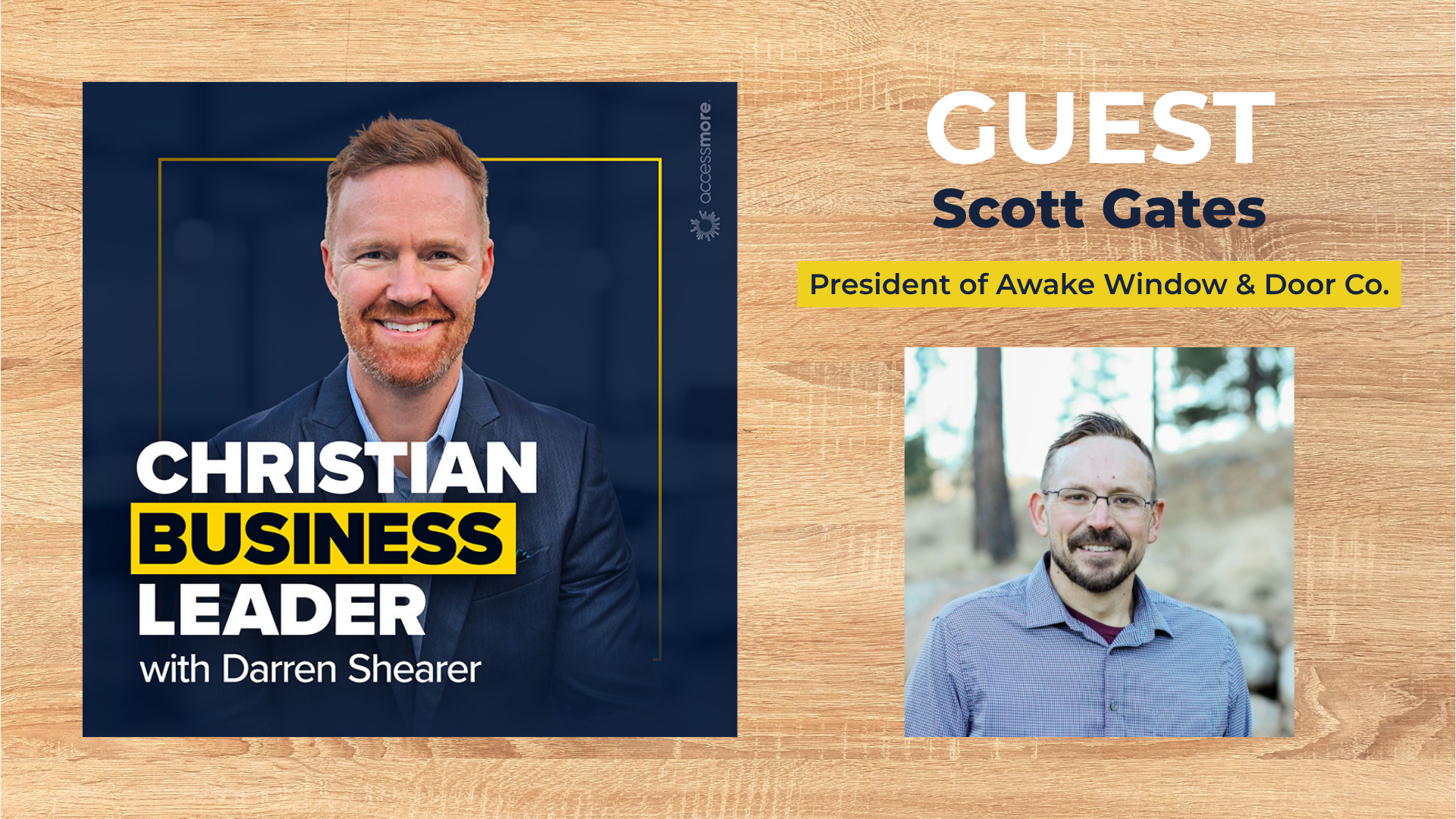
On this episode, Darren sits down with Scott Gates (President of Awake Window & Door Co.) to discuss his company’s bold hiring model: more than half its workforce is made up of formerly incarcerated individuals.
Darren Shearer sits down with Scott Gates, president of Awake Window and Door Company, to explore how faith drives a business built on redemption and second chances. After leaving his corporate role in 2020, Gates founded Awake — a $30 million window and door manufacturer where over half the workforce is made up of formerly incarcerated individuals. Rooted in the belief that everyone deserves dignity through work, Awake helps break cycles of recidivism by offering purpose and employment to those society often overlooks. Guided by Christian principles and a mission-first mindset, Gates has created a thriving culture of gratitude, accountability, and hope — proving that profit and purpose can coexist. Through partnerships, retention success, and stories of transformation, Awake reflects Gates’s conviction that business can be both a ministry and a movement for change.
Key Takeaways
- Faith at Work – Scott Gates’ Mission of Redemption – After decades in manufacturing, Scott Gates felt called to fuse business with ministry, founding Awake Window and Door Company to give second chances to the formerly incarcerated through meaningful work and restoration.
- From Profit to Purpose – Realizing employment was the key to breaking cycles of recidivism, Gates built Awake around a simple truth: people need “Jesus and a job.” More than half his workforce are ex-offenders whose gratitude and loyalty have transformed the company’s culture and success.
- Building God’s Kingdom Through Business – By uniting excellence with empathy, Awake has grown into a $30 million enterprise proving that faith-led leadership and high performance aren’t opposites. Gates’s story challenges business leaders to see hiring as discipleship — and work as worship
Christian Business Leader is the show for marketplace Christians seeking to explore and apply God’s will for business. If you want to learn more about how to do business for the glory of God and shape culture through discipling the business world, this show is for you.
Full Episode Transcript
Heads up: This transcript was created with AI, so you might notice a few typos or small mistakes. We recommend listening to the episode for the best experience!
SPEAKER_00 0:05
Welcome to the Christian Business Leader Podcast, where Christ-following business leaders explore God’s will and ways for business. This show is the ministry of the Center for Christianity and Business at Houston Christian University and features conversations with today’s Christ-centered business leaders who are representing Christ faithfully in the business world. I’m your host, Darren Scheer, and if you want to make your work, leadership, and company’s culture more Christ-centered, you’ve come to the right place. On this episode, we’re joined by Scott Gates. Scott is president of Awake Window and Door Company. Awake is more than a fast-growing U.S. manufacturer of high-performance windows and doors. It’s a company grounded in the power of redemption and second chances. Under Scott’s leadership, Awake has grown into a$30 million company partnering with top builders and architects nationwide. Actually, partnered up with Jerry Meek, one of our hybridge books authors, who has a great construction company out there in the Scottsdale, Phoenix area. And you’re supplying windows to them. That’s awesome. And what truly sets Awake apart is its bold hiring model. More than half of its workforce is made up of formerly incarcerated individuals. Scott, welcome to the Christian Business Leader Podcast.SPEAKER_01 1:30
Oh, thanks for having us. Super excited to be here and love that you’re you guys always share such great stories about good Christian business leaders out there.SPEAKER_00 1:39
So when did you first realize God wants to be involved in your work and business?SPEAKER_01 1:44
Well, it’s like interesting. You know, I grew up in a Christian household. God’s obviously been a huge part of my life, and I’ve worked for many Christian business leaders myself. So it’s always interesting to see, you know, how do you bring it into the workplace? And throughout my career, especially as I became the leader in charge, you know, it’s that fine line of, you know, I don’t want to be forcing things on you, but how do I let my values and, you know, the things that define me as a person shape the way I lead, make God contagious. Um, and that was really kind of always my goal in businesses that weren’t my own. You know, how do I let my Christian values be reflected and, you know, make the kingdom look appealing to other people, right? But in 2020, I had just gone through an acquisition at my old company. I decided I wanted to be truly an entrepreneur and start my own company. And that’s where things felt a little bit different. I felt like we could be a little bit more forward and missional than maybe we had ever been before. Um and I think that intention was, you know, God had laid something on our heart, and it was this people group. And we realized let’s build a business around helping a group of people that tend to really struggle, um, tend to get overlooked. And let’s not be shy about it. Let’s make it very clear this is who we are, this is why we exist. Um and hopefully, if anybody wants to know why, we’ll tell them because that’s what God commands us to do.SPEAKER_00 3:28
Yeah. Was there a particular person or situation that happened that really just awakens this desire to make this central to your business model?SPEAKER_01 3:42
It’s a great question. I and people ask that a lot, almost like there’s an assumption of did I have a personal connection to someone who had been incarcerated? And it’s actually the opposite. I I grew up in a home where my dad was a police officer, my uncle was a police officer, my brother’s a police officer. I just grew up in a cop family. But I think, and not to any fault of theirs, but I think sometimes you grow up and you look at things as more binary than they are. There’s good guys and bad guys, right? But then you, in my time at my previous company, as we were growing and the economy was really, really strong in the mid-2000s or 2010s, it was really difficult to find labor at our manufacturing facility. And we sometimes would have to turn to temporary agencies because we were just growing so fast. And oftentimes the individuals that are working at those temp agencies, they often are there because they have a criminal record. Um, and they’re really struggling to find work. And as I would interview them or get to know them, the stigma around, oh, this is a bad guy versus this is just a person who’s trying to help their family to turn their life around. That was my first, like I’d say, real exposure. And I really started to shift my perspective. And that coupled with a couple of different key moments were conferences I was at, books that I read, podcasts that I listened to. I really felt like God was working on me to pay attention to this people group. And then my wife was kind of on the same journey with me. And, you know, our heart began to be broken as you really read more and more and listen. There’s a lot of complications with our justice system, especially when people get out of prison. And one of the things that broke my heart was learning that, you know, 50% of people end up back in prison within five years. Um, and the main reason is because they can’t find employment. And we just started to realize, well, maybe we’re supposed to do something about that. And that was what we felt God was leading us to.SPEAKER_00 5:59
Yeah. I’ve heard a great quote. I cannot remember who originally said it, but what people need is Jesus in a job. Um, and and that that statistic makes perfect sense. I mean, if you’re if you know that I mean your fallback plan is to go back into prison where at least you’re gonna get three square meals a day and a roof over your head. Um I mean, it’s it’s not, I guess not so bad. Uh maybe. I I I have not experienced prison, but um I I know that it’s no place that I or anyone else wants to be, but maybe hey, if you get that desperate and you can’t get work, I mean, what do you what are you gonna do?SPEAKER_01 6:48
Well, it’s like it’s humbling to me. You especially now at our new company, getting to know so much of our staff and their stories. You you hear a lot about prison and and you you probably heard the term before about people getting like institutionalized, where you know, the guys go in, like one of the things that really was overwhelming to me as you read about these issues, most criminal behavior happens in late teenage years and early 20s. Um, and then just it, the, the curve drops so dramatically as people get older because they get wiser, they lose their, you know, their edge that sometimes drives these things. And a lot of these guys that are getting out that have been there eight years, 10 years, 15 years, 20 years, they’re just they don’t even really, I mean, think how much the world changes in 20 years. But the first key step they need before they can actually get their life going is steady work. And man, I’m thinking of one guy on our staff right now. I remember him telling me, I have applied for 400 jobs.SPEAKER_00 8:00
Oh my goodness.SPEAKER_01 8:00
And he’s like, I got to the final interview stage. He’s like, no less than 25 times. They love me, they wanted to hire me, but then they see this thing on my record and they stop listening to any of the context or any of my story, they just decide, yeah, you’re not a fit for us. And I’m telling you, for us, he’s been an incredible employee, right? And I think what’s hard, and this is like one thing I always, whenever I’m talking to anybody about this people group, it’s always trying to remind them that in our justice system, which is designed to be, you know, punishing and also reforming, they have paid their debt to society and done their time. Once they are out, if we aren’t willing to hire them, then they can’t function. Right. And if they have already paid their debt, I understand that there may be something in their past that makes people uncomfortable or nervous or fearful. But the justice system has already decided the fact that they’re out, they shouldn’t be those things. And I think realizing as an entrepreneur and as a business leader that that responsibility falls on us was humbling to me. And it’s why I’m always passionate about trying to share these stories, the success of it, so that other business leaders might think differently too.SPEAKER_00 9:28
Yeah. Yeah. I mean, without a higher purpose for your company beyond just improving your profit margins or, you know, getting more, getting more revenue, I mean, why would you? Why like why would you go hire somebody that has a history that that and you don’t know them enough well enough to take that risk? Whereas, you know, if if all things being equal, you have a choice between somebody that seems qualified, they seem like they’re able-bodied, they seem like they can do the job and pass the aptitude tests or whatever. Uh, and then but they’ve got the record, and then somebody who also has all of those same skills, they don’t have the record, like who wouldn’t hire the person that doesn’t have the record?SPEAKER_01 10:20
Yeah, that’s that question is a good one. And I think it’s why most leaders or HR or hiring managers default to that position, because it it just makes sense, right? So what we decided to do from the beginning was to say, hey, this is our mission and this is why we exist. So not in a like reverse discrimination way, but in a, hey, we are intentionally trying to do this. So we’re gonna be on the lookout and not just communicating to this people group, hey, we’re willing to consider you here, but instead saying we exist for you. So tell your friends, tell your parole officers. We’re a place that really we felt like God wanted us to start a company to hire this people group. And what has been incredible for me as a CEO and a business leader, along with my co-founders, is leading a company where the mission is the driving force changes everything. So, you know, we’ve grown really fast. We’ve, you know, we’re setting records for fastest growing companies and profit. And but when we talk to our sales team who have so we do a thing every every month where we have an all hands lunch and we get everybody together, and there’s a lot of storytelling about our staff and letting everybody get to know them, know their story, where they’ve come from, how they’ve turned their lives around. Well, this becomes then the heartbeat of everybody working there of like, man, I I love hearing about Jessica or David or Ralph or any of these people. And then the sales team, when we go to budget for the year, they’re not only thinking about growth because it means higher commissions or higher pay. They’re thinking, man, if we if we grow another 20%, how many more people like Jessica do we get to hire? Right. And for me, I’ve never felt such an urgency to want to grow a company because we literally right now have a waiting list, Aaron, of like 25 people pre-qualified, who just desperately want to work here. And we’re trying to grow fast enough so we can hire all of them. Um, and that’s the type of thing that having a mission-driven company lights up and energizes the entire team in a way that I’ve never experienced before.SPEAKER_00 12:57
Yeah. Do you ever have people, because you can’t hire everybody and you got a you got a waiting list? Um, do you ever have people who don’t have a record that get upset with you and accuse you of reverse discrimination? No, that’s because they don’t have a record. But but you’ve got it in your in in your founding documents, right? This is why we exist. It’s like if a if a company, like one that I interviewed, sight and sound theater, is a for-profit company and they hire Christians because they need Christians to you know fill these, fill these well. They got 600 employees, they can do that because it’s in the founding documents.SPEAKER_01 13:37
Yep. It sounds like now the breakup of our staff is about 50, around 56% of them have a record. So the other 44 don’t. So, but when we are in the hiring process, one of the things we really drill in on is our mission. And what we’re trying to see is, hey, because it’s also not everybody wants to work alongside someone who has a record. Um, and we’re not really looking to, you know, lecture them or tell them that they’re wrong to each their own on their own perspectives and the type of work environment they want to be in. But our staff that doesn’t have a record, part of the reason why they want to work at awake is they want to be a part of a company that’s helping make a difference for people that they know tend to struggle in the world, right? So we intentionally, when we’re interviewing, our HR team doesn’t actually inform the hiring managers whether a person has a record or not. We let the best person win the job. Um, but what has been interesting is there might be assumptions. And every now and then there can be, you know, things like tattoos or things that maybe give you an indicator. But what you know, really reinforcing that this bias that we all have about what maybe a person coming out of prison looks like or talks like so many times our hiring managers don’t even know, right? And then we leave it up to the individual who works there, whether they want to make their past or the fact that their second chance be public, that’s up to them, right? We want to respect their privacy, but we know that they don’t need to be ashamed of their past. That’s why we exist. And I will say, just like any ministry position or any company, not everybody is a fit, right? Just because they have a record does not mean we’re gonna hire them. You know, we have a very defined culture, we have very defined cultural values, we have a very defined working culture. And really what we’re looking for is are you a fit for our culture? And whether they have a record or don’t have a record, that’s usually the litmus test that determines whether we’re gonna bring them on, right? Because safety is important, all of these things. But I think what I’m really proud to say and articulate is despite the fact that 56% of our staff have a record, we have a stellar safety record, an incredibly happy, engaged culture and employee base. And this isn’t something other leaders have to be afraid of if they’re ever considering it.SPEAKER_00 16:36
Yeah. So for those, and I don’t know if you track this separately, maybe you do, for the formerly incarcerated people that come to work on the team, what is the average length of hire?SPEAKER_01 16:49
So you like how long they’ve stayed at.SPEAKER_00 16:51
Yeah, like how long they’ve stayed, yeah.SPEAKER_01 16:52
Yeah. So we do track and try to benchmark against like retention rates relative to like just say industry averages, and ours are better. Um, and I think one of the reasons why it’s interesting, like one of our key core values, we we say it’s the one that is like the the foundation of what it means to work at awake is the word gratitude. And it’s not expecting employees to have gratitude for us for hiring them, it’s the opposite of that. It’s I want to hire people who have a grateful outlook on life, that they are grateful for opportunity, for the chance to do hard work. They’re grateful for the products we have, they’re grateful for their fellow coworkers caring the way they do. And I’m telling you, putting people in buckets, especially people who have done some time in prison, gratitude is something that just emanates out of them. Um, because I think they know more than the rest of us know how difficult life can be when you’re in a cage, and then also how difficult it is to re-enter society with some of the challenges and difficulties you had from that time and the stigma associated with you as you try to get good work. And when they do finally find that work, their gratefulness and gratitude just emanate out of them. And I think because of that, they don’t tend to go looking for other jobs. They like to stay, they like to get promoted internally, they become very loyal to the company. And I tell you what, when you’re a business leader and the overwhelming emotion you feel from your staff is gratitude, that is a fun workplace to go into every day.SPEAKER_00 18:46
So this sounds kind of utopian. Um, but I anyone who has actually done this uh on any level would know that this is what you’re doing is extreme. I don’t know how if I would say extremely, but uh it it’s got its ups and downs, we’ll we’ll put it that way. Um, you know, I over the last year we had a guy attending my church who was fresh out of prison, had been out of in prison for 10 years. His license had been suspended, basically revoked permanently. And but he’s a carpenter by trade and just needed needed some help, needed somebody to believe in him, had a property uh for him to help us uh kind of renovate. And it went really well. You know, he was he was fit, he was I mean, turning things around. And he was uh he had a ride, somebody that was uh out hauling him and all of his uh tools that was kind of his his carpenter’s helper. And and that project went really well. So fast forward probably six months or so, um and now he is uh he’s just changed. You know, he’s not uh he’s not the guy that I originally uh agreed to have come work on my project. So we’ve got another another uh house to develop. And in the agreement, I had him sign it so you will not drive to this job site because I’m not gonna participate in you, you know, because he had been um his license had been taken away because of so many drunk driving and you know other things that had been on his record. And and and I said, You won’t you won’t drive. I’m I’m not gonna participate in that. I will pick you up every time you come to the job site, I’ll pick you up and and we’ll we’ll make it work. And he said, Oh no, I’ll you know, I’ve got I’ve got rides, I got guys that can take me that help, you know, on the job site and everything. And well, he just started he just didn’t do it. And he would he started driving to the job site. I’m like, I mean, we can’t we’re we’re not gonna do this. He’s like, Well, this is just the way it is, you know, kind of take it or leave it. And he just he just flipped. Um, and it and it was like and it was a little scary, uh, to be honest with you. And you know, because my uh he knows my my family now, he he knows my kids, and uh and and just felt uh felt very unsafe. And uh and I I haven’t seen him since, you know. I try to reach out, I tried to get him to come to this Christian men’s uh event, paid his way. That’s a that’s another long story, but he just you know didn’t didn’t end up coming. Um just a really sad, tragic uh way that things uh went down on with this particular guy.SPEAKER_01 22:00
um i i and it you know and it kind of it kind of burned me you know it kind of kind of jaded me uh about the whole the whole prospect not not that not that he’s not the exception here um but what do you say to somebody like me no and i think it’s it’s important to articulate that because there we’ve had similar experiences too right where someone starts out with the best intentions they just need an opportunity and they thrive and then the complications of their home life and their background and mental health sometimes that’s not enough to keep them on a permanent path and one of the I think most strategic things we did especially when you’ve got a a big staff that’s growing you know we’re we’re you know 110 employees or whatever now is we hired on our HR team a person who was actually was best man my wedding but he was a pastor for about 20 years and then he was a social worker working with this people group. Well now he works on our team we had to go get him OSHA certified so he could run safety for us but really what he is is a liaison navigating some of the complexities like the ones you just mentioned, right? Of I’ve had a relapse or maybe I’m struggling drugs have re-entered into my life right well in a previous life where I’m just a business owner or a business leader hired to work for other owners you size that up as a risk and you say well we got to fire this person. Well when it’s your mission to exist for people like this instead what we do is we say hey if you will go to this rehab facility and follow through on this process we will save your position here for you right um and we will give you an opportunity to turn around and we have had times where that has worked and we have had times where it hasn’t worked where people were unwilling or they said they were willing and they didn’t follow through right but what I always like to emphasize is especially in my previous companies when I have similar stories of people who did great work and fell apart who didn’t have records as well right that it’s almost this reality of we’re sometimes like waiting for that to happen when it’s someone who has made mistakes in their past or especially when they have the checkbox that says I have a felony record. But it happens a lot with people who don’t as well just because um people are still people um so yeah it’s important to go into anything like if if there was a a leader listening to your podcast that was considering this to know they’re not all going to work out there will definitely be complications um but I think what has worked well for us is we’re we don’t just consider or we’re not just willing to consider people with a record. When it’s your mission it’s that unifying focus of no no no this is what we signed up for right this is what God called us to do. So this may be a little bit I’ll I’ll tell you a quick story. We had a moment uh so we have a we run a manufacturing company right so it’s a factory there’s a lot of equipment it’s a swamp cooler we’re in Arizona it gets pretty hot and we had one time this was probably a year in we had an altercation on the floor where two guys got chippy with each other they got in a fight well I’ve worked in manufacturing companies for many years that’s not uncommon on factory floors but in that moment I called the entire company together and explained why we have a zero tolerance policy for that and basically said the whole world is looking at us right now believing this isn’t going to work. Unfortunately we have more pressure on us to not let things like this happen right um and we I prayed for everybody we talked it through and really tried to remind people of the whole world expects us to fail and they expect you to fail because they don’t think you’re capable of doing great things. We have to prove them wrong right yeah and since that moment we’ve had zero altercations in the factory floor versus my old company where we didn’t hire a large percentage of second chance employees we had altercations once a month right so it’s a reminder of if the culture’s right and we’re hiring the right people and again they’re not the right person just because they have a record they’re the right person if they fit our culture but if we get that right and we have a welcoming culture that’s set up for them to succeed hopefully most of the time they can they can do well but they certainly don’t all work out and it’s sad every time but we always like to say there’s someone else waiting in line who needs the spot that that person was unwilling to to run with yeah so those two guys you said zero tolerance so they’re cyanari so you allowed someone who came forward to you to say they were using drugs they didn’t get fired but someone who fought with someone and yeah different cultures different philosophies but we know I mean this is a humbling thing a lot of people who are in prison it’s like one in five are in there for a nonviolent offense right usually it’s drugs so drugs and then like what’s also humbling so we do this thing all of our products they have like a a series number you know you think like a car like a BMW a three series a five series well all of our series are a play on a statistic associated with this people group right so our 905 series which is our flagship products our multi-slide big glass walls that slide away stands for the fact that 90% of kids who had five or more so 90 in five 90% of kids who had five or more foster care placements end up in prison. Right? And I think a lot of my like Christian brothers and sisters we think of foster care kids as a tragedy and we’re sad for them and we want to help them but we think of like people in prison as bad guys. And then when you recognize they’re the same person hopefully that reshifts your perspective on it and you start realizing okay this drug behavior is a byproduct of difficult upbringing and if someone won’t stand by them they’re never going to turn this around and I we’ve got a guy who literally just one employee the month at our all hands the slunge came in for his first year was great around the holidays we have a shutdown you know there’s a time we they got big bonuses that year stumbled into some drugs came forward was honest with us about it we put him through rehab he came back he’s now I think two and a half years sober um thriving has been promoted three times but that one week where he had a bad moment after he got out of prison a year after he just needed someone to say we’re not giving up on you yet right yeah um and for us the payoff with that was we got to keep a great employee who who turned it around so have you have you ever been threatened by anyone that you’ve had to let go or even somebody that has is that you didn’t let go no that’s a good question because right there’s you do have to fire people sometimes and sometimes because I mean there’s money at stake here a lot there’s somebody’s livelihood at stake. Yep we it it’s like anything those you know those running a company type decisions where you have to make hard calls where you you get that pit in your stomach and your heart is racing because you know you’re about to impact somebody’s life that same feeling exists right and and I won’t even lie there’s been moments at the beginning especially at the beginning when this was new for us for my so my wife um was one of our co-founders and she actually runs RHR um so she’s in these owning them even more than I am and and some of those first few ones at the beginning you’re like not so dissimilar to what you said Darren like these people know me personally I’m is this a risk to me and here’s what I’ll say we’ve had no moments of you know people showing back up or difficulty and I think where my wife her part her her team member Joe deserve a ton of credit is maybe the people in our pre-screening process that maybe would have been riskier we’ve just got a lot of that process right so usually and then we have a pretty I’d say loving but fair discipline process along the way so that if we’re ever asking someone to leave they’re not surprised it’s coming they they know and sometimes they self-manage themselves out um but I mean truthfully not utopian but truthfully because this has worked so well we have less turnover and higher retention than any other company I’ve ever worked at partly I think because of the mission. So while those hard moments do happen they happen less than we’re used to which has been really really great. Yeah and this is a$30 million company I mean this is not a you’re not a nonprofit correct no and I wasn’t one thing so and maybe other of your listeners might relate to this but so my whole life I’ve wanted to do God’s work right so much so that in my mid-20s I actually started in the window business right out of college because a guy I was teaching a Sunday school class a fifth and sixth grade Sunday school class and the dad of one of the sons in there was like man you’re a bright kid would you come work for me at my window and door company and in my late 20s I was on a mission trip to Brazil where I just felt like God calling me into ministry and actually left the business world and I worked for a ministry in Africa for a few years and I really felt like I this is what it means to to live for God right but what was interesting is in that time I realized that ministry even if you’re working out of ministry it’s still people different cultures and I realized man this I thought this was going to be all perfect and glorious and God was gonna you know this was my big moment my my my Abraham’s about to sacrifice Isaac I’m giving up all this money to go to ministry and I realized wow this isn’t as fulfilling as I thought it would be and I really felt the call to you know try to build something myself and I think what has been incredibly rewarding for me was that time when I did ministry one of my main roles was to be a fundraiser. And I struggled with constantly having to ask people for money to do God’s work right and I know that’s a part of the job and there’s a lot of people that are really good at it and how they function. But with awake and my new company I didn’t want it to be hey can you give us money so we can do good work it was we’re going to build a fantastic product that you are going to love and need. And because we build that great product we get to do God’s work and build and hire people and change their lives and turn it around and we like to celebrate and thank our customers for the role they play in helping that happen. But we’re not asking for a handout for our staff we’re asking for the opportunity for them to have the dignity of hard work and it’s amazing how well our customers have responded to that as well. They are so sold on the mission and we love that it’s not this isn’t like a political thing it’s just a human thing. And for those of us that call ourselves Christian it’s a biblical thing. And our customers from whatever state because we we sell all throughout North America in whatever political affiliation they don’t care. They all just love that we’re trying to help this people group which has been really cool.SPEAKER_00 35:47
So for those who are listening who are thinking about kind of putting their toe in the water and giving this a try the the government actually does have a bit of an incentive to do that called the work opportunity tax credit uh that is going to help just sort of for the onboarding period I guess to kind of de-risk the you know the proposition of hiring somebody who you don’t know if if they’re gonna work out I mean the the the credit is basically they’re they’re gonna they’re gonna pay you to to hire this person.SPEAKER_01 36:27
And and so it’s not really anything out of pocket up front at least for the first couple of months right is that something that y’all are able to do there’s a little bit of you know like probably to be expected with regulation there’s a little bit of a red tape and process to get those tax credits but it’s worth it especially if you’re like we’re doing this for the right reasons and the government’s you know I think the whole reason like that subsidy exists is because the government knows this is a problem and they’re trying to incentivize business owners so that’s a good thing to take advantage of if you consider it um and you know hopefully like one thing I’d like to say is it’s for me as a leader it’s always felt like the morally right thing to do because this is someone you know that Jesus died for right they’re a human. And if they can’t get a job their difficulty in life and the reality for them is is very bleak. So it feels morally right to do it. But as business leaders we like to do things morally right but we also like to do things that are strategically right. So on that side it’s not just the retention and the culture and the gratitude and the the the fact that our customers love it it’s also that we have found some of the most talented highly educated motivated people that never would have ended up working for a window and door company that certainly wasn’t their career goal but we found them because they found us because other companies were unwilling to consider them right I’m talking about people who like one of our best hires has completely developed using like a Microsoft Power app platform, an entire MRP system that drives our entire business and our data architecture is someone who was in prison for 16 years. This is a woman who was in the wrong place at the wrong time when she was like 19 years old, right? How many of us also had moments like that but maybe just bad things didn’t happen or we got lucky and if you were to meet her on the street you would never think she’s been in prison. She’s just a kind, fun loving I always also like Star Wars loving um person who has literally changed our entire company all because we were willing to give her an opportunity and that strategic side and the moral side when those two things are aligned, man, that’s powerful. And I feel like it’s God ordained.SPEAKER_00 39:20
So people can learn more about how to do this and and some other case studies in a book that you referenced before we got on the on the recording here called Untapped Talent.SPEAKER_01 39:30
What else do you want to say about next steps people can take yeah it’s like a that’s a great book to read I there’s usually two books I like to recommend and it’s going back to that the heart and the mind the the morality and the strategic side so the untapped talent book is a great book for the the mind and the strategic side because it’s it’s really really eye-opening about just the millions of people this is that have a record who are really struggling to find work and some of them have master’s degrees and are certainly not a threat or anything to be fearful of, but your processes of risk management just might exclude them. And it’s really just about helping you see as a business leader that that exclusion is help really causing you to miss out. So I really recommend that book it’s a great one. And then if you’re really trying to have your heart broken for a people group there’s a book called The New Jim Crow that really explores incarceration. And I’m telling you is one of the most never cried so much reading a book. So that’s a hard recommend but I know as Christians sometimes we want God to break our heart because it gives us purpose and direction and clarity. And that was a very important book for me to read to candidly realize I think sometimes we think about moments in time or we look back in history of times of discrimination and we think man would would I have been on the right side of history if I was living in that time would I have fought for the you know the least of these um and for me I started to think a lot about this as a father of how will my kids look at me someday when they’re in their 40s and 50s and they’re reading about just the I mean an overwhelming statistic to me is that the US has 4% of the world’s population but 25% of its prison population. So we lock up more people than any other country and then we make it really hard for them when they get out and I personally want to be able to look at my children and say hey I I I tried to help make a difference on this issue. And that’s the type of book that after you read it it’s hard to look away um and I think sometimes those are two really good things.SPEAKER_00 42:10
Well I’m gonna get that on audible right after this interview. Thank you for that challenging recommendation and for your challenging interview. I said that I was jaded I don’t know that’s probably not the right word. It was just uh it was a tough experience but I I know God never gave up on me and I’m certainly I mean this guy if I saw him right now I’d give him a great big hug uh I would um you know I don’t I don’t know that we’d be able to you know work on another uh another I mean the the advantage that you have in your factory is that there is a there’s a culture yes there and there’s different individuals totally there’s support there’s accountability whereas me working with one contractor uh uh is you know he’s got a just too much too much autonomy and there’s too much he’s just not in the right especially not having a license um you know there’s so many better environments for him to be in and and it is really sad that you know he hasn’t made that the the right move there but um I pray that he will uh you pray with me on that too absolutely and I think what’s awesome Darren is even hearing the ways you tried to meet him where he’s at and that we talk about that a lot it’s like it’s that extra effort but in the end they have to make their own choices.SPEAKER_01 43:46
Um but what is also encouraging and I appreciate your perspective on it is the next person who maybe has a similar record might be different. Right. Um, and that’s what we found is at the beginning, especially when we first started, it’s like, man, we want to save them all. Please work out. And then you realize some aren’t ready to be in that state of mind, but the next person might. Um let’s give them that opportunity.SPEAKER_00 44:17
That’s so well said. Awakewdc.com is the website where people can learn more about your mission or more about the great beautiful windows that you are designing for some of the most beautiful and installing manufacturing for some of the most beautiful houses in the world. Thank you. Yeah, it’s it’s it’s just amazing work that you’re doing all around, Scott. Thank you so much for uh challenging us today. It’s been a real pleasure.SPEAKER_01 44:46
I enjoyed it, Aaron. Thank you very much.SPEAKER_00 44:48
Thanks for listening to this episode of the Christian Business Leader Podcast. Be sure to subscribe, leave a review, and tune in for the next episode as we continue exploring God’s will and ways for business.
BIG THANKS to this episode’s sponsor: High Bridge Books
High Bridge Books helps Christ-centered authors build a legacy by crafting and publishing messages and stories that glorify God in all spheres of culture.
- High Bridge Books’ professional book publishing package: https://www.highbridgebooks.com/publishing/
- High Bridge Books’ proofreading, line editing, developmental editing, and co-writing services: https://www.highbridgebooks.com/editing-and-proofreading/
- Examples of our books: https://www.highbridgebooks.com/bookstore/
We’re extremely proud that …
- 45% percent of our 204 books under contract were written by authors who have published more than one book with us, and
- 51% percent of our books under contract were referred to us by authors who have previously published with us.
Contact High Bridge Books’ CEO Darren Shearer at [email protected] to get a conversation going about your book!