A Biblical Principle That Transformed a Major City (w/ Jeff Williams)
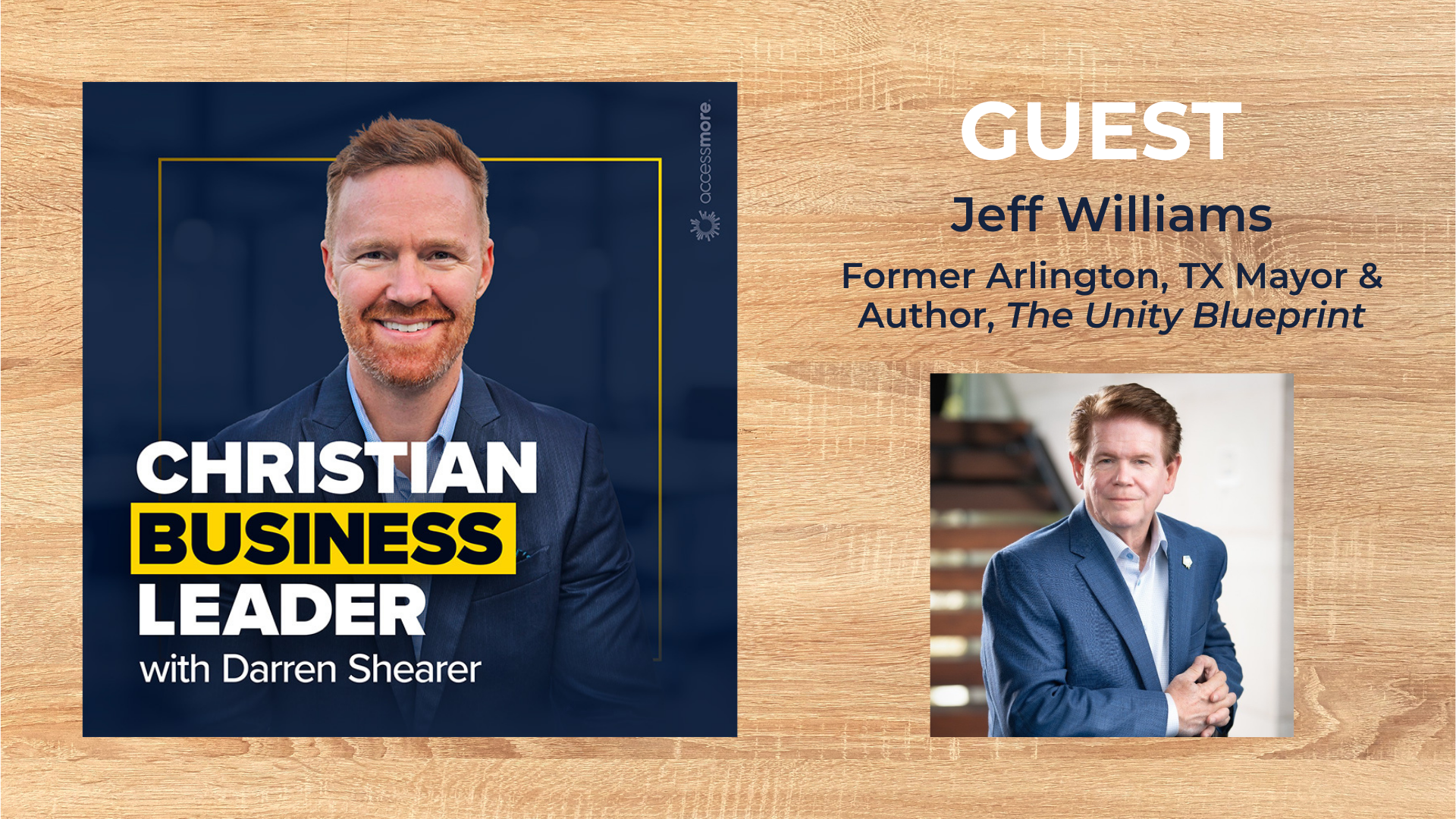
On this episode, Darren sits down with former Arlington mayor and author of The Unity Blueprint Jeff Williams to discuss how he leveraged a key biblical principle to transform Arlington, Texas from a pass-through town into the most popular U.S. tourist destination between Orlando and Vegas.
Darren Shearer hosts Jeff Williams on the Christian Business Leader podcast to explore how faith-driven unity transforms cities and businesses. Jeff, author, CEO, and former mayor of Arlington, Texas, shares how he led projects like AT&T Stadium, Texas Live, and the National Medal of Honor Museum while keeping the Texas Rangers in town.
He recounts challenges like the 2008 recession, when trusting God and showcasing projects such as Cowboy Stadium opened doors to new work including Warren Buffett’s Nebraska Furniture Mart. Jeff emphasizes valuing people, reshaping offices for collaboration, and weekly “high fives” to build culture. His company lives out core values: Deliver, Innovate, Give back, Navigate, while posting scripture and dedicating buildings to the Lord.
He urges leaders to pursue unity through vision, prayer, and valuing every person, whether revitalizing small towns like Maggie Valley or managing growth in major cities. His new book, The Unity Blueprint, distills stories and principles showing how trust, valuing others, and character-driven leadership can break down barriers, forge friendships, and advance God’s kingdom through unified purpose.
Key Takeaways
- Discovering God’s Role in Business: Jeff Williams, author, CEO, and former mayor of Arlington, Texas, led projects like AT&T Stadium, Texas Live, and the National Medal of Honor Museum. He kept the Texas Rangers in town and helped shape Southlake Town Square and Prestonwood Baptist Church.
- Marketplace Discipleship: Jeff and his wife set firm character values early in their careers. During the 2008 recession, he trusted God and used completed projects like Cowboy Stadium to attract new work, including Nebraska Furniture Mart with Warren Buffett.
- Modern Models of Leadership: His company fosters unity by valuing employees, creating collaborative offices, hosting weekly “high fives,” and posting scripture in common areas. They also dedicate buildings through prayer.
- Values That Guide Decision-Making: His firm lives by Deliver, Innovate, Give back, Navigate, focusing on excellence, creativity, generosity, and courage rooted in faith.
- Translating Faith Into Practice: In The Unity Blueprint, Jeff shows that unity requires vision and valuing every person. He calls leaders to build trust, pursue shared purpose, and advance God’s kingdom through collaboration.
Christian Business Leader is the show for marketplace Christians seeking to explore and apply God’s will for business. If you want to learn more about how to do business for the glory of God and shape culture through discipling the business world, this show is for you.
Full Episode Transcript
Heads up: This transcript was created with AI, so you might notice a few typos or small mistakes. We recommend listening to the episode for the best experience!
SPEAKER_00 0:05
Welcome to the Christian Business Leader Podcast, where Christ following business leaders explore God’s will and ways for business. This show is a ministry of the Center for Christianity and Business at Houston Christian University and features conversations with today’s Christ-centered business leaders who are representing Christ faithfully in the business world. I’m your host, Darren Scheer, and if you want to make your work, leadership, and company’s culture more Christ-centered, you’ve come to the right place. On this episode, we’re joined by Jeff Williams. Jeff has spent his life designing places that bring people together. He says civil engineer, CEO, and former mayor of Arlington, Texas, and transformed Arlington from a pass-through town into the most popular U.S. tourist destination between Orlando and Vegas, attracting more than 15 million visitors every year. And he did it by unifying architects, investors, municipal leaders, and business executives. He won the bid for the National Medal of Honor Museum, which um he I know he’s really excited to announce that they have just completed. He kept the Texas Rangers in their hometown. I mean, they’re not they’re not the Houston Astros, but you know, they are the I gotta say that because we’re we’re sponsored by uh Houston Christian University here. Um, and I’m a big Astros fan myself, uh, but but um the Rangers are an amazing team as well. And he also developed Texas Live, that’s the Texas Live District ATT Stadium where the Cowboys play in the largest esports arena in the U.S. At the heart of it all, he credits his faith in one major principle. That’s the principle of unity. And his new book, The Unity Blueprint, launches September the 9th of this year, which uh should be out by the time this interview airs. Jeff, welcome to the Christian Business Leader Podcast.SPEAKER_01 2:04
Great to be here, Darren. Excited to visit with you.SPEAKER_00 2:07
Jeff, when did you first realize God wants to be involved in your work and business?SPEAKER_01 2:12
Uh very early uh there. In fact, I had a tremendous uh opportunity in my high school youth group and then in college. We had a really large student ministry uh there at Texas Tech. And I really felt the calling uh there to become a leader and uh and a leader that did uh value people, and I think that’s so critical. But then my wife and I had a life-changing uh event uh after a few years I’d been in business. I actually went to dinner with uh a Fortune 500 company executive and and a very successful contractor who’s very wealthy, and uh had the opportunity as a young young engineer to sit and listen to them talk about life. And um, there were many good things, but there were other things that really bothered me. And I went home that night and told my wife, we have got to set our character values, we have got to establish who we want to be. I said there were lots of good things about these two men, but there were also things that really bothered me and bothered them. And I said, we’ve got to establish this early because we wanted to be good parents, we wanted to be good in our business, and we knew that God had called both of us to be leaders and and to move out and make it. And and yet we knew that we weren’t capable alone. We needed we needed God and we needed others. So that started us on a big path for unity.SPEAKER_00 3:42
And what are some of the, I mentioned some of them, but what are some of the engineering projects you’ve worked on that you’re really most proud of?SPEAKER_01 3:50
Well, I’ll begin uh with uh the ballpark in Arlington. Uh, there, of course, we ended up later replacing that now, but it is the only refurbished Major League Baseball project uh that is out there right now. It is currently office building and they’re playing all kinds of sports on the field itself with retail and restaurants going in it. But that one was a major opportunity for me to get to watch President George W. Bush in action before he was president. He was uh the uh managing partner of the Rangers, but I also got to see an incredible mayor uh there working on it, also two other people, and I watched how they, through their character values, forged unity on that project, and it made such a difference. Southlake Townsquare, which is really one of the grandfathers of all the town centers uh here, and and the opportunity to be able to create a place where people come together, uh where true unity can happen, and it was uh remarkable. And then, of course, ATT Stadium working for the Cowboys and the Jones family was also a great experience. And of course, I get questions all the time of what are the Joneses like, and I can tell you they are great business people. And later on, Charlotte Jones became very much a part of us bringing in the Medal of Honor Museum because we got her involved uh there later on. But I have projects of Preston Wood Baptist Church is one of my favorite uh that we’ve worked on too. It has continued to grow, and they have two campuses now, and uh it was amazing how God has blessed that, but also being able to come into contact with the people and get to know them, that staff and so forth has been huge. And so we’ve worked on churches and schools and and uh roadways, bridges, which I love bridges. Uh, you know, they really help set the character of a community, but I also love all of the metaphors uh there of bridges, you know, people connected to places, but people connected to purpose is also so important. And we as leaders need to help move people into that purpose where they have a passion and we can really make a difference in other people’s lives and more importantly in the kingdom.SPEAKER_00 6:15
Jeff, could you tell a story of a time when you saw God’s hand of work in your company?SPEAKER_01 6:20
Yeah, without a doubt, uh there. One of the uh major things that happened to us, uh, we were finishing Cowboy Stadium. And uh we were excited. Uh, we also were completing a large highway project, and we had won awards for both Cowboy Stadium and this highway project. And I had booked up the whole year. This was in 2008, and uh by the end of that year, almost all of my projects that were booked that next year were gone. And uh after I cried uh there over the Christmas holidays, uh God really laid on my heart and said, Jeff, you have some great projects. You really need to try to find people and have them bring them through and tour Cowboy Stadium, tour this highway project that we had, and try to find other work that uh, you know, I just felt like I need to put it right in God’s hands. And what happened uh there was remarkable is that we were able to tour people through and we gradually started getting work because we had a national recession, you may recall that started in 08, uh there in 09, and you talk about trusting him, and we ended up with some tremendous projects that came out of that time and uh got us moving again. But in my career, that was the toughest time uh there, and and God brought me out of it and I think really led me down that path. And then one of my other favorite projects came out of that. We toured a little town by the name of the City of the Colony, and they said we don’t have any work, but we would love to come and see your projects. I said, come on. Well, two years later, they landed Nebraska Furniture Mart and they asked us to interview with Warren Buffett, who owned Nebraska Furniture Mart, to potentially become the engineer, and we did. We won it, and uh it was a tremendous project and and a great opportunity.SPEAKER_00 8:20
Wow. You know, I’ve asked this question uh hundreds of times on this podcast. I think this is episode 313. And what was a time that you saw God’s hand at work in your business? And a reference to 2008 and just the faith walk that was required to be able to walk through that in business gets mentioned again and again and again. You know, we always talk about how bad it was, and yet that specific time time frame and the circumstances around it were really the seedbed for a lot of these kinds of stories where where these business executives like yourself are giving glory to God for helping you get through it. Uh so wow, appreciate you sharing that. Um, Jeff, what’s one of the business practices that helps your company reflect the character and ways of God? Not so much a guiding principle, but an actionable, repeatable practice. And I’m sure it probably relates to unity.SPEAKER_01 9:25
Very much so. Um I think people need to be valued. I think it’s one of the most important things that a CEO can do is to show that you value people. And so consequently, uh there even recently when I left coming out as mayor, I studied everything I could about when because I was going back into my engineering firm and I had been gone, uh, really doing very little during the time I served as mayor for about eight years. And so in coming back, I realized that hey, we need to put forth an effort to show each and every employee that we care about them. So I learned that they like to work from home, of course, but yet we are very team-oriented. And in fact, I think most businesses are. And so what I did is I gutted our offices, I created collaboration rooms, I tried to give each person a good space, regardless of what level they were, and so that they would have show that we trusted them and we wanted them to have a good space. And then in addition to that, um, we worked on our culture. And part of that culture is that we implemented what we call a high five meeting on every Friday uh there we pull our whole staff together and we uh we actually talk about what did someone else do for me to help me uh in in my work or in my life somehow that day. And that’s why we call it high five. Hey, I want to give a high five to so-and-so because they really help me in this way, but we also uh allow our our mid-level to lower level people to have a chance to give a nugget. We call it a nugget, something that uh they learn that they can share with the others, and then we do a lot of uh team building and and collaboration type exercises during that time. And then I don’t mind telling you that when we first started that, all of my older engineers says, why are we wasting a whole hour of billable time? And uh now they are the first ones at this meeting and they look forward to it and it’s created camaraderie. But we did that because we wanted to show them that we cared. And then I think too, it’s so important to for people to understand your mission. What are you trying to do? It doesn’t matter if they’re doing just a small part or a large part, they stall still are in that big overall mission. And for us as a civil engineer, we our mission is to be an integral and valued partner in building communities. But then you’ve got to have core values uh there too, and and to live them and to know them. And so we uh again spent a lot of time on our core values, and and um it worked out to be an acronym that wasn’t necessarily where we started, but uh it ended up, but it’s the acronym is designed, deliver excellent service, innovate, give back, and navigate. Well, the two new ones that are in there for us is innovation. You know, God is laying on the hearts of so many people, uh, there are new inventions, new things, and I think we’ve got to embrace it because we are at the beginning of a technology revolution, and we’ve got to think outside the box. And God tells us to use our gifts here to to serve the people, and so that’s what we want to do. We’ve had give back, but then a very important one is navigate. You know, I think many times uh people are prone to sit back and watch and wait, and yet uh no one wants to step forward and say, hey, we need to do this. So we’ve created uh a really safe atmosphere here for people of all whether whatever position they are, to step forward and say, Yes, I want to help. But then when we go out with our clients, it’s not in the nature of an engineer to be aggressive, but yet we do have so much knowledge, we need to be willing to speak up. And so we work on that every day to help navigate. But the other part about navigating is to show that we do care about the overall mission of our client and the overall mission of our company.SPEAKER_00 13:50
And you mentioned before the recording that you actually post scripture verses in the common areas. What are some of those verses?SPEAKER_01 13:58
Oh my goodness. Uh, there’s uh so many um there, Romans 12, uh, there where we’re to live in harmony and encourage each other. Um there uh also 1 Peter 4.10, we’re to use our gifts uh there. And and it’s really interesting because in the business world, so many times people believe they have to step on someone else to get ahead, and yet uh that is so important, I think, for us as leaders in business to share with them that’s not necessary because I believed in, in fact, when I was mayor, we proved that principle too that when you grow your business, it provides opportunity for all, and there’s no need uh there for stepping out. In fact, we need each other uh there too. But I want to go back to we have put up uh scripture and positive phrases in all of our commons areas, uh, our break rooms, our our uh copying rooms, and and uh and our lobby and so forth. And you know, people notice them at the beginning and it and it makes an impact, but then subliminally they are continually seeing positive things there uh with them. And so it’s it’s a little thing, but yet it’s a big thing.SPEAKER_00 15:15
You know, I’m thinking back to just all of the the great projects that you’ve done, and building the cowboys stadium, and um thinking back to biblical examples of people that built great things in in the scriptures, and you know, one that comes in mind would be the Tower of Babel, right? Where this is just uh you know extraordinary technological achievement and the way that they were able to do this, and and and God says because they’re unified, nothing’s gonna be impossible for them. Like, do you ever in the middle of those projects, do you ever feel like this kind of feels like we’re just sort of doing a a Tower of Babel kind of um recreation? And and how do you how do you kind of get out of that in and to the recognition that you truly are building something for the Lord and to honor the Lord, especially when you have so many different people coming to the table with so many different agendas and worldviews?SPEAKER_01 16:19
Well, I think you’ve uh mentioned something that’s very important. Uh, back when I was mayor, I started doing something uh because we did build a lot of buildings while I was mayor. And of course, all through all my engineering time, I worry about that. I want it to be used for the glory of God. I want it to be used to bring people together in a positive way. Well, what we have started doing is bringing out our ministers to pray over and dedicate these buildings to the Lord and that they will be used for the Lord as we move forward. It is a very powerful thing to do. Uh, but then also I think it’s uh important for people to recognize these spaces and how they can be used. There’s nothing uh more uh more gratifying for an engineer or a contractor or anyone who’s had a part in a building project than to be able to take their family and friends there and experience it. And again, to pray for that space that it will be used here for the glory of God and how it will be used. And that doesn’t always happen. You know, uh there are times when we see that, but uh I think it’s important for us uh to show love even when people are abusing spaces or abusing things, and I I think that’s and that’s hard, not easy. Uh in fact, myself, I’ve added forgiveness uh there is a major core value personally because it’s uh it’s harder for me to forgive when it’s family or friends, and uh, and and I think it’s just so critical that we do because unity is so important. And then I’ve got to mention that unity doesn’t just happen, you have to work at it, and and that’s the reason I wrote this book is that we really wanted to give people a blueprint, a plan uh there for making unity happen. You know, we’ve gone through so many different stories uh that we’ve had uh in which we achieve unity, and then there were times where we didn’t, and uh and we have uh tried to share what happened right, what happened wrong uh there, but it is one thing’s for sure. God created us to live in community, and we need each other. Whether you’re an introvert or or uh think you choose to be alone, we all need each other. God made us that away, and it’s amazing what coming together and working together can do uh there for the people that are lonely, for the people that may need a distraction from the problems at work or the problems of their family there so that they are being productive, because we all know that one of the greatest things that God gives us is when we work together for good and to make impact in his kingdom. It is an amazing uh reward and gratitude that we have because we know we’re doing the Lord’s work.SPEAKER_00 19:20
I wonder if you could give some advice to my town’s leaders. So I live uh we we left Houston several years ago, and we now live in uh a town that I fell in love with growing up. We used to come up here, uh I live in Maggie Valley, North Carolina, and uh there’s uh an old theme park here that was built in the 90s that used to bring half a million people to this town every year, and and there’s only 1900 people in the town, and and so it’s it’s almost sort of a case study in kind of how not to do it, and just the way that the the park just fell into disrepair, and there’s just our local papers constantly got these headlines about the legal battles for the the ownership and the direction of what they’re gonna do to kind of get the park back on its feet. Um, but it’s it’s kind of ironic that it’s named Ghost Town because that literally is kind of what it has uh has become. Um, you know, what what do you do you give guidance to kind of I know you work with a lot of the bigger cities and advising the other bigger city mayors on kind of how to kind of revitalize their towns, but um what what what is what would be your guidance to the leaders of Maggie Valley and how they might be able to get that back on its feet?SPEAKER_01 20:47
Well, Darren, I grew up in a town of 1,900 people. I had 43 people in my graduating class. So I love small towns, and it doesn’t matter what size town you are, it’s the same blueprint. It’s basically what you need to do is to come together. You need to gather the ideas that are there from your constituents. You need to go and find the experts that are out there, look at other cities that are similar to you, and try to learn from them somebody has done it. And then you do a lot of praying, and then you develop a vision, but then that vision that comes from the leaders then needs to be taken to the people and refined because we need to value them, and then you need an implementation plan. And who uh and who else do you need to include? Because um, you know, when I came into office uh there here in Arlington, we had major challenges. Um, there were a lot of cities that wanted to take the Texas Rangers out of our community and attract them to their city. We had not been bringing in jobs there for quite some time. Um, our tourism has had not been flourishing, and of course, tourism is a great thing. I would say that for your city there, it’s other people’s money. OPM. It’s one of the greatest things to be able to bring in other people’s money to help pay for your streets and your neighborhoods and so forth. So it’s a it’s a very, it sounds uh simple, but the biggest mistake a lot of people make, they don’t make a plan. They they don’t come forward and actually create that vision and a plan. And then you would be surprised at all of the people that would want to help when you search out and try to find them. And and what, and then two, you’ve got to think about the history of your community and who might have lived there that may have a heart for your community, that may want to come back. One of the greatest things that happened to me is that a lady I did not know by the name of Sunder Ducket came and said, Mayor, I grew up here in Arlington, I love it. What can I do for you, for you, and and to help my hometown better? And she got very involved, and then she is currently the CEO of TIAA, which is one of the largest head funds or largest uh pension funds in America, and she is constantly in the top 50. And you never know who that is. It also is a great formula for us in many ways, uh, there to go out and find the people that may be able to help. But so many times, also a leader has an ego. He or she develops a plan and tries to push the plan on the community instead of actually opening that up to um all of the citizens to have an opportunity to get it. And then the leader should research and study enough so that when bad ideas come up, you tell them, well, here’s why it won’t work, but come back, bring some more ideas. But uh we all need other people, we all need each other, and God made us that away, and we the analogy in the Bible of how we are each a body part, and together we make the whole. Uh, even the church was created there for unity and people coming together uh there. God gave us that gift of the church, and it is a great model too for for bringing in a community. But I I feel for for your city because there’s nothing worse than when you lose a thriving business and the business goes down and and uh the you lose that. And and then I especially feel for you, we’re home to Six Flags Over Texas, and that has been a cycle up and down uh there throughout where it flourishes sometimes and doesn’t. And then by the way, I love that word flourishing, and I hope that uh you know we can all keep that on mind. That’s a word that has not that has not been hijacked. Uh, it is uh still means to grow and develop well. And um, so I hope that for your city.SPEAKER_00 24:55
Yeah, yeah. And it’s it’s disappointing to see the the response from a lot of my fellow citizens here when they just are doing like a road project to make things, you know, the building and turnaround real close to where I live. And people are upset about that because they’re getting ready for some new housing development that’s going in. And just that and I saw that word over tourism in the news recently, I think related to some places in in Europe, and uh I think a lot of the folks in our area, we wanna we kind of want to keep the mountains to ourselves and don’t want anyone else to come. There’s a lot of people here that are like that. It’s like we don’t need any other theme parks or anything like that. It’s just let us just enjoy the waterfalls and and the tr and the hiking trails and everything just by ourselves because these Floridians come in here and you know mess it up for everybody with their traffic and you know different value systems and and everything. I’m I’m sure that’s you’re no stranger to that kind of pushback from kind of the the local citizens. How do you how do you overcome when people are you’ve got people that are campaigning against those initiatives?SPEAKER_01 26:11
Well, the first thing I’ll say is that things never stay the same. You can’t expect them to stay the same. And what I would do is I would uh bring the people together, and it’s and it’s of course it’s uh you’re not gonna get everyone, but what do the majority of the people have as their vision? What are the common vision items that we can do? And I do that quite often uh there where I’m called in to actually work on uh the vision for a community and or or the vision for a development. And so what is it? You know, they don’t want to do a theme park, so what is it that they would like to do to help their community thrive? Because a community that’s stagnant is going to start moving backwards. And the other part that is uh very tough, and that is that you want to remain. I I don’t I know of very few cities that don’t want to be multi-generational cities. Uh they want their city to live, they don’t want it to die. And uh that does happen where all of the young people leave a community and no one is moving in, and then uh suddenly it starts shrinking, and uh, and then before long, all you have is a cemetery and a gas station and a grocery store, and that’s all that’s left. And so I would I wish for you uh there too to find a vision that everyone can get behind and still preserve uh because I do that is a beautiful area. I haven’t been to your city, but I have some friends uh there in the Blue Ridge uh mountains, there in the smoky great smoky mountains that have places, and it’s uh it’s a phenomenal area of the country.SPEAKER_00 27:50
Yeah. So, Jeff, with your new book, The Unity Blueprint, what can readers expect to get out of that?SPEAKER_01 27:57
Well, they’re gonna be uh hearing stories, and these stories are uh the stories where we learned principles uh there or we applied principles that that did bring people to together in a world where there’s so much dissension and and so many problems that are going on. Wouldn’t it be awesome in your home and in your business and and in your community if you eliminated most of that strife and instead you were working on productive things instead of spending all your time on conflict resolution? And then, of course, we all know that when you get into uh tough or arguments and and so forth, that can leave scars and it occupies your mind. But think about when people come together on a common vision and a common purpose that they have a passion for, barriers are broken down. People uh have great friendships that are suddenly forged. And in fact, my strongest friendships are ones that I was working on initiatives with. It might have been at our school, it might have been in our church, it might have been in the community, or it may have been at the workplace uh there when we’re working on great projects uh there and coming together. So they’re going to see how we do that, and I just mentioned to you developing a common vision and a plan is so important, but also working hard to value each and every person. I uh actually spoke to uh about 20 Chick-fil-A managers here a couple of weeks ago, and I asked a question that I always get the same answer to, but I asked them if in somebody that you would want to work for, someone that you would want to follow, what are the two most important qualities that you want to see? And they said, I want to trust them and I want them to value me. And that that is the answer that happens 90% of the time when I ask that. And so I think that is uh a very important thing for each of us as Christians to to have uh there because that’s what God teaches us to do. Um in fact, one of my favorite scriptures is Psalm 37, 23, and it says, if the Lord delights in a person’s way, though he may stumble, he will reach down with his hand to pick him up. We’re not perfect, we make mistakes, it’s a journey, we have to work at it uh each and every day, and uh, but yet the Lord does appreciate us doing it. And I think that’s really the definition of a person of character is someone who is working to try to have good character values. And even though we make mistakes too, people are more forgiving and they understand if you’re trying, and uh that’s makes all the difference in the world.SPEAKER_00 30:49
Yes. Well, Jeff, congratulations on the new book release and the completion of the National Medal of Honor Museum. I can’t wait to go see it myself, and may God continue to bless you and all of the other projects that you will undertake. Uh and as you continue to equip us to uh become more unified in our approach to uh to getting things done and to to honoring the Lord. Uh, we appreciate you sharing with our listeners today.SPEAKER_01 31:20
Thank you, Darren. And I hope that we will all be on that journey for unity and following God’s guidance.SPEAKER_00 31:27
All right, everybody. The book is the Unity Blueprint, and you can also go to wjeffwilliams.com to connect and hear more from Jeff. Thanks again. Thank you. Thanks for listening to this episode of the Christian Business Leader Podcast. Be sure to subscribe, leave a review, and tune in for the next episode as we continue exploring God’s will and ways for business.
BIG THANKS to this episode’s sponsor: High Bridge Books
High Bridge Books helps Christ-centered authors build a legacy by crafting and publishing messages and stories that glorify God in all spheres of culture.
- High Bridge Books’ professional book publishing package: https://www.highbridgebooks.com/publishing/
- High Bridge Books’ proofreading, line editing, developmental editing, and co-writing services: https://www.highbridgebooks.com/editing-and-proofreading/
- Examples of our books: https://www.highbridgebooks.com/bookstore/
We’re extremely proud that …
- 45% percent of our 204 books under contract were written by authors who have published more than one book with us, and
- 51% percent of our books under contract were referred to us by authors who have previously published with us.
Contact High Bridge Books’ CEO Darren Shearer at [email protected] to get a conversation going about your book!