Who Does God Want to Replace You? (w/ Harry Jones)
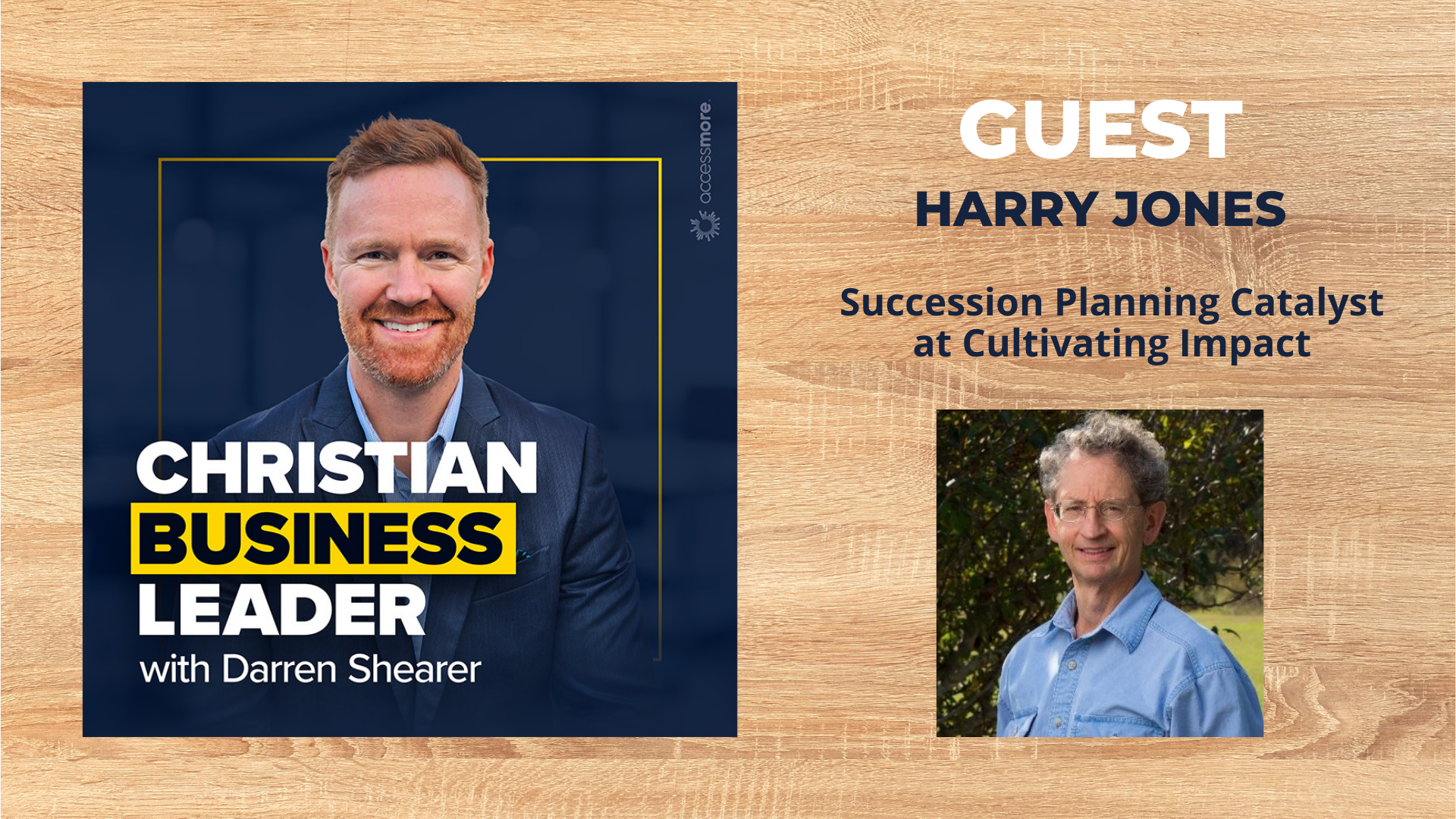
On this episode of the Christian Business Leader Podcast, we’re joined by Harry Jones, Succession Planning Catalyst at Cultivating Impact.
Harry Jones spent two decades each leading food distribution and manufacturing companies before answering a higher calling—helping leaders build legacies that outlast them. With deep conviction, Harry shares wisdom from his new book, Succession Planning for Impact, which outlines a practical, biblically grounded model for generational leadership.
Together with host Darren Shearer, they discuss how Christian business leaders can confront fears around succession, define their long-term impact, and prepare others to carry the mission forward. Harry shares personal stories from his own leadership journey and explains how cultivating a successor is part of every believer’s mandate to make disciples.
Harry challenges leaders to rethink transition not as a loss, but as a sacred act of stewardship—one that multiplies their influence, preserves mission, and honors God’s design for leadership that endures beyond a single lifetime.
https://www.cultivatingimpact.biz
Key Takeaways
- Purpose-Driven Awakening: Harry Jones’ faith journey was reignited after a business-as-mission trip to Central Asia, where he witnessed believers boldly living out their faith in restricted nations. Convicted of his own missed opportunities, he returned home with a renewed sense of calling to integrate faith more fully into his business leadership.
- Biblical Blueprint for Succession: Inspired by scriptural examples like Moses and Joshua or Jesus and His disciples, Harry teaches that succession is not optional—it’s discipleship. He encourages leaders to see preparing a successor as a spiritual responsibility that ensures mission continuity.
- Courage to Step Away: Leaving a successful company and a leadership role wasn’t easy. But Harry chose obedience over comfort, giving a 12-month notice without a clear plan—trusting God to guide the next chapter. That step led him to write Succession Planning for Impact and coach others through transition.
- The Identity Trap: Many leaders, Harry warns, equate their worth with their role. Fear of irrelevance, pride, or lack of clarity can keep them from planning their exit. He challenges them to remember: your assignment may end, but your calling does not.
- Clarity Through Community: Through “breakthrough groups,” Harry fosters peer-driven clarity and accountability. These virtual cohorts help business owners uncover answers already within them—while sharing wisdom, asking hard questions, and aligning vision with values.
- Kingdom Legacy, Not Just Exit Strategy: For Harry, succession planning isn’t just a business move—it’s an act of stewardship. Leaders must define their impact early, build a team steeped in shared values, and think beyond liquidation to mission continuation.
- When Leaders Don’t Let Go: Harry recounts cautionary tales of founders who held on too long—stalling growth or causing collapse. He underscores the high cost of inaction, reminding leaders that without a plan, even the most mission-minded businesses can fade overnight.
- Multiplying Influence for the Kingdom: Ultimately, Harry believes true leadership is not measured by titles, but by how well we prepare others to lead. He urges listeners to step aside with faith, elevate others with purpose, and leave behind organizations that reflect Christ long after they’re gone.
Christian Business Leader is the show for marketplace Christians seeking to explore and apply God’s will for business. If you want to learn more about how to do business for the glory of God and shape culture through discipling the business world, this show is for you.
Full Episode Transcript
Heads up: This transcript was created with AI, so you might notice a few typos or small mistakes. We recommend listening to the episode for the best experience!
SPEAKER_00 0:05
Welcome to the Christian Business Leader Podcast, where Christ following business leaders explore God’s will and ways for business. This show is a ministry of the Center for Christianity and Business at Houston Christian University and features conversations with today’s Christ-centered business leaders who are representing Christ faithfully in the business world. I’m your host, Darren Schear. And if you want to make your work, leadership and company’s culture more Christ-centered, you’ve come to the right place. Hi everyone, and welcome back to the Christian Business Leader Podcast. I’m your host, Darren Scheer. On this episode, we’re joined by Harry Jones. After two 20-year careers leading food distribution and manufacturing companies, Harry began a third career helping business leaders strengthen their impact to continue their legacies for another generation. The seven-step process he developed, called the succession planning for impact process, provides the template for senior leaders to build a significant life in a company that will outlast themselves. And he explains how to do it in his new book, Succession Planning for Impact, which I’m proud to say was published by HighBridge Books. And today we’re not just talking about succession planning for senior leaders, we’re talking about the biblical mandate all leaders have to work ourselves out of a job by preparing others to take our place, regardless of whether or not we own the company, because every job is temporary and because making disciples is the mission. Harry, welcome to the Christian Business Leader Podcast.SPEAKER_01 1:41
Thank you, Darren. Great to be here. And I’m I’m grateful for the ways that you have impacted my walk and brought me to this point. So thank you.SPEAKER_00 1:51
Oh, it’s an honor to partner with you, Harry. So when did you first realize God wanted to be involved in your work and business?SPEAKER_01 1:59
I went to a I went on a business as a mission trip to Central Asia with two veteran BAMers, Gary and Hans, who some of the audience may know. There were a total of six of us. We spent 14 days in three countries that end in S T A N. And there I saw Christians in business who were demonstrating their faith. They were living their faith where they could not quote scripture or prayer or pray. And I came back and met with my pastor two days after I returned home. And I said, Tim, I have squandered 41 years of being in business by failing to live my faith. And he said, Wait, don’t beat yourself up. What are you doing in your business to demonstrate Jesus and double down? And it was so clear after thinking through this, praying through this, my business partner of 20 years, Randy Harvey, grew up tough, and he would hire people that everyone else had rejected. It became clear that our purpose at Blackberry Patch was hiring people that others had rejected. And we would help people we literally paid for people to get teeth who had all had all their had had their teeth knocked out. And if they needed a helping hand, we would help them get tires for their car if they didn’t have a dependable uh source of transportation. And through that, I started working with other businesses, and that calling at Blackberry Patch gave us a reason to get up and go in the morning to grow the business so we could hire more people. And as I worked with other people, God was stirring in my heart. And my wife Hile is a faithful prayer warrior. And we went to the mountains of Western North Carolina, where you hail from, for two weeks as a sabbatical. And one of the things I did in those two weeks is I completed your course, Theology of Business. And in module seven, excuse me, a lot of module 11, it’s about spiritual alignment. And I understood at that point I was not completely aligned spiritually. And the last thing I wanted to do was leave a comfortable place in my career. I had it all. We laughed about my office being street level into the parking lot so that when I was 95 years old and in a wheelchair, I could just roll in and out of my office. But all that changed. I came back uh from that sabbatical and I met with my partners. One was my partner of 20 years, and I had recruited my successor two years prior to this, who’s 30 years younger than me. And I said, guy, and I’d sold him a little stock, and I said, Guys, I love you, but I’m leaving. I’m leaving, I’m giving you a 12 months notice, and I don’t know what I’m gonna be doing, but I am called to go do something different. Next day they asked if they could meet with me. They say, Can we buy you out? I said, I think that’s a great idea. So with that, uh, I was gone in six months, and I didn’t know what I was gonna be doing, Darren, but I knew that God had placed a calling on my next career, and I started writing. I’ve made so many mistakes and I’ve met so many wonderful people who’ve influenced my life. I just started writing, and then I started emailing this weekly a story, something about business, and I I take opportunities to weave the gospel in, but most of the people that I reach out to are are not Christians, many of them, anyway. So I started writing, and I kept writing, and probably two years into these writings, I started writing about succession planning and my mistakes and what I’d seen from other people, and their tremendous engagement came with that. And again, clarity comes before breakthroughs. I got the clarity, that’s what I was supposed to be doing, and then I started putting together a book, and I had the book all ready to go, and I told you about it. I reached out to you and said, Thank you for your theology of business course that helped me get to this point. And you said, Well, I want I want to learn, I want, I may want to publish that. So I just sent you the information, and uh it took a few more months, but you cut it in half, you helped me clarify. Um, it’s much more effective book for people to use. It’s half the size that it was when I brought it to you.SPEAKER_00 7:41
So it’s a it’s a fantastic book, if I do say so myself. Um, so we’re gonna get more into uh succession planning for business owners and the senior leaders, but regardless if we own the company or not, do you think we have a biblical mandate to work ourselves out of a job we’re in by preparing someone else to take our place? Absolutely.SPEAKER_01 8:05
And and uh, and it may not be in your last role in a business, it could be preparing someone to succeed you as you go to another company, uh, as you transition to another another career. So it’s not just for people who are aging out, is it for people at all ages? Uh think about how Jesus prepared his successors. He was only here, he was only really in ministry for three years. He got a lot done, but he selected his team, he steeped them in the values that he wanted to continue. He even had a small group of three people really who were kind of like his uh executive committee, but he trained them, he trusted them, he selected people of diverse backgrounds and and personalities, so we can learn a lot from Jesus about selecting an individual and a group of people to select to succeed us. Yeah, we someone recently expressed to me that we retire from a career but not from our calling. It’s very important to understand what is your calling, and there are people who are miserable, who are stuck in a position and not fulfilling their calling, and it takes courage to make that change at all levels.SPEAKER_00 9:42
Yeah, I love the statement by John the Baptist, he must increase, I must decrease. And you know, I find that Jesus typically increases through other people. Uh, but by I must decrease, I think what’s counterintuitive about that, that doesn’t mean your impact decreases. Your impact actually increases as Jesus increases through other people that you train up, that you disciple. And and so with with that being said, why don’t we do it? I mean, as leaders, why don’t we train people up? Why don’t we work ourselves out of those leadership positions?SPEAKER_01 10:25
Well, it relates to the first step of our process, confronting our fears about succession planning. Too many unanswered questions. We’re afraid somebody else might do a better job than us, or loss of identity. You know, I went through an experience that proved to be a refinement, but when we when we sold our first business, in the eyes of the world, it was glorious. We made an exit to a public company, but I I went into a funk. No, I hit it well, nobody else knew it. But my identity was wrapped up in being the CEO of a great business. And we had a good, we had a wonderful team, but I lost that overnight, and it helped me to prepare for the next career. Uh, and I bring this up just to say we can get wrapped up in our identity in a certain position or a certain company without understanding that our real calling is to be at work demonstrating our faith wherever God has placed us. It’s a lot more important to demonstrate your faith. It makes your your credibility something that people want to listen. So demonstrating your faith and being prepared to share the hope that lies within when the spirit prompts you.SPEAKER_00 11:51
Yeah, yeah. And so as leaders, we have uh an identity crisis where we get our identity wrapped up in our assignment, right? And and so even when we use the term vocation, calling, and when we say, I’m I’m bivocational, that means my calling is you know to be uh um a business owner, to be a pastor. I mean, there’s a high calling, but then there are assignments, and and and yeah, we need to have our identity wrapped up in the high calling, but getting your identity wrapped up in being uh even a pastor or being a business owner, when that gets taken away, who are you? You know, you kind of lose. So I think we kind of misuse a lot of these terms. Um, you know, and and especially with with with pastor, I know there is a sense that you have to be called to be uh to be a pastor, but it’s a calling to that assignment, it’s not calling to have your identity wrapped up in a particular assignment that’s that’s only temporary. So why don’t business owners do it? I mean, is it the I love how Stephen Covey says um to begin with the end in mind? Is that a big part of it that we just um I mean, should entrepreneurs be thinking about um succession planning early in the in the process? Absolutely.SPEAKER_01 13:27
Uh next month I’m going to speak to a group of college students uh in the classroom. They’re in an entrepreneurial classes, uh and and that’s the message that exit planning begins when you start your business. It’s not something you dwell on. If you just take one day, one day a year and think about well, what am I building this for? It will help you with the direction of your business. Uh again, I think it comes back to the to the fears. We have uh we have a several groups going on right now. Now these are online groups, they’re virtual. The first group was from four time zones. So we have people from all over the world of a monthly meeting as a group, and then in between they have a one-on-one, they can have a one-on-one with me. But what we’ve seen is typically the answers lie within the individual, but it takes an outside voice. And this group, the commitment of the group is that we show up to engage with others and expect to give more than we receive. The group members ask questions of the individual. Actually, we have a hot seat, now two hot seats each meeting, and so a person does a presentation for five minutes on what the situation is and what they’d like to accomplish. And then for 10 minutes, the group members engage with questions and sharing experiences, and eventually there’ll be some kind of clarity, and that comes before breakthroughs. We call these breakthrough groups, and it’s so exciting to see people engage with one another and have these answers uh come out of the individuals.SPEAKER_00 15:20
Yeah. What do you think about the build-it to sell approach to entrepreneurship? Where I’m gonna start a business on day one. I’m thinking about selling that business. Uh, what do you think about that approach?SPEAKER_01 15:38
I think it’s one of several scenarios to consider. And we are regularly approached about helping someone sell their business. Sometimes they have uh have the model in mind that they’ve been building it to sell. Often they just realize that they they’ve gotten too old to keep going at the pace they want to case. So the build-a-sell model, we would encourage people to say, well, that’s one of several scenarios for you to consider. And an important part of our process is defining the impact of your business. And when you realize that you have a purpose for the profit that’s being made, that opens up new scenarios, and it really defines our process, which is you understand the impact of your business that makes it worth continuing. Then how do you use that to build a team, steep them in the values and the impact that you want continued, and it can carry on well beyond you, yeah. So it that that’s really the subtitle of the book is you know how to build a significant life in a company that outlasts you.SPEAKER_00 16:55
Yeah.SPEAKER_01 16:55
So build a cell is one option.SPEAKER_00 16:59
Yeah. And there was uh there’s there’s some misconceptions because it doesn’t always work out better. I mean, you would you would think that uh the reason that business owners, you know, they they don’t do it, they or they just go ahead and sell the business, just liquidate everything is because they’re thinking more about short-term financial rewards than long-term impact. Um, but that doesn’t even pan out well financially for them. There was a story. Could you share that story of the guy that um it actually would have been better for him to hang on to the business and cash flow the business versus just getting a lump sum?SPEAKER_01 17:45
Darren, it happens regularly. We’ll have someone who’s come to us after the fact and bemoan the fact that they’ve lost not only their position and they fail to see the impact, continue their business, but they have suffered financially. And one of our group members who graduated, actually, we had out of our eight group members, three graduated. One of them had refused an offer. Actually, the buyer pulled the offer after off the table because they did not have a team to run the business. And he shared with the group, let’s just say he was gonna get a million dollars. It sounds like a lot of money, but he was making over$200,000 a year out of his business. He was going to get a million dollars. Well, after he paid taxes, he’s gonna have six or seven hundred thousand dollars left at five percent interest. He’d make thirty-two thousand dollars a year. Well, that’s not not a good proposition for him, right? In this instance, he recognized through the group process, he recognized he had a short-term successor, which was his general manager, and that was a good stopgap measure. If something got, if he got hit by the bus, he had someone to take over. And he had a younger person that he had was going to take several years to train up to steepen the values that he wants continued so they can take over and the team buy him out over time, and he will continue to have a role. See, our ideal client is someone who has a business with an impact they recognize and they want it continued. Also, they don’t want to throw in the towel, they want to do something with all their experiences to continue to make an impact in life, either in the business that they are transitioning out of or another career. They want to elevate to flourish.SPEAKER_00 19:55
Yeah. Do you find that the larger the company is, the the easier it is for the business owner to get this, or because they’re the just the size of the company requires that you that you delegate, that you kind of work yourself out of a job and not try to do everything? And is it the the smaller companies where you know it’s the this the small family business where the the patriarch is in charge and they they feel like nobody can do it better than them? There’s that ceiling. And is it harder for them to think about succession planning? What’s been your experience?SPEAKER_01 20:42
Often the smaller business has a more difficult time, but not always. We we have somebody we’ve written around written about, uh, we call him Henry. All the names in our stories are changed to protect the innocent and the guilty. Well, Henry’s got a hundred million dollar business that’s a hundred years old, and he’s still signing all the checks, and he’s still doing the hiring the fire, and he has, I think, 140 employees. So Henry will die in that chair, and it’s very sad. There are people who are, you know, I I I can think of right off one of the members of our group had transitioned his small business to his son, and he did it and kept his job. He had a second business that he had started, and that’s the reason he joined the group. He was stuck, he could not see a way through. And he’s one of one of the three people who graduated from our first group. They helped the group helped him work out a way to transition out of a second small business so it can be done. The advantage of a larger business, as you described, is they they’ve Had to build a team of people in order to carry on. But we have some large businesses where the founder is or CEO is stuck. And what happens is in Henry’s example, and some of our listeners will can relate to this, too often in a family business, people are treated as family rather than a team. Now, in a team, you’ve got to make the cut. In a family, we love you regardless, but that doesn’t necessarily mean that you are affected for the business. Over and over, we see where a family member who is incompetent is tolerated, then the competent family members and non-family members on their team will leave because they’re so frustrated. And the incompetent person is is left is left to be the successor. And that often leads to a you know a sad ending.SPEAKER_00 23:01
Right. And you point out this uh Harvard Business Review statistic that 70% of businesses are sold or fail before the second generation of leadership gets the chance to take over. And and we talk a lot about cultivating Christ-centered companies on this, uh on this show. And what a shame that you would cultivate a Christ-centered company, but then have no way to sustain it, um, even into the just the just the next generation, let alone the you know, third, fourth, fifth generation. Um, and so this is such a key piece of cultivating a Christ-centered company is thinking about the future and and who’s going to be the the leader who’s in charge of continuing to cultivate that culture because the weeds will come in and you know the storms will will come to the company’s culture, but like John Maxwell says and so many others, that everything rises and falls on leadership.SPEAKER_01 24:17
Now, the the 70% of businesses will not make it the second generation of leadership, according to Harvard Business Review, is an important principle. The second part of that is whose responsibility is it to lead the succession planning process? We believe that it is the CEOs. However, about half of the people who engage with us are not the senior leader, and they are in a position of saying, how can you help us get Henry to just have a kind of conversation about this? It all begins with conversations. In the book, it it we provide the questions for seven different conversations to hold over the course of a year. You may have to ease those in, especially if you’re not the CEO. You may have to ease those in one at the time and pick your pick your timing, because often this the CEO or founder does not want to discuss succession planning. But they can come along. We have regularly, we have just through these groups, we regularly see progress with someone who recognizes they have a business with an impact worth continuing.SPEAKER_00 25:43
Yeah, yeah, it impacts not just businesses but churches and presidencies and you know, every other leadership, you know, somebody hanging on too long. Um, but that’s not God’s way because we’ve got to number our days. We have to know that I mean, we it might not just be a life expectancy issue. You know, you just might not be the right person for the job at a certain point. And if there’s nobody that’s being prepared to take over, especially if you own the company, I mean, you it’s gonna be less valuable, um, not just in terms of financially, but also in terms of the the social impact as well. What are some of the the biblical applications? What else can we learn from what else can the scripture teach us about the importance of succession planning and how to do it?SPEAKER_01 26:51
One is recognizing the impact and a and a crystallizing question is so what if we go ahead and shut this business down in 90 days? Why would that be bad? What would the consequences be for the family, for the employees, for the customers, for the vendors, for the community? Businesses build up leaders who can have substantial influence in their community. And when that business is gone, that influence is gone. Uh, we had a uh a classmate of mine, I’ll call him Jacob, who built up a great business. He was a fireman, so he had three days a week and he built a wonderful restoration uh and and maintenance business. But he did everything, he took all the calls. At age 62, he went in for routine back surgery and he died on the operating table. He had 130 employees, a son and a daughter who had never allowed to have much authority to make decisions, and that business has dwindled to almost nothing. The impact is 130 employees, many of whom were had very limited skills, but he provided a good livelihood for these people. He had 40 vehicles. That means the garages and the in the in the truck dealerships missed out on this business. It has a trum, a business has a tremendous effect, ripple effect throughout a community with jobs and investment and in and influence. So that that’s uh that’s worth continuing itself. I think about the the building a team, whether it’s establishing a succession planning team, keeping it small, building your leadership team. It’s a struggle so often to move from two leaders to three leaders to add one at the time. But I think about Ecclesiastes 412, about a court of three strands is better than one. And as you build a team, just being intentional about are these people aligned with our values? If they’re not, are they coachable? That is building the strength of the company through its leadership, throughout the team to carry on.SPEAKER_00 29:32
Well said. Well, this is the biblical model. I mean, when you look at Moses and Joshua and uh Elijah and Elisha and Paul and Timothy and Jesus and his disciples, this is the this is the story, and this is the the way that we are a part of the kingdom culture. This is the way of God’s kingdom culture is training up leaders to come and continue on the impact of what God is wanting to do through our organizations. Um, Harry, there’s so much more that we can learn from you. People can go to cultivatingimpact.biz uh to to get on to your email list for a lot of these tips that you’re emailing out, and also certainly to get the book Succession Planning for Impact, you can get that on Amazon and at Harry’s website. Um, Harry, anything else you want to say about how people can connect with you and get involved? You can go to our website and and click contact.SPEAKER_01 30:37
And if I know that they came through this show, I’ll give them a free one-on-one virtual. And we just ask you to frame it up. You know, what’s your current situation? How would you like things to be different? What do you think we can do to help? And then if you know of someone, you or know of someone who liked to consider one of our breakthrough groups, consider it as a an accelerator for succession planning for impact. We want to get people through in seven months and and to get the results of a breakthrough so they can carry on their business. So, Darren, I just appreciate what you’re doing and the ways that you’re making positive impact for Christ’s kingdom.SPEAKER_00 31:19
Yes, same to you, Harry. It’s an honor to partner with you. Thank you for sharing your wisdom and experience with our listeners today. We’re all better for it. Thanks for listening to this episode of the Christian Business Leader Podcast. Be sure to subscribe, leave a review, and tune in for the next episode as we continue exploring God’s will and ways for business.
BIG THANKS to this episode’s sponsor: High Bridge Books
High Bridge Books helps Christ-centered authors build a legacy by crafting and publishing messages and stories that glorify God in all spheres of culture.
- High Bridge Books’ professional book publishing package: https://www.highbridgebooks.com/publishing/
- High Bridge Books’ proofreading, line editing, developmental editing, and co-writing services: https://www.highbridgebooks.com/editing-and-proofreading/
- Examples of our books: https://www.highbridgebooks.com/bookstore/
We’re extremely proud that …
- 45% percent of our 204 books under contract were written by authors who have published more than one book with us, and
- 51% percent of our books under contract were referred to us by authors who have previously published with us.
Contact High Bridge Books’ CEO Darren Shearer at [email protected] to get a conversation going about your book!